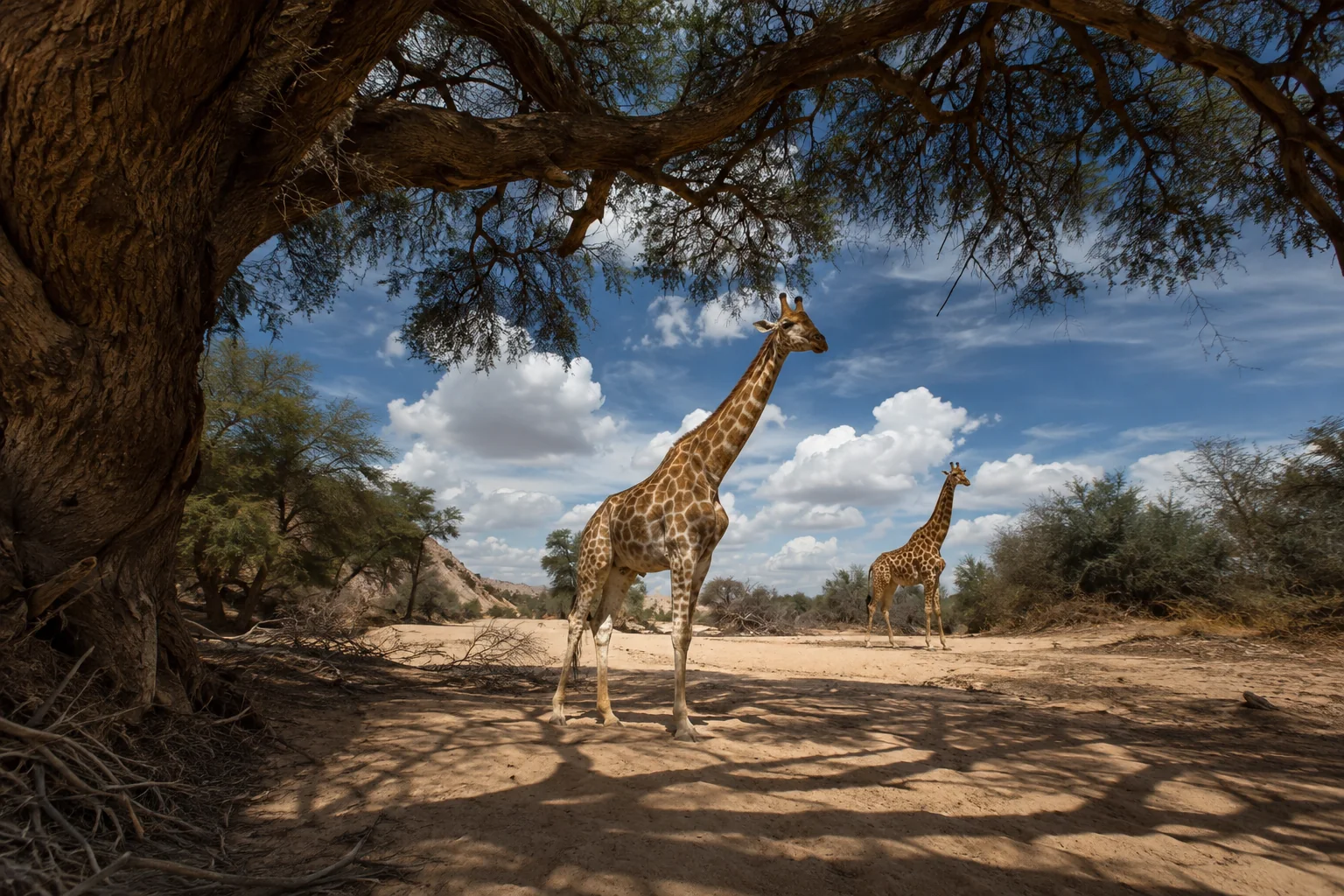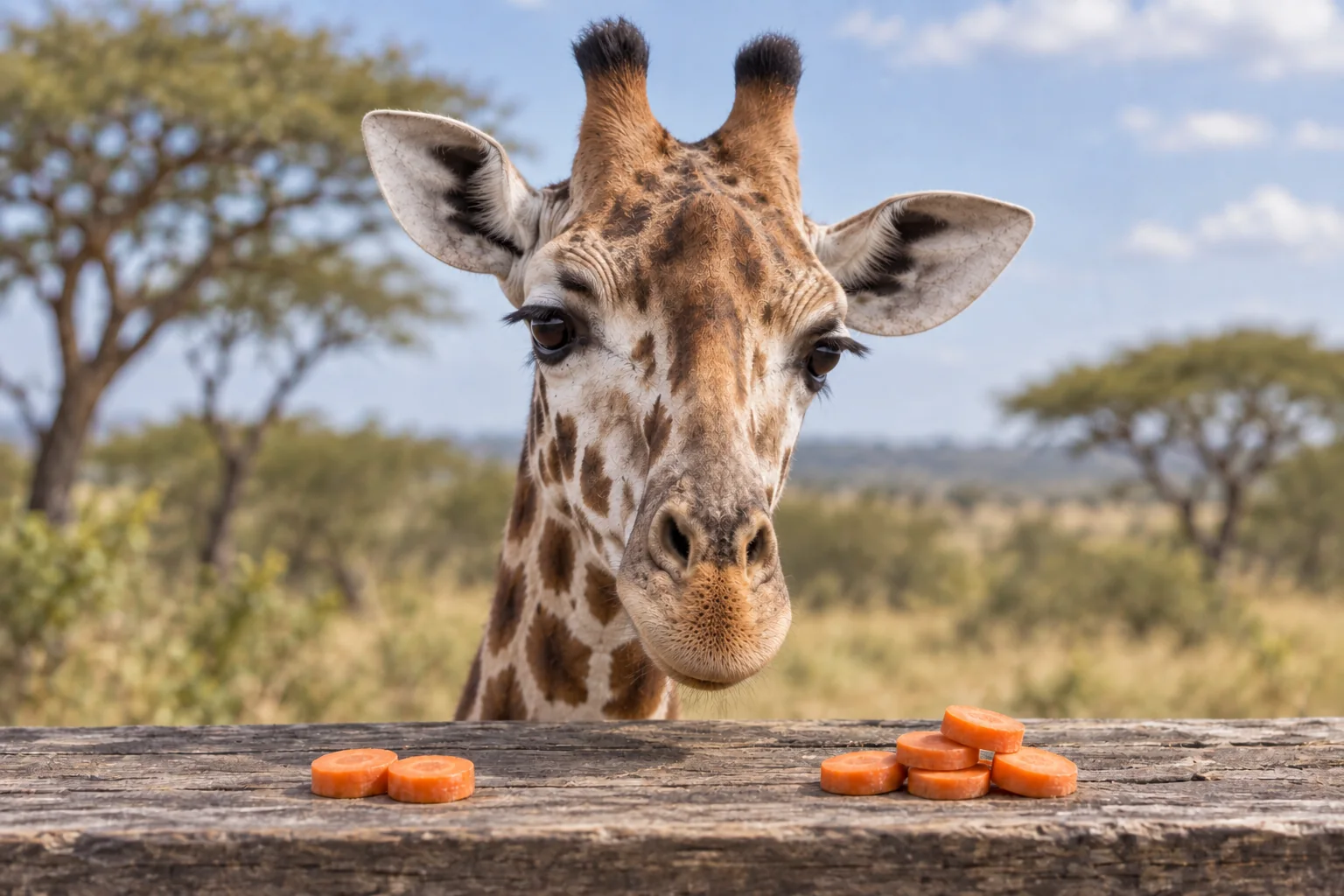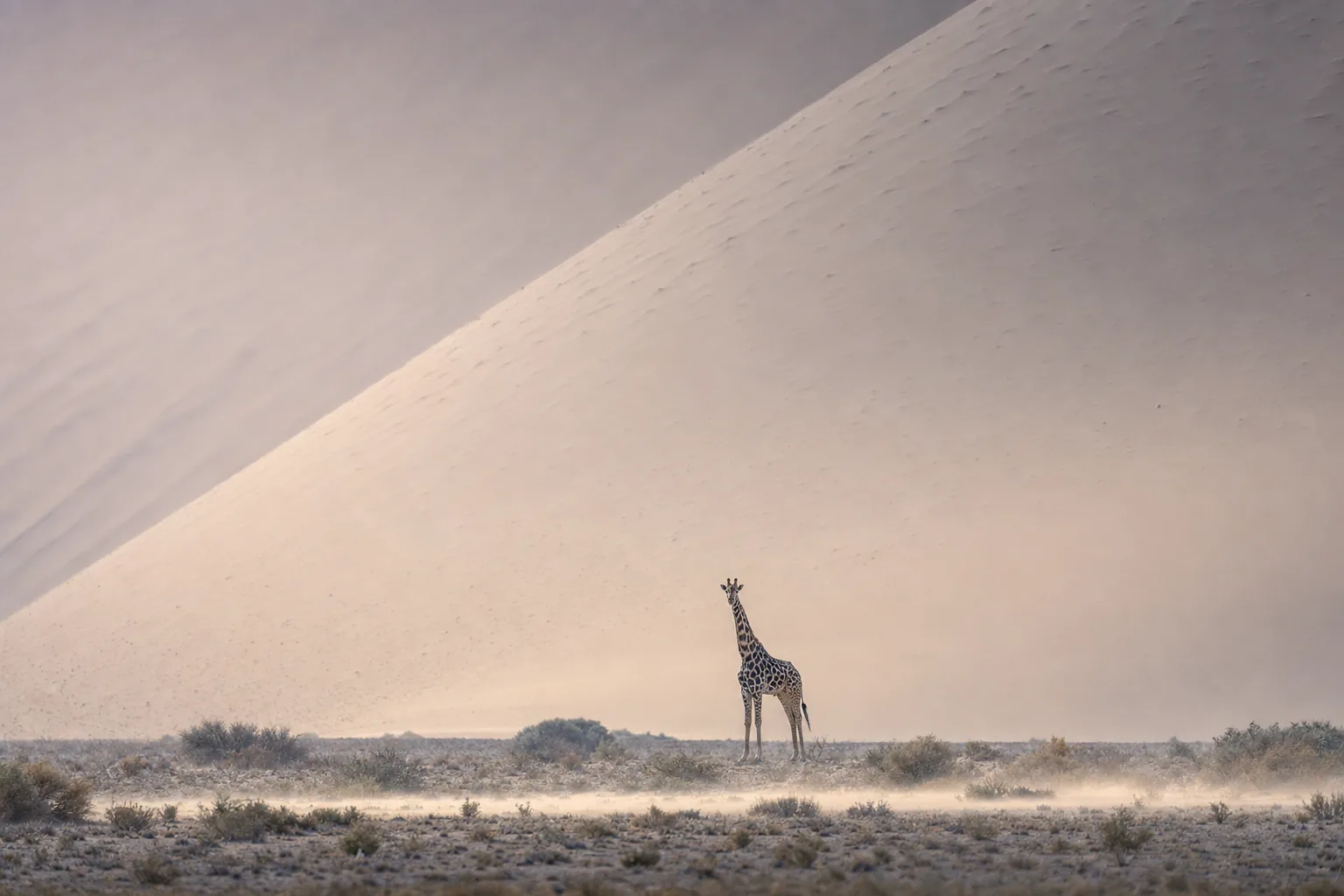
A giraffe can look familiar before you know anything about it. Then the details upend the picture: its long neck has the same number of bones as yours, its heart is not disproportionately enormous, and its quiet reputation hides recorded nighttime humming. Getting those facts right matters when the animal’s conservation story is so easily reduced to an outdated number or a frightening deadline.
Giraffe facts at a glance
These are starting points, not measurements that every individual must match. The sections below explain the evidence and provide the original sources.
| Question | Short answer |
|---|---|
| How tall are giraffes? | Large adult males can reach about 5.5 metres, or 18 feet |
| How many neck bones? | Usually seven cervical vertebrae |
| What do they eat? | Mainly tree and shrub leaves, with other plant parts too |
| How does the tongue work? | It can grasp food; it is prehensile |
| What are the head bumps? | Skin-covered bony structures called ossicones |
| What is a baby called? | A calf |
| Do giraffes sleep? | Yes; duration depends on what and how researchers measure |
| Are they silent? | No; researchers have recorded nighttime humming |
| How many species? | Four in the classification announced by IUCN in August 2025 |
| How many remain? | About 140,700 in the report’s 2025 four-species summary, not a live census |
Looking for a classroom version? The kids’ fact guide and printable worksheet combine a shorter reading activity with an answer key. For the conservation question first, use the endangered-status guide.
Height, neck bones, and the challenge of gravity
Giraffes are the tallest living land animals. San Diego Zoo gives adult male height up to about 5.5 metres and female height up to about 4.3 metres. “Up to” describes an upper example, not a species-wide average. Calves, growing animals, and adults should not be collapsed into one measurement.
Seven bones, stretched into a long neck
A giraffe usually has seven cervical vertebrae, just as a human does. The extraordinary neck is not made by adding dozens of extra neck bones. The University of Minnesota’s veterinary anatomy specimen makes the comparison tangible: these are real skeletal structures, not an inference from an animal’s outline.
There are two different questions here. Anatomy asks how the neck is built. Evolution asks why those characteristics developed and persisted. Showing that height helps an animal reach leaves does not, by itself, resolve the entire evolutionary explanation. Our neck-evolution guide explores that distinction.
A high-pressure heart, not simply a giant one
Blood must reach a brain positioned well above the heart. A 2009 study measured body mass and heart structure in 56 giraffes of different sizes. It found that heart mass, relative to body mass, was comparable with other mammals, while the left ventricular and interventricular walls were thickened.
That is more informative than a fixed “11-kilogram heart” fact. Absolute organ mass changes with the animal; proportions and internal structure help explain function. See Mitchell and Skinner’s cardiovascular analysis.
The finding does not mean every giraffe has the same blood pressure in every posture. A physiological explanation needs to distinguish where pressure is measured and what the animal is doing. A single comparison with a human reading leaves much of that context out.
A gripping tongue and a browser’s diet
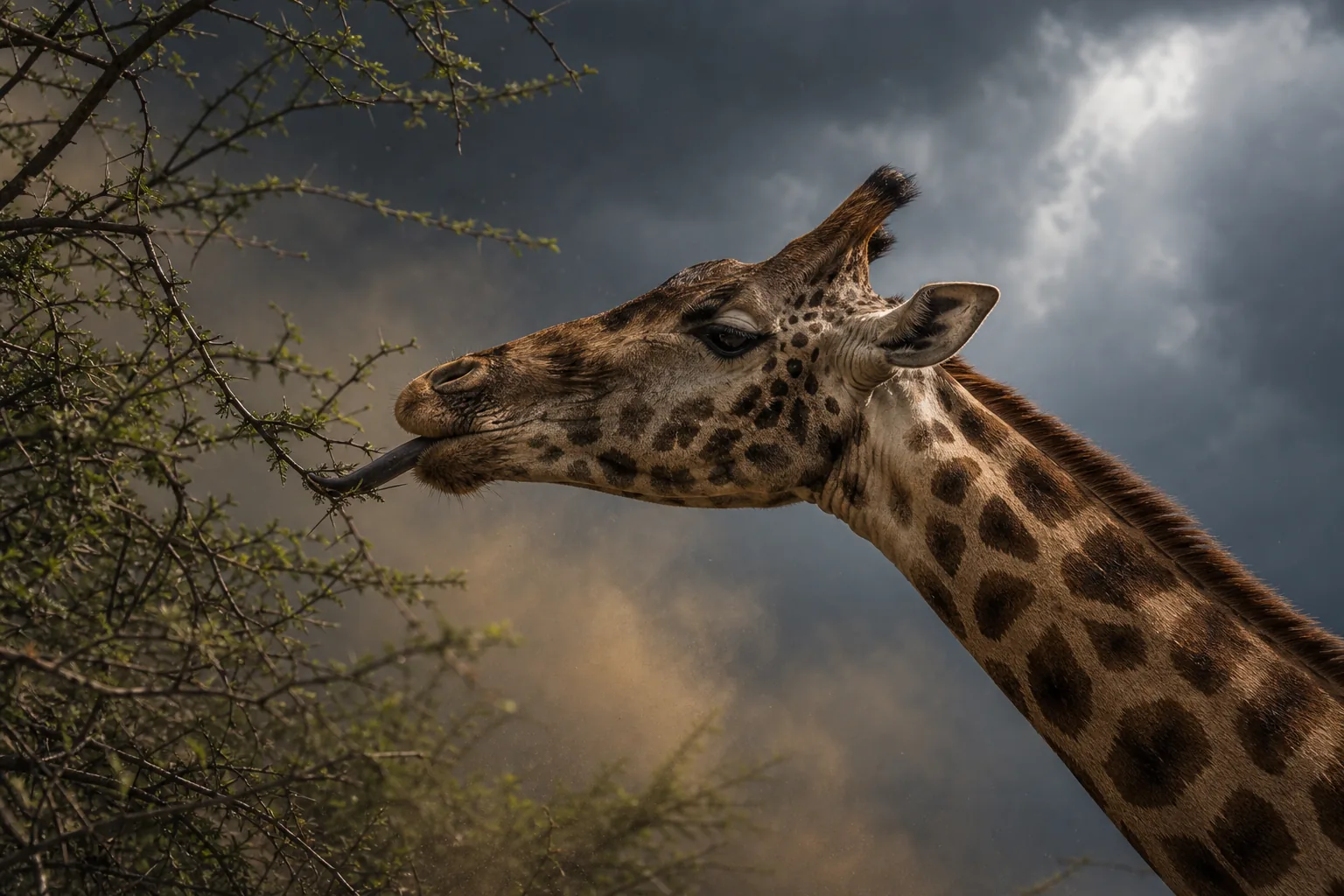
The word prehensile means able to grasp. A giraffe’s tongue, around 46 centimetres in San Diego Zoo’s account, works with mobile lips to collect foliage. Its dark exposed surface is often explained as protection from sunlight; the zoo presents that function as a proposed explanation, not a guarantee against sunburn.
That mouth belongs to a browser. Giraffes eat leaves and other material from woody plants rather than living mainly by grazing grass. Animal Diversity Web also records flowers, fruits, and seed pods. A diet described as “only acacia leaves” misses both the variety of food and the distinction between plant species and plant parts.
Giraffes are ruminants: swallowed material can return to the mouth for further chewing. Their stomach has four compartments, not four separate stomachs. Chewing away from a branch may therefore be processing an earlier mouthful rather than collecting a new one.
Our tongue guide explains the feeding anatomy; the diet guide connects food choices with season and local vegetation. Basic feeding and digestion details are documented in Animal Diversity Web’s giraffe account; its older taxonomy is not used here.
Spots, ossicones, and baby giraffes
The head bumps are ossicones: skin-covered bony structures, not antlers. Our giraffe horns and ossicones guide compares the structures and explains their development. A newborn calf is already about 1.8 metres tall. San Diego Zoo Wildlife Alliance describes those details and the approximate height and tongue measurements above.
A spotted coat is also a research tool. Comparing coat patterns can help scientists recognise individuals and follow their lives, rather than repeatedly treating each sighting as an unknown animal.
Some spot traits run in families
In a 2018 study, Lee, Cavener and Bond measured coat patterns in wild giraffes and compared mothers with calves. Some spot-shape characteristics appeared heritable, and particular pattern traits were associated with early survival.
This is not evidence that a calf copies its mother’s entire coat. Nor does an association with survival establish one mechanism responsible for it. The value of the work lies in measuring defined characteristics and testing relationships rather than relying on an impression that two giraffes look alike. See the study’s institutional research record.
For the visual evidence itself, use the study’s photographs and measurements.
Sleep, sounds, and social lives
The idea of a nearly sleepless, voiceless loner makes a memorable animal fact. It does not accurately describe the research.
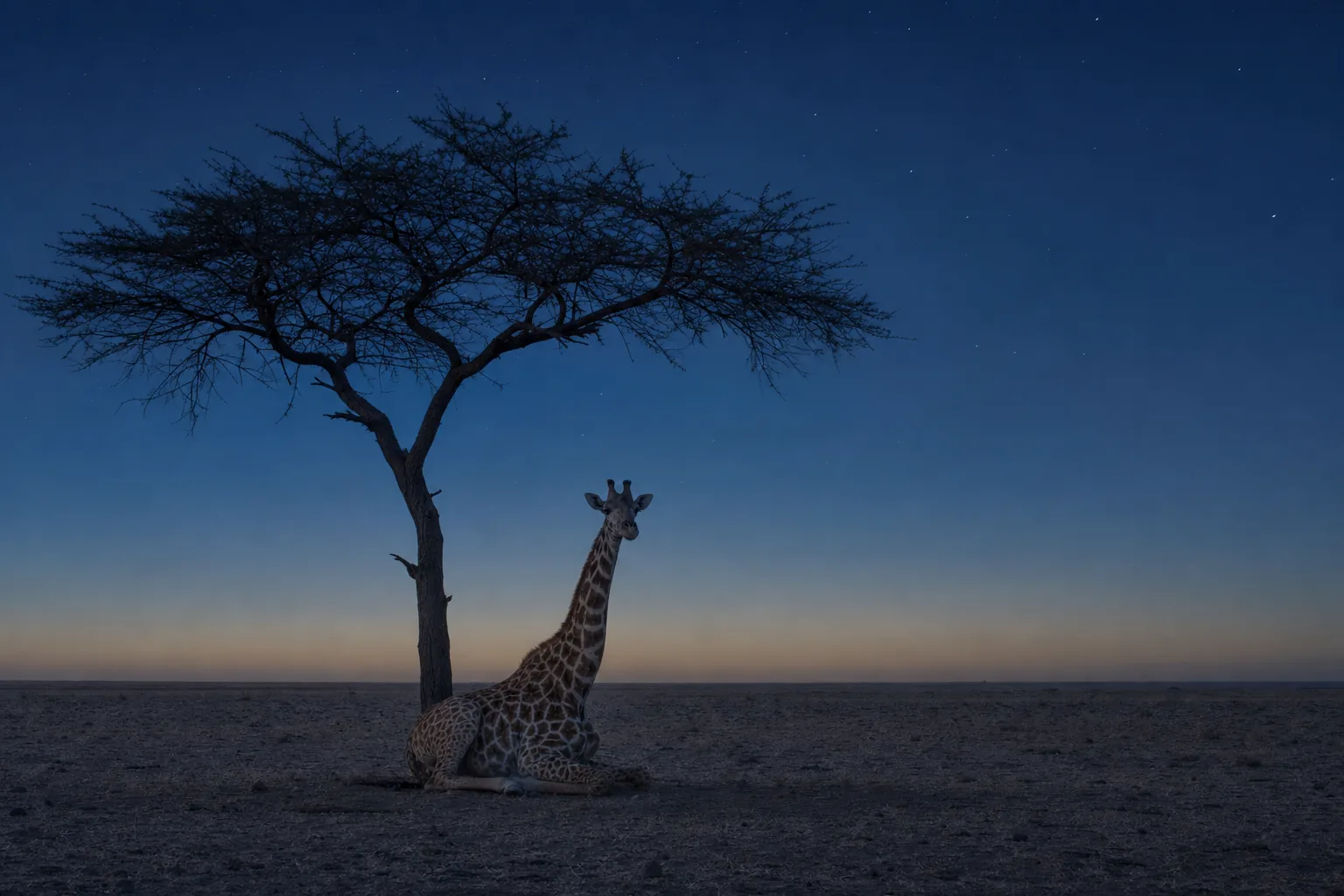
Giraffes sleep, but the measurement matters
Tobler and Schwierin’s 1996 zoo study reported about 4.6 hours of total sleep, excluding the juvenile from that total. Sleep occurred in bouts. That result concerns the observed animals and the study’s behavioural definitions; it is not a universal schedule for wild giraffes. See the original sleep study.
A later field study attached movement sensors to three Angolan giraffes in Namibia. It identified nighttime inactivity and characteristic sleep-position events from head movements. That is a different measurement from every kind of sleep throughout a full day, and the small sample limits generalisation. See the 2023 accelerometry study.
Before comparing two sleep numbers, ask whether they refer to inactivity, a particular posture, a sleep stage, nighttime observation, or a whole 24-hour period. Our giraffe sleep guide puts the minute and hour estimates side by side and explains why they are not directly comparable.
Nighttime humming is real; its meaning is unresolved
Baotic, Sicks and Stoeger recorded 65 humming vocalisations in data from three European zoos. The hums occurred at night. Without simultaneous nighttime video, the researchers could not identify the callers or establish the behavioural context.
They also found no evidence of infrasonic communication in their dataset. That does not prove giraffes can never produce infrasound; it does mean “giraffes communicate through infrasound” should not be presented as settled on the strength of this work. The original humming study preserves both the discovery and its limits.
You can hear a real giraffe hum in our sound guide, with its research credit and an explanation of what the recording does not establish.
Changing groups do not mean an absence of relationships
Giraffe group membership can change while longer-term social associations persist. This is part of what researchers mean by a fission–fusion society: groups split and come together.
A study of 512 adult female giraffes in Tanzania used five years of records to examine survival and social relationships. Females observed with more other females tended to have better survival. This was an observational association, not an experiment assigning animals to friendships, and it does not establish that a particular grandmother caused a calf to survive. See Bond and colleagues’ social-survival study.
These findings make social context worth studying. They do not justify giving every herd a fixed family structure or translating animal behaviour directly into human roles. Our behaviour guide introduces the wider topic.
Four giraffe species and a striped relative
In August 2025, IUCN announced recognition of four giraffe species after a specialist review of genetic, morphological, and geographic evidence:
- Northern giraffe — Giraffa camelopardalis.
- Reticulated giraffe — Giraffa reticulata.
- Masai giraffe — Giraffa tippelskirchi.
- Southern giraffe — Giraffa giraffa.
The IUCN announcement explains the change. A taxonomic decision identifies which animals are grouped as species; a Red List assessment evaluates extinction risk. Those are connected processes, not interchangeable labels.
The okapi is the giraffe’s close living relative. Its striped legs can suggest a zebra to an unfamiliar observer, but stripes do not determine evolutionary relationships. Both belong to the giraffe family, Giraffidae. The giraffe–okapi comparison explains the relationship; Animal Diversity Web identifies the okapi as the giraffe’s closest living relative.
How many giraffes remain, and are they threatened?
The four-species summary in State of Giraffe 2025 adds up to 140,701, usually rounded to 140,700. This dated estimate excludes populations the report separately classifies as outside their natural ranges. It is not a live count of every giraffe in the world, including zoos.
The report was published by the Giraffe Conservation Foundation; its permanent research record identifies the original work. Our population guide and downloadable figures explain the scope and why an increased estimate can reflect better surveys as well as biological growth.
Giraffes face extinction threats. The IUCN’s 2016 assessment announcement listed giraffes as Vulnerable under the one-species taxonomy then used, describing habitat loss, illegal hunting, and civil unrest among the pressures. Its widely repeated decline figure refers to 1985–2015, not a rolling “last 30 years” statistic.
A continental total can obscure very different local situations. Neither a historical decline nor a more recent higher estimate supplies a credible date when the final giraffe will disappear. Keep the species, place, year, and method attached to a conservation claim.
What to remember
The most useful giraffe facts explain an animal, not just a number. Height connects with anatomy and circulation; feeding connects with vegetation; coat patterns can help track lives; social and sleep studies depend on their methods.
Use the science library to explore original research and distinguish a study from a headline about it. This guide gives an entry point, not a substitute for reading a method when a particular claim matters.
Frequently asked questions
Do giraffes have more neck bones than humans? Usually no: both have seven cervical vertebrae. The giraffe’s are much longer.
Do giraffes sleep only a few minutes a day? That is not a reliable universal rule. Studies measure different behaviours and periods, in different settings.
Are giraffes silent? No. Nighttime humming has been recorded, but the study did not establish its function.
Is the okapi a kind of zebra? No. It is a member of the giraffe family despite its striped legs.
Are all giraffes recovering? A larger combined estimate does not demonstrate recovery for every population. Look at dated, comparable evidence for the particular animals being discussed.
Sources
The twelve links beside the relevant claims lead to zoological accounts, an anatomical specimen, original studies, IUCN statements, and the population report. Approximate body measurements come from the San Diego Zoo account; its short universal sleep claim is not adopted.
Research discussed includes Mitchell and Skinner (2009), Lee and colleagues (2018), Tobler and Schwierin (1996), Burger-Schulz and colleagues (2023), Baotic and colleagues (2015), and Bond and colleagues (2021). The 2025 species framework and 2025 population summary are kept separate from the historical Red List assessment.