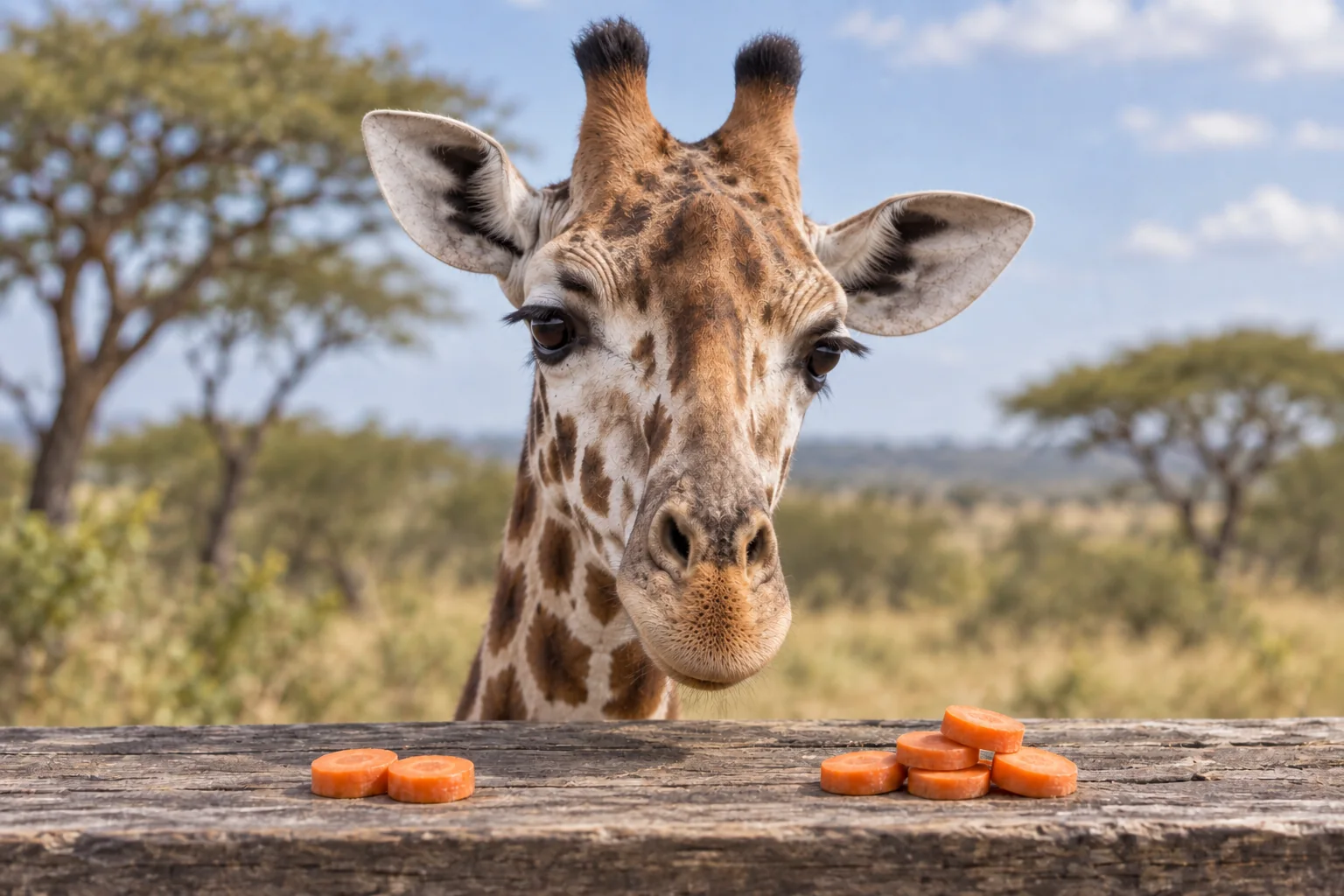
Twenty carrots can make a promising mixture or an unpromising one. Put them among four pieces of zucchini and most possible bites are carrots. Put the same twenty carrots among a hundred zucchini pieces and carrots become the exception. For an animal that prefers carrots, the total number of carrots is only part of the useful information.
Alvaro L. Caicoya, Montserrat Colell and Federica Amici used this difference to investigate how giraffes make choices when they cannot see the food being offered. In their 2023 study in Scientific Reports, all four giraffes tested at Barcelona Zoo succeeded across three comparisons of food mixtures. Together, those comparisons made two simple explanations inadequate: always following the largest carrot count, or always avoiding the largest zucchini count.
The achievement was a decision about a concealed sample. The giraffes could see where the food came from, but the final choice was between closed hands. The researchers had found a way to ask whether the composition of a visible mixture could guide a choice after the food itself disappeared from view.
A choice between two closed hands
The four participants were Nakuru, Njano, Nuru and Yalinga, two males and two females. They took part voluntarily, could leave during testing and continued to receive their regular food. They were already familiar with some cognitive experiments, so these were experienced zoo animals facing a new problem.
Before the main experiment, the team checked their food preferences. All four reliably chose carrot over zucchini. That established what a successful food choice would mean for each animal; the researchers did not simply assume that the foods had different values.
The apparatus consisted of two transparent containers holding mixtures of the two vegetables. The experimenter put a hand into each container, concealed a piece of food in each fist and offered both hands to the giraffe. Touching one hand with its muzzle or tongue selected that piece.
The animal therefore had two kinds of information available at different moments. First came the visible mixture. Then came an unseen bite taken from it. Choosing between the hands required carrying information from the first moment into the second.
The team did not literally draw food at random on every trial. In the main mixture tests, the experimenter deliberately selected the more numerous food type from each container. The proportions describe which mixture would offer the better chance of a carrot under representative sampling; they are not a record of the reward frequencies actually delivered. This distinction becomes especially useful in understanding the third comparison, where both hands contained zucchini.
Why one successful comparison was not enough
In the first condition, one container held 100 carrots and 20 zucchini pieces. The other held 20 carrots and 100 zucchini pieces. The giraffes preferred the sample from the mixture dominated by carrots.
That was encouraging, but several strategies could produce the same result. The animals might have compared proportions. Equally, they might have followed the larger pile of carrots or avoided the larger pile of zucchini. The next two conditions separated those possibilities.
| Comparison | First mixture | Second mixture | What it tested |
|---|---|---|---|
| Carrots dominate one mixture | 100 carrots, 20 zucchini | 20 carrots, 100 zucchini | Whether the giraffe favours the carrot-rich source |
| Same number of carrots | 20 carrots, 4 zucchini | 20 carrots, 100 zucchini | Whether carrot count alone explains the choice |
| Same number of zucchini | 57 carrots, 63 zucchini | 3 carrots, 63 zucchini | Whether avoiding a larger zucchini count explains the choice |
In each row, the first mixture contains the higher proportion of carrots. In the second row, carrots make up five-sixths of one mixture but only one-sixth of the other. A rule based only on the twenty carrots in each container cannot distinguish them.
The third row closes another route to success. Both mixtures contain 63 zucchini pieces, but the first is nearly half carrot and the second contains very few carrots. Simply avoiding more zucchini cannot identify the better prospect because their zucchini counts are identical.
All four giraffes reached the study's criterion of at least 17 preferred-source choices in a 20-trial session in every condition. Most did so in the first session. Nuru needed a second session in the equal-carrot comparison, and Njano needed a second in the equal-zucchini comparison.
The third condition is particularly revealing because zucchini remained the majority food in both containers. Under the experimenter's sampling rule, both hands consequently held zucchini. The animals nevertheless favoured the sample from the mixture with the higher carrot proportion. Their success in that condition means selecting the statistically better source, rather than actually receiving carrots on those trials.
Across the three conditions, the pattern supports sensitivity to relative quantities. It does not require imagining a giraffe silently calculating a fraction. A perceptual impression of the relationship between the two foods could help guide a choice without an exact count.
Was the useful information really in the mixture?
The researchers also tested alternative sources of information. If a giraffe could smell the carrot inside a closed hand, the container contents might be irrelevant.
When the containers were absent and only the closed hands were offered, none of the four showed clear above-chance success. In another control, the experimenter reversed the usual sampling rule, taking zucchini from the carrot-rich mixture and carrot from the zucchini-rich mixture. At the group level, the giraffes still favoured the hand associated with the carrot-rich source, even though it now held the less-preferred food.
These results support the interpretation that the visible mixtures influenced the choices. They make an account based solely on detecting the food inside the final fist less plausible.
A further control addressed what the giraffes could see at the top of the containers. Both containers began with the same number of visible carrots, and different numbers of zucchini pieces were then added in view of the animal. The group still favoured the mixture with the higher carrot proportion. Success was not confined to a static display in which one container happened to expose more carrots on its surface.
A barrier changed the problem
The next experiment required an extra step. Each container held forty carrots and forty zucchini pieces overall, but a horizontal barrier separated the food above it from the food below. The experimenter could take food only from the upper section.
Looking at the entire container would now be misleading. Its overall mixture was half carrot in both cases. To identify the more promising sample, a giraffe had to restrict its comparison to the accessible food above the barrier.
Only Nuru passed the first barrier condition. She then also passed a second condition that changed the relative quantities in the upper sections. The other three animals did not pass the first condition after four sessions, so they did not proceed to the second.
That individual difference deserves as much attention as the success of all four in the initial experiment. The barrier result provides evidence that one giraffe could combine information about food proportions with a physical restriction. It does not establish the same ability in every participant. Conversely, failure in this setup does not prove that the other animals could never use a barrier: they had received no preliminary training about its effect on access to food.
What the comparison with parrots adds
The design followed work by Amalia P. M. Bastos and Alex H. Taylor on kea, a New Zealand parrot. Their study used rewarding and unrewarding tokens, with a rewarding token exchanged for food. The birds succeeded in tests of relative quantities and could incorporate a barrier into their sampling choices.
This connection explains the logic of the giraffe experiment. The investigators were bringing a comparable question to an animal with a different way of life and brain organisation: can information about a mixture guide a choice about an unseen item drawn from it?
It also explains why the results should not become an intelligence ranking. The kea used tokens, underwent different training and had experience of barriers before those tests. The giraffes used food directly. Differences in performance can reflect those demands as well as the abilities under investigation.
The four Barcelona giraffes later took part in experiments involving changing amounts of hidden food. In that work, all four chose the larger final portion above chance after watching carrots being added behind a cover. The question had shifted from judging a sample from a mixture to following a quantity that changed out of sight. Because the animals overlapped, these studies build a more detailed account of the same subjects rather than providing independent samples of the wider giraffe population.
The most informative next barrier experiment would separate understanding the partition from understanding the food proportions. Animals could first gain experience of which pieces remain reachable, then face new mixtures. Success after that experience would suggest that unfamiliarity with the barrier contributed to the original difficulty. Continued difficulty would leave a more specific question about combining the two sources of information.
For now, the clearest finding comes from the three unpartitioned comparisons. These giraffes made useful choices based on how two foods were mixed, even when a simple count of either food could not explain the full pattern. The experiment makes a usually invisible part of feeding behaviour accessible to study: how an animal uses what it can see to judge what it cannot.
Sources
The research behind this story: Alvaro L. Caicoya, Montserrat Colell and Federica Amici (2023). Giraffes make decisions based on statistical information. Scientific Reports 13, 5558. Published 4 May 2023. DOI: 10.1038/s41598-023-32615-3. Read the full paper.
Amalia P. M. Bastos and Alex H. Taylor (2020). Kea show three signatures of domain-general statistical inference. Nature Communications 11, 828. DOI: 10.1038/s41467-020-14695-1. Read the full paper.
Iker Loidi, Álvaro L. Caicoya, Federica Amici, Pilar Padilla-Solé and Jordi Galbany (2026). Assessing quantity combination and dissociation in giraffes. Scientific Reports 16, 19615. DOI: 10.1038/s41598-026-54126-7. Read the full paper.