Suppose one container holds a single carrot piece and another holds two. Both are covered, and two more pieces go into the first. The initially smaller portion has become the bigger one, but the finished meals remain out of sight. Could a giraffe follow the change? This was one of the problems researchers put to four giraffes at Barcelona Zoo.
Iker Loidi and colleagues wanted to find out whether giraffes could follow such changes. Earlier experiments had shown that they could choose between visible food quantities. The new question concerned what happened after that information disappeared from view. Could a giraffe combine what it remembered with what it watched being added?
In their 2026 paper in Scientific Reports, the team found evidence that the animals could. All four selected the larger final portion more often than chance in the addition task. The researchers then examined a harder question: which choices actually required tracking the amount, and which might be explained by following the food's movement?
A meal that changed behind a cover
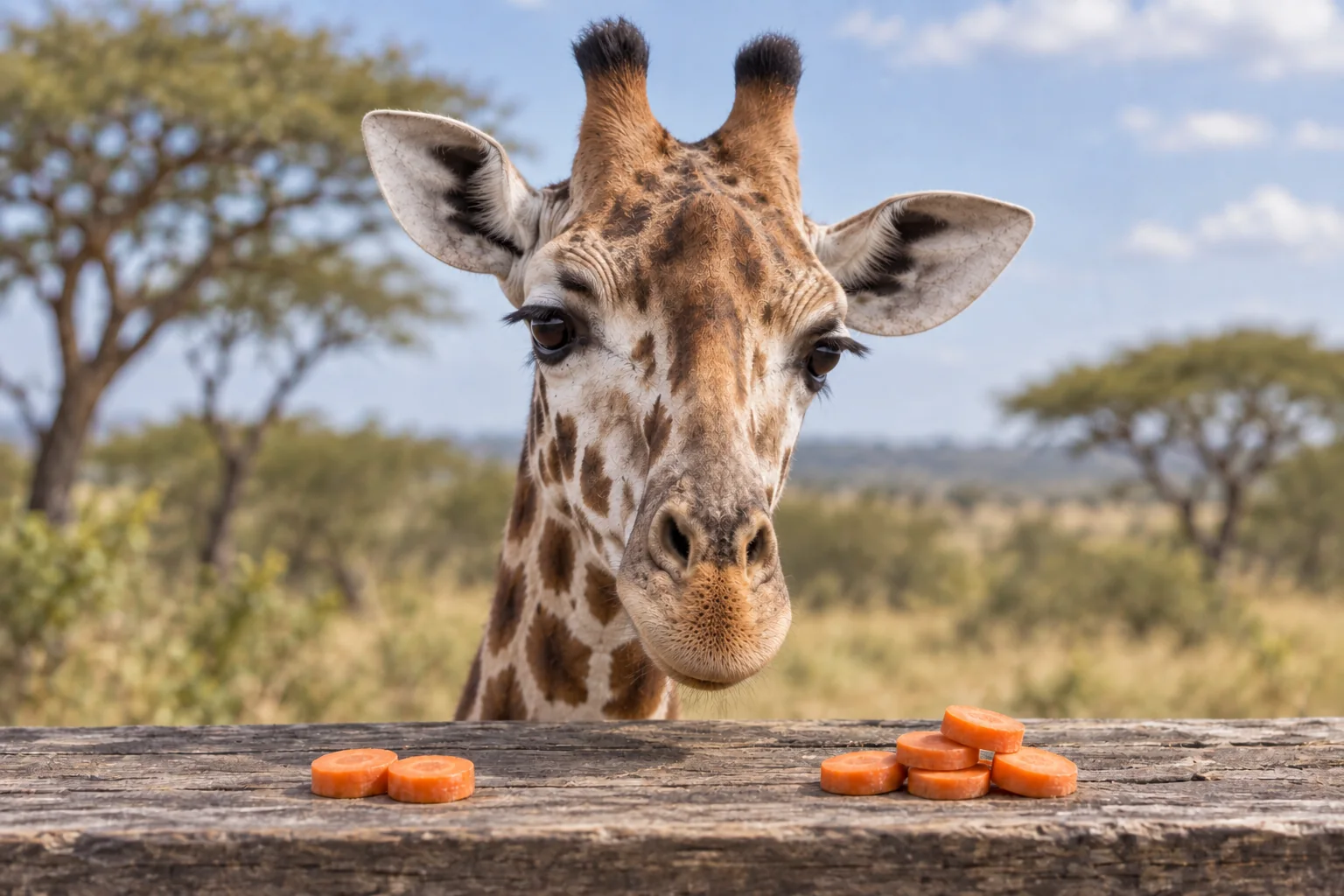
The experiment used two yellow containers from which the giraffe could choose, with a green container between them to hold food being moved. Their covers blocked the animal's view while leaving the contents accessible from the researcher's side. The giraffe could watch each carrot piece travel without seeing the resulting pile.
Loidi conducted the experiments with Nakuru, Njano, Nuru and Yalinga, working with Álvaro L. Caicoya, Federica Amici, Pilar Padilla-Solé and Jordi Galbany, with support from Barcelona Zoo staff. The animals approached voluntarily and could leave during testing. They were familiar with earlier cognitive experiments, but this task did not require teaching them numerals or symbols for addition.
In an addition trial, Loidi first showed the two starting portions, then covered them. Next he showed the carrots in the middle container and moved them, one at a time, into one of the hidden portions. Finally, he offered the two yellow containers. The giraffe selected one with its muzzle or tongue and ate the food inside.
The sequence mattered. If the final amounts had been visible, the animal could simply have looked for more food. Keeping them hidden made earlier information useful at the moment of choice. Moving the pieces separately also meant that several events could contribute to the final amount: the tests included additions of up to three pieces, producing portions of up to five.
Two further tasks changed the direction of the movement. In one, pieces were removed from a hidden portion and put aside. In the other, pieces left one choice container and eventually entered the other, passing through the green container on the way. That transfer required keeping track of two changing amounts: one shrinking while the other grew.
When following the carrots gives the wrong answer
An animal need not keep track of a total to make some successful choices. A simple rule—choose the container that received food—would often work in the addition task. To learn more, the team included trials in which that rule would lead to the smaller reward.
Consider two of the comparisons they used:
| Starting portions | Change to the smaller portion | Final portions | Larger reward |
|---|---|---|---|
| One piece and two pieces | Add two pieces to the one | Three pieces and two pieces | The container receiving food |
| One piece and four pieces | Add two pieces to the one | Three pieces and four pieces | The untouched container |
In both cases, two pieces enter the initially smaller portion. What changes is whether that addition is enough to overtake the other meal. Following the receiving container helps in the first comparison and fails in the second. Remembering only which portion started larger has the opposite problem.
This is what made the experiment informative. The researchers varied the relationship between the starting quantities, the movement and the final reward. They could examine whether an animal's success continued when a particular shortcut stopped being useful.
There were also simpler comparison tasks in which no food moved. Sometimes the giraffes could still see the portions when choosing; sometimes the portions were covered first. All four showed clear success with visible food, and three did so with unchanged hidden food. Nuru did not show clear success in that hidden-food control, although she succeeded in the addition task. The pattern suggests that visibility alone cannot explain performance, while also showing that the animals did not respond identically in every setting.
Four successful giraffes, with differences beneath the average
Each giraffe made 72 choices in the addition task. All four chose the larger portion reliably more often than the one-half success rate expected from guessing between two options. Together they got about seven choices in ten right.
That result establishes a useful starting point: they could often find the better reward after watching food enter a concealed portion. The analysis of simpler rules then asked how far that success extended.
Across the three tasks involving food movements, Nuru and Njano also performed above chance on trials where choosing the receiving container or avoiding the one losing food would give the wrong answer. Nakuru and Yalinga did not show clear above-chance success on those trials.
The distinction concerns evidence for how the choices were made. The second pair's results leave more room for a simple rule to explain their performance. Nuru and Njano's choices are harder to explain that way and support the possibility that they were keeping an updated impression of the hidden food.
Those checks combined addition, removal and transfer trials, so they do not tell us precisely which strategy each giraffe used within every task. Even so, they move the investigation beyond an average success rate towards the mental processes that could produce it.
Taking food away was harder
Removal produced a different pattern. None of the four giraffes showed statistically clear success, and performance was lower than in the addition task. The same animals, carrots and containers had produced better choices when portions grew.
One possible reason is the extra difficulty of revising a remembered amount downwards. After a piece leaves, the animal must judge what remains behind the cover. The study demonstrates a difference between these tasks, but it does not directly identify the mental operation that made removal harder.
The transfer result needs a different interpretation. No individual showed statistically clear success there either, but each had only 24 transfer trials, compared with 72 addition trials. Three animals chose correctly on roughly two-thirds or more of their transfer trials. With fewer observations, a moderately successful performance is harder to distinguish from chance variation.
The authors explicitly discuss this problem. Transfer performance was not clearly lower than addition performance in their task comparison. The experiment therefore leaves a worthwhile opening: more observations could show whether giraffes can follow food moving between hidden portions, and under which conditions. The present result does not settle that question.
What kind of amount was in the giraffe's mind?
The carrot pieces were similar in size. Adding another piece therefore increased several things at once: the number of objects, the amount of food and its combined volume. A giraffe could have kept a rough impression of the growing portion without assigning it an exact count.
A previous study helps explain why that distinction matters. In Giraffes go for more, Caicoya and colleagues offered five giraffes at Barcelona and Leipzig zoos visible portions that varied in piece number and size. When each option contained a single piece, the animals could use its size to select more food. Their choices became less reliable when the larger individual piece was on one tray and the more numerous pieces were on the other.
Food offers several kinds of information, and those cues can agree or compete. The new study shows giraffes responding successfully to additions while leaving open which aspect of the quantity they were updating. Its interest lies in that use of remembered information, even before the exact representation is known.
Another experiment extended the question in a different direction. In a 2023 study by Caicoya, Montserrat Colell and Amici, giraffes saw mixtures of carrots and less-preferred zucchini. An experimenter took a concealed piece from each mixture and offered a choice between his closed hands.
Some comparisons held the carrot count constant while changing the number of zucchini pieces around them. Twenty carrots mixed with four zucchini offer a higher proportion of the preferred food than twenty carrots mixed with 100 zucchini. All four giraffes succeeded across the first experiment's three conditions, supporting the idea that their decisions were sensitive to proportions rather than simply to the largest carrot count. Our research-library account follows those comparisons.
These experiments ask different questions: comparing visible amounts, judging an unseen sample from a mixture, and following a quantity that changes behind a cover. The 2026 study identifies its animals as previous participants in the earlier work, so the results build a more detailed picture of an overlapping group of subjects. Testing more giraffes would show how widely these abilities are shared.
Following the information further
Loidi and colleagues propose separating the different quantity cues in future experiments. For example, comparing additions with different piece sizes could make number and total food amount point towards different choices. That would help reveal whether giraffes keep track of individual pieces, the overall portion, or a combination of information. The animals would first need to be able to distinguish the relevant visible quantities, so that a later difficulty could be linked to remembering and updating them.
The researchers also call for automated procedures and tests in which the person presenting the final choice does not know the better option. Loidi wore sunglasses, maintained a neutral posture and touched both containers before offering them, reducing obvious cues. A person who knows where the larger reward sits can nevertheless give subtle signals unintentionally. Removing that information from the person presenting the choice would make the animal's own use of memory easier to assess.
More transfer trials could answer a complementary question. If success improves when the sequence is shorter or fewer pieces move, that would help identify which demands make the task difficult. Such comparisons would also need to account for practice: an animal might learn a new way to solve a task as testing continues.
For now, the addition experiment has exposed a capacity that visible food choices alone could not reveal. Some giraffes could make useful decisions after a meal changed behind a cover, and two continued to succeed where a simple rule about the moved food failed. The next step is to discover more precisely what information they carried forward from seeing the carrots to choosing where to eat.
Sources
The research behind this story: Iker Loidi, Álvaro L. Caicoya, Federica Amici, Pilar Padilla-Solé and Jordi Galbany (2026). Assessing quantity combination and dissociation in giraffes. Scientific Reports 16, 19615. Published 26 June 2026. DOI: 10.1038/s41598-026-54126-7. Read the full paper.
Alvaro L. Caicoya, Montserrat Colell, Ruben Holland, Conrad Ensenyat and Federica Amici (2021; first published online in 2020). Giraffes go for more: a quantity discrimination study in giraffes (Giraffa camelopardalis). Animal Cognition 24, 483–495. DOI: 10.1007/s10071-020-01442-8. Read the study in Chapter 2 of the author's University of Barcelona thesis.
Alvaro L. Caicoya, Montserrat Colell and Federica Amici (2023). Giraffes make decisions based on statistical information. Scientific Reports 13, 5558. DOI: 10.1038/s41598-023-32615-3. Read the full paper.