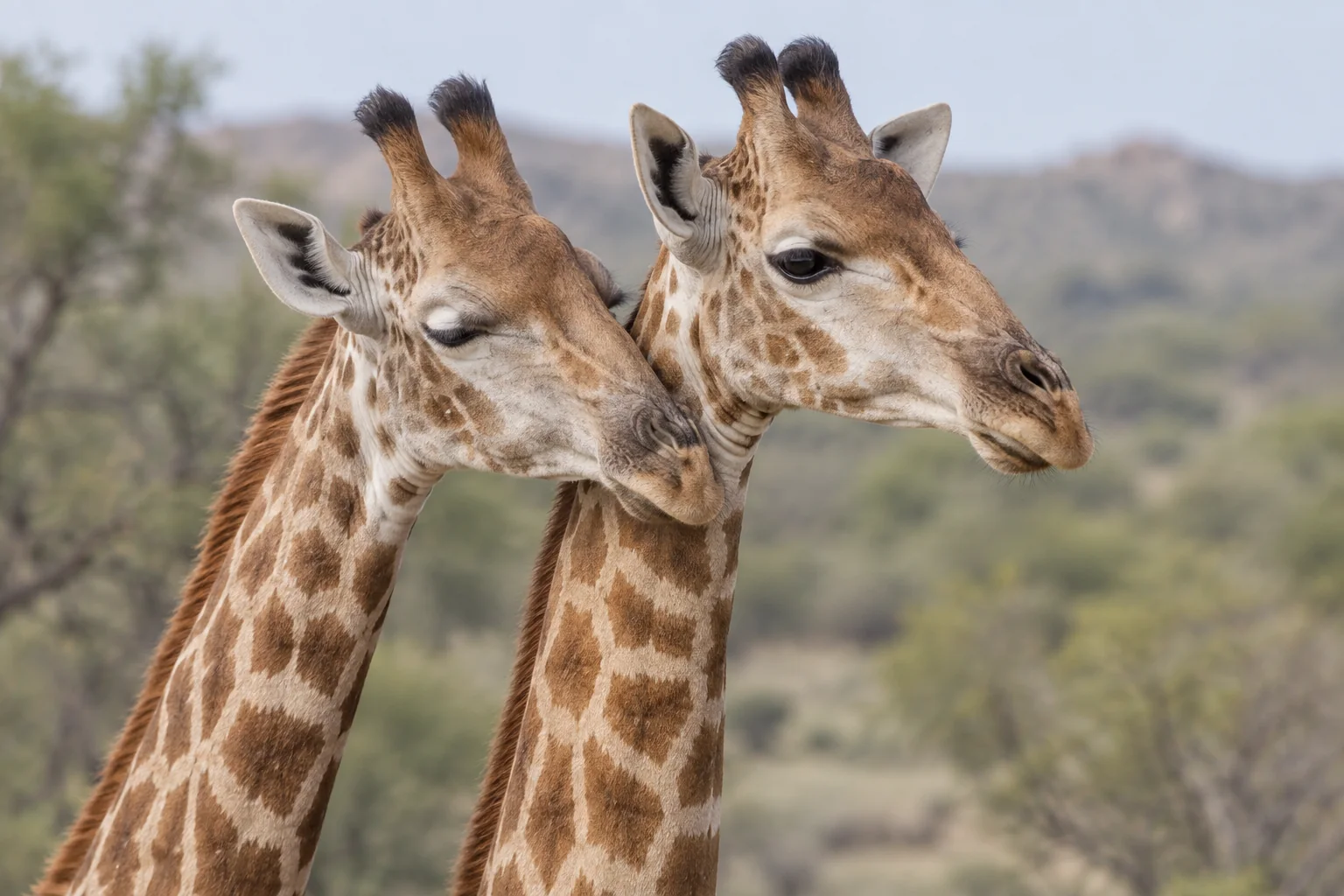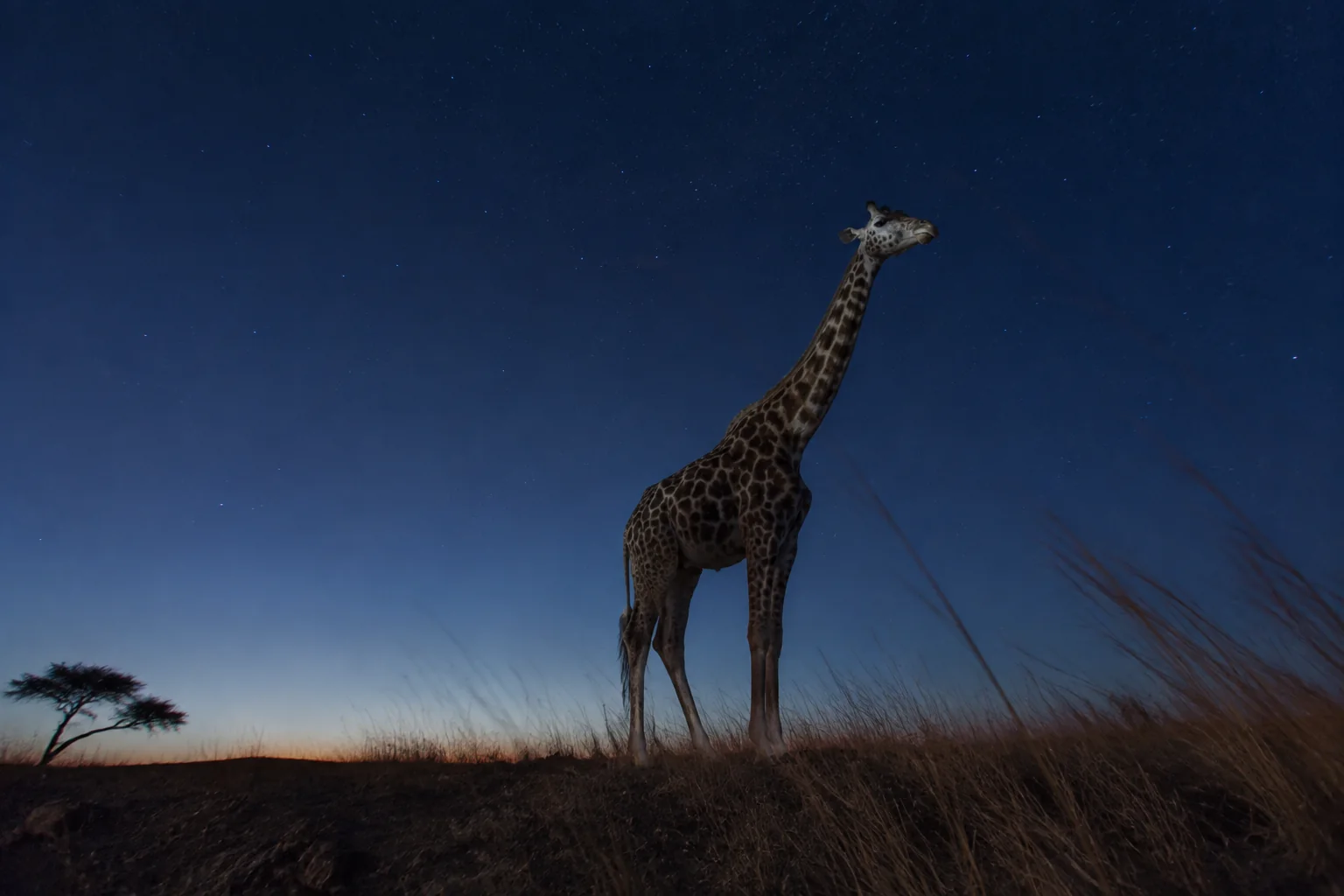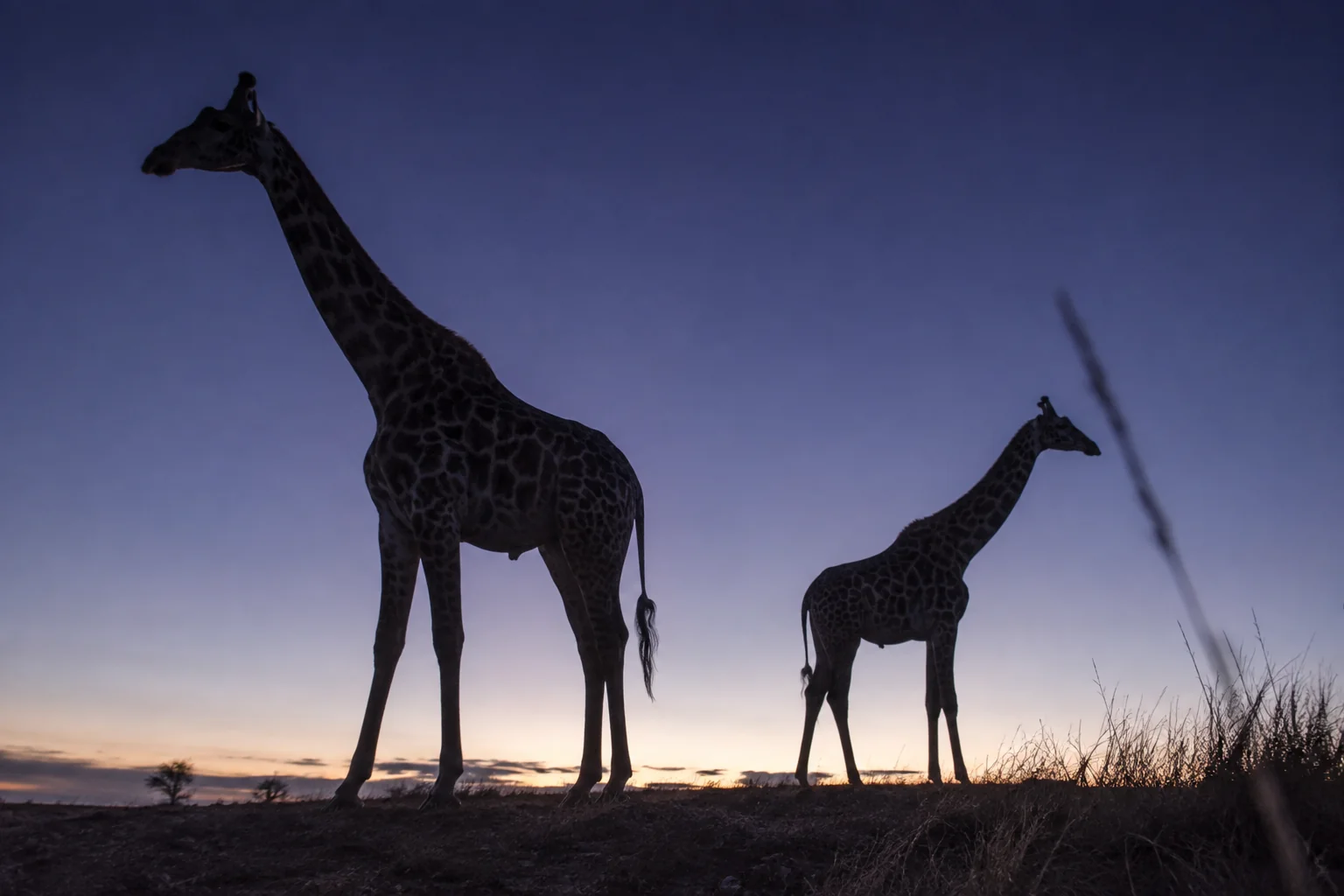
Two giraffes feeding beside one another might be relatives, frequent companions, or simply animals using the same patch of vegetation. A photograph cannot tell you which. Follow their encounters over months and years, however, and a different animal emerges: not a solitary silhouette, but an individual moving through a social world. Understanding that world means looking beyond both the herd count and the attractive family story.
A changing herd is not a random herd
Giraffes live in fission–fusion societies: groups separate and join together. That describes changing membership, not an absence of relationships. The same two animals can associate repeatedly without spending every day together.
In Etosha National Park, Namibia, Carter and colleagues examined associations alongside relatedness and overlapping space use. Female pairs with preferred associations were more closely related than expected by chance, but kinship and spatial overlap explained only part of the observed variation. Their 2013 association study supports a more complex picture than either random herds or families held together solely by blood ties.
Group, community, and relationship are different scales
A group is the set of animals observed together under a study’s definition. A social community is a larger pattern of associations detected across observations. A relationship concerns a particular pair, rather than the size of the gathering around them.
Imagine three observation dates: A appears with B; later A is with C; later still A is again with B. This invented example illustrates why changing membership does not tell us whether the A–B association is persistent. To evaluate it, we would also need to know how often the animals could have met and which encounters were observed.
For the wider animal, start with giraffe facts. The coat-pattern guide explains why recognising individuals is so important when asking questions that a simple count cannot answer.
Do giraffes have friends?
“Friends” is an accessible word, but a study usually measures association, gregariousness, or relationship strength. Those measures give the idea a definition that can be compared with evidence.
Bond and colleagues followed 512 individually recognised adult female giraffes in Tanzania’s Tarangire Ecosystem over five years. Females observed with more other females on average had higher survival. The sociability and survival study compared social measures with environmental variables.
This is an observational result. Researchers did not assign giraffes to friendship groups, and the association does not identify one proven mechanism responsible for the survival difference. It is also a result about adult females, not direct evidence that a grandmother protected a particular calf.
Our review of the sociability and survival study explains how the researchers measured associations, accounted for missed sightings and compared competing explanations.
What the word “social” does—and does not—tell us
A high association score does not mean two animals feel exactly what human friends feel. Nor does a low score prove hostility. A useful explanation keeps the measured behaviour separate from the emotional interpretation.
That does not make the finding less interesting. It turns a broad impression into a question researchers can investigate: who is repeatedly found with whom, and how does that pattern relate to the animals’ lives?
Are giraffe societies led by grandmothers?
Older females may have important roles, but a demonstrated giraffe grandmother survival effect is not established by the review discussed here.
Muller and Harris reviewed 404 papers on giraffe behaviour and social organisation. They argued that giraffes exhibit features associated with complex cooperative and matrilineal societies. Crucially, they also asked whether the presence of older females improves juvenile survival. That was a research question, not a reported causal finding.
Their social-behaviour review, published online in 2021 and in the 2022 journal volume, is an argument for taking social complexity seriously. It should not become a claim that every giraffe group has an experienced matriarch directing the others.
Matrilineal refers to patterns organised around maternal lines. Matriarchal leadership is a different claim about who leads. One word cannot be substituted for the other without evidence.
For young animals, see the baby giraffe guide. The questions of who associates with calves, who cares for them, and what changes their survival should remain distinct.
Growing up changes the social picture
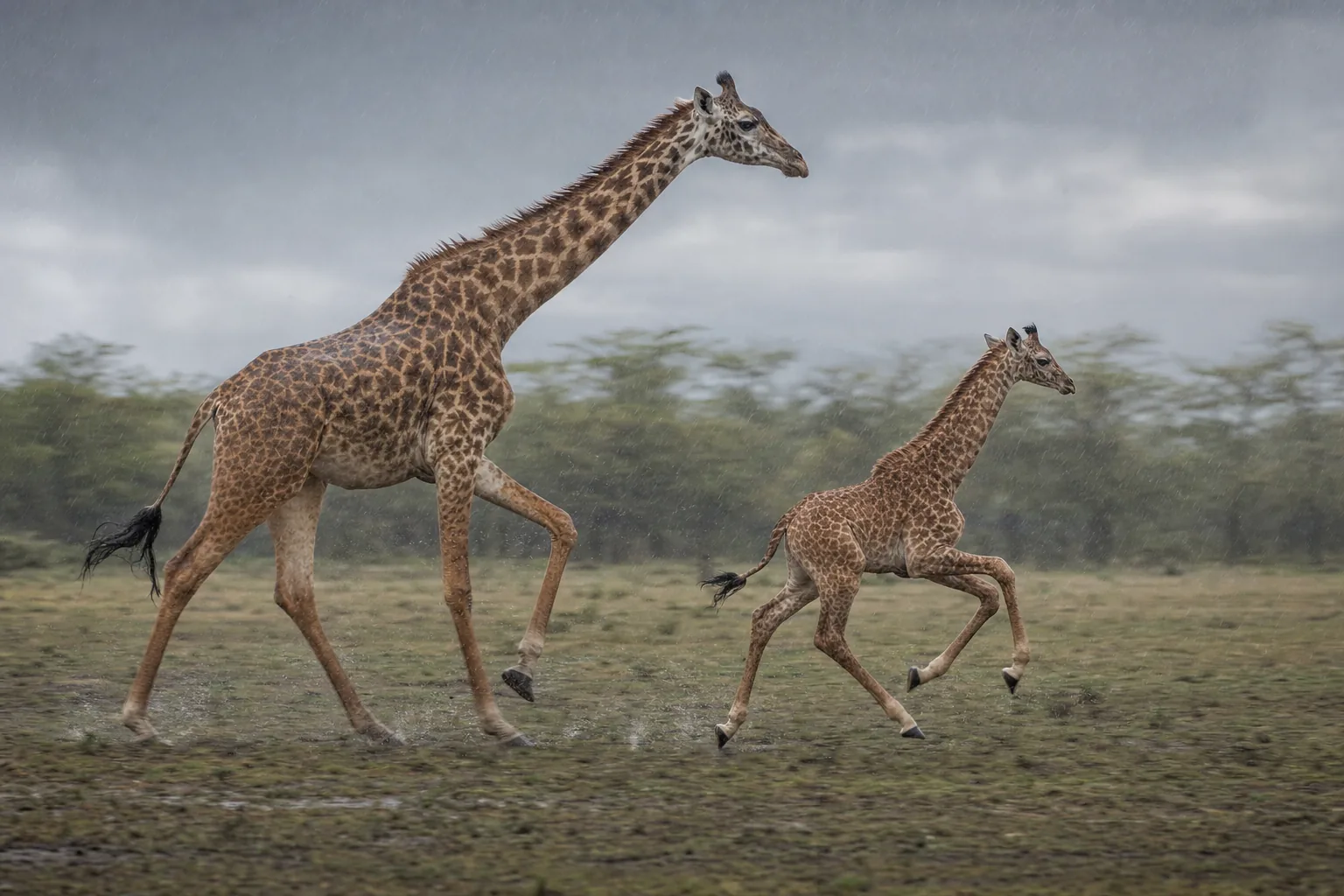
A young giraffe’s social surroundings should not be assumed to match an older animal’s. A 2022 study in two wild Kenyan populations found that adolescents associated especially strongly with others of the same sex and life stage, followed by adults of their own sex.
The adolescence study used social-network analysis to examine those patterns. Its findings give age and sex a place in the explanation; they do not establish one fixed social timetable for giraffes everywhere.
Leaving a community without moving far
A different study followed dispersal outcomes for 137 giraffes first identified as calves over a seven-year period. Females were more likely to remain associated with their natal setting, while young males dispersed more often.
Some animals changed social community without moving far from their natal area. The social-dispersal study therefore distinguished changes in associates from changes in location. It did not simply equate dispersal with a long journey.
This distinction is useful beyond giraffes. A map can show where an animal travels without revealing whom it meets. A social network can show changing associations without establishing the distance covered. Combining both answers a richer question.
Why do male giraffes spar with their necks?
Necking and sparring are conspicuous, but not every encounter should be described as an all-out fight. Granweiler, Thorley and Rotics studied males on a fenced reserve in Limpopo, South Africa. Sparring was most frequent among young adults and between males of similar size.
They also found individual preferences for delivering blows from one side. Their 2021 sparring study supports the interpretation that these encounters can allow maturing males to assess competitive ability without escalating into full fighting.
The study does not make each bout a direct contest for a particular female, and it does not explain the entire evolution of the giraffe’s neck. Those are larger questions, addressed separately in our neck-evolution guide.
For an observer, useful details include the participants’ apparent sizes, how the interaction starts and ends, and whether the same pair meets again. “Two giraffes fighting” loses much of that context.
Giraffes make sounds, but the meaning is not settled
Giraffes are not voiceless. Baotic, Sicks and Stoeger recorded 65 humming vocalisations in data collected at three European zoos. The hums occurred at night.
The researchers lacked simultaneous nighttime video, so they could not identify the callers or establish the behavioural context. Their 2015 acoustic study found no evidence of infrasonic communication in that dataset. That is not proof giraffes can never produce infrasound, but it does not support presenting it as their established long-distance communication system.
Recording a sound is not decoding a message
Three questions need separate evidence: what sound was produced, which animal produced it, and what effect it had on another animal. An audio recording can make real progress on the first without resolving the other two.
Our giraffe sounds guide includes an authentic humming recording, field evidence on hisses and snorts, and newer research on responses to other animals' sounds.
Calling every hum a contact call, warning, or expression of emotion would go beyond this study. The uncertainty is part of the discovery, not a detail to remove for a more confident headline.
What happens after dark?
The social story does not end when daylight observations stop. Giraffes sleep, and their nighttime record includes more than one posture or activity. Tobler and Schwierin’s behavioural sleep study documented sleep in bouts, including standing and lying observations.
Our dedicated giraffe sleep guide compares the different measurements used in zoos and in Namibia. A few minutes in one characteristic posture are not interchangeable with total behavioural sleep across a day.
There is no need to squeeze those measures into a universal “barely sleeps” fact. Just as one daytime group does not reveal a whole social network, one quiet nighttime image does not reveal the animal’s complete activity budget.
Human surroundings and giraffe relationships
Social patterns can vary with the landscape people and giraffes share. Research in northern Tanzania used six years of photographic records to examine social communities. The analysis found weaker relationship strengths and more exclusive associations in communities closer to traditional Maasai compounds.
The human-proximity study reports an association in that setting. It is not a basis for blaming a whole community, treating every form of human presence as identical, or assuming one intervention would reverse the pattern.
The authors’ starting records included 1,139 adult females, while the analysed social network used 540 females meeting the detection criterion. Those numbers refer to different stages of the study, not contradictory population counts.
Our habitat guide supplies geographic context. These social findings add a consideration to conservation decisions; they do not replace population surveys or evaluation of a particular intervention.
A practical guide to reading behavioural claims
| What you see or read | Reasonable starting point | What needs more evidence |
|---|---|---|
| Giraffes together in one image | They shared a place at that moment | A lasting bond or family relationship |
| Repeated pair associations | A pattern worth analysing | Why it occurs and whether it is a preference |
| An older female near a calf | An age-mixed encounter | Kinship, caregiving, or a survival benefit |
| A recorded hum | An acoustic event | Caller identity and communicative function |
| A change of companions | Possible social movement | Whether it also involved spatial dispersal |
The table is a reading aid, not a classification of any particular herd. It shows the extra information needed to move from an observation to a stronger explanation.
What to remember
Giraffe behaviour is neither random solitude nor a human family drama translated into a spotted coat. Flexible groups can contain persistent associations. Age, sex, space use, and local surroundings help shape the patterns researchers observe.
The most useful next question is often “how was that measured?” Our research library links to original papers. Preserve the distinction between a recorded behaviour, an association, a proposed explanation, and a demonstrated effect.
Frequently asked questions
Are giraffes solitary animals? Some individuals are seen alone, but that does not establish an absence of social relationships. Long-term studies reveal structured associations.
Do giraffes have a fixed herd leader? The studies discussed here do not establish a universal permanent leader. Changing groups and maternal associations should not be rewritten as one leadership system.
Do giraffes communicate through infrasound? The cited acoustic study did not establish that. It recorded nighttime humming, with its function unresolved.
Does every giraffe group consist of relatives? No such universal rule follows from the evidence. Kinship and shared space explain some association patterns, not every encounter.
Do giraffes stay with the same companions all their lives? Not necessarily. Studies document changing groups, age-related associations, and social dispersal.
Sources
Nine links support the guide: Etosha association research; the female sociability/survival study; the social-behaviour review; studies of adolescence, dispersal, and sparring; the acoustic paper; behavioural sleep observations; and the human-proximity analysis.
The studies concern different populations and methods. This guide synthesises them without pooling their numbers or treating every finding as universal.