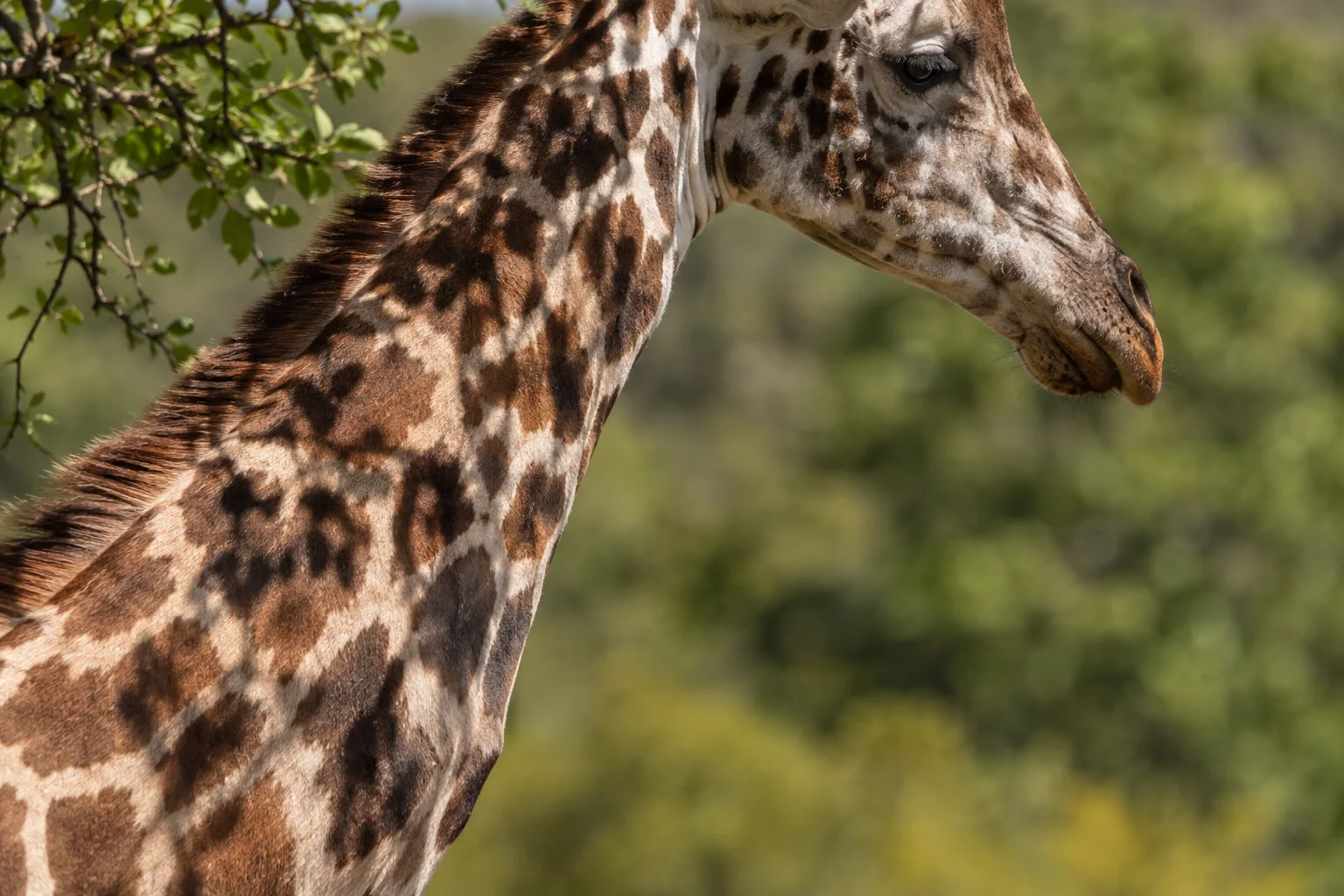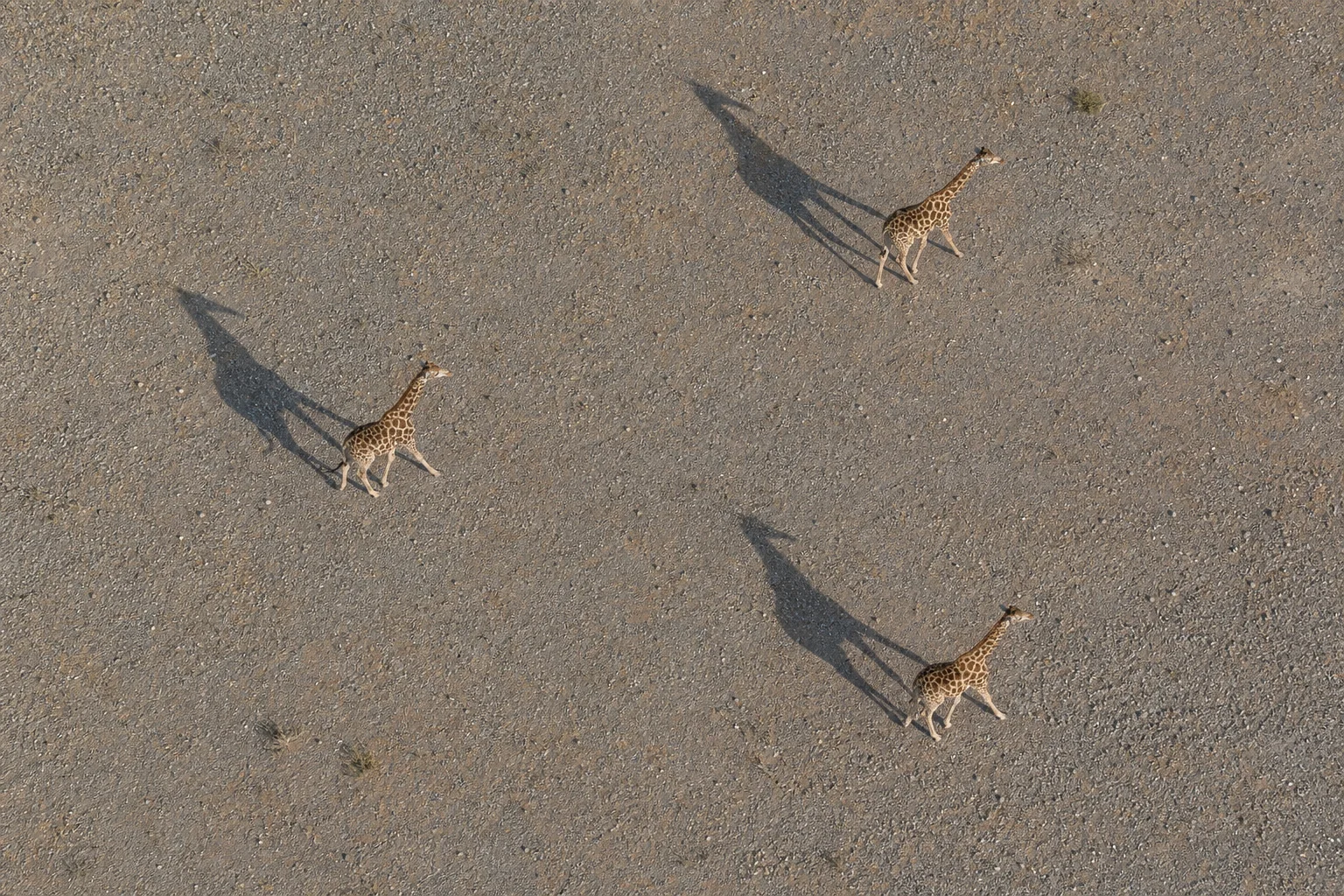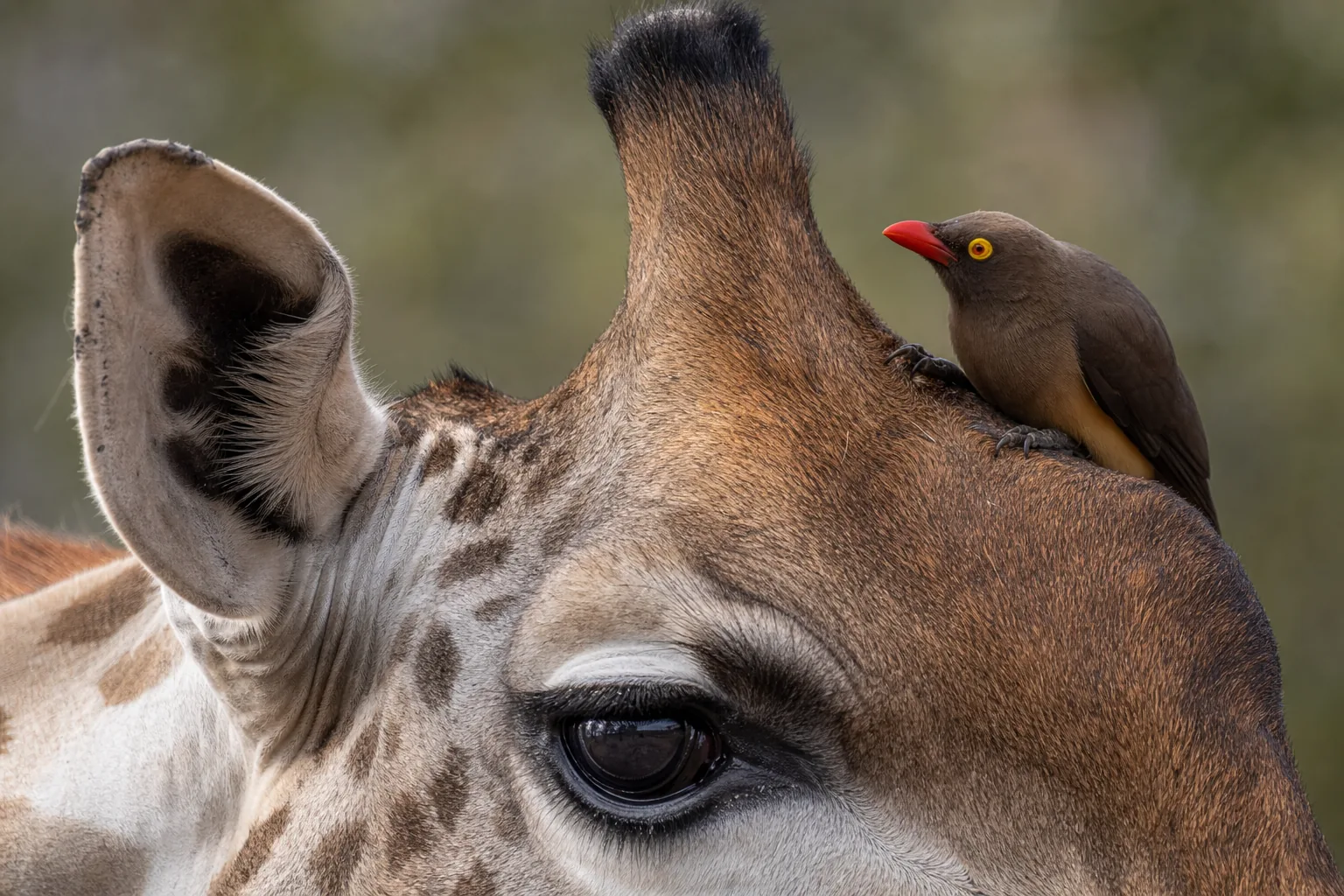
A giraffe disappears behind the trees. Months later, another photograph captures an animal on the same track. Is it the same giraffe, still alive, or a different individual? Getting that answer wrong can distort a population study. The coat offers a way to recognise the animal—and opens harder questions about why its spots look the way they do.
Why do giraffes have spots?
There is no single settled explanation covering every feature of the giraffe coat. The strongest practical answer is that its distinctive markings allow researchers to recognise individuals. That is a use people make of the pattern, however, not by itself an explanation of why the pattern evolved.
The evolutionary questions concern concealment, heat exchange and communication. Different studies address different parts of that story. A photograph can show resemblance; an anatomical preparation can reveal blood vessels; repeated field observations can connect characteristics with survival. None of those measurements automatically supplies the others.
Keep three questions separate while reading: Which individual is this? What might its markings do? Which species does it belong to? They require different evidence. Our wider giraffe facts guide introduces the animal; here the focus is what the coat can—and cannot—tell us.
How researchers identify giraffes by their spots
In a 2012 Wild-ID study, researchers compared photographs of the right side of giraffes in northern Tanzania. Software ranked candidate matches, with people checking the proposed identities. The study used known matching photographs to evaluate identification errors before applying the approach to population analysis. See Bolger and colleagues’ photographic identification paper.
Two errors matter. A missed match treats another photograph of the same animal as a new individual. A false match merges different animals under one identity. The first can inflate a catalogue; the second can erase individuals from it. Both can corrupt the sequence of sightings on which later analysis depends.
This is why “spots are like fingerprints” is a useful introduction, not a guarantee of error-free recognition from any photograph. A matching system needs validation on its own images. The population survey methods guide explains how repeated sightings become estimates rather than merely a collection of pictures.
A striking photograph is not necessarily an identification photograph
Halloran and colleagues examined 552 opportunistic photographs from Zambia’s Luangwa Valley. Their study, first published online in 2014, found that background complexity affected Wild-ID identification success. Removing backgrounds reduced errors, and the authors recommended visual verification after software analysis. These findings concern that dataset and workflow, not a universal accuracy score for every modern system. Read the study of photo-identification in messy datasets.
An atmospheric portrait can make a reader look closer without supplying a comparable view of the flank.
Try a simple pattern-matching exercise
You can explore the logic without claiming to perform wildlife research. Use your own genuine photographs, images you have permission to compare, or hand-drawn patterns. Keep an untouched original of each photograph. If you use drawings, label the exercise as a demonstration.
Compare arrangements, not one attractive spot
Start with two views of the same side and body region. Choose a small cluster, then describe relationships: a narrow gap above a large patch, a smaller patch beside it, a fork in the pale space between them. A written description forces you to say what you are comparing.
Now introduce a deliberately unhelpful image: a different side, an obstructed view, or a crop missing most of your cluster. The important outcome is not always a match. Sometimes the correct answer is “not enough information.”
| Demonstration result | What to record | What not to conclude |
|---|---|---|
| Several neighbouring features agree in comparable views | Candidate match, with the features listed | That one matching-looking patch proves identity |
| Clear features disagree in the same region | Candidate mismatch, with the disagreement listed | That every difference in lighting is a different marking |
| The region or features are not visible | Insufficient evidence | That the animal is new or absent from the catalogue |
Ask a second person to assess the same pair before seeing your conclusion. If you disagree, preserve both observations and identify which feature needs a better view. This is a reasoning exercise, not a validated identification protocol.
For a classroom extension, shuffle several drawings, including duplicates, and ask pupils to explain their groupings. The giraffe guide for kids has a separate printable activity. Do not replace missing photographic detail with image generation and then treat the invented detail as evidence.
Do calves inherit their mothers’ spots?
A 2018 study of wild Masai giraffes compared 31 mother–calf pairs. Two measured aspects of spot shape, circularity and solidity, showed significant mother–offspring similarity. Circularity describes shape in relation to a circle; solidity distinguishes fuller shapes from more indented outlines. The finding supports inheritance of some characteristics, not an identical arrangement copied from mother to calf.
The authors explicitly note that this comparison cannot separate genetic inheritance from maternal or shared environmental effects. Fathers were not identified in the dataset. The open-access study and methods make those limits clear.
Its separate survival analysis used 258 calves. Associations depended on the trait and age period examined. Camouflage was a proposed explanation, not a demonstrated sequence of predators overlooking particular calves. “Inherited” and “protective” should not be compressed into one claim.
For the broader challenges of early life, see the baby giraffe guide. Recognising a calf’s mother and explaining the genetics of its coat are different tasks.
Can giraffe spots help regulate temperature?
An anatomical study published in 2023 investigated the skin circulation of one giraffe cadaver, alongside comparative material from other animals. It found a distinctive relationship between patches and their blood supply, including connections between arteries and veins. The arrangement supports a thermal-window interpretation: changing circulation through skin could influence heat exchange. See Taylor and colleagues’ anatomical study.
The distinction is between anatomical capacity and measured performance. This was not an experiment recording how many degrees a living giraffe cooled through each spot. A cadaver study cannot directly show active blood-flow adjustments during a hot afternoon.
That does not make the finding unimportant. It identifies structures that a physiological explanation must account for. The next question is what those structures do under changing conditions. The giraffe circulation guide explores why pressure, flow and vessel anatomy should not be treated as interchangeable measurements.
What the 2026 field study adds
Mouchet and colleagues analysed eight years of photographic observations from 810 Masai giraffes in Tanzania. They examined relationships among spot traits, apparent survival and land-surface temperature anomalies—departures from seasonal averages. The 2026 published study found that these relationships varied with life stage and sex.
For calves and adult males, larger versus smaller spots were associated with better survival under unusually cold versus hot conditions. The pattern was not identical in adult females. Nor does the work establish one universally advantageous spot size: shape, age and environmental context matter.
The study supports investigating thermoregulation, but did not measure cooling through living patches directly. Its discussion also considers predation and behaviour. Apparent survival cannot fully distinguish death from permanent departure from the study area.
The lesson is not “the old camouflage explanation is wrong.” A coat may have several functions, and survival associations do not isolate one mechanism. Our climate and water evidence area provides a route into related conservation research.
Do giraffes recognise one another by their patterns?
A 2022 study examined spot characteristics and social associations in 399 adult female Masai giraffes. Females with more similar spot shapes tended to have stronger associations. The authors interpret this as compatible with coat patterns helping recognition, potentially alongside relatedness. Read the original social-association study.
That is not the same as experimentally showing that a giraffe chooses a companion after inspecting its spots. Related animals could resemble one another and associate for additional reasons. Observing who spends time together does not, on its own, reveal which sensory cue they used.
It is an intriguing connection with giraffe social behaviour, not evidence that every similar-looking pair is a family or a friendship. A human observer’s ability to recognise markings should not be silently substituted for an experiment on giraffe perception.
Can you identify a giraffe species from its spots?
Treat the coat as a clue, not a standalone verdict. The IUCN specialist group’s 2025 taxonomy assessment notes limitations in systematic study of pelage, including variation within populations and with age. It did not use pelage characteristics in reaching its taxonomic assessment. See the assessment’s phenotype section.
This does not mean every population looks identical. It means that a tidy visual key should not promise more certainty than the evidence supports. An image stripped of its location and history can be especially difficult to interpret. The four giraffe species guide explains the names and the wider evidence behind them.
A useful caption can preserve uncertainty: “Giraffe photographed at this location; species identification not independently verified.” It is more informative than assigning a scientific name because the spots resemble an online illustration.
What to remember
A giraffe photograph can be beautiful, identifiable and scientifically useful—but those qualities are not interchangeable. To judge a claim about spots, ask what was measured, which animals were studied, and what conclusion the method permits.
Use pattern resemblance to formulate a question, not to skip verification. Keep candidate identities separate from confirmed matches; keep inherited traits separate from exact copies; keep proposed functions separate from direct measurements. That discipline turns an appealing animal fact into something readers can check and build on.
Frequently asked questions
Are every giraffe’s spots unique?
Individual patterns are distinctive enough to underpin photo-identification studies. That does not mean every image contains enough information for a reliable match, or that software identification is infallible. The photograph and checking process matter.
Does a calf have exactly the same spots as its mother?
No. Resemblance in measured shape traits does not mean the complete arrangement is duplicated. Think of a shared characteristic rather than a copied picture.
Do giraffe spots work like radiators?
“Thermal windows” is the more careful research description. Skin-vessel anatomy supports a role in heat exchange, but a metaphor should not imply that cooling performance has been measured for every patch or every giraffe.
Can a tourist photograph establish that giraffes are recovering?
One photograph can document a sighting. A recovery claim needs evidence about population change over time, with survey coverage and uncertainty considered. Our giraffe population guide explains why seeing more animals and demonstrating an increase are different things.
Sources
The linked primary studies cover photographic identification, image quality, mother–offspring similarity, vascular anatomy, temperature-related survival and social associations. The taxonomy document is the specialist group’s assessment, not a visual identification manual.
Research checked on 6 September 2026. This article provides original explanations and a clearly labelled demonstration exercise; it does not report fieldwork by The Last Giraffe. Follow the links beside each finding for its methods and limitations.