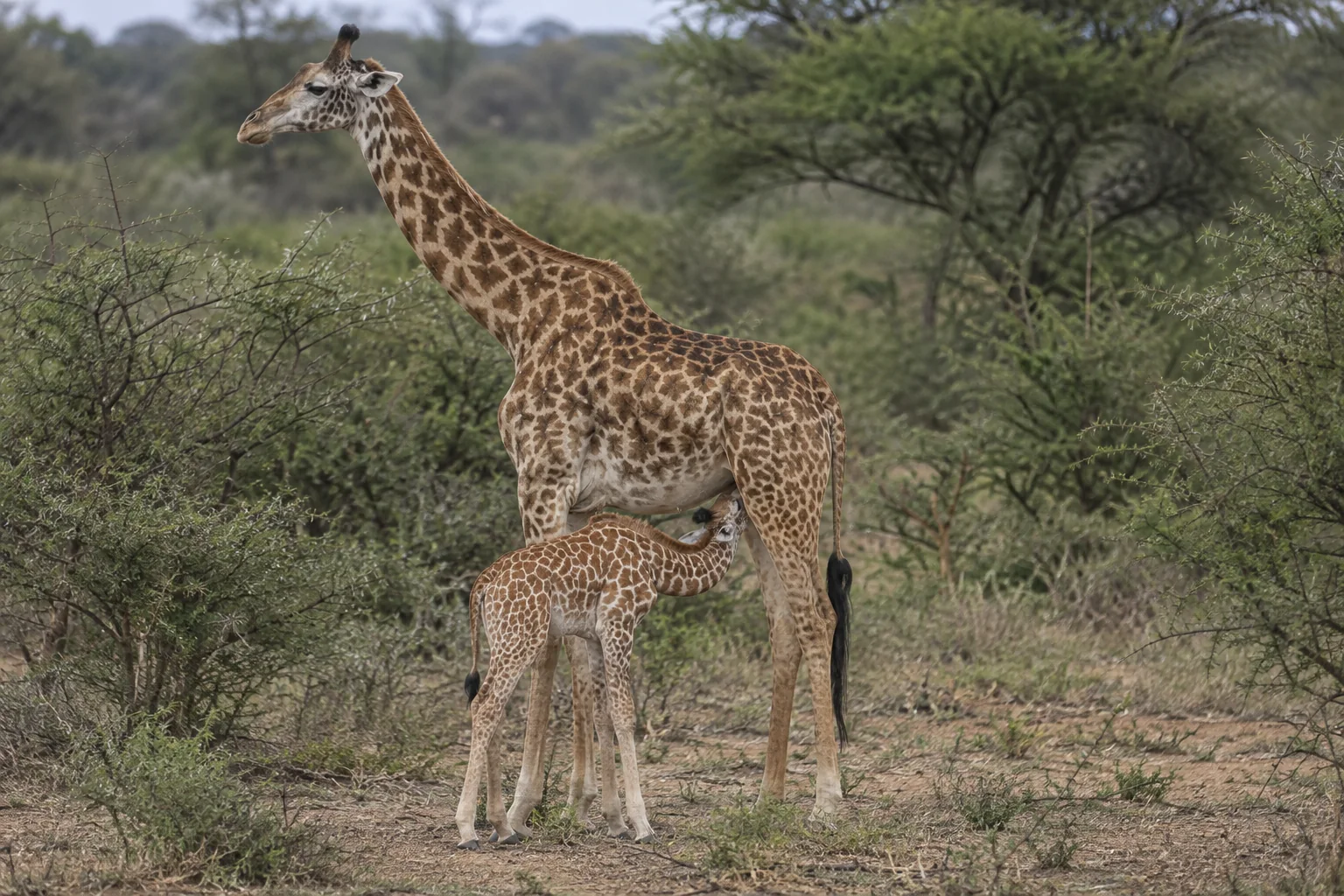
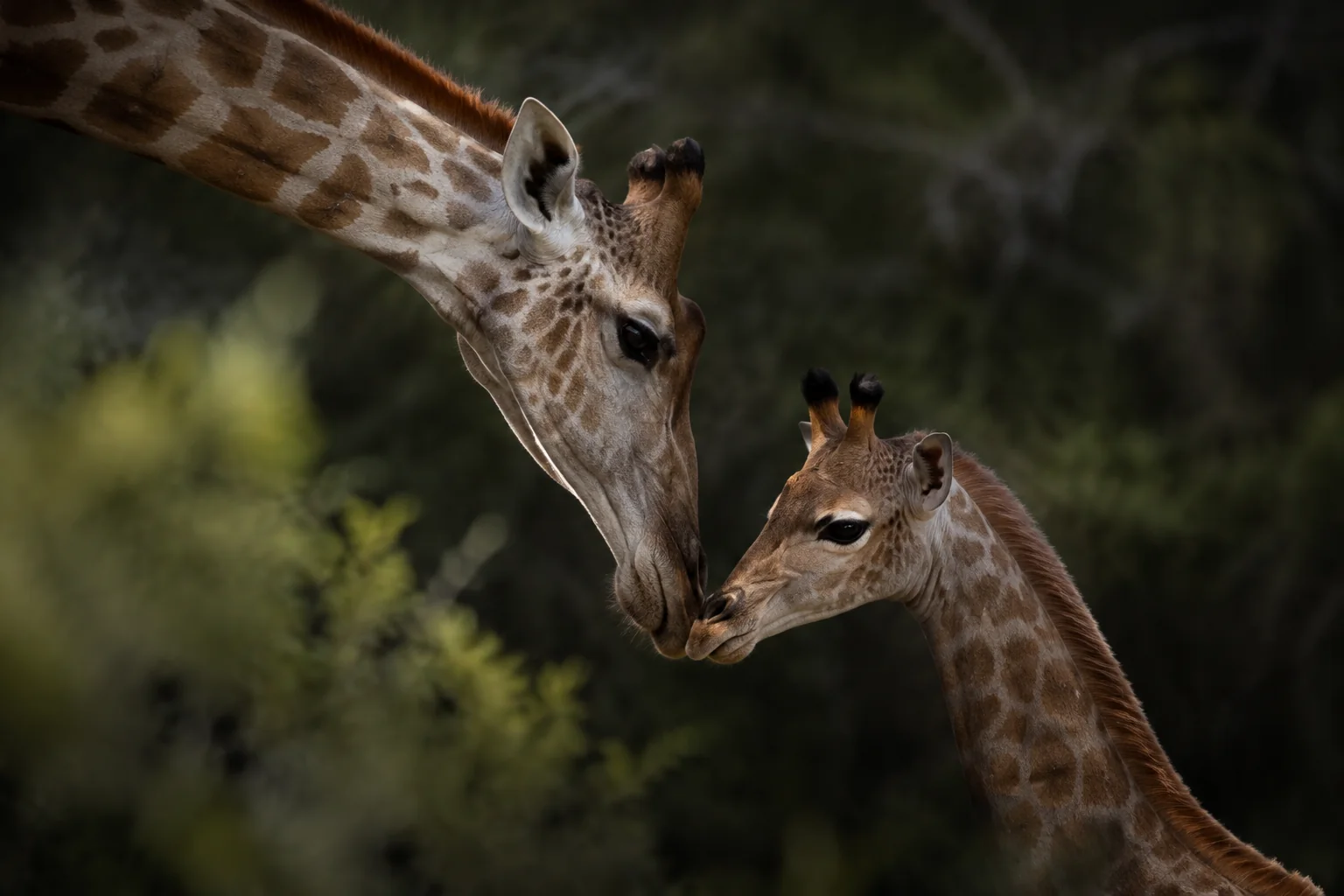
Before it takes its first step, a baby giraffe has already made a dramatic entrance: a fall from its standing mother. But the landing is only the beginning. The calf must find its feet, feed, and grow from a vulnerable newborn into an animal able to make its own way through a landscape of food, companions and predators.
What is a baby giraffe called?
A baby giraffe is a calf; more than one are calves. Adult females are often called cows and males bulls. “Calf” describes a life stage, not a separate kind of giraffe. The four giraffe species guide explains the names used for different giraffe lineages.
The quick facts below are approximate reference points, not deadlines every calf must meet. In particular, taking a first mouthful of vegetation is not the same as no longer needing milk.
| Milestone | Useful reference | How to read it |
|---|---|---|
| Pregnancy | Roughly 15 months | An approximate duration, not a guaranteed due date |
| Birth | Usually a single calf | Twins are unusual |
| Newborn height | Around 1.8 metres / 6 feet | A rounded guide, not a measurement of every newborn |
| First standing | Often around an hour | Individual observations vary |
| Early feeding | Milk first, with vegetation sampled while nursing continues | Dietary change is gradual |
The AZA giraffe care manual supplies the gestation, birth-number and early-standing context. San Diego Zoo’s giraffe account provides the rounded newborn height and describes early vegetation sampling.
Pregnancy length is not the time between successive calves. Our giraffe pregnancy guide separates gestation, age at first birth and the interval between births.
How big is a newborn giraffe?
A calf can already stand near the height of a tall adult person. That is height from the ground to the top of the head—not a six-foot neck. Much of the animal’s height is in its legs. Our giraffe height guide separates newborn reference figures from adult measurements and upper limits.
A dated birth record makes the scale less abstract. Hogle Zoo reported that Stephanie’s female calf, born on 20 July 2026, stood six feet tall and weighed 159 pounds, approximately 72 kilograms. Those are the figures in the zoo’s 27 July announcement, not a universal birth weight or a measurement we made. Read the original Hogle Zoo birth report.
When comparing announcements, look for when the calf was measured. “At birth,” “at its first examination” and “at one week old” are not interchangeable. A report may also round height much more heavily than weight. Combining several such reports into a precise-looking average would require checking their methods first.
Why does a baby giraffe fall when it is born?
The mother normally gives birth standing. The calf therefore travels from the birth canal to the ground rather than being delivered onto a surface beside a lying mother.
Woodland Park Zoo’s 20 June 2017 account describes a drop of about five feet, or 1.5 metres. It also records that Tufani’s calf stood an hour after birth. These are useful examples of an observed birth and its early progress; they are not a reason to promise that every delivery is identical. See the zoo’s original birth announcement.
The fall is part of normal giraffe birth, but “normal” should not be translated into “every birth is risk-free.” Nor does a short clip establish everything that happened before or afterwards. A calf landing, a calf attempting to rise, and a calf feeding successfully are separate observations.
Look beyond the most dramatic second
Birth videos often end at the landing or the first successful stand. To understand the animal’s progress, look for the account accompanying the footage: the date, the mother’s identity, the time of the first stand and whether nursing was observed.
Those details give a video context without turning it into a diagnosis. Animal-care teams assess the whole calf; a viewer should not infer health, injury or maternal rejection from a single edited moment.
How soon can a calf stand—and what comes next?
The AZA manual describes healthy calves standing, on average, within about one hour and starting to nurse, on average, within about 2.5 hours. These are professional reference observations. They are not a promise that a newborn will move through a fixed schedule.
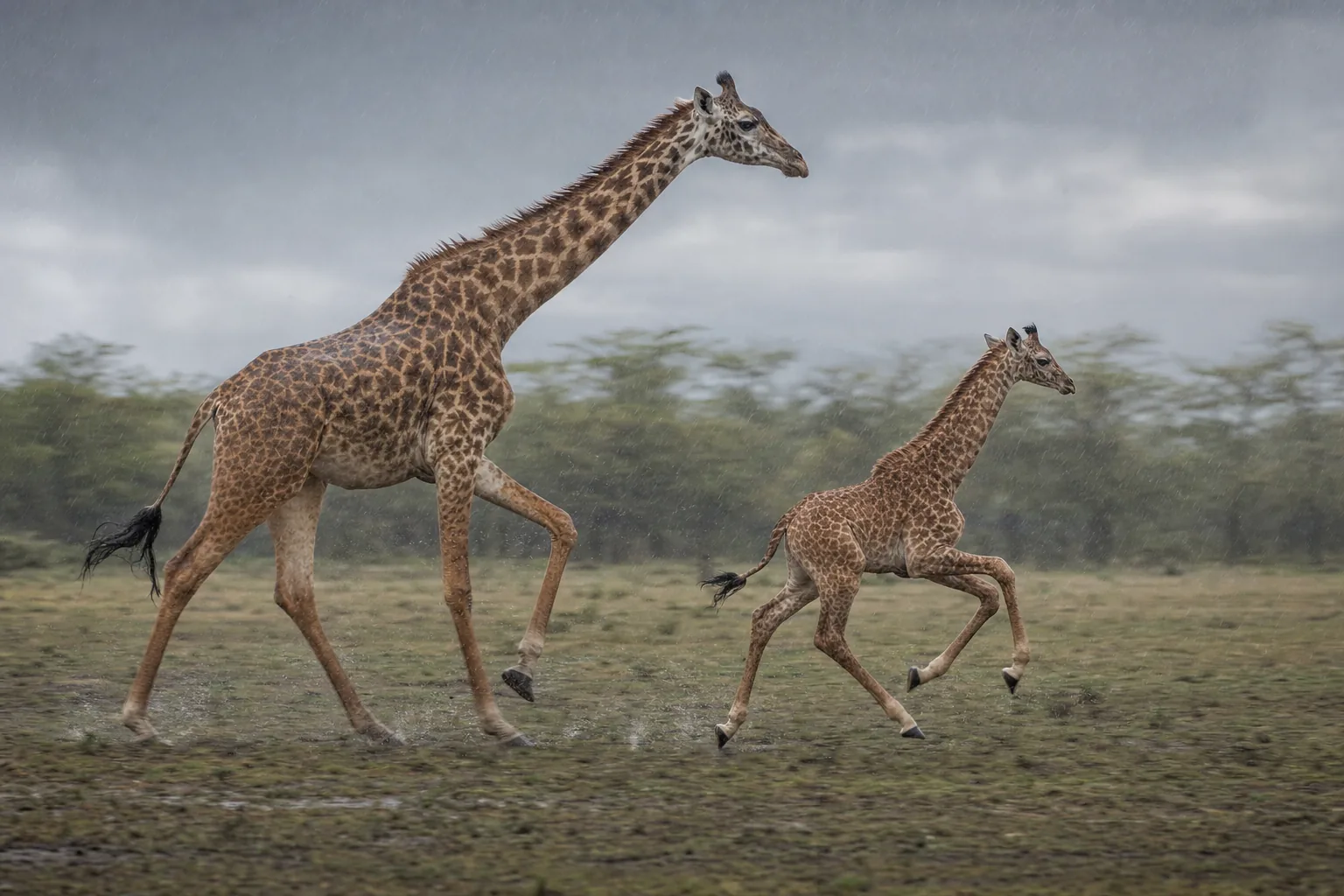
Standing and running also answer different questions. Getting onto four feet is a milestone in balance and mobility; it does not demonstrate feeding, sustained movement or independence. Describing a calf as “ready for life” after its first stand skips much of its development.
For an observation exercise, make separate entries for lying, attempting to rise, standing and moving. Record only what is visible. If a video jumps forward, leave a gap in the timeline rather than assuming the missing behaviour occurred continuously.
What do baby giraffes eat?
Milk is central to early life. Sampling leaves begins while nursing continues: San Diego Zoo describes vegetation sampling within the first week, followed by a longer period in which the young animal still nurses.
Weaning is therefore a transition, not the first bite of a leaf. The AZA manual describes lactation lasting six to twelve months, with variation in nursing behaviour. Its care guidance should not be converted into one exact weaning birthday for every wild calf.
The adult diet becomes easier to understand through the giraffe feeding guide, which explains browsing and rumination. For a calf, distinguish what it is trying from what it relies on. A photograph of a leaf in its mouth cannot establish the proportion of its nutrition coming from plants.
Do other females ever nurse a calf?
Yes. Nursing another female’s offspring is called allonursing. A 2021 study followed 22 nursing females and 47 calves in four Czech zoos. It found behavioural evidence compatible with both reciprocal nursing and calves attempting to obtain milk from females other than their mothers. See the open-access allonursing study.
The zoo setting matters. The study does not establish how often the behaviour occurs in every wild population, and “milk theft” is a behavioural hypothesis—not a moral judgement about a calf. Observing a nursing event is also not the same as measuring the volume of milk transferred.
Why do giraffe calves gather in nursery groups?
Young giraffes do not always remain beside their mothers throughout the day. In a classic 1977 field study, Langman followed naturally marked and radio-collared giraffes, observing known-age young for up to a year and a half. Calves participated in different groupings while their mothers travelled to feed and drink; the maternal bond persisted through to the mother’s next calving.
The University of Nairobi’s record of Langman’s study describes this development from lying out to calf groups and nursery herds. “Crèche” is a useful name for a grouping of young, not proof of a formal rota of babysitters.
The distinction is easy to picture. Seeing several calves together establishes a group. Demonstrating that a particular adult consistently guards them requires observations over time. Showing that the arrangement improves survival requires another kind of evidence again.
The broader giraffe social-behaviour guide explores these changing associations. A calf’s world expands beyond one mother–offspring pair without making the maternal relationship irrelevant.
How many baby giraffes survive their first year?
There is no single percentage that responsibly describes all giraffe calves. A survival estimate needs a population, a period, an age definition and a method. “Half are killed by predators” is not a safe substitute for those details.
Lee and colleagues’ 2016 demographic study used photographic records of 860 adult females and 449 calves at five Tarangire sites, alongside a synthesis of other populations. It found spatial variation in demographic rates. The original paper illustrates why one figure should not stand in for every place.
A calf missing from a later survey is not automatically a documented predator kill. Researchers must account for animals they fail to see, and permanent departure can be difficult to distinguish from death. Our survey-methods guide explains the role of repeated sightings; the coat-pattern guide explains how those sightings are linked to individuals.
Birth season can change the picture
A 2017 Tarangire study found that calves born in the dry season had the highest survival probability among the birth seasons compared. The authors proposed several possible explanations involving maternal resources, vegetation and predation conditions; they did not isolate one mechanism. Read the season-of-birth study.
That result challenges a simple “more rain always means safer calves” story. It does not mean drought benefits giraffes everywhere. A normal seasonal cycle and an extreme drought are different conditions, and evidence from one ecosystem needs its geographical context.
Why protecting calves is not the whole conservation story
Calves are the next generation, but a population also depends on the adults already alive. Births alone cannot show that a population is recovering.
A 2025 Serengeti study identified 1,520 giraffes across four subpopulations. Its analysis connected population dynamics with adult survival and calf recruitment; lower adult survival was associated with declining subpopulations. The published demographic analysis supports local, population-specific interpretation rather than one universal conservation slogan.
Our commentary on the Serengeti paper explains what recruitment means in that model, how the four study areas differed and why apparent survival cannot identify a cause of death.
Think of three different questions: Are calves being born? Do young animals survive and join later age classes? Do breeding adults survive? A favourable answer to one does not settle the others. Movement between areas can matter too. The giraffe lifespan guide explains why life expectancy from birth and survival after reaching adulthood answer different questions.
The practical reading lesson is to ask which rate a conservation claim actually measures. Our population guide covers counts and trends, while the calf-survival evidence area offers research starting points. Neither a beautiful calf photograph nor a single birth announcement proves a wild population increase.
What to remember
The first stand is remarkable, but it is not the finish line. A calf grows through overlapping changes in feeding, movement and social relationships, in conditions that differ among places and years.
To make an evidence-based calf profile, record three things separately: an observed milestone, its date or age, and the source. Keep general reference figures apart from a named animal’s measurements. That small habit makes a school project, caption or article much more informative than a collection of unqualified numbers.
Frequently asked questions
Is a baby giraffe already six feet tall?
Around six feet is a common newborn reference. It is not an exact height for every calf. Use a dated measurement when describing an individual.
Are baby giraffes born with their spots?
Yes. A calf is patterned from birth. Resemblance to its mother does not mean it has an identical coat; the linked pattern-science guide explains the research.
Does standing quickly mean a calf no longer needs its mother?
No. Mobility and independence are different. Nursing and the mother–calf relationship continue beyond those first steps.
Can giraffes have twins?
Twins occur, but a single calf is the usual outcome. A twin birth is an exceptional record, not the normal litter size.
Sources
Primary research and direct zoo accounts are linked beside the findings they support. The care manual provides professional reference information; the named birth reports describe particular animals, and field studies describe particular populations.
Sources checked on 6 September 2026. This article reports no field observations or veterinary assessments by The Last Giraffe.