A giraffe can stand in a landscape full of trees and still face a food shortage. The question is not simply whether there are leaves overhead: it is whether the right plants have usable food when the animal needs it. Understanding that distinction turns a familiar wildlife scene into a much more revealing story about survival.
The short answer: giraffes are browsers
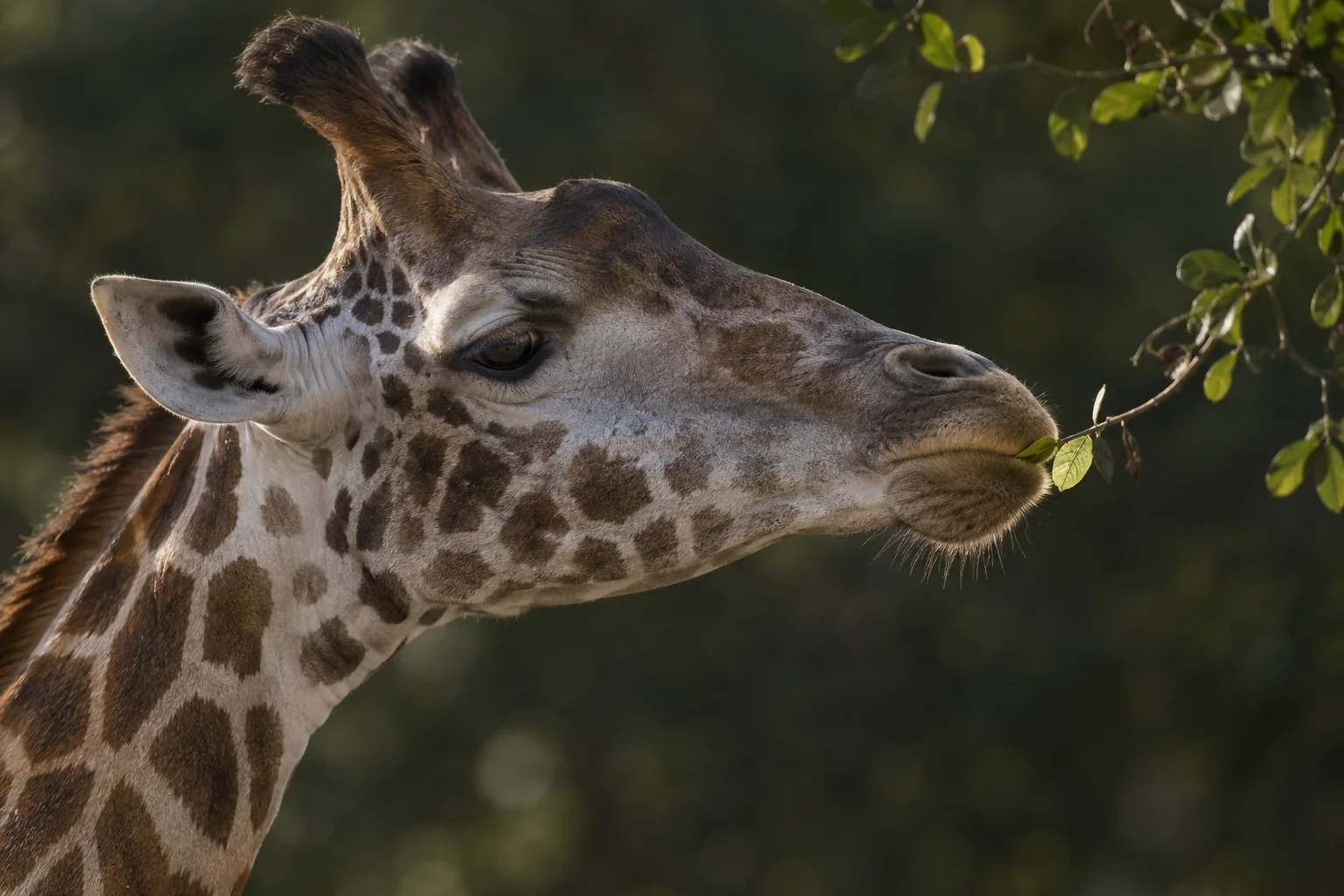
Giraffes eat mainly leaves from trees and shrubs, with flowers, fruits, and seed pods also appearing in their diet. They are herbivores, but more specifically they are browsers, rather than animals that live chiefly by grazing grass. Animal Diversity Web describes this range of plant foods in its giraffe account, linked below.
Think of browsing as a feeding strategy, not a fixed menu. “Giraffes eat acacia” is a useful starting point, but it does not tell you what every giraffe eats throughout its range. The habitat and range guide explains why a single imaginary African landscape is a poor substitute for real places.
Food collection and digestion are separate parts of the process. The giraffe’s gripping tongue helps gather a mouthful; rumination helps process what has been swallowed. Neither height nor tongue length alone explains the animal’s diet.
Which plants and plant parts do they eat?
Acacias are the familiar example. Many African trees historically called acacias are now placed in the genera Vachellia and Senegalia, so those names often appear in modern feeding studies. A change in the name on a plant list does not necessarily mean researchers have discovered a new food.
The useful distinction is between a plant species and the part being eaten. A record of a giraffe at a tree is not automatically a record of leaf consumption: the observer needs to identify what the animal actually takes.
| Food or activity | What it tells you | What it does not establish |
|---|---|---|
| Eating leaves | The animal is using foliage from that plant | That this is its only food plant |
| Taking flowers, fruit, or pods | Other plant parts can enter the diet | That they are available all year |
| Returning to one tree species | Repeated use during the observations | Preference without knowing what else was available |
| Chewing away from a tree | The animal may be ruminating | That it is collecting a new mouthful |
This is a guide to interpreting observations, not a feeding prescription. Knowing that a wild animal eats a category of plant material does not make an unfamiliar garden plant, snack, or leftover suitable for it.
A local example from the Kalahari
A 2023 study at Khamab Kalahari Nature Reserve in South Africa followed diet selection across 15 months. Researchers used one GPS-collared giraffe to help locate the population and combined feeding observations with vegetation information. Important foods included Vachellia erioloba, Ziziphus mucronata, Boscia albitrunca, and Senegalia mellifera.
Diet selection changed as browse availability shifted during the dry period. The value of this study is its connection between feeding and the local vegetation, not a claim to have discovered a universal giraffe menu. Its single-reserve setting and tracking design matter when interpreting the results. See Deacon, Smit and Grobbelaar’s study.
How do giraffes eat around thorns?
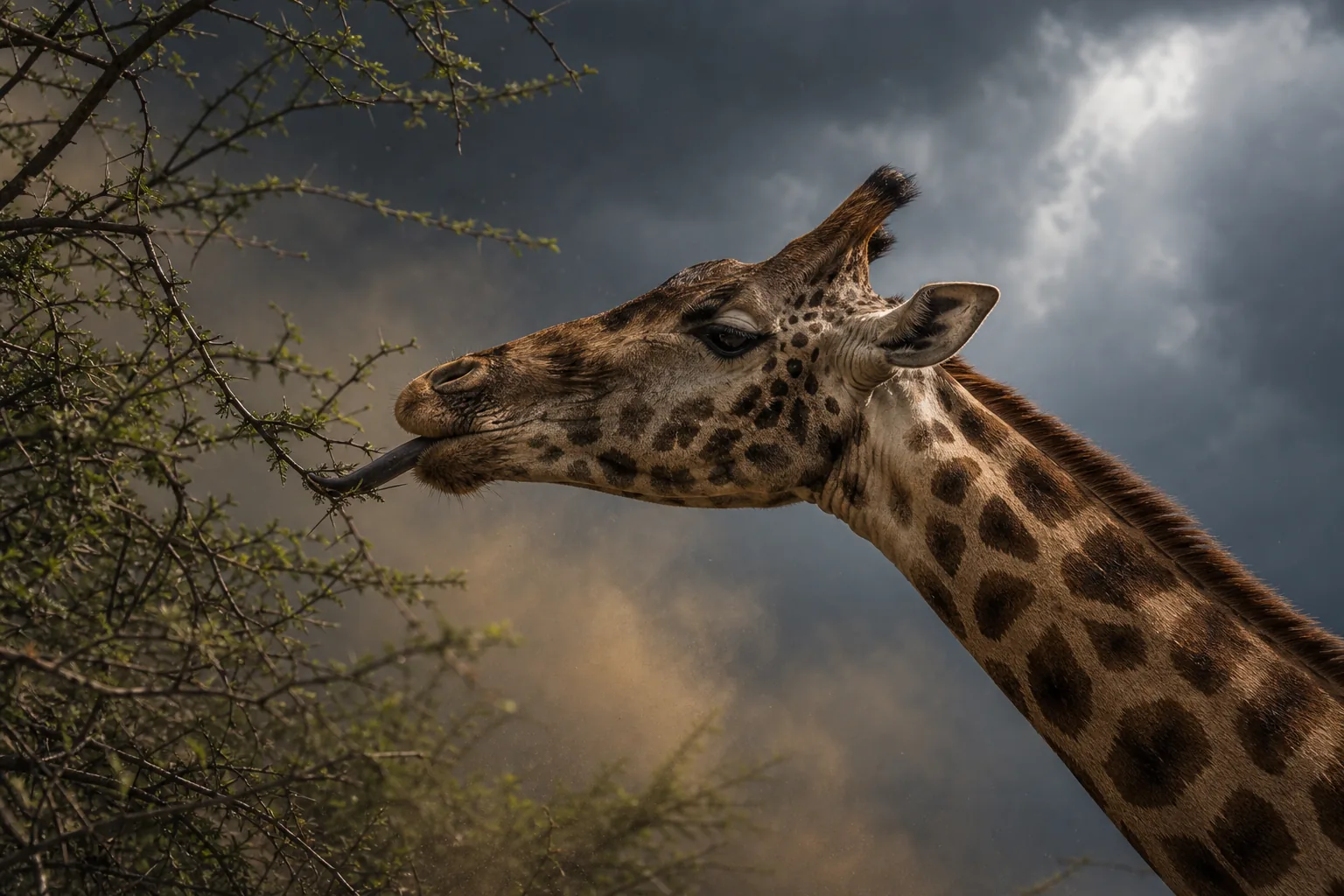
A long reach gets a giraffe near the food. A mobile mouth helps it collect it. San Diego Zoo describes a tongue around 46 centimetres long and gripping lips that work around thorny branches. The tongue is prehensile: it can grasp, not merely extend.
An anatomical study by Pérez and colleagues examined giraffe mouths and included feeding observations. It described developed lips, tongue muscles, glands, and different tongue surfaces. That supports an explanation based on physical structures and movement, rather than the idea that the animal simply swallows every branch it reaches.
The limits are important. An anatomy paper is not a trial measuring how often thorns cause wounds. Saliva and a robust mouth do not establish “antiseptic saliva,” instant healing, or immunity to injury. Our tongue guide separates the observed structures from popular explanations that go beyond the evidence. The original mouth-anatomy paper is available for readers who want the technical detail.
How much do giraffes eat, and how long does it take?
San Diego Zoo gives an intake figure of up to 34 kilograms, or 75 pounds, of food a day. Read “up to” carefully: it is not an average requirement for every calf, female, and large male, and it is not a ration to copy for an animal in human care.
The units also matter. Fresh vegetation contains water. A mass of fresh browse cannot be compared directly with the same mass of dried feed as if both represented identical nutrition. When comparing published quantities, check what was weighed before deciding that two sources disagree.
Feeding time is not a fixed daily schedule
In a study of Nubian giraffes at Lake Nakuru National Park, foraging accounted for roughly 53% of recorded activity in the dry season and 57% in the wet season. The seasonal difference was not statistically significant in that study.
Those percentages describe the observations, not an exact 24-hour timetable for every giraffe. They should not be multiplied into a universal “hours spent eating” fact without checking the sampling period and method. See Gitau and colleagues’ 2024 paper.
That distinction also helps with wildlife watching. A brief stop beside a herd can show what animals are doing at that moment; it cannot reveal the full daily activity budget. Resting, travelling, feeding, and chewing cud must be distinguished rather than folded into one activity.
What happens after a giraffe swallows?
Giraffes are ruminants. Food can return from the stomach to the mouth as cud for further chewing. Their stomach has four compartments: saying “four stomachs” makes the system sound like four separate organs, which is misleading. Animal Diversity Web describes both rumination and the compartmentalised stomach.
This is why an animal chewing without a leafy branch beside its mouth may still be processing a meal. The visible bite is only one part of feeding. A useful way to follow the sequence is: collect plant material, swallow, bring material back for further chewing, and continue digestion.
Leaves also supply water. San Diego Zoo explains that moisture in food can let giraffes go substantial periods without drinking. That does not mean they never drink or that water requirements are identical in every environment. A dry-looking landscape, on its own, does not tell you how much moisture is present in the food.
How scientists investigate diet quality
Watching a giraffe take leaves answers “what did it eat?” better than “did it obtain everything it needed?” These are related but different questions. To investigate nutritional quality, researchers can examine chemical measurements alongside field observations.
What droppings can reveal
A 2025 study analysed fresh giraffe faecal samples collected from six locations in South Africa’s Free State Province during 2021–2023. It examined ten chemical parameters. The authors identified combinations of faecal crude protein and fibre-related measures that could help distinguish feeding practices and seasons in the studied populations.
This is a non-invasive research approach, not a visual diagnosis someone can make from a photograph of droppings. The faecal-analysis study supports further monitoring of diet quality; it does not supply a universal health score for every giraffe.
Why several kinds of evidence help
Each method answers a different question. Direct observation records feeding events. Vegetation surveys describe available resources. Chemical analysis adds information that cannot be read from a plant’s colour or an animal’s apparent appetite.
Photographic body-condition scoring asks another question: what do visible body contours tell researchers? Our commentary on the giraffe body-condition study examines how that score was checked, and why it is not a weighing scale or an individual health diagnosis.
Our science library helps readers find the underlying research. When evaluating a study, ask where it took place, which animals were included, how long observations lasted, and whether it measured food selection, intake, or an indicator of quality. Treating these as interchangeable can produce a confident but wrong headline.
Why diet matters for conservation
The Kalahari study highlights the importance of assessing browse before introducing giraffes to an area. From that finding, a practical conservation question follows: will the landscape supply usable food during difficult periods, not just look suitable on the day animals arrive?
Aerial space, tree cover, and a green photograph are not the same as a year-round food assessment. The relevant questions include which plants are present, when their food parts are available, and whether animals can reach the areas they need. These are questions to investigate locally, not a recipe that can be applied unchanged across Africa.
Our guides to giraffe threats and protecting giraffe habitat connect food resources with the wider conservation picture. Diet is one part of that picture; it should not be used to erase other pressures or promise that planting a few trees will solve every problem.
What to remember
Giraffes are selective plant eaters, not machines that consume any leaves within reach. Browsing, collecting food, ruminating, and obtaining enough nutrition are different parts of the story. Location, season, and the way a study measures feeding all affect the answer.
For visitors, the practical rule is straightforward: do not feed wild giraffes. At a managed facility, follow the staff’s rules and use only what they provide for an authorised encounter. A general-interest article is not an animal-care diet plan.
Frequently asked questions
Do giraffes eat only acacia leaves? No. Acacias are important examples, but giraffes use other woody plants and can eat flowers, fruits, and pods. The menu varies by place and season.
Do giraffes have four stomachs? They have one stomach with four compartments. They are ruminants and chew cud.
Does every giraffe eat 34 kilograms a day? No. The zoo figure is an “up to” amount, not a universal daily requirement.
Does a long neck mean giraffes always eat at maximum height? No. Reach is an ability, not proof of the height used in a particular feeding event.
Sources
- San Diego Zoo Wildlife Alliance — Giraffe: approximate intake, gripping mouth, and water in food. Universal sleep and feeding schedules are not adopted here.
- Animal Diversity Web — Giraffe: plant parts, rumination, and stomach compartments. The account’s older taxonomy is not used to establish current species names.
- Deacon, Smit and Grobbelaar (2023): local diet selection and browse availability; linked in the Kalahari section.
- Pérez and colleagues (2012): mouth anatomy, not a test of immunity to thorn wounds; linked above.
- Gitau and colleagues (2024): Lake Nakuru activity and foraging observations; linked above.
- Grobbelaar and colleagues (2025): faecal chemistry as a potential diet-quality indicator; linked above.