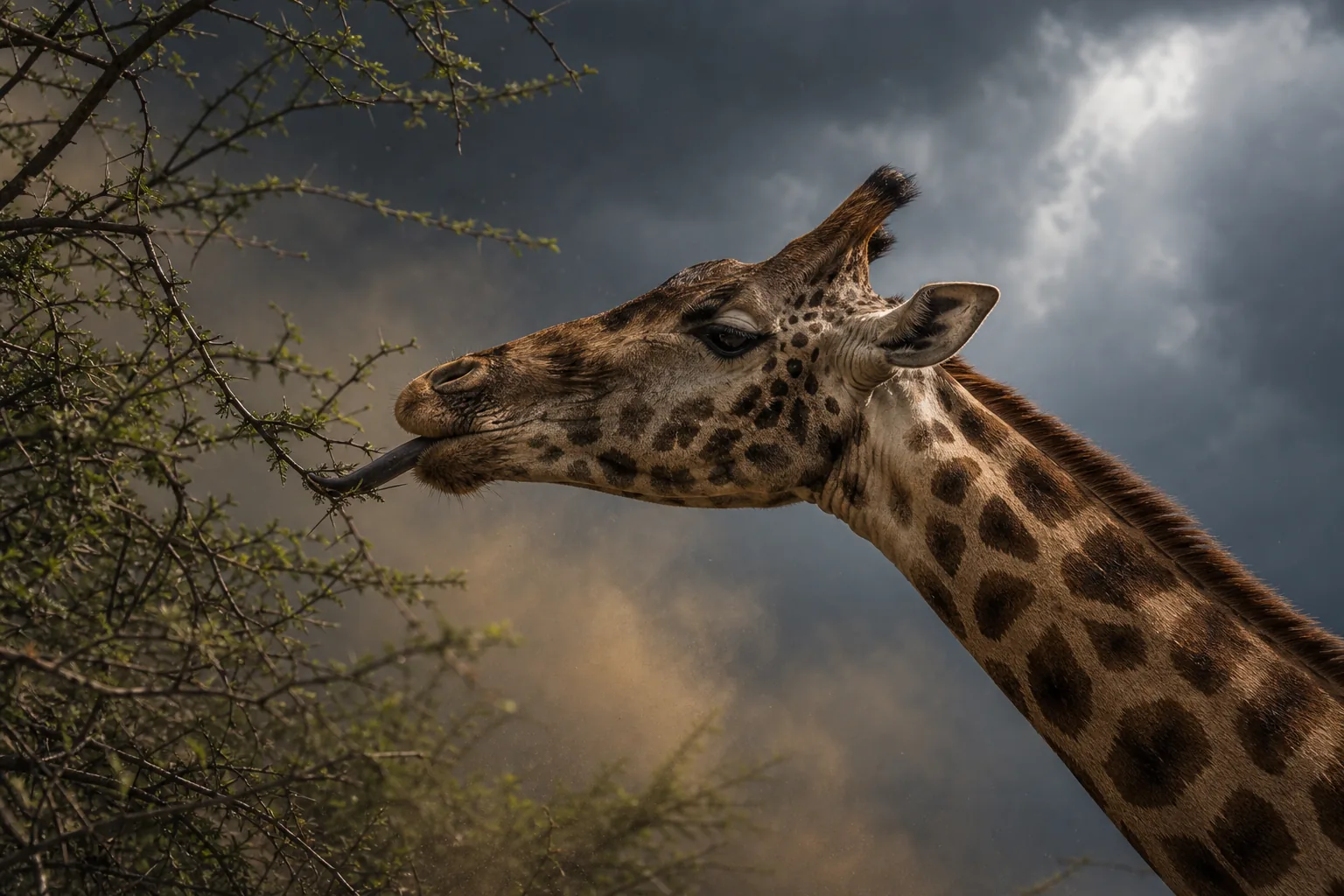
A thorny branch looks like a slower meal than a smooth one. For a giraffe, that intuition may miss the way food is gathered. The animal can work around obstacles, and the time between bites may depend on much more than whether a plant carries spines.
Rosemary P. Mramba, Harry P. Andreassen and Christina Skarpe tested associations between plant traits and feeding in two Tanzanian parks. Their 2017 study recorded elephants, giraffes and impalas browsing, then compared bite rates with leaf size, spines and feeding height. Giraffes showed no clear difference in bite rate between spiny and spineless plants in either park. Even leaf size failed to provide a simple rule that travelled between sites.
The finding is about the pace of taking bites. It does not establish that thorns are ineffective defences, or that the fastest feeder obtains the best meal.
Watching bites rather than assuming difficulty
The researchers worked in Serengeti and Mikumi during wet and dry periods in 2014. The parks offered contrasting settings: Serengeti was described as a nutrient-rich savanna and Mikumi as nutrient-poor. They were existing landscapes, not experimental plots with nutrients added or removed.
Observers drove along accessible roads and watched mature animals feeding within about 50 metres. They selected a visible animal and counted successive plucking actions, timing its feeding on a plant for up to 15 minutes. They also recorded the plant species and the animal’s feeding height.
The giraffe dataset contained 226 observations in Serengeti and 154 in Mikumi. Individual animals were not recognised, so those 380 observations were not necessarily 380 different giraffes. Road access and visibility also shaped which feeding bouts could enter the study.
Leaf-size classes and spine characteristics came from published descriptions of the plants. Feeding heights were estimated from positions relative to the animal’s body and converted using reference measurements. The study therefore compared recognisable categories of plants and feeding positions, rather than measuring every leaf and thorn beside a watched animal.
Spines separated some browsers, but not giraffes
In both parks, the analysis found no clear association between spine presence and giraffe bites per minute. In Serengeti, elephants provided a useful contrast: they averaged 3.8 bites per minute on spiny species and 4.7 on species without spines.
That comparison suggests the same visible plant feature can present different handling problems to different browsers. The authors propose that a giraffe’s selective use of its lips and tongue may let it gather leaves around spines, while elephants handling larger plant parts encounter a different obstacle. The field observations did not experimentally test that mechanism.
Nor did the researchers show that giraffes escaped all costs of eating thorny plants. A giraffe might take a smaller bite, choose a different twig or avoid a particularly difficult plant altogether without producing a detectable change in the bite rate recorded during successful feeding. The result concerns observed meals, not every decision that preceded them.
Leaf size did not give the same answer everywhere
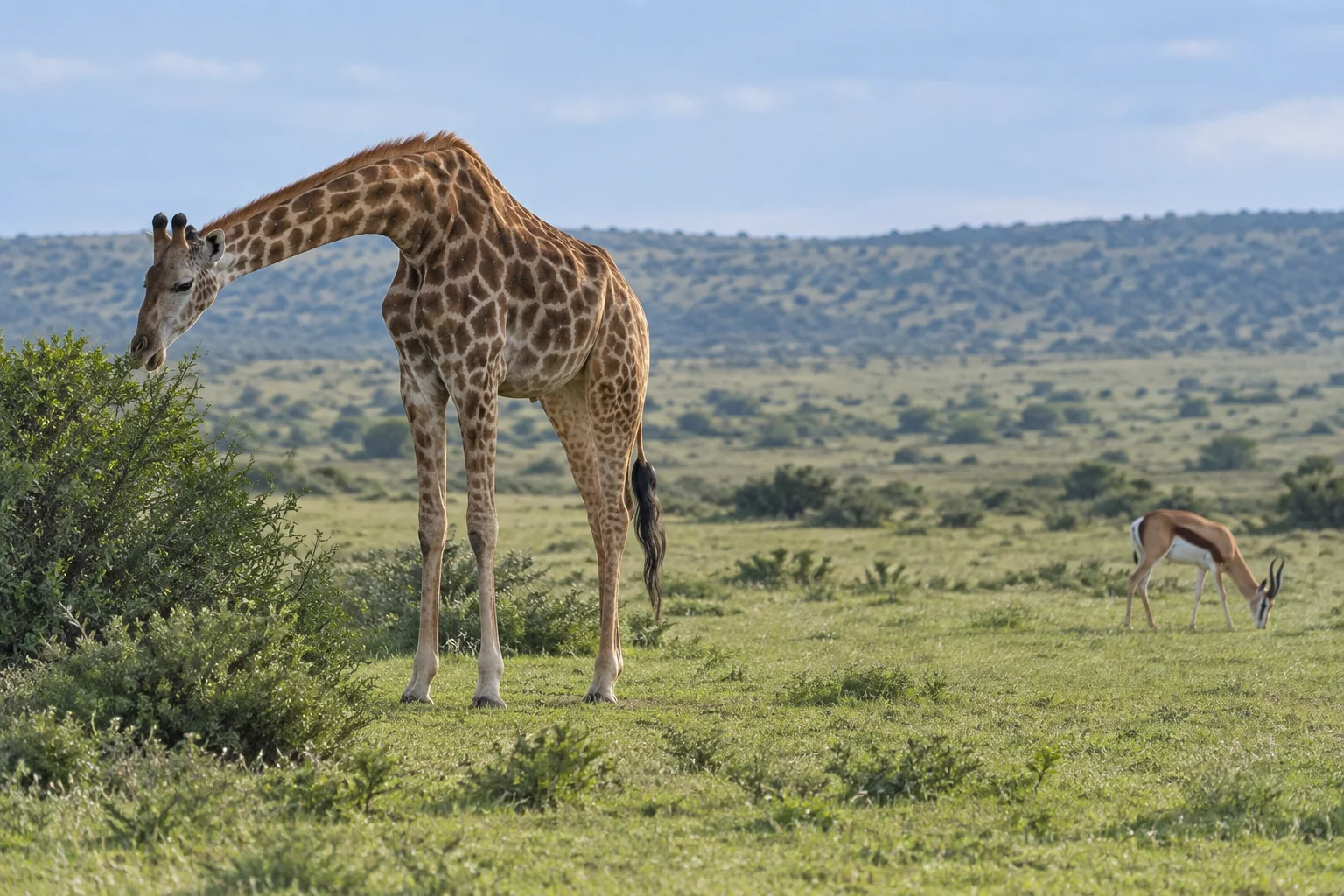
In Serengeti, giraffes took bites more slowly from the smallest-leaved plant category than from medium- and large-leaved categories. The overall leaf-size comparison supported a difference. Most recorded giraffe bites there occurred between 3.5 and 4.8 metres above ground.
Mikumi showed a different numerical pattern: mean bite rates were 19.5 per minute for the smallest-leaved category and 16.7 for the largest. The evidence was weaker than in Serengeti. The overall test across all three leaf-size categories did not reach the study’s conventional significance threshold, although a pairwise comparison between the smallest and largest categories did.
It would therefore overstate the results to announce a proven reversal caused by soil fertility. Different plant species, chemical properties and feeding conditions occurred in the two parks. Leaf chemistry was not measured, and a comparison of two landscapes cannot isolate nutrients as the explanation for every difference.
The useful discovery is that an apparently straightforward plant trait was not a reliable universal predictor. A leaf’s size can describe part of the handling task without describing its fibre, chemistry or the arrangement of neighbouring leaves.
A quick mouthful is not automatically a profitable one
A bite count treats each plucking action as one event. It does not tell us whether that action collects a large bundle of leaves or a small fragment, or how much of that material the animal can digest. For understanding giraffe diets, feeding speed and nutritional return must therefore remain separate questions.
A stronger follow-up would pair observed bite rates with estimates of material gathered per bite and measurements of the actual food plants. Repeated comparisons across more sites would also help separate local plant communities from a broader nutrient effect.
This study shifts attention from what a branch looks like to what a feeding animal can do with it. Spines, leaves and height act together with the browser’s way of handling food. Counting bites made some of those relationships visible while showing why appearance alone cannot tell us how difficult a giraffe’s meal will be.
Sources
Rosemary P. Mramba, Harry P. Andreassen and Christina Skarpe. (2017). Browsing and plant traits in nutrient-rich and nutrient-poor savannas in Tanzania. Journal of Tropical Ecology, 33, 327–336. DOI: 10.1017/S026646741700030X. Read the full paper.