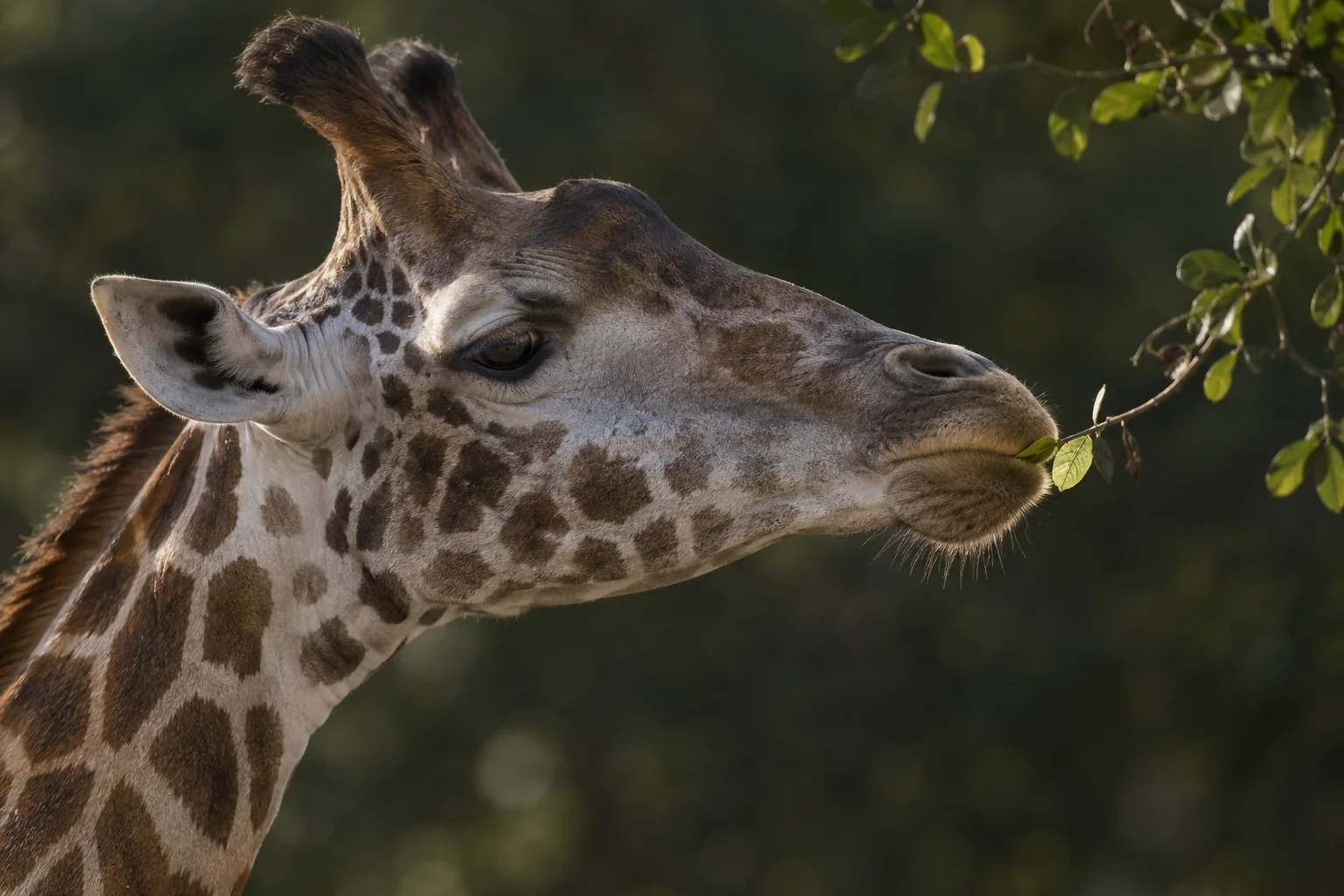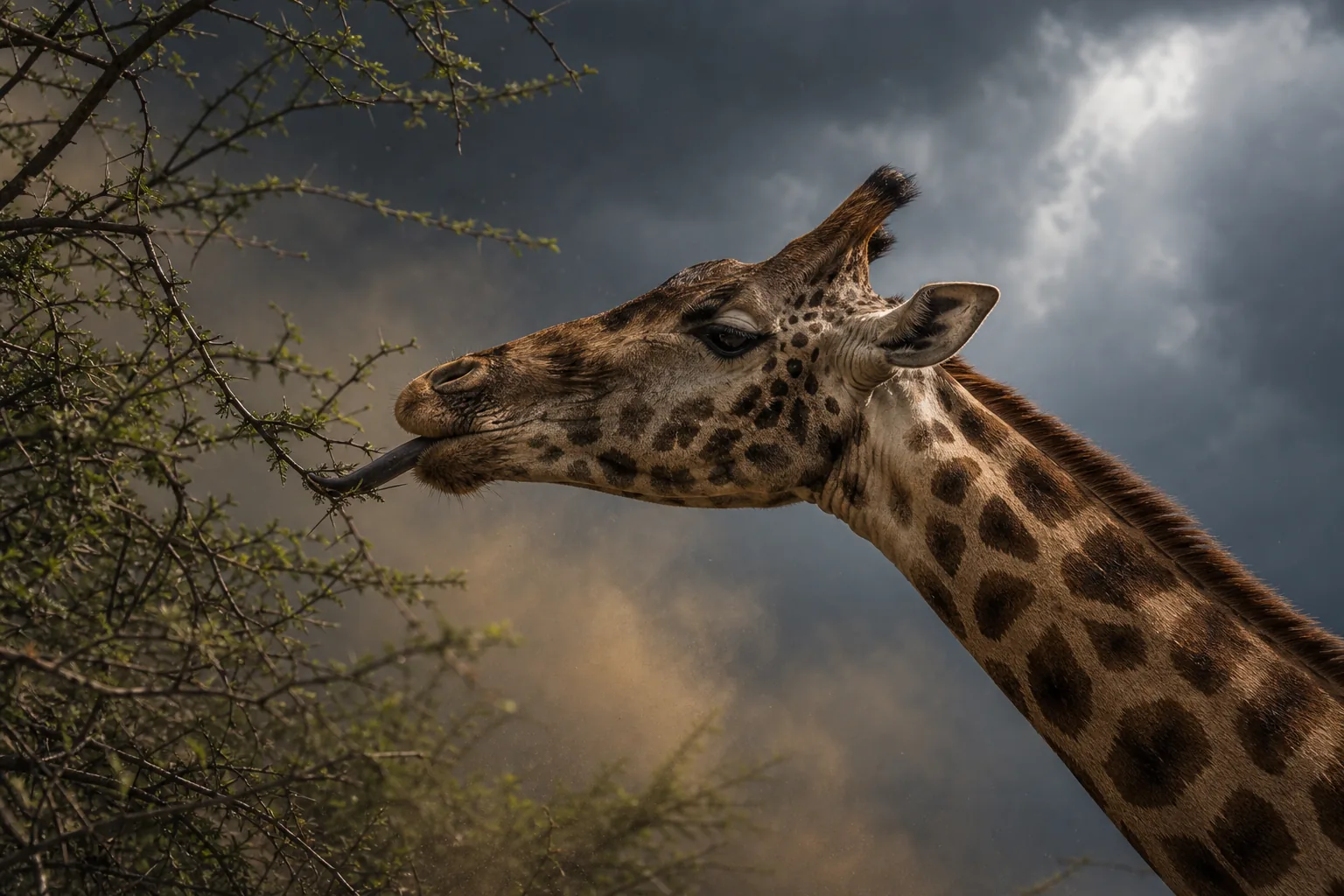
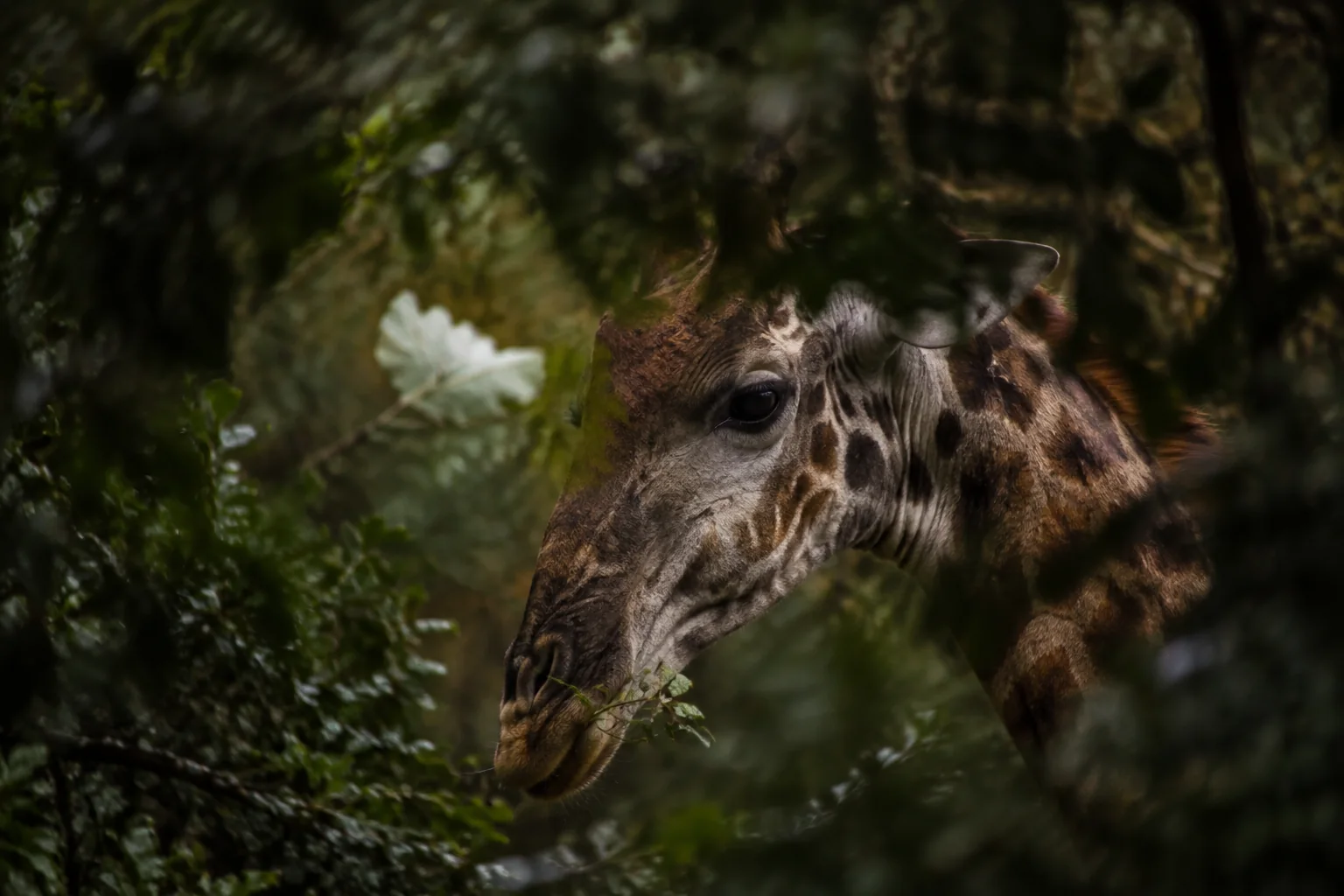
A thorny branch puts a barrier between a giraffe and its next mouthful. Height gets the animal close, but height alone cannot pick out the food. Watch the mouth instead: the long tongue reaches, curls, and gathers, while the lips help handle the foliage. That small, repeated movement is as important to feeding as the much more famous neck.
How long is a giraffe’s tongue?
A useful general answer is about 45–50 centimetres, or roughly 18–20 inches. San Diego Zoo gives an example length of 46 centimetres. These are approximate descriptions, not a promise that every individual has an identically sized tongue.
For scale, measure half a metre along a desk. That is close to the upper end of the commonly cited range. It is clearer than “as long as your arm,” because a child’s arm and an adult’s arm are very different measuring tools.
A long tongue adds reach at the mouth, but it does not turn the giraffe into an animal that can feed only at the highest branches. The position of the head, the available foliage, and the movement of the lips also matter. Our giraffe diet guide explains browsing in its wider context.
Length is not the whole adaptation
If a tongue merely hung out of the mouth, extra centimetres would be much less useful. The important combination is length and control. A giraffe can bring the tongue into contact with foliage and manipulate it rather than simply touching whatever lies directly in front of its teeth.
This is why a close view of feeding can reveal more than a still portrait. The function lies in the movement, not just the measurement.
What does prehensile mean?
Prehensile means able to grasp. In the giraffe’s case, the tongue helps collect plant material and bring it toward the mouth. San Diego Zoo describes the tongue and mobile lips working together around thorny vegetation.
Calling it a “fifth limb” can be a memorable metaphor, but it is not an anatomical description. A tongue has no fingers, and the rest of the mouth is not passive. The lips and tongue form part of a coordinated feeding process.
The distinction matters when explaining the giraffe’s shape. The neck helps position the head; the mouth handles the food once it is within reach. Treating the neck as the only feeding adaptation misses the precise work happening at the end of it.
A simple observation exercise is to follow one mouthful in a wildlife video. Does the animal move its head first? When does the tongue appear? Can you see the lips meet the branch? Describe those movements before guessing how much force each part produces.
What colour is a giraffe’s tongue?
The exposed part is dark and can look purple, blue, or almost black. A 2012 anatomical study by Pérez and colleagues described pigmentation in the front part of the tongue, particularly its underside. The exact appearance in a picture also depends on lighting and how much of the tongue is visible.
“Purple” is a convenient everyday label, not a separate material inside the mouth. Washington State University’s Ask Dr. Universe explains the colour in terms of melanin, a pigment also involved in the colour and protection of skin.
Is the dark colour natural sunscreen?
Sun protection is a biologically plausible explanation. Melanin can help protect cells from ultraviolet damage, and a browsing giraffe repeatedly exposes its tongue outdoors. The Washington State University explanation connects these ideas; San Diego Zoo presents the sun-protection role as something thought to occur.
The important distinction is between a plausible protective function and a demonstrated guarantee. Neither educational account measures a giraffe tongue’s sun-protection factor, establishes that sunburn is impossible, or proves that sunlight alone explains the trait’s evolutionary history.
So a useful short answer is: the dark pigment may help protect exposed tissue from sunlight. There is no need to turn that into “a tongue that never burns.”
Why not infer the whole story from a photograph?
A photograph can show colour and position. It cannot, by itself, reveal the chemical composition of a tissue, its response to ultraviolet light, or the evolutionary reason a characteristic persisted. Those questions need other kinds of evidence.
For actual specimens and research images, follow the study links in the source section.
How does a giraffe feed among thorns?
The tongue is one part of the answer. Positioning a branch, gathering foliage, and moving food into the mouth involve multiple structures. It is more accurate to describe this coordination than to imagine the animal simply swallowing every thorn in front of it.
In Anatomy of the Mouth of the Giraffe, Pérez and colleagues examined two adult heads and a fetus, and observed two living giraffes feeding. They described well-developed lips, tongue muscles, a raised region of the tongue called the lingual torus, and several salivary glands. The study provides a map of the mouth, not a measurement of how often wild giraffes suffer injuries.
The authors also found broad similarities with the arrangement in cattle. A giraffe’s mouth is specialised, but it remains part of the wider ruminant anatomical pattern rather than an entirely unprecedented feeding machine.
What saliva can—and cannot—tell us
Saliva is part of food handling, and the zoo account describes thick saliva coating swallowed thorns. That is different from demonstrating that giraffe saliva is antiseptic or that it heals wounds unusually well.
We found no such clinical result in the anatomical studies used for this article. Their descriptions of glands should not be converted into a claim about treatment or healing. Likewise, successful browsing does not establish that the mouth is puncture-proof.
For the broader conservation context, see giraffe health and veterinary science. Anatomical adaptations help animals function; they do not remove every risk.
What researchers see under a microscope
The tongue’s surface is not featureless. Small projections called papillae vary in shape and position. Looking closely at them helps anatomists describe structures that a feeding video cannot resolve.
Emura, Okumura and Chen’s 2013 study used scanning electron microscopy on the tongue of one adult giraffe. It described several papilla types across the tip, body, raised region, and rear sides of the tongue. Their images reveal different surface forms rather than one uniform coating.
That is useful evidence about structure. Its limits are equally straightforward: one adult specimen is not a survey of variation across ages, populations, or all four giraffe species. The study also did not test puncture resistance or quantify the force needed to strip leaves.
| Question | Evidence that helps answer it | What that evidence alone does not show |
|---|---|---|
| How does food enter the mouth? | Observations of feeding movements | Forces inside the muscles |
| What structures are present? | Dissection and anatomical description | How frequently injuries happen in the wild |
| What does the surface look like? | Microscopy of tissue | The complete function of every projection |
| Does pigmentation protect against UV? | Relevant physiological measurements | An answer derived only from a dark photograph |
The table is a guide to reading evidence, not a new experiment. Each method gives a different view of the same animal. Combining them is more informative than asking one photograph or one specimen to answer everything.
The okapi has a similar feeding tool
The okapi is a living giraffe relative with a long, dark tongue used in browsing. Its forest habitat and very different body proportions make it a useful comparison: a dark, specialised tongue is not restricted to an animal feeding at giraffe height in open country.
A 2024 study by Goździewska-Harłajczuk and colleagues examined tongues collected after death from two zoo okapis. Using several microscopy methods, the researchers described pigmentation, papillae, glands, and tissue structure. They also identified taste buds in particular papillae.
The authors interpreted the observed anatomy in relation to processing plant foods. But the animals were okapis, not giraffes. Similarity can guide questions; it does not allow every result from one species to be assigned automatically to another.
Comparative anatomy is most useful when it retains both sides of that distinction: what the animals share and where their structures, diets, or habitats differ. Our research library is a starting point for exploring the underlying literature.
What to remember
A giraffe’s tongue is long, dark, and capable of grasping food. Its role becomes clearer when you look beyond the tongue alone to the lips, muscles, mouth surface, and feeding movements.
The evidence supports a remarkable browsing system. It does not support an injury-proof mouth, a measured natural sunscreen rating, or healing powers inferred simply from the presence of salivary glands. The real anatomy is interesting enough without those additions.
For a shorter introduction suitable for younger readers, use our giraffe facts for kids. For a wider overview, continue with the giraffe facts guide.
Frequently asked questions
Is a giraffe’s tongue blue or purple?
Both descriptions are common, along with black. They refer to the dark exposed portion, whose appearance varies with lighting and viewpoint. The colour labels do not imply different tongue types.
Can a giraffe grip things with its tongue?
Yes. That is what prehensile means in this context. During feeding, the tongue helps gather foliage and works with the lips rather than acting alone.
Does a giraffe’s tongue stop thorns from hurting it?
Its feeding anatomy helps it handle thorny vegetation. That does not establish immunity to injury. The studies discussed here describe structures and movements, not a zero-injury rate.
Do okapis have dark tongues too?
Yes. The okapi anatomical study describes dark pigmentation, along with specialised surface structures and glands. Similarities are informative, but an okapi result should still be labelled as evidence from okapis.
Sources
- San Diego Zoo Wildlife Alliance — Giraffe: approximate tongue length, prehensile feeding, and the proposed sun-protection explanation.
- Pérez and colleagues — Anatomy of the Mouth of the Giraffe (2012): dissection and feeding observations; small sample.
- Emura, Okumura and Chen — Morphology of the lingual papillae in the giraffe (2013): scanning electron microscopy of one adult tongue.
- Washington State University — Why are giraffes’ tongues purple? (2026): pigment-science explanation and proposed UV protection.
- Goździewska-Harłajczuk and colleagues — Morphological adaptation of the tongue of okapi (2024): anatomy and microscopy from two okapis.