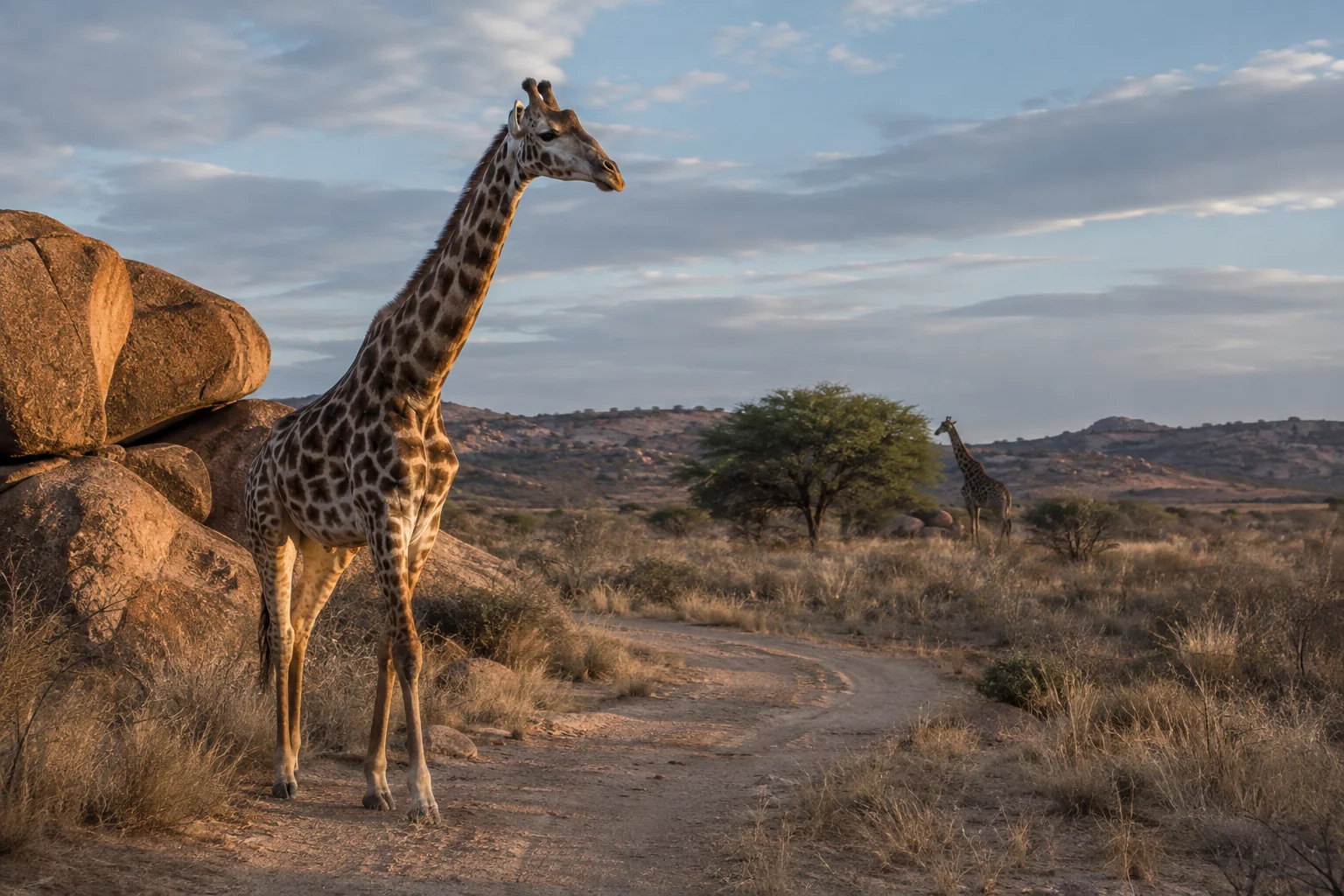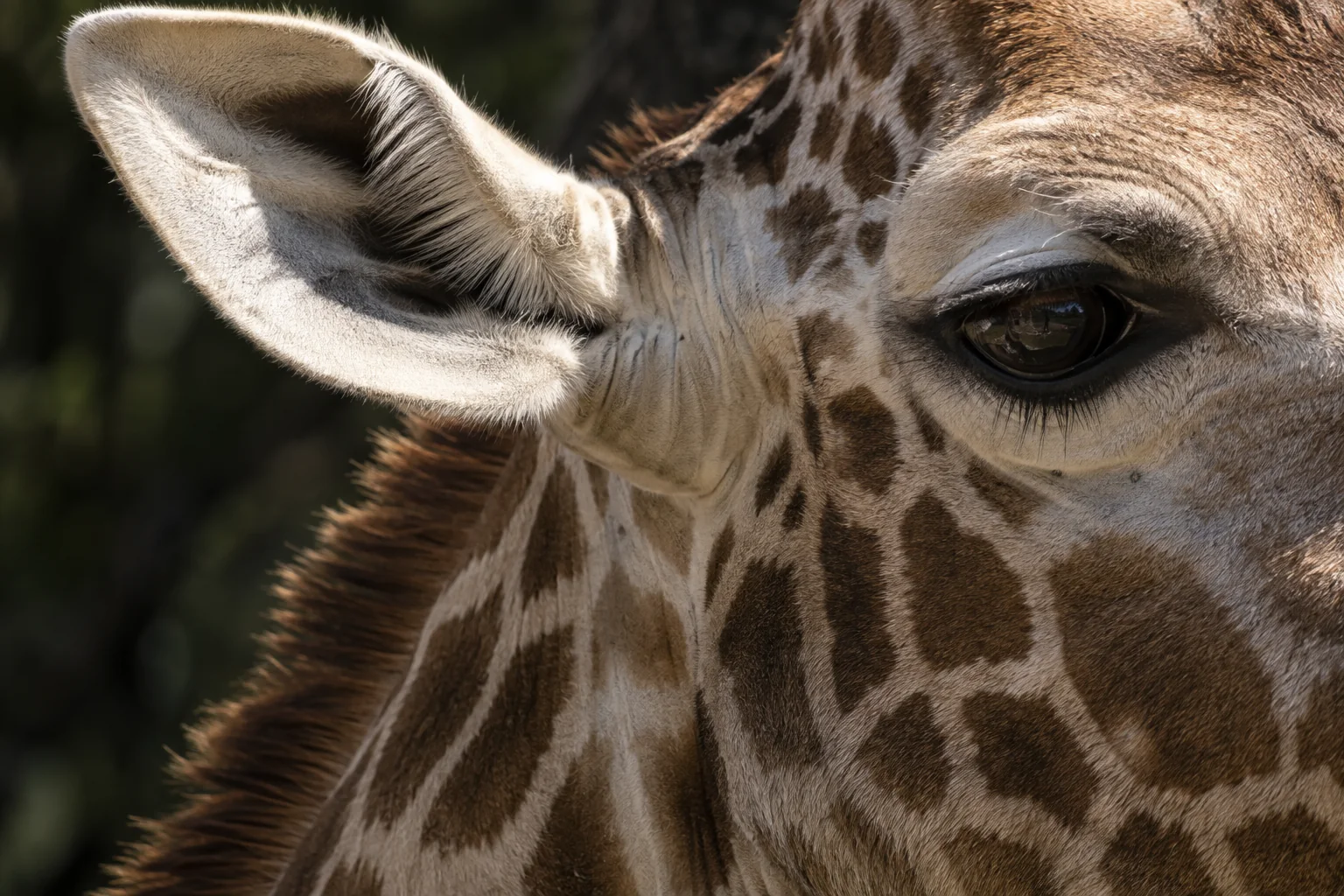
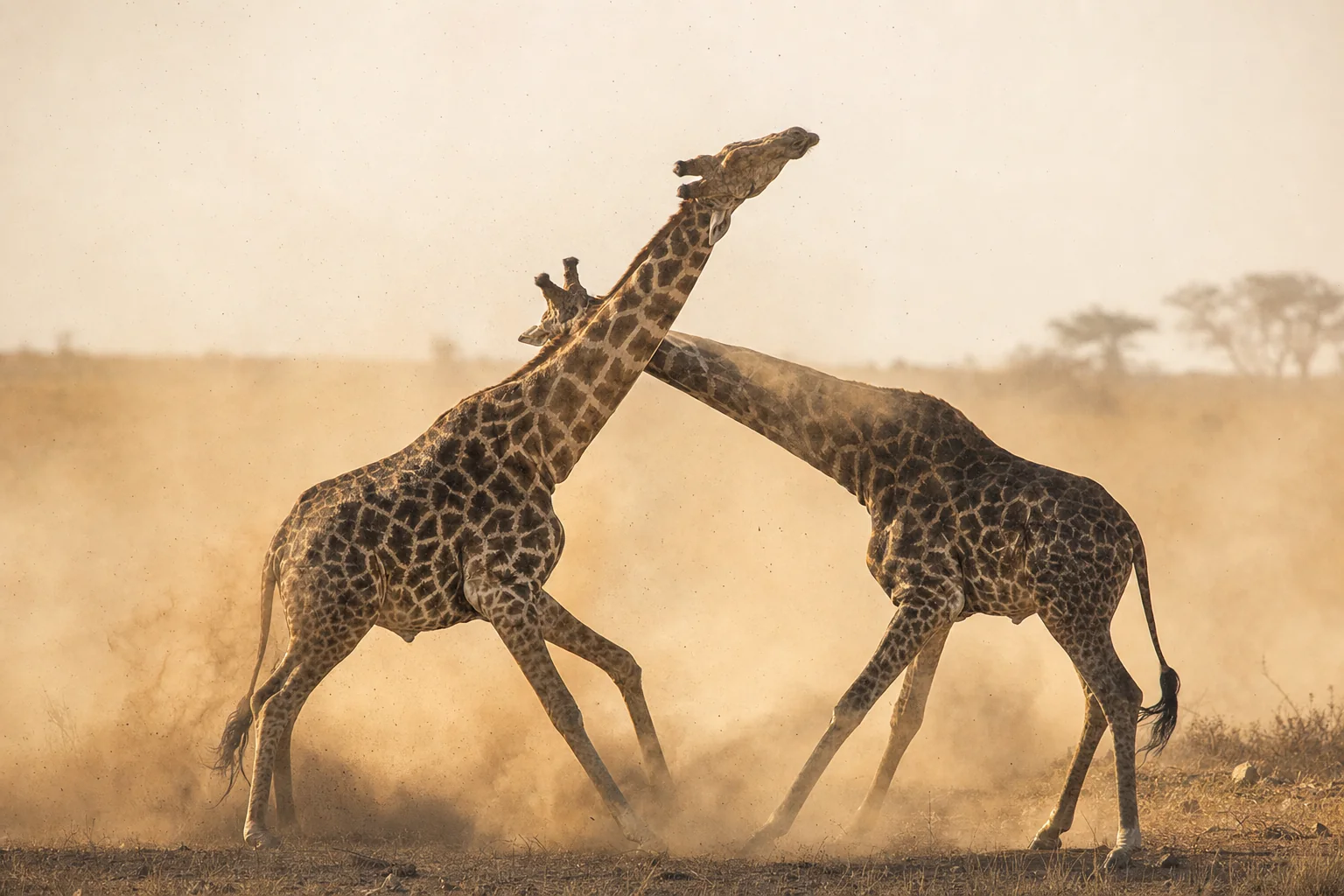
A giraffe reaches into a tree; a male swings its head at a rival. The same neck serves two strikingly different purposes. Which use explains its extraordinary length? The answer matters beyond one animal: it shows how scientists distinguish a plausible story about evolution from an explanation that survives measurements, experiments and the fossil record.
Why is the giraffe’s neck so long?
Feeding competition and sexual selection are the main explanations examined here. They ask whether greater reach improved access to food, whether changes in the head and neck improved reproductive success through competition, or whether their importance differed across stages of evolution.
A present-day giraffe cannot reveal that sequence simply by eating or fighting in front of a camera. Researchers need predictions that distinguish the explanations, then evidence that could support or contradict those predictions.
Natural selection does not require an animal to know what adaptation it needs. If heritable differences affect survival or reproduction, those differences can become more or less common across generations. Sexual selection concerns differences in mating success. It is not a separate process in which animals deliberately redesign their bodies.
Keep the length, width, mass and mobility of the neck separate. An explanation for a thicker male neck need not explain the initial evolution of length in both sexes. Our giraffe facts guide introduces the animal; this guide follows the evidence behind its most recognisable feature.
How many bones are in a giraffe’s neck?
Giraffes have seven cervical vertebrae, the usual mammalian count. But seven is a count, not a statement that the bones are identical, equally long or interchangeable.
A 2010 study by van Sittert and colleagues examined vertebral growth from fetal stages to maturity. It found that disproportionate cervical elongation occurred after birth. The work also identified the first thoracic vertebra as transitional in its growth characteristics. Read the vertebral growth study.
This helps separate development from evolutionary history. A calf growing a longer neck during its life is not the same process as a lineage evolving different proportions over generations. The baby-giraffe guide follows early development; neither process is explained by saying that individual animals stretched harder.
Why the first chest vertebra matters
The first thoracic vertebra, T1, retains its rib-bearing identity but has unusual neck-like characteristics. A 2021 comparative study analysed three-dimensional vertebral shapes and modelled movement at the transition between neck and trunk. It supported increased mobility at this boundary in giraffes.
The functional-elongation study therefore adds something important to the familiar seven-bone fact: functional movement can extend beyond a simple anatomical label. It does not require relabelling the giraffe as having an ordinary eighth cervical vertebra.
Counting bones, measuring their proportions and estimating movement answer different questions. A skeleton can tell you much more than the total number of pieces.
The feeding explanation: reaching food above competitors
The feeding hypothesis is more specific than “giraffes eat leaves.” It predicts an advantage from reaching foliage that shorter browsers cannot exploit as effectively.
Cameron and du Toit tested a related prediction by excluding browsers from individual Acacia nigrescens trees in South Africa’s greater Kruger ecosystem. After a growing season, leaf biomass per shoot did not differ across height zones in protected trees, while control trees showed differences. The result supported competition as an explanation for the feeding advantage of browsing higher. See the 2007 experiment.
That is stronger evidence than a photograph of a giraffe eating high leaves. It compares conditions in which an important factor—browsing access—differs. It is still a study of a particular setting, not a direct replay of millions of years of neck evolution.
The giraffe diet guide explores food selection beyond height. A long neck expands the reachable space; it does not force every mouthful to come from the highest possible branch.
Why feeding lower does not automatically refute the idea
A trait can provide an advantage under particular conditions without being used to its maximum at every moment. To challenge a feeding explanation, ask when access to high foliage would matter most and what the animals do then.
The useful comparison is not “high bite versus low bite” in isolation. It is the availability and value of food, competing animals, and the costs of reaching it. A convincing evolutionary argument needs to connect those observations with survival or reproduction over time.
The combat explanation: necks and mating competition
In their 1996 paper, Simmons and Scheepers argued that male competition offered an alternative explanation for neck elongation. Males use their heads as weapons, with the neck contributing to the striking movement. The authors connected male head–neck anatomy and dominance with access to females. Read the original sexual-selection argument.
This is a hypothesis about reproductive advantage, not simply an observation that fights occur. Its predictions need to account for the anatomy of females as well as males, and distinguish a longer neck from a heavier or more robust one.
It would be too simple to conclude that every longer-necked male wins, every encounter is a serious fight, or a video reveals lifetime reproductive success. The social-behaviour guide distinguishes sparring and broader social interactions.
The central question is which features were favoured, in which animals, at which stage of the lineage’s history. “Used in combat” is a starting point for that investigation.
What the 2024 female–male comparison found
Cavener and colleagues measured body proportions in captive and wild Masai giraffes. Females had longer necks relative to their forelegs, whereas males had proportionally wider necks and longer forelegs. The 2024 proportions study challenges a simple prediction that males should have proportionally longer necks because of combat.
The authors proposed that feeding demands could have influenced initial elongation, with male competition subsequently increasing neck mass. That historical sequence is their interpretation, not something the photographs directly observed. Two-dimensional neck area also served as a proxy for relative mass; it was not a direct weighing of every neck.
“Proportionally longer” does not mean females are taller overall. Our height guide explains the distinction. Results for Masai giraffes should also retain that species context rather than silently becoming a measurement of all four giraffe species.
What fossils reveal about neck elongation
Fossils let researchers investigate anatomical changes that living animals alone cannot show. In 2015, Danowitz and colleagues compared 71 cervical vertebrae across 11 taxa, including extinct forms, giraffes and okapis. They examined shape characters and proportions to propose stages of elongation.
Their analysis suggested that lengthening involved different parts of the vertebra at different stages, rather than each bone simply stretching uniformly. Within the family, elongation towards the head preceded a later contribution towards the tail end. See the fossil-anatomy study.
“Cranial” and “caudal” here refer to directions along a vertebra. They do not mean that researchers discovered one ancestor with only a long head and another with only a long tail. Nor should every fossil in a comparison be drawn as a direct ancestor in a straight procession towards modern giraffes.
The giraffe–okapi comparison introduces the living relatives. Fossil comparisons help reconstruct change; explaining the selective pressure behind each change requires additional evidence.
The head-butting fossil—and the disagreement
A 2022 Science paper described Discokeryx xiezhi, an early Miocene ruminant with unusual headgear and robust head–neck joints. Wang and colleagues interpreted its anatomy and mechanical modelling as evidence of head-butting adaptation, discussing the evolution of extreme structures in giraffoids. Read the original fossil study.
Its relevance was contested. In a 2023 comment, Hou and colleagues challenged the animal’s giraffoid placement and the inference drawn from it. The authors’ response defended their interpretation.
This is not a fossil that can safely be presented as a proven direct ancestor explaining the modern giraffe’s neck. The disagreement illustrates why evolutionary relationships matter: a mechanical adaptation in one lineage does not automatically establish the history of another.
Did the long neck evolve to keep giraffes cool?
Thermoregulation is another proposed benefit of giraffe shape, but the claim needs care. A 2017 study of 60 giraffes calculated the surface areas of different body regions. Total surface area was not unusually large for body mass: extra area in the neck and legs was offset by a smaller trunk.
The authors discussed other thermal advantages of shape, including the narrow neck and lower legs and orientation to sunlight. Their surface-area study does not support the shortcut that a giraffe simply carries much more skin than an equally heavy mammal.
A present-day thermal benefit would not, by itself, establish that cooling caused the initial evolution of the neck. It is a functional question that must be connected to an evolutionary one.
The separate coat-pattern guide examines skin patches and heat-exchange evidence. Those studies should not be substituted for measurements of whole-body shape.
How to judge an explanation of the giraffe’s neck
The strongest account is not necessarily the one with the most confident conclusion. Look for a clear connection between a claim, the measurement that supports it, and the alternatives still possible.
| Evidence type | What it can help establish | What it does not establish alone |
|---|---|---|
| Feeding experiment | Whether a proposed feeding mechanism works under the compared conditions | The complete historical origin of neck length |
| Body-proportion comparison | Which dimensions differ between groups | The exact evolutionary sequence producing those differences |
| Fossil anatomy and mechanical modelling | Past structures and their plausible functions | Every behaviour or mating outcome of an extinct animal |
Try reading an article twice. On the first pass, underline observations: measured proportions, the treatment in an experiment, a preserved structure. On the second, mark interpretations: why a trait was advantageous, which pressure came first, whether a finding extends to another species.
Then ask what new evidence could change the conclusion. If no conceivable result could challenge the story, it is not being presented as a useful scientific explanation.
The long neck also depends on the rest of the animal functioning with it. The circulation guide explains the elevated brain’s blood supply, while the nutrition evidence area provides further research leads. Those connections make the biology richer without proving that every present-day adaptation evolved for the same reason.
What to remember
A long giraffe neck is an anatomical feature with several uses and a history that researchers reconstruct from incomplete but informative evidence. Feeding experiments, sex-related proportions and fossils contribute different pieces.
Avoid replacing one single-cause slogan with an equally confident claim that every proposed cause has been proved. The useful conclusion is narrower: there is evidence to evaluate, predictions to compare and genuine uncertainty about historical importance and sequence.
Frequently asked questions
Did giraffes grow long necks by stretching for leaves?
Individual stretching does not explain heritable evolutionary change. The feeding hypothesis concerns advantages associated with inherited variation across generations, not effort lengthening the necks of future offspring.
Do female giraffes have longer necks than males?
The 2024 Masai study found proportionally longer female necks relative to forelegs. That is not a claim that females have greater absolute neck length or overall height.
Do giraffes have seven or eight neck vertebrae?
The conventional cervical count is seven. The first thoracic vertebra has unusual functional characteristics, which is a different question from adding an ordinary eighth cervical bone.
Has one study settled why giraffes have long necks?
No single study discussed here reconstructs the entire history. Evidence of feeding advantages, anatomical differences or possible fossil combat should be read with its specific scope.
Sources
Primary papers are linked beside the findings: vertebral development, functional anatomy, feeding experiments, sexual selection, body proportions, fossils and surface area. The Discokeryx section includes both sides of the published technical exchange.
Sources checked on 6 September 2026. The Last Giraffe did not conduct the experiments or fossil analyses described.