A giraffe can reach leaves far above your head, yet its extraordinary height becomes a challenge when the next destination is water at ground level. Even its starting size is remarkable: a newborn stands around 1.8 metres tall. Understanding those dimensions means separating adults from calves, ordinary reference figures from exceptional records, and the length of a neck from the height of the whole animal.
How tall is a giraffe?
For a quick reference, use the figures below. San Diego Zoo’s figures are rounded and describe size, not the results of a population-wide survey.
| Giraffe | Height in metres | Height in feet | Weight reference |
|---|---|---|---|
| Adult male | Up to 5.5 m | Up to 18 ft | Up to 1,360 kg / 3,000 lb |
| Adult female | Up to 4.3 m | Up to 14 ft | Up to 680 kg / 1,500 lb |
| Newborn calf | Around 1.8 m | Around 6 ft | 45–100 kg / 100–220 lb |
Source: San Diego Zoo Wildlife Alliance’s size and newborn entries. The adult “up to” wording is important: these are not average sizes, guaranteed limits, or measurements of every giraffe.
A useful answer keeps the animal’s age and sex beside the number. If a school report needs one short sentence, “adult males can reach about 5.5 metres” is more defensible than “a giraffe is 5.5 metres tall.” The second sentence makes a calf, a smaller adult and an exceptional individual disappear.
Height is not the same as weight
The table gives two different kinds of measurement. Height describes a vertical distance; weight figures describe body mass. A photograph with no reliable scale cannot supply either just because the animal looks impressive.
Nor should the male and female upper weight figures be divided to claim that an average male weighs exactly twice an average female. Ratios of two published upper values are not a comparison of population means. For other quick answers with their qualifications intact, start with our giraffe facts guide.
For the mass question itself, our giraffe weight guide separates adult and newborn references, kilograms and pounds, and published upper figures from measured samples.
How tall was the giraffe documented by Guinness?
Guinness World Records announced in July 2020 that Forest, a male at Australia Zoo in Queensland, measured 5.7 metres (18 feet 8 inches). The height extended from the ground to the tips of his ossicones, the projections on top of the head.
The original Guinness announcement also describes the practical difficulty: staff installed a marked measuring pole near a feeder, then spent months obtaining the required photographic and video evidence.
That makes Forest a useful dated, documented example, not evidence that no wild giraffe has ever been taller. This article is not announcing a new 2026 record or certifying the current record-holder.
A record and a reference table answer different questions. One asks how large a particular verified individual was; the other gives readers a convenient description of adult and newborn size. Forest exceeding the table’s male figure does not invalidate either when their scope is stated.
What exactly does “giraffe height” measure?
Total standing height runs vertically from the ground to a specified point on the head. Shoulder height stops much lower, while neck length follows another anatomical span. None is a substitute for the others.
Posture matters too. An animal reaching upward and the same animal with its neck angled forward do not put the top of the head at the same elevation. A credible measurement needs a defined endpoint and an account of how the animal was positioned.
Why a striking photograph is not a measuring tape
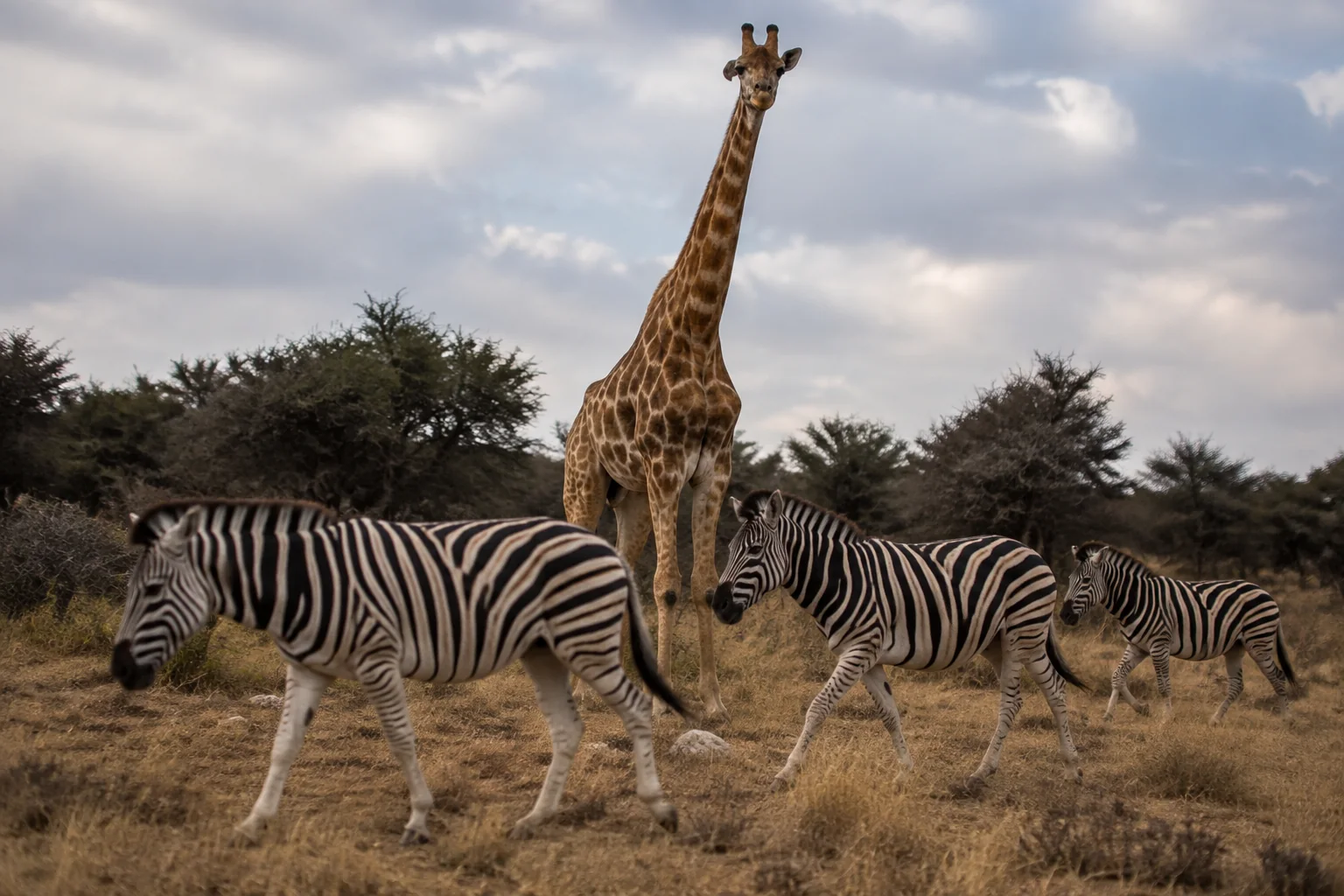
An animal close to the camera can appear larger than a taller one farther away. Even side-by-side subjects need to share a useful reference plane before their apparent sizes become meaningful comparisons.
Researchers use more disciplined approaches. Brown and Wells used calibrated photography and measured camera-to-animal distance to estimate body-part dimensions in a 2020 study of unusual skeletal proportions. Their calibration connected image pixels with real-world distances; it was not an estimate from scenery alone.
That study described two wild giraffes, one in Uganda and one in Namibia, with unusually shortened limb bones compared with similarly aged animals. These were rare case descriptions, not a new small giraffe species or a survey of how common the condition was.
The distinction is useful when sharing wildlife images: an illustration can communicate scale emotionally, while a measurement needs a method.
Is a giraffe mostly neck?
The neck is conspicuous, but total stature also depends on the legs and the way the body is arranged above them. Dividing every giraffe into equal thirds of neck, legs and body is not a supported anatomical rule.
Cavener and colleagues examined Masai giraffe proportions in a 2024 study of captive and wild animals. Females had longer necks relative to their forelegs, while males had proportionally longer forelegs and wider necks. That does not mean females were taller overall.
Proportion and absolute size answer different questions
Consider an invented example, not giraffe measurements: a 40-centimetre component in a 100-centimetre model occupies 40% of its length. A 60-centimetre component in a 200-centimetre model occupies only 30%. The first is proportionally longer, but the second is longer in centimetres.
This is why a headline about “longer female necks” needs its denominator. The study compared defined body proportions, not simply which animal’s head stood highest.
The researchers also required carefully aligned photographs and adjusted neck angle for their measurements. Their findings do not justify declaring one fixed neck-to-height ratio for all species and ages. Our neck-evolution guide explores the separate question of how this body form evolved.
What does height let a giraffe do?
Greater reach can open feeding opportunities above shorter browsing animals. But “can reach high foliage” is not the same as “only eats at maximum height” or “has no competitors.”
Cameron and du Toit investigated competition around individual trees in South Africa’s greater Kruger ecosystem. Their experiment excluded browsers from some trees and compared leaf biomass per shoot across height zones after a growing season.
The pattern supported the idea that competition with smaller browsers helps explain high browsing. Read the 2007 feeding experiment. It provides evidence for a feeding advantage in that setting, not a universal height band for every meal or a complete reconstruction of giraffe evolution.
When watching an animal feed, useful questions are what plant it selects, where the leaves are, and how it positions its head. Knowing only its maximum reach misses those choices. Our giraffe diet guide follows the feeding story beyond body size; the nutrition and body-condition evidence area provides a route into the underlying research.
Reaching the ground creates a different problem
An elevated head puts the brain above the heart. Supplying it requires high arterial pressure, while vessels and tissues elsewhere must function under different gravitational conditions. A 2021 cardiovascular review describes these connected adaptations.
That is a better starting point than a story about one enormous heart or a single protective valve. Lowering and raising the head changes the problem dynamically. Our giraffe heart and blood-pressure guide explains the experiments without claiming that a normal drink would make most other animals black out.
A simple giraffe-height comparison you can make
A bus or a house sounds like an easy reference, but neither has one universal height. A measured line gives a more reproducible comparison, particularly for a classroom or a family activity.
Try the interactive height comparison above, then make your own paper version below. The model illustrates total height; it is not a scan or a set of measured body proportions.
Use a scale of one centimetre on paper for every metre in real life. This is a 1:100 drawing: one real metre contains 100 centimetres. The numbers below are our arithmetic conversions of the height references, not additional animal observations.
- Draw a common ground line.
- Mark vertical lines at 5.5 cm, 4.3 cm and 1.8 cm.
- Label them male upper reference, female upper reference and newborn reference.
- Add a person’s measured height at the same scale: for example, a person who is 1.70 m tall becomes a 1.70 cm line.
- If you include Forest, draw a separate 5.7 cm line and label it “Guinness announcement, July 2020.”
Keep the “upper reference” labels: the tallest line does not represent every male, and the comparison is not an age-growth chart. A newborn line is a starting-size reference, not a prediction of exactly where an individual will finish.
For a larger demonstration, multiply all drawing lengths by ten and use a floor rather than climbing to mark a high wall. The 5.5-centimetre line becomes 55 centimetres; the relative differences stay unchanged. Do not mix the two scales on the same diagram.
You can make the comparison more personal by adding your own measured height rather than guessing the height of an “average human.” Our giraffe classroom guide includes a printable worksheet for extending the lesson into reading and evidence questions.
What to remember
A good giraffe-size fact names what was measured and which kind of animal it describes. Rounded upper figures, population averages, newborn measurements and exceptional records are not interchangeable.
The interesting story is what stature changes: access to foliage, body proportions and the demands of circulation. Height is also a poor standalone identification tool; use our four-species guide for that different question.
For deeper reading, the research library helps you find the papers behind the explanations. A dramatic number is a useful beginning, but its source and measurement method make it worth repeating.
Frequently asked questions
Is a giraffe six metres tall? Do not use six metres as a standard height for all giraffes. The rounded adult references above and the dated Forest example are more specific.
How tall is a baby giraffe? The newborn reference is around 1.8 metres, approximately six feet. “Baby” can describe animals at different stages, so include “newborn” when using this figure.
Are female giraffes taller than males? The adult reference heights are higher for males. The finding that female Masai giraffes have proportionally longer necks is a different comparison, not a reversal of total stature.
Does a giraffe’s height tell you its species? Not reliably on its own. An individual’s age and posture also affect the comparison, and the Masai proportions study was not a height-ranking survey across all four species.
Sources
Sources are linked beside their claims: San Diego Zoo’s size account; Guinness’s July 2020 Forest announcement; Brown and Wells’ skeletal case study; Cavener and colleagues’ Masai proportions study; Cameron and du Toit’s feeding experiment; and the cardiovascular review.
The drawing activity is an original unit-conversion exercise using the stated references. The activity does not establish field measurements, population averages or anatomical data.