A giraffe is not simply a familiar mammal stretched upward. Height changes the food it can reach, the pressure its heart must generate, the leverage of its limbs and the posture required for a drink. The important question is not which single feature “makes” a giraffe survive, but how a linked set of anatomical and physiological traits works—and which parts researchers have actually tested.
What are the main giraffe adaptations?
The main adaptations are a long neck and long legs for reach; mobile lips and a long, grasping tongue for browsing; a cardiovascular system that sustains high pressure; vessels and firm tissues that manage pressure below the heart; long-stride locomotion; and a patterned coat with possible roles in concealment and heat exchange. None works in isolation.
The labels below matter. Observed use or anatomy means researchers saw a behaviour or described a structure. Study evidence means comparisons, manipulations, measurements or explicit models examined a narrower mechanism. Historical hypothesis asks why natural selection favoured a trait across generations. A present-day benefit can support that hypothesis without proving the entire history.
| Feature → function | What is observed in living giraffes | What research examined or tested | Historical boundary |
|---|---|---|---|
| Long neck and legs → reach browse | Giraffes feed across a large vertical and horizontal space | A browser-exclusion experiment compared foliage at different heights | A feeding advantage does not prove that feeding alone produced the giraffe’s neck |
| Tongue and lips → collect leaves | The tongue curls and the mobile lips position foliage | Dissection and feeding observations describe the structures involved | Anatomy does not prove a puncture-proof mouth or a tongue with measured natural sunscreen |
| Heart and vessels → supply an elevated brain | Blood circulates while the head is metres above the heart | Anatomical scaling, pressure recordings and isolated-vessel experiments test different parts | No single “giant heart” or valve explains the giraffe circulation system |
| Long limbs → standing reach and long strides | Adults walk and gallop on elongated limbs | Video measured stride motion; a numerical model tested how heart height changes pumping cost | A modelled benefit is not proof of why limbs first lengthened; see the running evidence |
| Patterned skin → identity, concealment and possible heat exchange | Individuals can be recognised by their markings | Cadaver anatomy and long-term resighting data test narrower thermal and survival predictions | No one study proves a universal function for the giraffe coat |
Height is a package, not just a long neck
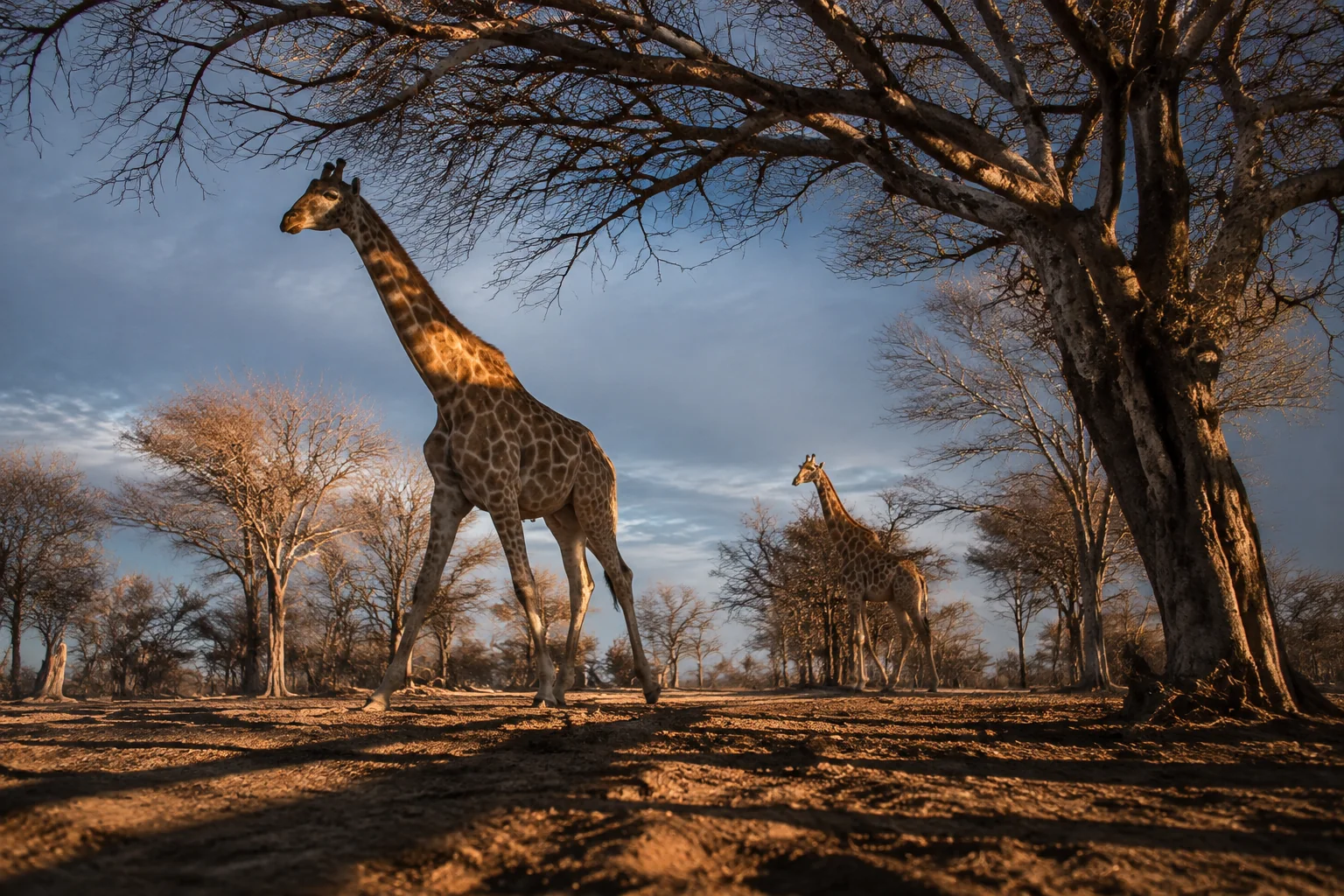
Height expands the feeding envelope. A giraffe can reach foliage unavailable to shorter browsers, but also feeds with its neck horizontal or lowered. The advantage is broader access, not an obligation to take every bite from the canopy. Our guide to how tall giraffes are separates neck length from total height.
Elissa Cameron and Johan du Toit tested a competition-related prediction in the greater Kruger ecosystem. They placed exclosures around individual Acacia nigrescens trees. After a growing season, protected trees did not show the same differences in leaf biomass per shoot across height zones as browsed control trees. Their 2007 browser-exclusion experiment supports a high-feeding advantage under those conditions.
It does not show that an ancestral giraffe acquired a longer neck for one reason at one moment. Food quality, season, competitors and plant shape all change which part of the feeding envelope is useful. The giraffe diet guide follows those choices.
Present-day use is not the same as evolutionary origin
Males also use their heads and necks in combat. That is an observed use; the disputed question is how much mating competition contributed to the origin and later modification of neck length, width and mass.
Douglas Cavener and colleagues analysed photographs of known-age captive Masai giraffes and wild adults. Females had proportionally longer necks relative to their forelegs, while males had proportionally wider necks and longer forelegs. The 2024 body-proportions study therefore challenges a simple prediction that male combat should produce proportionally longer male necks.
The authors interpret the pattern as compatible with feeding pressure contributing first and male competition later modifying the neck. That sequence is a historical hypothesis, not something the photographs recorded. The result concerns Masai giraffes, and neck area was a two-dimensional proxy rather than a direct mass measurement.
The mouth finishes the feeding job
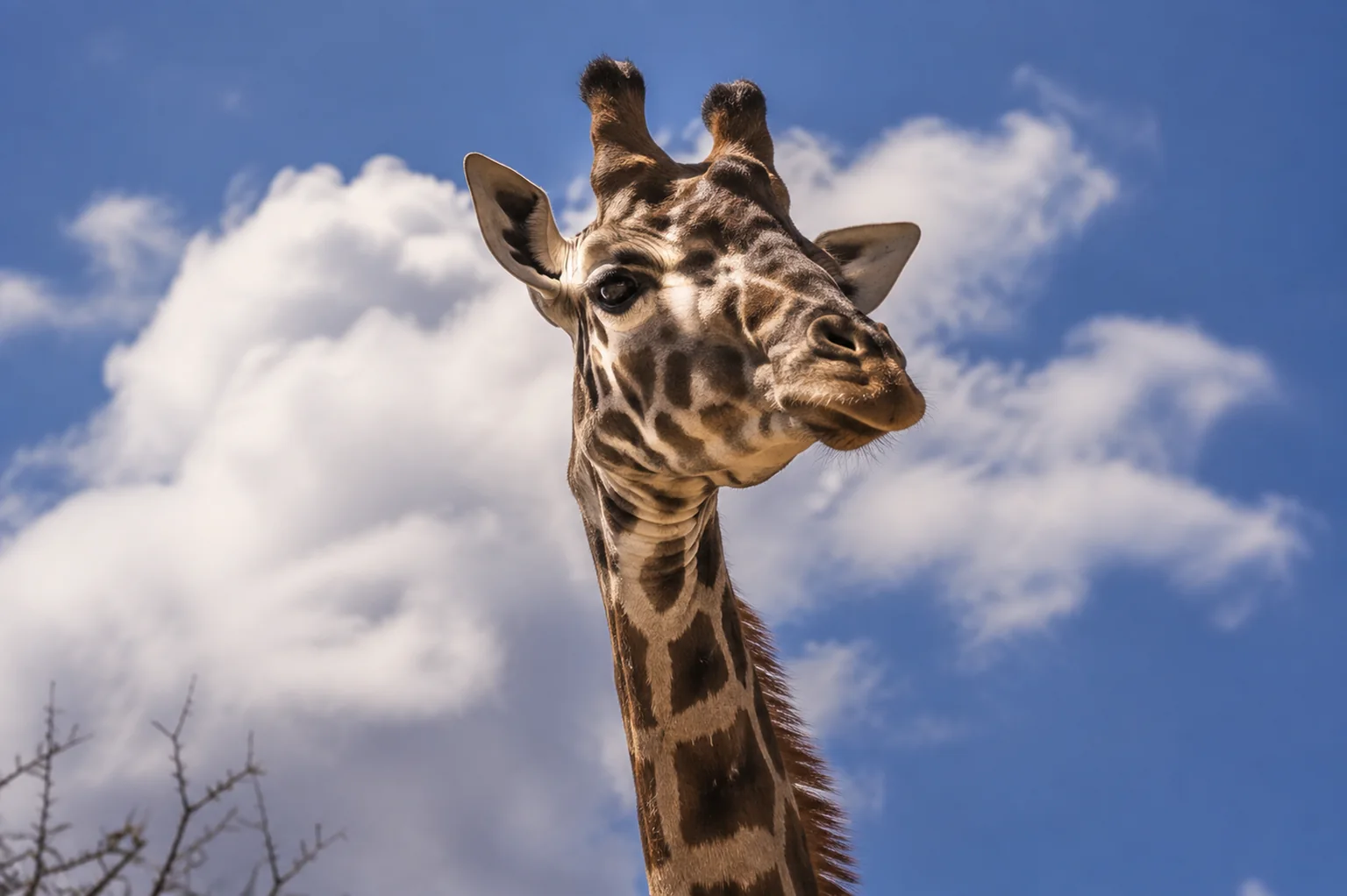
Reaching a branch is only the first step. The tongue has to contact and gather foliage, while the mobile lips help position it for the teeth and the rest of the mouth. Prehensile means able to grasp; it does not mean the tongue acts alone.
William Pérez and colleagues dissected two adult heads and one fetus and observed two living giraffes feeding. Their 2012 mouth-anatomy study described developed lips and tongue muscles, oral ridges, papillae, salivary glands and dark pigmentation near the front of the tongue. This is direct evidence of structure plus a small set of external feeding observations.
It is not a thorn-injury trial. The anatomy does not show that the mouth can never be scratched or punctured, while salivary glands do not establish antiseptic or wound-healing powers.
The dark exposed tongue is often called a natural sunscreen. Pigmentation may plausibly reduce ultraviolet damage, but the checked anatomical work did not measure UV exposure, tissue damage or a protection factor. The accurate synthesis is narrower: the tongue is dark, long and controllable; a protective role for pigment remains plausible rather than proved.
Circulation has to work above and below the heart
An upright giraffe’s brain sits well above its heart. Gravity lowers pressure along the rising blood column, so pressure near heart level must sustain supply at the head. Below the heart, vessels and tissues must tolerate high pressures without excessive fluid accumulation.
Petersen and colleagues’ 2013 study of 11 giraffes overall used foreleg imaging and pressure recordings, ex-vivo arterial work and tissue-compliance measurements. It found narrowing below the elbow and low tissue compliance that can help protect distal capillaries; endpoint subsets varied.
The popular answer is “a huge heart.” The useful answer is a specialised heart in a specialised circuit. Graham Mitchell and John Skinner measured body mass and heart structure in 56 giraffes from 18 to 1,500 kilograms. Their 2009 allometric analysis found relative heart mass around half a percent of body mass, comparable with other mammals. The left ventricular and interventricular walls, however, were thickened.
A fixed 11-kilogram heart is therefore a poor universal fact. Wall thickness, vascular resistance, pressure location and body size tell more.
When the head moves, the whole circuit responds
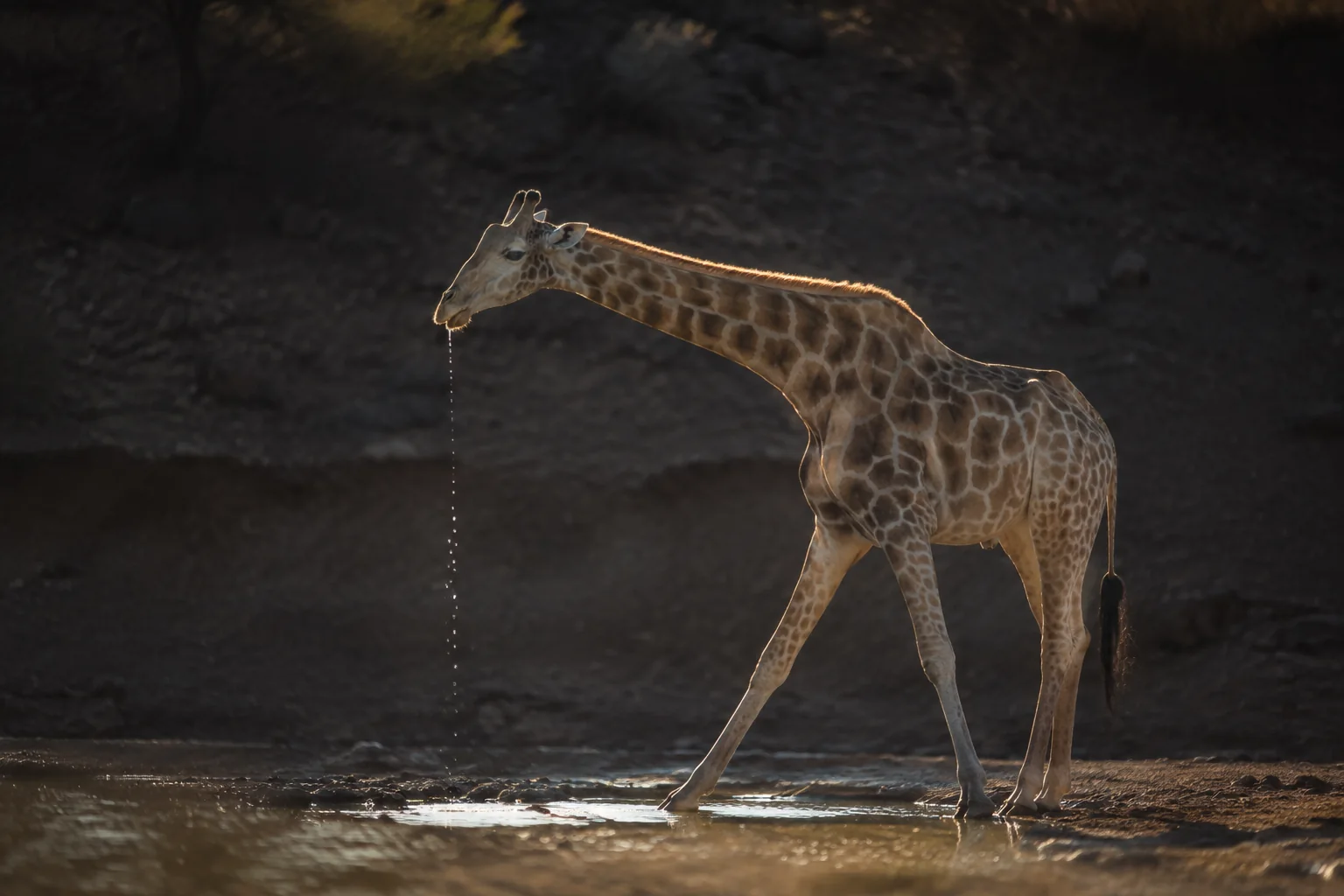
Drinking adds a rapid posture change. A giraffe spreads or flexes its forelegs, lowers the head, swallows while head-down and rises again. The visible sequence is covered in how giraffes drink; the circulatory response is not one valve switching on.
In 2025, Christian Aalkjær and colleagues combined awake drinking recordings with separate anaesthetised-animal and isolated-tissue experiments. Proximal carotid pressure during voluntary drinking was available from seven giraffes, while carotid flow velocity was measured in only two. Flow did not rise in those two as they drank. The open hemodynamics study also reported jugular-pressure oscillations and vessel responses.
The authors proposed that swallowing helped return pooled venous blood towards the heart. That interpretation fits several signals, but awake jugular flow during each swallow was not directly measured. A sponge-like brain structure, a rete or one-way valves should not be promoted as a complete, proved explanation when pressure, flow, arteries, veins, surrounding tissues and timing all matter.
Long limbs bring reach and locomotor trade-offs
Long legs raise the body, extend standing reach and permit long steps. They also lengthen the lever arms that muscles must control. An adaptation can solve one problem while making another more demanding.
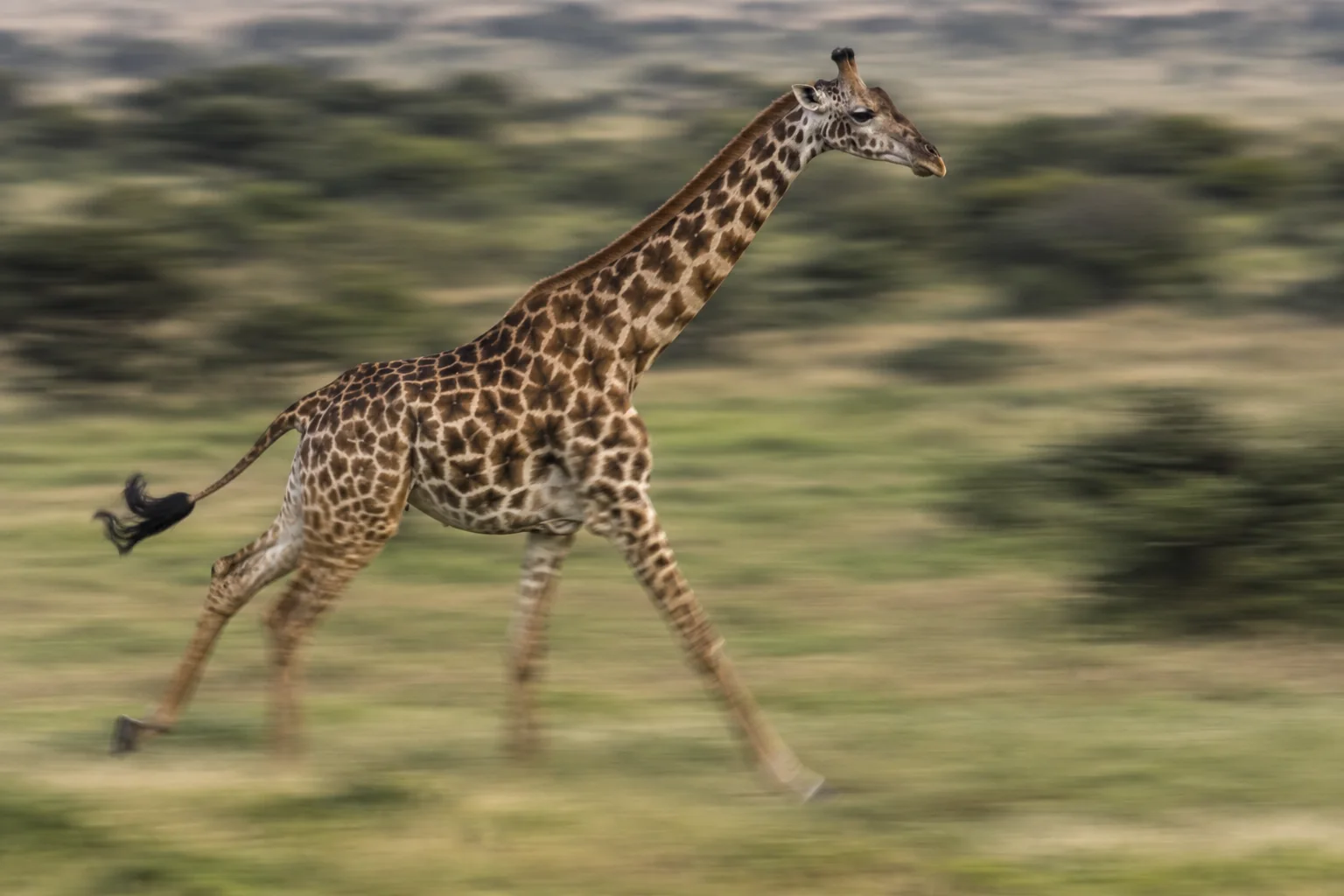
Christopher Basu and colleagues used 120-frame-per-second drone video to measure 25 representative strides from four similarly sized free-roaming adults. In their 2019 kinematics study, the giraffes used a grounded rotary gallop across the analysed speed range. They gained speed mainly by lengthening their strides, with a smaller increase in stride frequency.
Stride evidence is not a universal speed limit
Those 25 strides explain how the sampled adults moved under the study conditions. They do not establish maximum speed, endurance, turning, performance on every surface or escape success. “Long-legged” is not a synonym for “unlimited runner.”
The legs also change cardiovascular geometry. Roger Seymour and Edward Snelling modelled an adult giraffe of 651 kilograms and compared it with an invented same-height animal that had shorter legs and an even longer neck. Their 2025 numerical model estimated a smaller pumping burden when long legs raised the heart closer to the head.
This is an insightful integration of limbs and circulation, not an experiment in which researchers evolved alternative giraffes. Its result depends on model assumptions, including uncertain cardiac-output inputs. It shows how proportions can work together now; it does not by itself establish the historical order or cause of limb elongation.
The coat may do more than one job
Giraffe markings let researchers identify individuals from suitable photographs. Concealment is a longstanding proposed function, especially for calves. Heat exchange is another. These roles need not be mutually exclusive, and neither can be proved merely by looking at a patterned hide.
G. Ian Taylor and colleagues injected arteries in one giraffe cadaver and used radiographic anatomy to examine the skin’s blood supply. They found vascular territories aligned with patches and connections capable of routing blood between arteries and veins. The 2023 cadaver study supports a “thermal window” interpretation.
The phrase describes anatomical capacity, not a live cooling performance test. One preserved animal cannot show whether every giraffe changes patch blood flow in the same way, how much body temperature changes, or which environmental conditions trigger the response.
A 2026 study adds a different kind of evidence. Alexia Mouchet and colleagues used eight years of resightings from 810 wild Masai giraffes. Relationships among spot traits, apparent survival and temperature anomalies differed by life stage and sex. The published survival analysis strengthens the case that coat variation can matter in a thermal environment.
It still did not measure heat moving through living patches. Apparent survival can also combine death with permanent departure from the study area. The defensible conclusion is that coat function is plural and still being tested, not that all spots are universal radiators or that camouflage has been discarded. Related climate evidence is mapped in the drought, climate and water research area.
How genes fit without becoming a master explanation
Anatomy and physiology ultimately depend on development, so genome comparisons can identify candidate changes. But a DNA difference associated with bones or blood vessels does not automatically explain a whole animal.
Chang Liu and colleagues compared the giraffe genome with other ruminants and focused experimentally on seven giraffe-specific amino-acid substitutions in FGFRL1. Mice edited to carry those substitutions showed greater resistance to experimentally induced hypertension and higher adult bone-density measures than comparison mice. Read the 2021 genome and gene-editing study.
The test went beyond finding a suggestive sequence, but these were mice in a mouse genetic background. Adult edited mice did not develop longer limbs or vertebrae. The experiment supports effects relevant to blood pressure and bone; it does not make FGFRL1 a master switch for giraffe height.
Adaptation does not mean perfection
An adaptation is a heritable characteristic shaped by selection, not a promise of perfect engineering, immunity to injury or equal fitness in every condition.
Giraffe height illustrates the trade. Greater reach changes access to food, but the same proportions demand high-pressure circulation and an awkward drinking stance. Long limbs create stride length and cardiovascular geometry while challenging muscle leverage. Pigmented tissue may be protective without making damage impossible.
Traits can also be reused. The skull’s skin-covered ossicones have anatomical and social roles, while male combat uses the head and neck together. A structure’s current job may differ from the pressure that first shaped it, and later selection can modify an existing feature.
The accurate picture is a network, not a row of independent gadgets. The giraffe science library provides the wider source trail.
What to remember
Giraffes do not depend on one spectacular trick. Height, feeding anatomy, circulation, lower-leg tissues, locomotion and skin function interact. The long neck would be much less useful without a mouth able to gather browse and a cardiovascular system able to supply an elevated brain.
Keep three claims separate: what a feature does now, what a study observed, compared or tested, and why it may have been favoured over evolutionary time. The first can be obvious, the second narrow, and the third contested. That is the difference between a biological explanation and a just-so story.
Frequently asked questions
What is a giraffe’s most important adaptation?
There is no useful single winner. Height expands feeding reach, but it depends on circulation, limb support and food-handling anatomy. Removing any of those connections gives an incomplete animal.
Did giraffes evolve long necks only to reach leaves?
No single study establishes that exclusive history. A feeding experiment supports an advantage from browsing above shorter competitors, while combat, sex-related proportions and fossils inform other parts of the debate. Present-day uses may have mattered at different stages.
Is a giraffe’s heart much larger than expected?
Not relative to body mass. The 56-animal analysis found a proportion comparable with other mammals. Thick ventricular walls and the organisation of the wider high-pressure circuit are more informative than one absolute heart weight.
Does a giraffe’s dark tongue prevent sunburn?
That has not been demonstrated by the anatomical evidence used here. Pigmentation may help protect exposed tissue from ultraviolet damage, but it should not be described as measured immunity from sunburn.
Do giraffe spots cool the body?
The skin beneath patches has vascular anatomy compatible with heat exchange, and spot traits have been associated with survival under different temperature anomalies. The studies cited here do not directly measure a whole-body cooling effect through living patches.
Sources
Primary and authoritative works are linked beside the claims they support. They include Cameron and du Toit’s browser-exclusion experiment (2007); Pérez and colleagues’ mouth anatomy (2012); Mitchell and Skinner’s cardiovascular allometry (2009); Petersen and colleagues’ lower-leg pressure protection study (2013); Cavener and colleagues’ Masai body proportions (2024); Aalkjær and colleagues’ drinking physiology (2025); Basu and colleagues’ running kinematics (2019); Seymour and Snelling’s explicit cardiovascular model (2025); Taylor and colleagues’ one-cadaver coat anatomy (2023); Mouchet and colleagues’ Masai survival analysis (2026); and Liu and colleagues’ genome comparison and mouse experiment (2021).
Sources and competitor pages checked 7 September 2026. The evidence table is an original editorial synthesis, not a new experiment or a reproduction of a study figure. The Last Giraffe did not conduct the cited studies.