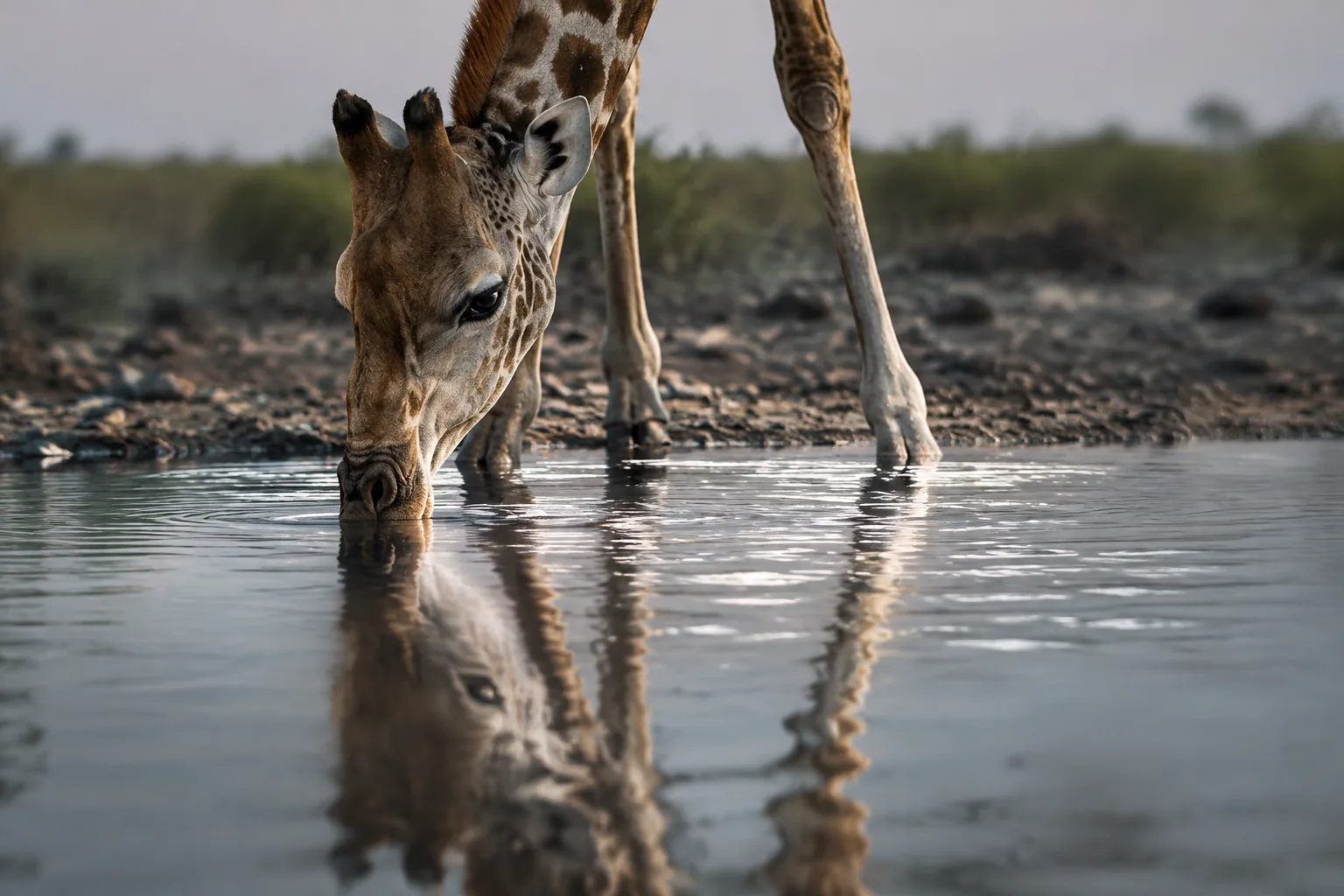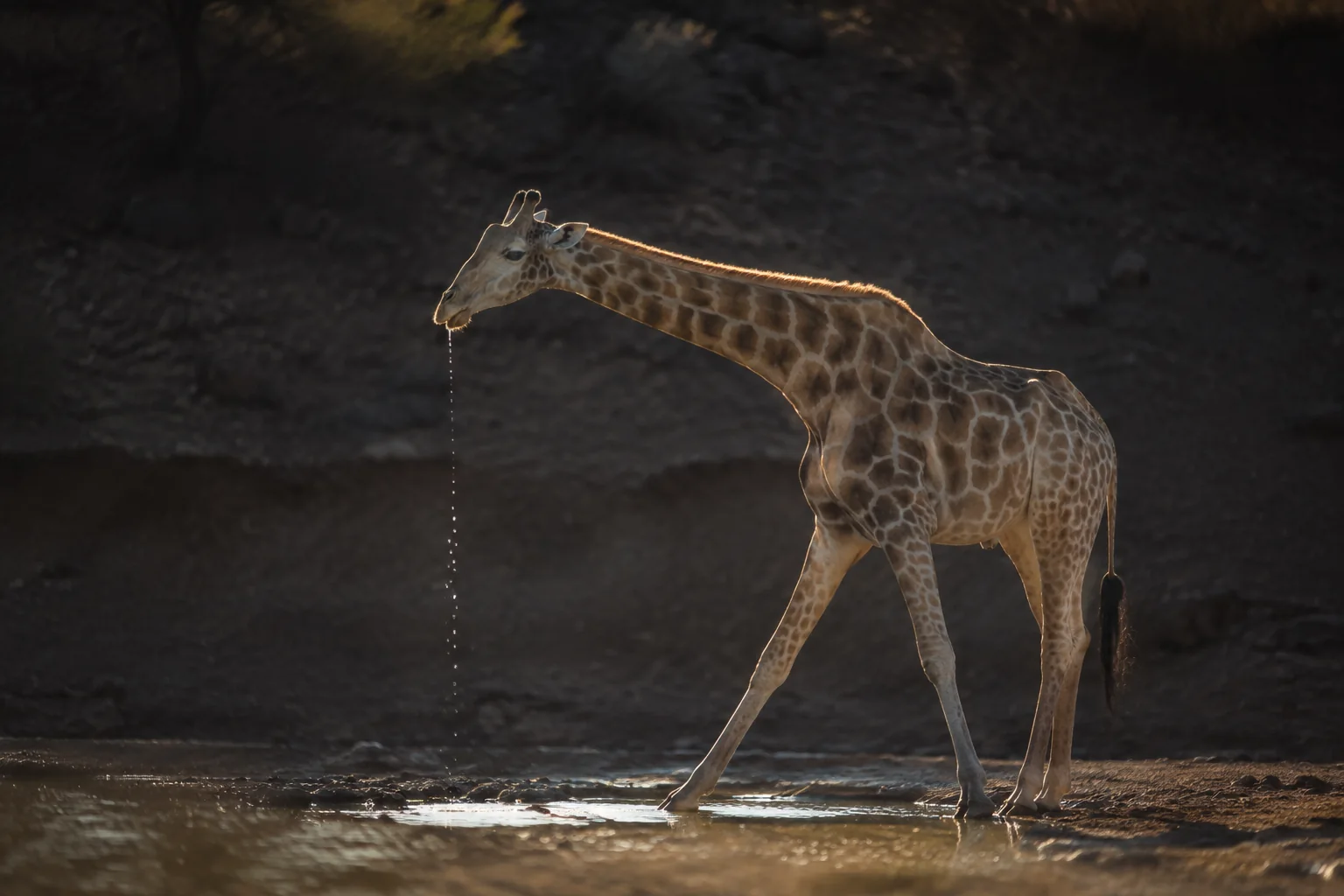
A giraffe can reach a high branch without effort, yet its muzzle does not reach ground water by neck movement alone. Drinking reorganises the whole animal: the forelegs move apart, the head drops, water enters and is swallowed, and the body returns upright while circulation changes with height. The visible sequence is clear. Some of its internal mechanics are not.
How does a giraffe drink?
A giraffe usually widens its forelegs, sometimes flexing the wrist-like carpal joints, until its muzzle reaches the water. It places the front of the mouth at the surface, takes in water through repeated mouth movements, swallows with its head down, and then raises the head.
That answer separates what observers can see from what researchers still infer. The characteristic stance and head-down swallowing appear in published behavioural descriptions. The details of water uptake inside the mouth are less settled: a jaw-and-mouth pump is a serious proposal, not a completed X-ray record of a giraffe drinking.
The circulation question is different again. The reviewed guide to the giraffe heart and blood pressure explains how posture changes pressure and flow. The giraffe tongue guide covers feeding anatomy, but a tongue that grasps leaves should not automatically be described as a measured water-lapping tool.
This distinction prevents three common errors: claiming that the tongue scoops water because it is long, claiming that the oesophagus is simply filled and tipped like a bottle, or assigning the whole circulatory response to one valve.
How the stance brings the mouth to the water
The first problem is geometry. Even with its extraordinary neck, an upright adult giraffe cannot put its muzzle at hoof-level water by bending the neck alone. It changes the support beneath the body.
One familiar version is a wide lateral splay: one forefoot moves out, then the other, lowering the chest between the legs. A giraffe may also flex the carpal joints. The final shape varies with the animal and the height and edge of the water source, so “the splits” is a memorable description rather than one compulsory pose.
Published observations show that reaching the stance itself can involve choices. In one 2017 study, four male reticulated giraffes at Zoo Atlanta were observed for three months. All four first moved the left leg when beginning to splay. That small, all-male captive sample raised a question about laterality; it did not establish a left-first rule for every giraffe.
A newer mechanical analysis adds a useful estimate. Seymour and Snelling measured the posture in nine front-view public-domain photographs. After scaling the images to a model 651-kilogram giraffe, they estimated that splaying lowered the elbow—and therefore approximately the heart—by 0.48 metres. The images had no physical scale, so this is a modelled estimate, not a tape measurement from nine known animals. Read the open 2025 posture analysis.
The useful conclusion is not the decimal. Splaying lowers the front of the body as well as extending the mouth’s reach. Our guides to giraffe height and neck evolution explain the proportions; this page follows what the animal does with them at water.
What happens at the water’s surface?
At the end of the reach, the front of the mouth meets the surface. A 2022 zoo study operationally defined drinking as placing the tip of the mouth on the water and sucking. The researchers watched three reticulated giraffes during 114 hours of winter observations at Kyoto City Zoo, but their question concerned water temperature and behaviour—not the internal movement of water. Their wording is a behavioural description, not an X-ray finding.
The most detailed mechanical account is a plunger-pump model proposed by physicists Philippe Binder and Dale Taylor in 2015. They used videos, size estimates, and elementary fluid mechanics. In their model, movements of the lips, jaw, and throat act in alternating intake and discharge phases, driving water from the mouth towards the oesophagus. The paper’s full final text was not accessible in this review; the AIP explanation of the proposal and the authors’ abstract provide the evidence boundary.
That is an evidence-based hypothesis, but it is often retold as if every part had been filmed inside a live giraffe. It had not. An independent biophysicist interviewed by AIP said internal imaging would be needed to confirm the mechanism. The authors themselves identified the tongue’s role as something such imaging could clarify.
An anatomical study supports only the more modest background. Pérez and colleagues dissected the heads of two adult giraffes and one fetus and described well-developed lips and tongue muscles; they also watched two living giraffes feed. The full mouth-anatomy paper maps structures that could participate in mouth movement. It did not test drinking kinematics.
So it is reasonable to say that the mouth draws in water. It is too strong to say that a long tongue has been shown to lap, scoop, or pump a measured amount with every stroke.
Does a giraffe swallow with its head down?
Yes. A published working ethogram—a standardised description used to record behaviour—states that giraffes swallow water while they remain in the ground-level drinking position. That observation matters because a popular alternative story says water stays in the neck until the giraffe lifts its head and gravity empties it into the stomach.
The visible evidence does not require that bottle-like story. A giraffe is a ruminant with an oesophagus capable of moving material in both directions: food goes down after feeding, and cud can return to the mouth for further chewing. The diet guide explains rumination without turning it into a model for every swallow.
During a drink, repeated swallows send separate water portions, or boluses, into the oesophagus. Muscular waves called peristalsis move swallowed material. In the 2025 physiological study, movements could be seen travelling along the side of the neck, and pressure in the adjacent jugular vein showed clear oscillations during drinking in six of seven giraffes. The authors proposed that oesophageal peristalsis helped drive venous blood back towards the heart.
That last step is an interpretation of simultaneous movement and pressure signals. It does not show precisely where each water bolus was at each moment, and it does not prove the complete plunger-pump model. What it does show is that swallowing occurs during the head-down phase and may influence more than digestion.
What happens when the head rises?
Raising the head ends the low posture, but it is not a switch that finally permits swallowing. It changes the vertical relationship among head, heart, arteries, and veins.
Aalkjær and colleagues recorded circulation during voluntary drinking in freely moving giraffes as part of a larger 19-animal study that also included separate anaesthetised-animal and isolated-vessel work. Individual analyses used smaller samples. In seven giraffes with the relevant recording, pressure in the proximal carotid artery initially fell as the head moved down. During actual drinking, it returned towards the preceding upright level.
Carotid flow velocity was measured in only two freely moving giraffes. It did not increase during their recorded drinking episodes. When the giraffes raised their heads after drinking, proximal pressure dipped transiently and returned to a steady upright value within roughly 10–20 seconds. These findings replace the simple picture of blood merely “rushing to” and then “draining from” the brain. Read the open full physiological study.
The study measured vascular pressure and—in the two-animal flow subset—flow velocity from the freely moving giraffes. It measured cerebrospinal-fluid pressure separately under anaesthesia and examined vessels outside the body. The proposed contribution of oesophageal movement to venous return is an interpretation of the jugular oscillations, not a direct measurement of a water bolus propelling venous blood. Together, these findings point to a coordinated response rather than one rete, valve, or fixed pressure number. Our experiment-by-experiment commentary maps each result to its sample and method; the drinking sequence only needs this proportionate summary.
Why is drinking biologically awkward?
The drinking stance narrows the options for fast movement. The feet are repositioned, the head is low, and the animal has to reverse that arrangement before departing normally. That mechanical constraint is enough to explain why vigilance at waterholes is a legitimate research question.
It does not justify saying that every giraffe drinks reluctantly, that every pause is caused by a lion, or that surface water always creates the same danger. In a field study at Zimbabwe’s Hwange National Park, researchers compared giraffe, kudu, and zebra vigilance with the proximity of 27 GPS-collared lions. Only kudu significantly changed the proportion of time spent vigilant near lions. Giraffes increased the frequency of vigilance bouts, but the change in their total vigilance proportion was not statistically significant. Risk, group size, competitors, water availability, visibility, and local experience can interact.
Our giraffe predators guide keeps possible danger separate from claims about how often attacks occur.
Nor does awkward posture produce a universal drinking schedule. Moisture in leaves can reduce reliance on surface water, as San Diego Zoo Wildlife Alliance notes in its giraffe account. But temperature, forage moisture, season, individual condition, water placement, and human care all change the setting. A fixed litres-per-day figure or a claim that giraffes always drink every set number of days would erase that variation.
A stage-by-stage evidence guide
This table is an original reading aid, not a newly measured drinking trial.
| Stage | What can be observed or measured | Evidence status | What remains open |
|---|---|---|---|
| Set the stance | Forelegs widen and/or carpal joints flex; the front of the body lowers | Behavioural descriptions plus photograph-based modelling | How posture varies across ages, individuals, and water-edge shapes |
| Take in water | The mouth tip contacts the surface and repeated mouth movements occur | Direct external observation | Exact internal roles of tongue, jaw, lips, soft palate, and epiglottis |
| Swallow head-down | Water is swallowed in the low posture; oesophageal movement is visible | Behavioural observation and physiological recordings | Position and volume of each bolus through the full oesophagus |
| Raise the head | The body returns upright; carotid pressure changes and recovers | Direct recordings in a small number of instrumented giraffes | How responses vary across species, ages, conditions, and uninstrumented wild animals |
The rule is simple: a photograph can establish posture, a video can show movement, a pressure trace can show circulation, and internal imaging could test mouth mechanics. None of those methods silently supplies all the others.
What to remember
A giraffe drinks through a coordinated sequence, not one anatomical trick. It lowers the body by widening or flexing the forelegs, puts the mouth to water, takes water in, swallows while the head is down, and rises again.
The best-supported surprise is also the least dramatic: scientists do not yet have equally direct evidence for every stage. The stance and changes in pressure and limited flow recordings have been measured; oesophageal assistance of venous return is a proposed explanation for observed jugular oscillations. The detailed mouth pump remains a model that needs a discriminating internal observation. You can find the underlying studies through our science research library.
Frequently asked questions
Does a giraffe have to spread its front legs to drink?
For water at or near ground level, an adult normally widens the forelegs and may flex the carpal joints to bring the mouth low enough. The exact stance depends on the animal and the water source; raised water can change the geometry.
Does a giraffe use its tongue to scoop up water?
That has not been directly demonstrated by the sources used here. A plunger-pump model proposes coordinated action inside the mouth, but the exact role of the tongue needs internal kinematic evidence. Its known feeding role does not prove a drinking role.
Does the water stay in the neck until the giraffe lifts its head?
Published behavioural descriptions record swallowing while the head is down. Peristalsis can move swallowed boluses through the oesophagus, so head raising should not be described as the event that finally makes swallowing possible.
Why does a giraffe not faint when it raises its head?
Circulation responds dynamically. In the 2025 study, researchers measured changes in carotid pressure; flow velocity did not increase during drinking in the two giraffes with that measurement. After head raising, carotid pressure returned to the upright steady state within about 10–20 seconds. The authors proposed—rather than directly measured—that oesophageal movement helped venous return. The evidence therefore supports a coordinated response, not one simple valve.
How much water does a giraffe drink each day?
There is no single amount that this evidence supports for every giraffe. Browse moisture, weather, season, body size, water access, and whether an animal is wild or under human care all matter. A facility figure or a modelled swallow should not become a universal daily requirement.
Sources
- Aalkjær et al., Hemodynamics and Drinking in the Giraffe (2025), DOI
10.1111/apha.70046: open full article linked above; awake drinking recordings were combined with separate anaesthetised-animal and isolated-vessel evidence, using different subsets. - Seymour and Snelling, How long limbs reduce the energetic burden on the heart of the giraffe (2025), DOI
10.1242/jeb.251092: open full article linked above; the drinking-posture estimate used nine unscaled photographs standardised to a model giraffe. - Binder and Taylor — How Giraffes Drink (2015): abstract and metadata accessible; the full final article was not accessible in this review. Its plunger pump is treated as a video-and-fluid-mechanics model.
- Normando et al. — Assessing Animal Welfare in Animal-Visitor Interactions (2018): open full article; a four-giraffe welfare study whose ethogram describes foreleg splay, carpal flexion, and head-down swallowing, not a swallowing biomechanics experiment.
- Svoke — Lateralization of Splay Posture in Reticulated Giraffe (2017): abstract accessible; observations were limited to four male zoo giraffes.
- Pérez et al., Anatomy of the Mouth of the Giraffe (2012), DOI
10.4067/S0717-95022012000100057: open full paper linked above; anatomy from two adult heads and one fetus, plus feeding observations of two living giraffes. - Okabe et al., Giraffes like it hot? (2022), DOI
10.19227/jzar.v10i4.669: open full paper linked above; winter husbandry observations of three giraffes, not internal mouth imaging or a wild-population intake study. - Périquet et al. — Individual vigilance of African herbivores while drinking (2010): lawful full author copy read; local Hwange observations from 2008, not a universal predator-response rule.
Sources and access limits checked 7 September 2026. The stage table is an original synthesis of the cited evidence, not a reproduction of a study figure or a new experiment.