Call every projection on an animal's head a horn and you lose the most interesting part of the story. A giraffe's fuzzy knobs, a bison's horn and a deer's antler can look like variations on one design. But their coverings, growth and replacement differ. Those differences explain why the giraffe's headgear has its own name—and why counting bumps in a photograph is not the same as understanding its anatomy.
What are giraffe horns called?
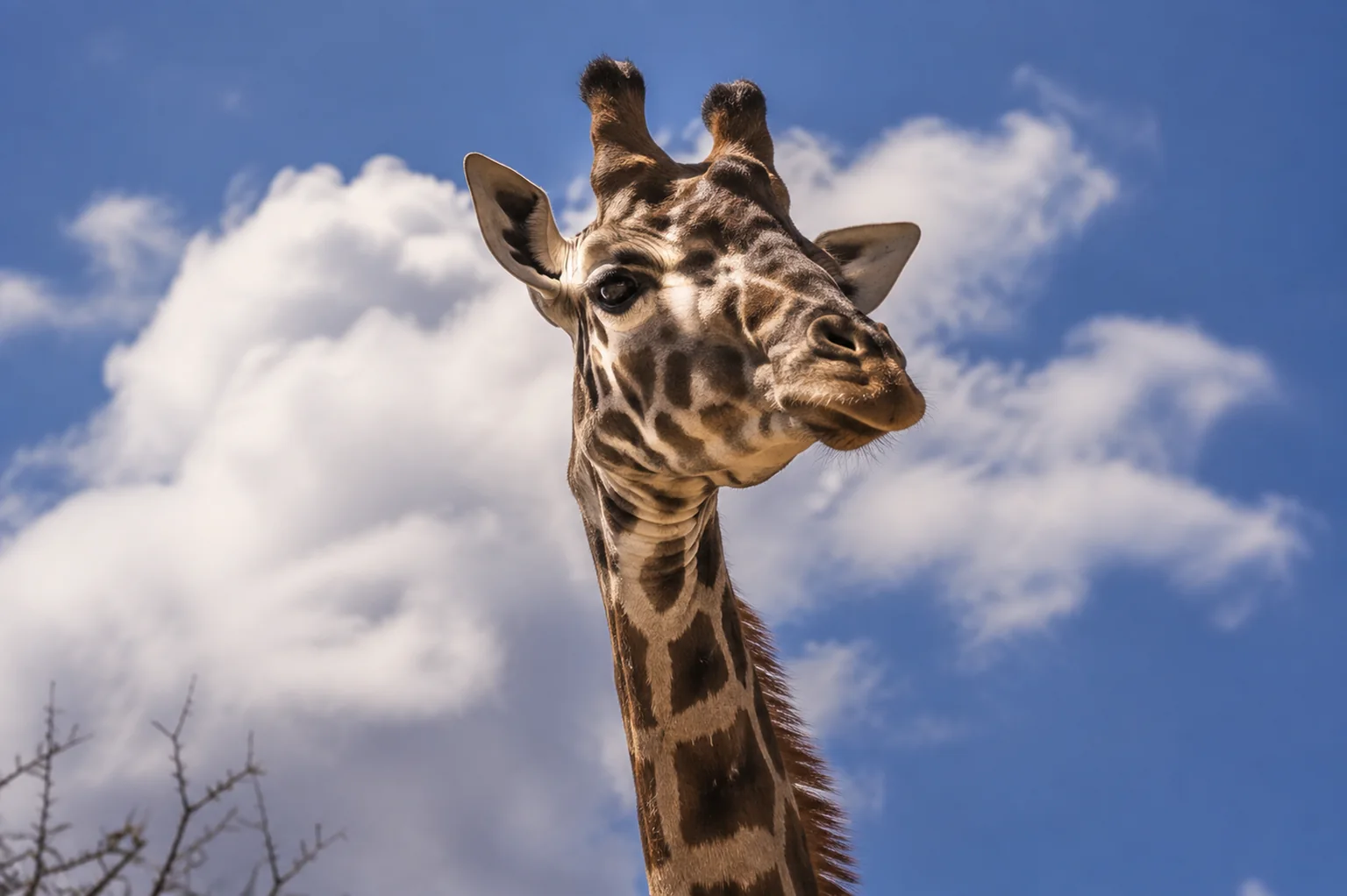
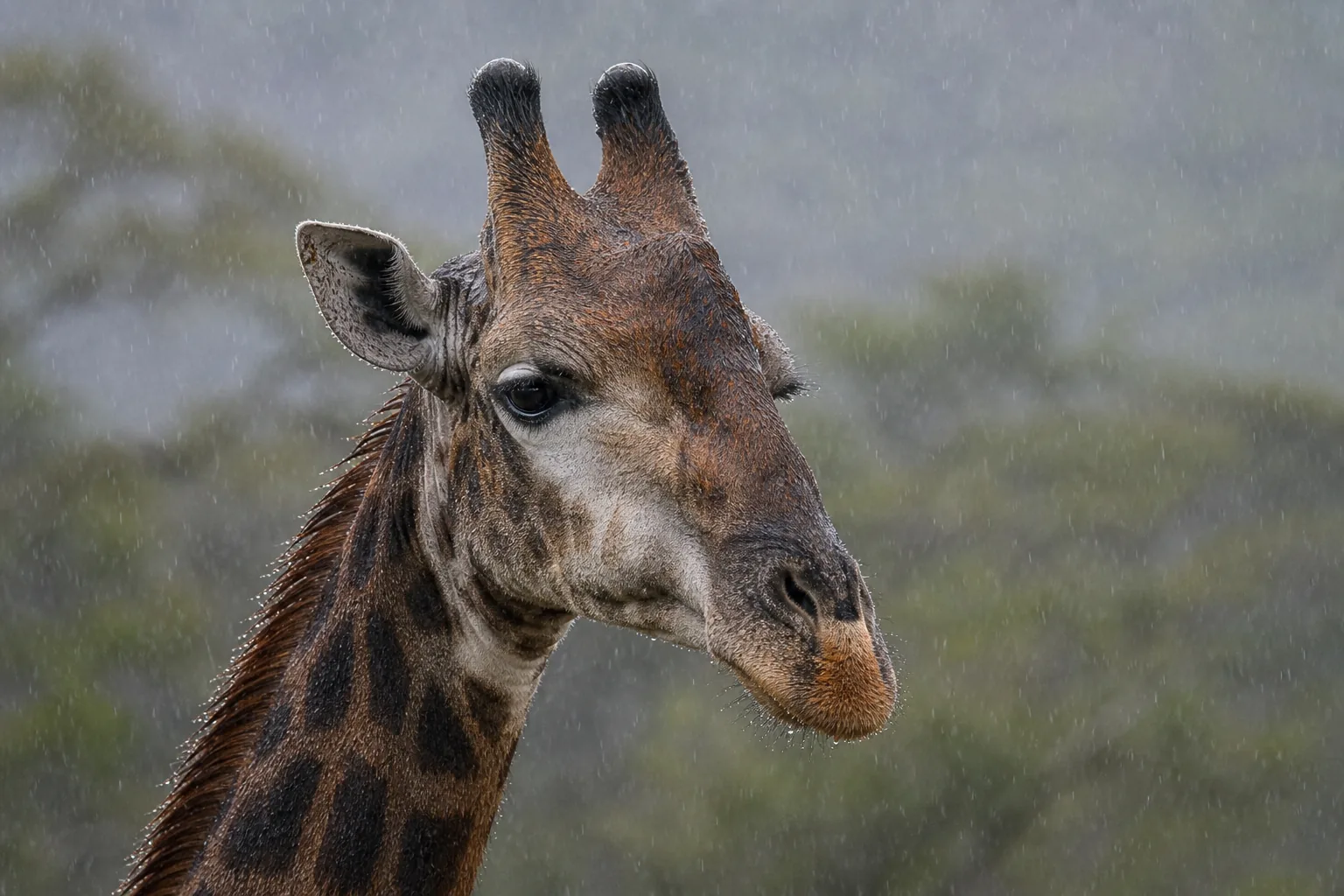
They are called ossicones; one is an ossicone. The main pair are bony projections on the top of the head, covered with skin and hair. San Diego Zoo's giraffe account describes this pair in both males and females and its use in male sparring.
“Giraffe horns” is understandable everyday language. The more specific word becomes useful when asking what they are made of, how they develop or whether they fall off. It prevents a fact about deer antlers from being accidentally applied to giraffes.
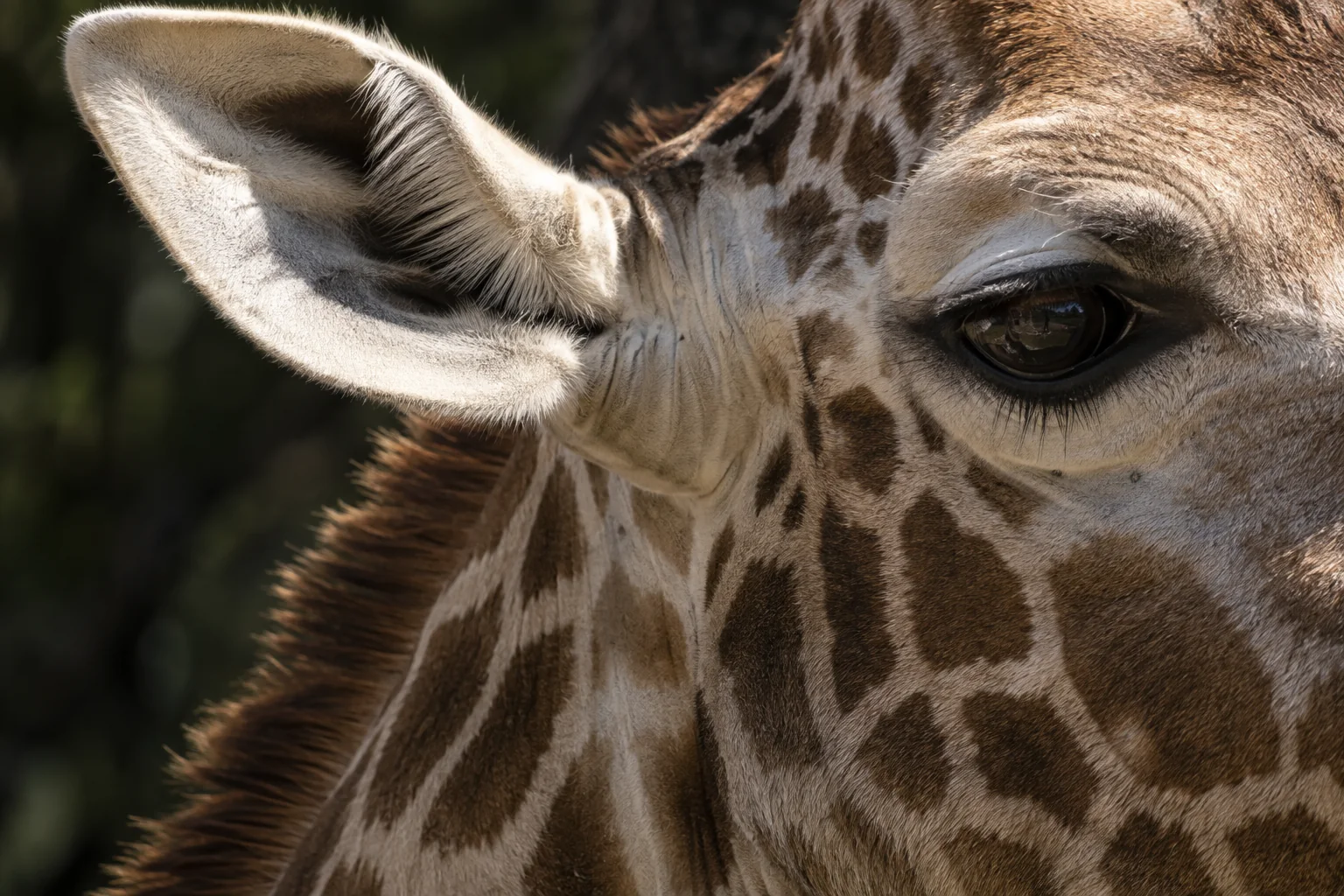
The ears are separate structures. In a head-on photograph, first locate the broad ears to either side, then the narrower projections above the skull. That simple distinction is a better starting point than assuming every outline belongs to the same kind of tissue.
Our giraffe facts guide places ossicones among the animal's other adaptations. The baby giraffe guide follows early life without treating a newborn as a scaled-down adult.
How are ossicones different from horns and antlers?
The useful comparison is not “pointed versus blunt.” Ask about the underlying material, outer covering and replacement pattern.
| Structure | Construction and covering | Replacement pattern |
|---|---|---|
| Giraffe ossicone | Bone with a skin covering, often visibly hairy | Retained rather than seasonally cast like an antler |
| Bovid horn, such as a bison's | Bony core inside a keratin sheath | Generally permanent; no normal annual casting |
| Deer antler | Bone, with nourishing velvet skin during growth | Usually shed and regrown seasonally |
The National Park Service comparison explains the horn sheath and antler cycle. A growing antler's velvet is not a permanent horn sheath: the velvet is lost as the antler matures. Pronghorns add another complication because they shed their outer horn sheath; that does not make them deer.
A skull and a living animal show different things
The American Museum of Natural History's specimen comparison includes giraffe skull 139696 alongside other headgear. It is a useful reference for seeing the bony structures.
A prepared skull does not preserve every visible feature of a living head. If a specimen looks bare, that does not mean its projecting bone was normally exposed in exactly the same way during life. Conversely, hair in a wildlife photograph cannot tell you everything about the bone beneath it.
This is why the comparison has several columns. Shape alone misses the covering; a covering alone misses growth; a single moment misses whether a structure is replaced.
What are ossicones made of, and how do they grow?
The adult structure is bony, but “cartilage that hardens” is an incomplete account of development. Ossification means bone formation; it does not tell you by itself which earlier tissue supplied that bone.
In a 2016 anatomical study, O'Brien and colleagues compared a stillborn, juvenile and old giraffe. Their discussion on pages 22–26 supports bone formation in skin-associated fibrous tissue, rather than simply treating the ossicone's base as a long-bone-style cartilage growth plate. They also stress that their CT images alone cannot identify the connective tissue's precise type.
A small developmental series, not a birthday timetable
Their comparison shows why several developmental stages matter, but it does not supply a universal age at which every giraffe's ossicones fuse. Different specimens are not a continuous recording of one animal growing up.
An earlier 1990 study by Ganey, Ogden and Olsen examined prenatal and postnatal structures, including their tissue development and blood supply. Its authors explicitly reported interpretations that differed from earlier accounts. The later study draws on that histological work—microscopic examination of tissue—to interpret the anatomy.
For a general reader, the practical answer is straightforward: these are living anatomical structures that develop and attach to the skull, not ready-made miniature antlers. For a technical explanation, the route from tissue to bone deserves more care than one familiar phrase.
If you are reading about a calf, distinguish the first visible head bumps from mineralised bone and from later attachment to the skull. These are different developmental observations, not interchangeable definitions of being “born with horns.”
Do female giraffes and okapis have ossicones?
Female giraffes have the main pair too. The presence of two projections is therefore not a male-only character. A drawing that gives headgear only to the male giraffe makes the wrong distinction.
The living family comparison is interesting: San Diego Zoo's okapi account describes a pair of ossicones in males. The museum account likewise distinguishes male okapis from giraffes of both sexes. Do not transfer one animal's sex pattern to the other simply because both structures have the same name.
Giraffes and okapis belong to the same living family, Giraffidae, despite their strikingly different proportions and markings. Our giraffe–okapi comparison follows that relationship beyond headgear. A shared anatomical term can reveal a relationship that a quick glance overlooks. It does not mean every aspect of their growth, behaviour or habitat is identical.
For a visitor or student, the useful question is “Which animal, and which sex?” rather than “Do horned animals always follow one rule?” Comparisons become more informative when the biological group stays attached to the claim.
What do giraffes use their ossicones for?
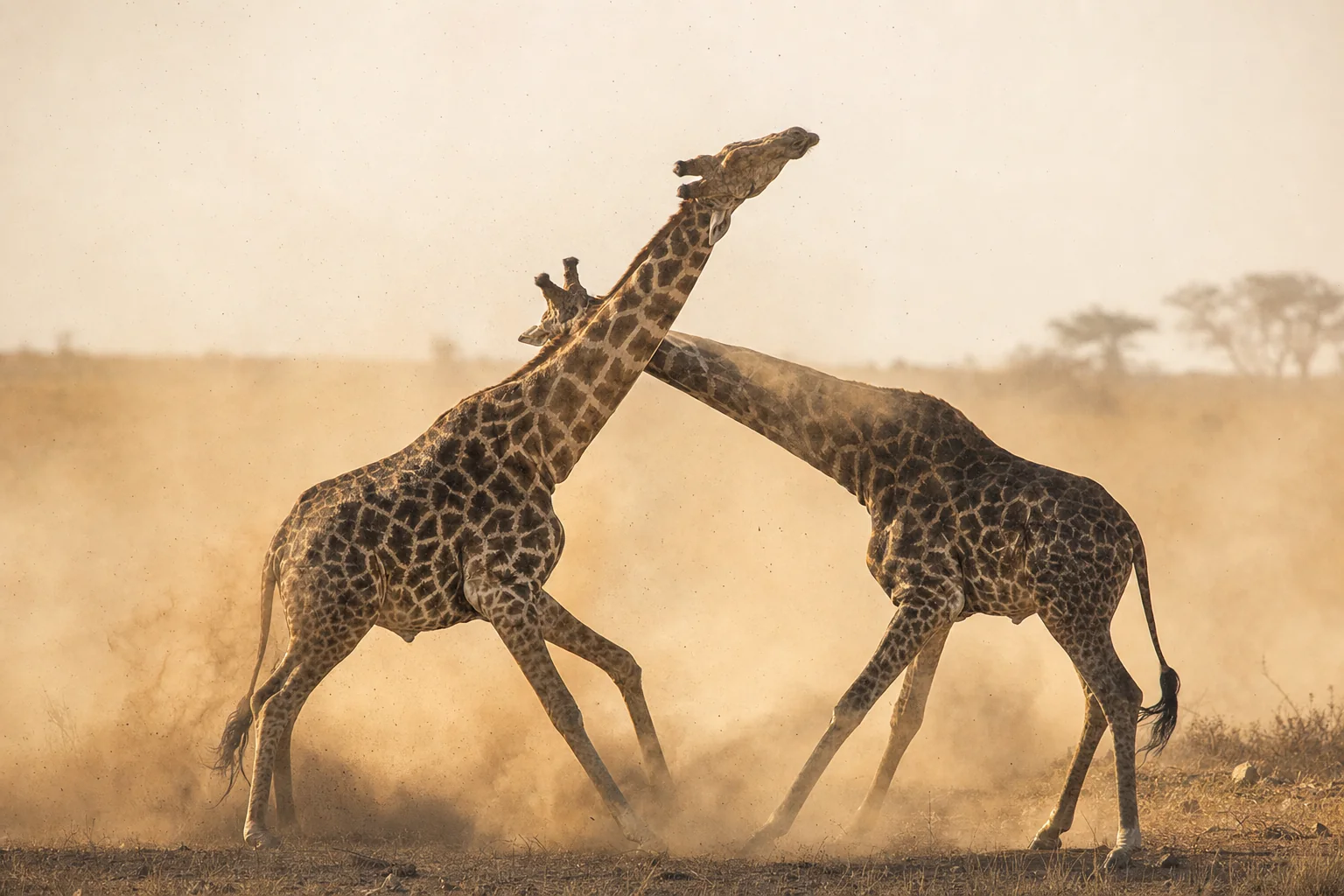
Male giraffes use the head and its projections in sparring, commonly called necking. This is a use of the whole head-and-neck system, not an ossicone acting independently. San Diego's account describes males swinging their necks against one another.
Our neck-evolution guide separates the mechanics and observations from larger evolutionary arguments. Showing that a feature is used in a contest does not, by itself, establish every reason that feature evolved or why it occurs in both sexes.
Avoid assigning a universal force, injury rate or outcome to a photograph of a contest. An image may show contact or posture, but those other claims require measurements and context. Nor should the word “sparring” imply that every observed interaction is harmless or that every head movement is combat.
Does their blood supply make them cooling devices?
Temperature regulation is a proposed role in public descriptions, including the museum's account. The anatomical study maps blood supply, but mapping vessels is not the same experiment as measuring how much heat an ossicone removes under particular conditions.
Treat “contains blood vessels” and “has a demonstrated cooling performance” as different claims. A useful test would need temperature and blood-flow measurements in a defined setting, not just an attractive explanation of the shape. This distinction keeps a plausible function open for investigation without presenting it as settled fact.
Why do some giraffes appear to have more than two horns?
The conspicuous pair is not the only source of relief on a giraffe's skull. Other bony growth can make a head appear to carry additional horns, especially in mature males. The number you see depends partly on which bumps the description is counting.
Solounias and Tang's 1990 anatomical paper distinguished the paired ossicones from the median, or central, projection. Their account describes different component structures and overlying secondary bone growth. It is a reason not to assume every visible prominence has the same developmental history.
For an ordinary identification, “the main pair, with additional skull prominences” can be more informative than a confident total detached from a definition. When reading a claim about three or five horns, check whether it counts the main pair, the central boss, other prominences or all of them together.
This does not mean every guide using a different count is describing an impossible animal. It means that names and counting rules need to be clear. The same caution applies when a side view hides the far projection behind the near one.
Can ossicones tell you a giraffe's age or sex?
They can contribute to an anatomical description, but the presence of the main pair cannot distinguish male from female giraffes. Nor does a photograph establish a birthday. Size, shape, visible hair and the appearance of the surrounding skull need context.
Consider a tightly cropped portrait. You may not know the animal's identity, developmental stage, viewing angle or image history. A confident sex or exact-age label adds information that the picture may not supply. If a zoo or research project identifies a known animal, keep that record separate from your own visual inference.
Our giraffe lifespan guide explains the difference between identifying an individual and knowing its age. The height guide makes a related measurement point: specify the endpoint when including the tips of the ossicones in an animal's height.
Try a simple headgear observation
Use the linked museum specimens for real anatomical reference. Start with three separate notes: what is visible, what the source identifies, and what remains unknown. For example, a photograph may show two projections; its caption may identify a giraffe skull; the animal's age may not be stated.
Then compare a bovid horn and a deer antler. Look for evidence of a sheath, exposed bone or a branching form, but do not treat one silhouette as a complete account of development. The source description and the object should be read together.
Finally, ask what would change in a living-animal photograph. Skin and hair would alter the visible surface.
Our science library offers routes into original research, and the reproductive and neonatal evidence area covers related early-life questions. An index helps locate studies; it is not a claim that every indexed paper has been independently reviewed.
What to remember
Ossicones are the giraffe's distinctive headgear, not small deer antlers. Both sexes have the main pair. Their bony structure, covering and development matter more than the casual word “horn,” while additional skull bumps make counting less simple than it looks.
Keep observation and explanation apart: a vessel is not a cooling measurement, and a projection is not an exact age. Those distinctions make the real animal more interesting, not less.
Frequently asked questions
Are giraffe horns really antlers? No. Ossicones are not normally cast and regrown through the antler cycle.
Do female giraffes have horns? Yes. Both sexes have the main pair of ossicones; their presence is not a male-only trait.
Do giraffes have two horns or five? Two is the conspicuous main pair. Larger totals may include additional skull prominences, which should not automatically be treated as identical structures.
Are ossicones just cartilage? No. Adult ossicones are bony. Their developmental origin is more complicated than treating all of the early tissue as cartilage that simply hardens.
Can I tell a giraffe's age from its horns? Not an exact age from a photograph alone. Known identity and life-history records provide information that appearance may not.
Sources
Seven source links are placed beside their claims: zoo and museum accounts, the National Park Service comparison and anatomical research. The 2016 paper is available through its co-author's public university page; the 1990 papers are represented here within the limits of their checked abstracts and the later anatomical discussion.
Reviewed on 6 September 2026. The comparison and observation exercise are original explanations, not a new anatomical study. No source figure, full paper or private animal record is republished.