Put a giraffe beside an okapi and the family resemblance is easy to miss. One towers over a woodland; the other has a dark body and startling striped legs. Trust the stripes alone and you might place the okapi beside a zebra. Look at its head, feeding anatomy and DNA, and a different relationship emerges—one that makes both animals more interesting than the idea of a tall version and a short version.
Are okapis related to giraffes or zebras?
Okapis are close relatives of giraffes. Their scientific name is Okapia johnstoni. Giraffes belong to Giraffa. These are the two living genera in the family Giraffidae. A genus is a classification level within a family, not another word for one individual species.
This distinction fixes a common outdated summary. On 21 August 2025, the IUCN specialist group recognised four giraffe species. Under that classification, four giraffe species plus one okapi species make five living species in two genera—not “only two species left.” Our four-species guide explains the giraffe side without mixing classification with extinction-risk categories.
Calling an okapi a “forest giraffe” can be a useful introduction, provided it is clearly a nickname. It is not one of those four giraffe species, nor a cross between a giraffe and a zebra. Similar markings are not enough to establish close ancestry.
Giraffe vs okapi: the differences at a glance
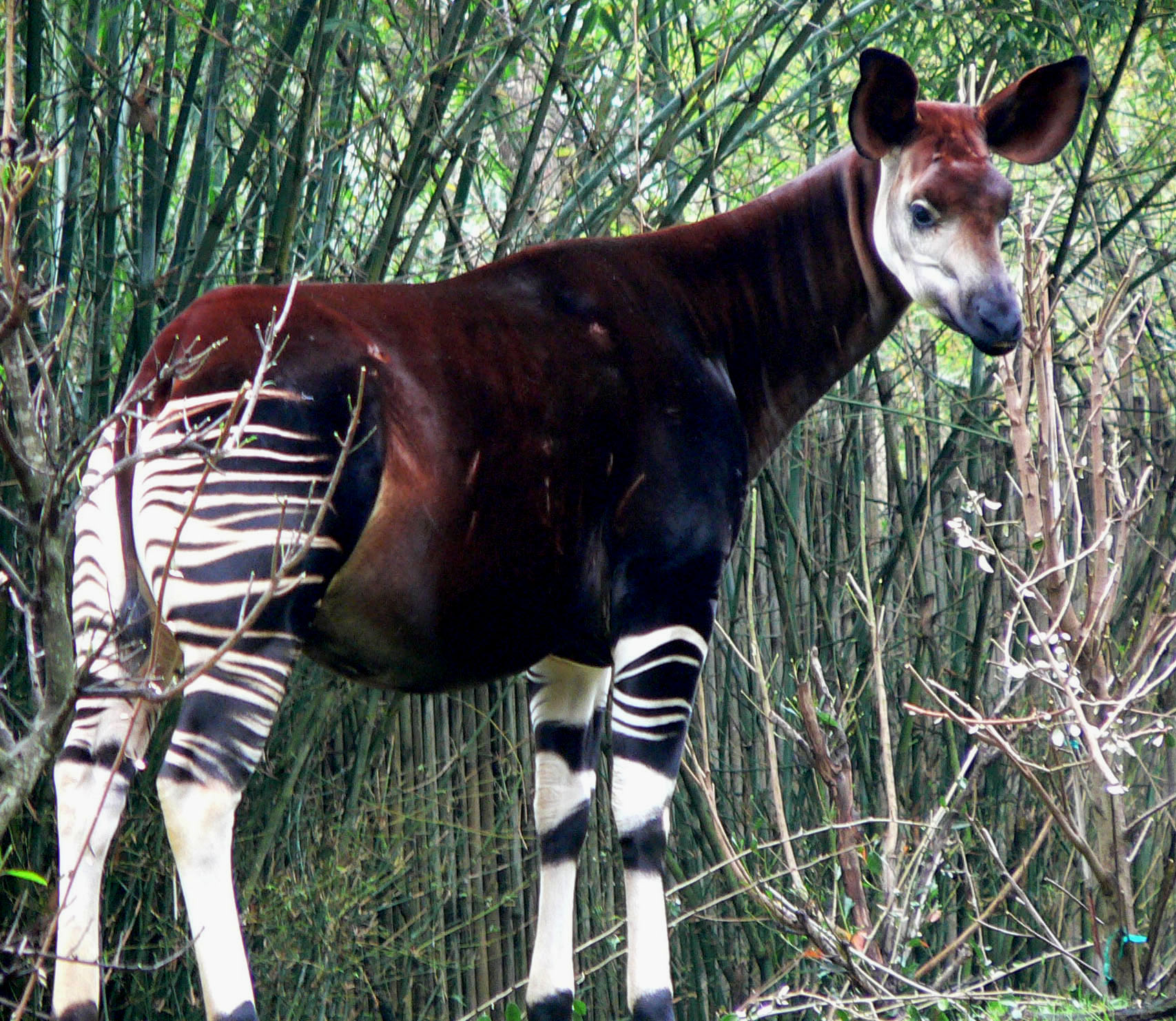
Start with the actual okapi. In the photograph, the pale cheek, large ears and striped hindquarters are visible together. It is a captive animal: surrounding vegetation should not be mistaken for a documented scene in its native forest.
| Feature | Giraffes | Okapis |
|---|---|---|
| Living genus | Giraffa | Okapia |
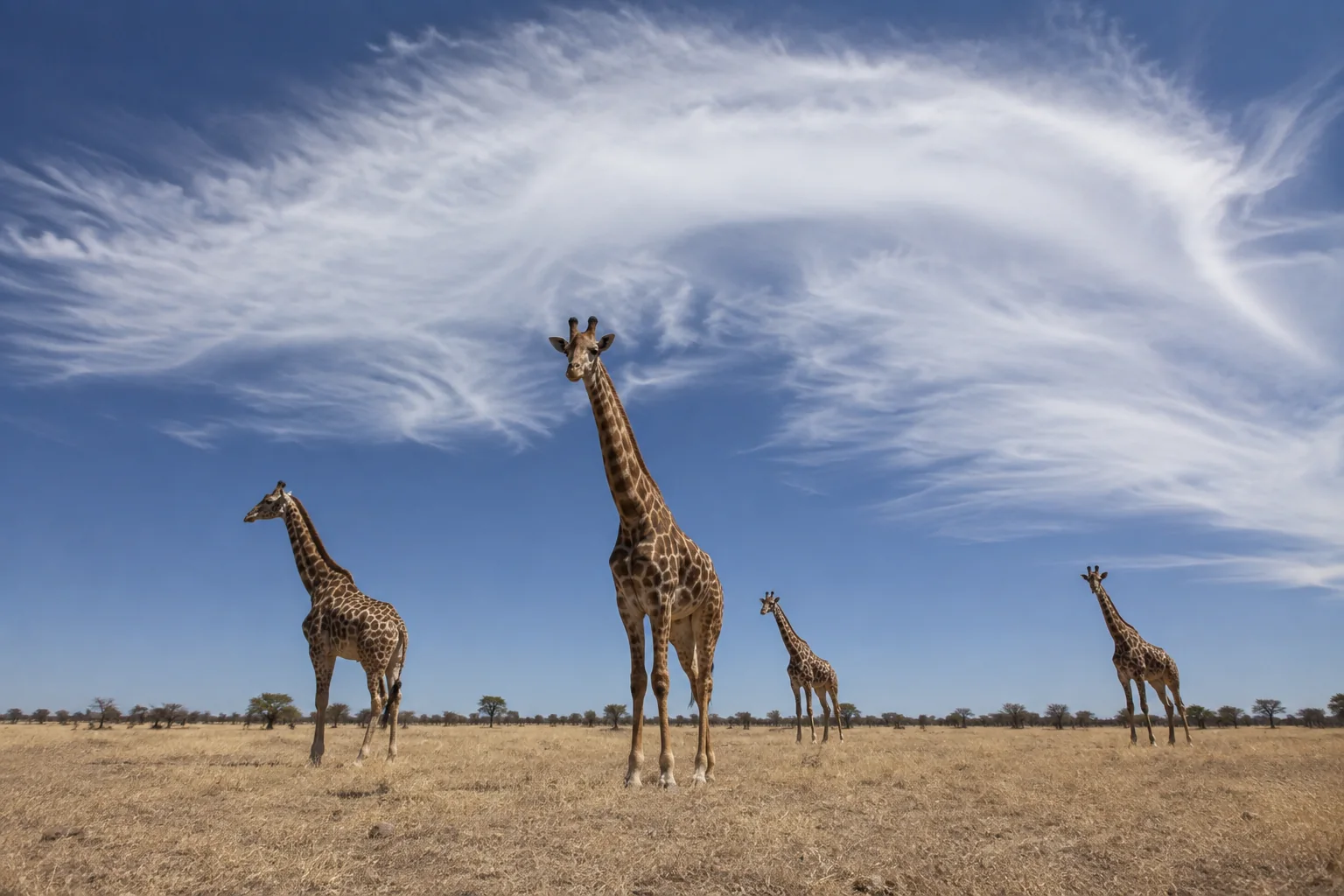
| Visible proportions | Very long neck and legs | Much shorter neck and more compact outline |
| Markings | Patches across much of the body | Dark body with conspicuous pale stripes on legs and hindquarters |
| Main ossicone pair | Both sexes | Males |
| General habitat | Savanna and woodland | Tropical rainforest in the DRC |
| Feeding comparison | Browsing, including high branches | Browsing forest vegetation closer to the ground |
| Height reference | Males up to about 5.5 m overall | About 1.5–2.0 m at the shoulder in the cited zoo account |
Why the height labels matter
The last row deliberately labels different endpoints. San Diego Zoo's giraffe account gives an upper male height of 5.5 metres; Jacksonville Zoo's okapi account explicitly gives a shoulder range of 1.5–2.0 metres. The okapi's head stands above its shoulder. Dividing these figures would therefore not produce a fair ratio of total animal heights.
A useful comparison keeps the measurement point, sex and type of statistic attached. An upper male value is not an average for every giraffe. A shoulder measurement is not interchangeable with the highest point of the head. Our giraffe height guide includes a labelled scale reference you can compare with your own height.
What do giraffes and okapis have in common?
The shared family is easier to understand when you stop looking only at height. Headgear and feeding equipment offer a closer comparison, although visible similarities are only part of the evidence for ancestry.
Headgear: look beyond the ears
Both animals have structures called ossicones, but the sex pattern differs. Giraffes have the main pair in males and females; in okapis, the pair occurs in males. San Diego Zoo's okapi account describes these bony projections near the ears and the animal's long, dark, grasping tongue.
The broad ears and narrower head projections are different structures. When reading a caption about “horns,” ask which animal and which sex it describes. Our ossicone guide explains the distinction from antlers and other horns without assuming every bump follows the same growth history.
Feeding: a tongue that can grasp
Prehensile means able to grasp. Think of the tongue as part of a feeding action: reaching around vegetation, gathering it and drawing it into the mouth. Both relatives browse plant material, and both are ruminants that bring food back up for further chewing.
That does not mean they eat an identical diet or reach the same branches. A shared feeding capability can operate at different heights and in different vegetation. The giraffe tongue article follows the mechanism more closely; copying one animal's tongue measurement onto the other would miss the point of comparing them.
How do their habitats and daily lives differ?
The broad contrast is woodland and savanna for giraffes, rainforest for okapis. San Diego's okapi account places the latter in northeastern Democratic Republic of the Congo and describes largely solitary adults, apart from females caring for calves. “Solitary” does not mean incapable of communication or contact.
For giraffes, the social-behaviour guide describes changing groups and relationships rather than one permanently fixed herd. Neither label tells you exactly what an animal will be doing at the instant a photograph is taken.
Likewise, “forest” and “savanna” are useful beginnings, not complete descriptions of food, shelter and movement. Our habitat and range guide explains why giraffe landscapes include different kinds of woodland and even some very dry environments. The comparison is not simply trees for one animal and no trees for the other.
Be equally careful with explanations of stripes. San Diego describes camouflage and suggests that stripes may help a calf follow its mother. That possible role should not become a claim that the function has been experimentally proved here. A conspicuous pattern in a close-up and visibility at a distance are different questions.
Did giraffes evolve from today's okapis?
No: shared ancestry is not the same as one living relative being the other's ancestor. Picture a fork with two continuing branches, not a ladder with an okapi on a lower rung and a giraffe above it. Calling the okapi primitive or unfinished obscures its own history.
In their 2016 genome comparison, Agaba and colleagues sequenced two Masai giraffes and one okapi and compared genetic information with other mammals. They identified candidate changes associated with skeletal development and cardiovascular biology. The okapi was an informative relative for the comparison, not a preserved sample of the giraffe's ancestor.
What the genome comparison can—and cannot—show
The study highlights potential biological mechanisms and estimates a split from a common ancestor. Such a date depends on the evolutionary model and calibration. It is not an observed birthday for the two lineages. Identifying promising genetic differences also does not experimentally establish the effect of every change.
This is a more useful scientific story than “one animal stretched its neck and the other stayed the same.” The neck-evolution guide separates anatomical change from competing explanations of why those changes were favoured.
Okapis also have a history within their own species. Stanton and colleagues' 2014 study analysed genetic material from faeces, museum specimens and skin artefacts. It found substantial variation and deep lineages, with evidence consistent with historical movement of genes across the Congo River. These results concern evolutionary history, not a current census or proof of population recovery.
Our genetic-isolation evidence area helps locate related giraffe research. An indexed record is a route to a source, not a guarantee that every paper has received a full editorial review.
Why does conservation need two different stories?
San Diego lists the okapi as Endangered. That does not mean its situation can be understood by borrowing a giraffe population trend. The okapi's forest setting, threats and available observations need their own assessment.
Consider the Okapi Wildlife Reserve in UNESCO's account. It is part of the Ituri forest, with Mbuti and Efe communities whose lives and cultures are connected to that landscape. UNESCO identifies commercial poaching, mining and agricultural encroachment among management challenges. It is not an empty patch of forest where conservation is only a matter of drawing a boundary.
The same page contains population figures in its descriptive account. Without a clearly attached census date, those should not be relabelled as the number alive today. A number can be accurately copied and still become misleading when its time and scope disappear.
For giraffes, start with which giraffes are threatened, rather than assuming one trend fits every species and location. Taxonomic recognition, a Red List category and a measured population change are three separate pieces of information.
The family connection gives readers a reason to care about both animals. It does not make their conservation problems interchangeable, and it does not imply that this website operates either animal's field programmes.
Try this comparison at a zoo or with photographs
Make three short notes: what you can see, what the source tells you, and what you cannot establish. In the okapi photograph above, you can describe markings and visible proportions. The credited source supplies the captive location and date. The picture alone does not tell you the animal's exact height, age or genetic history.
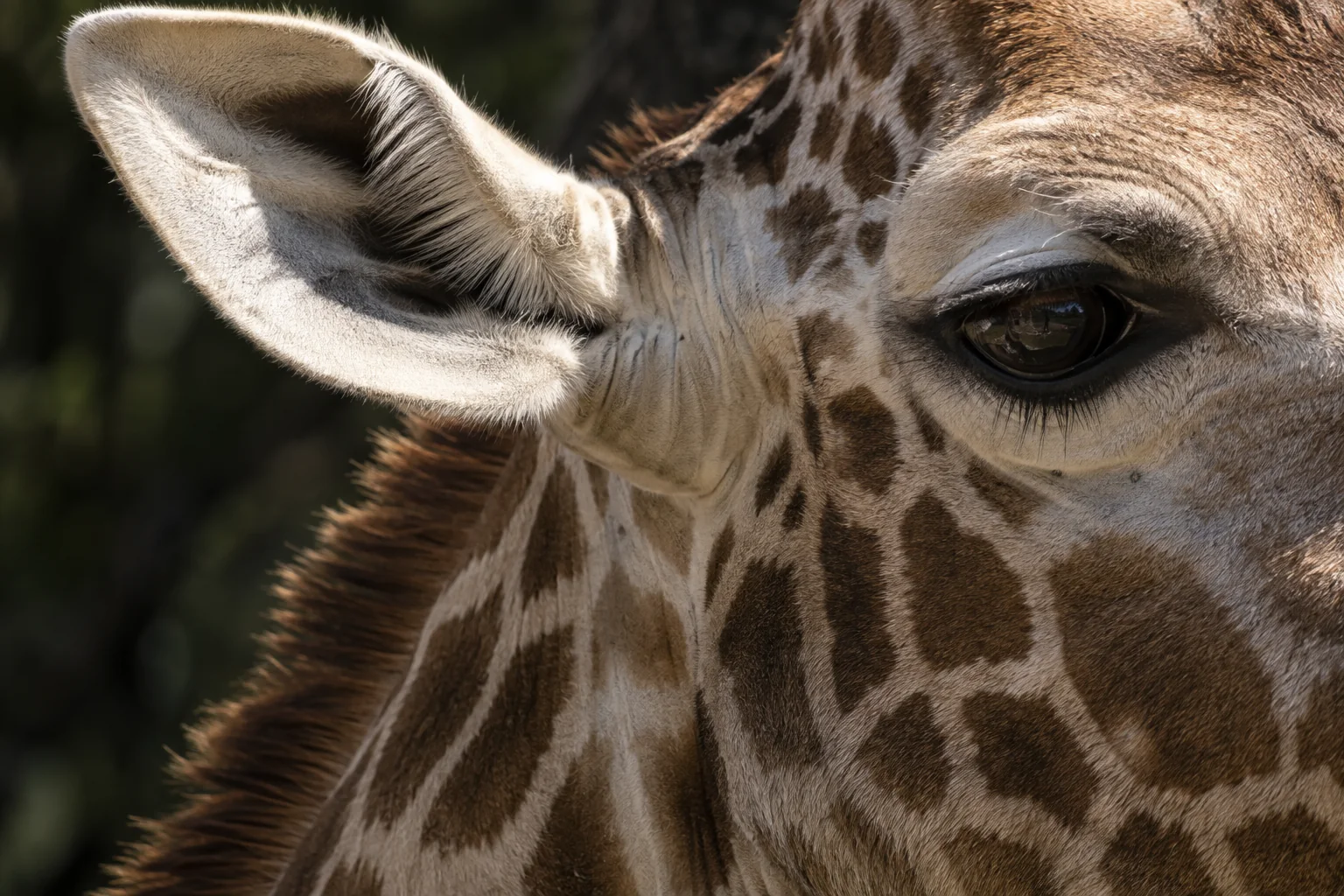
Now consider what a cropped portrait would hide. Without the legs, the most familiar stripes disappear. Without a measurement reference, apparent size depends on framing. A photograph is valuable precisely when its strengths and limits remain visible.
Finally, write a one-sentence relationship explanation without the words “hybrid,” “primitive” or “only two species.” If it says that giraffes and okapis share a family but represent separate living branches, it captures the essential idea.
What to remember
The okapi's stripes are memorable, but its close living family connection is with giraffes. Compare the head and feeding anatomy as well as the coat. Keep height endpoints explicit, distinguish genera from species, and treat both animals as living lineages with their own histories.
Neither a nickname nor an attractive evolutionary story replaces evidence. The real comparison is already remarkable without turning the okapi into a miniature giraffe or a zebra mixture.
Frequently asked questions
Is an okapi a zebra–giraffe hybrid? No. It is Okapia johnstoni, a distinct species in the giraffe family.
Is “forest giraffe” another giraffe species? It is a nickname for the okapi, not a fifth species within the genus Giraffa.
How many living giraffid species are there? Under the specialist group's 2025 four-giraffe classification, five: four giraffe species and the okapi, in two genera.
Do female okapis have the same horns as female giraffes? No. The main ossicone pair occurs in both giraffe sexes but in male okapis.
Are okapis baby giraffes? No. A giraffe calf is a young giraffe; an okapi is a different animal, including when fully grown.
Sources
Seven biological, institutional and research sources are linked beside the claims they support. The hero photograph has separate attribution, source-history and licence information below. No journal figure, copyrighted full paper or sensitive wildlife location is republished.
Hero photograph: Okapi at Disney's Animal Kingdom, 16 January 2005. “Okapi2.jpg” by Raul654; prior contrast adjustment by Postdlf. Photograph and source history, CC BY-SA 3.0. Reproduced unchanged; not a wild Congo photograph.
Reviewed on 6 September 2026. The comparison and observation exercise are original explanations, not a new field or genetic study. Research dates are publication dates; no exact current okapi census is claimed.