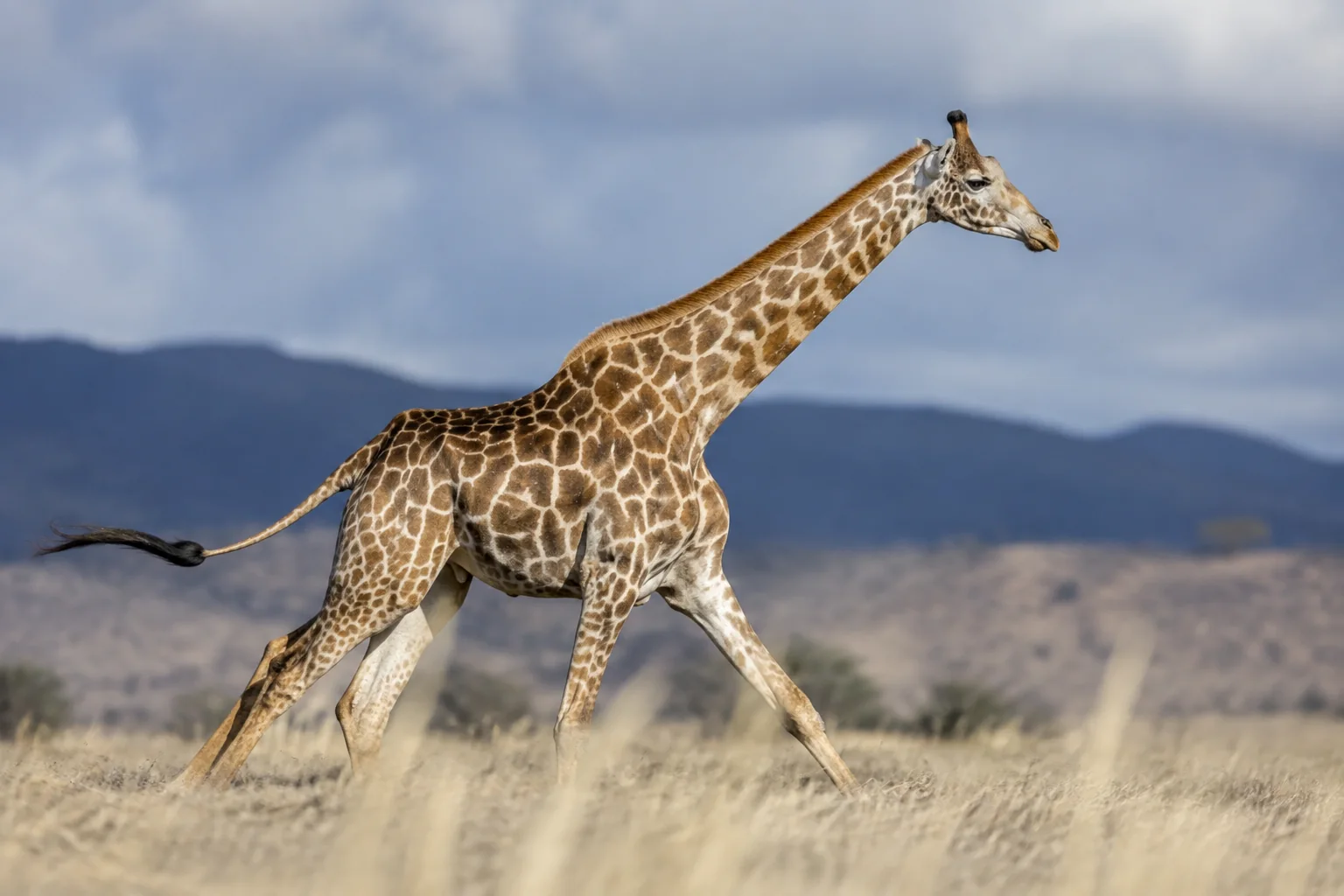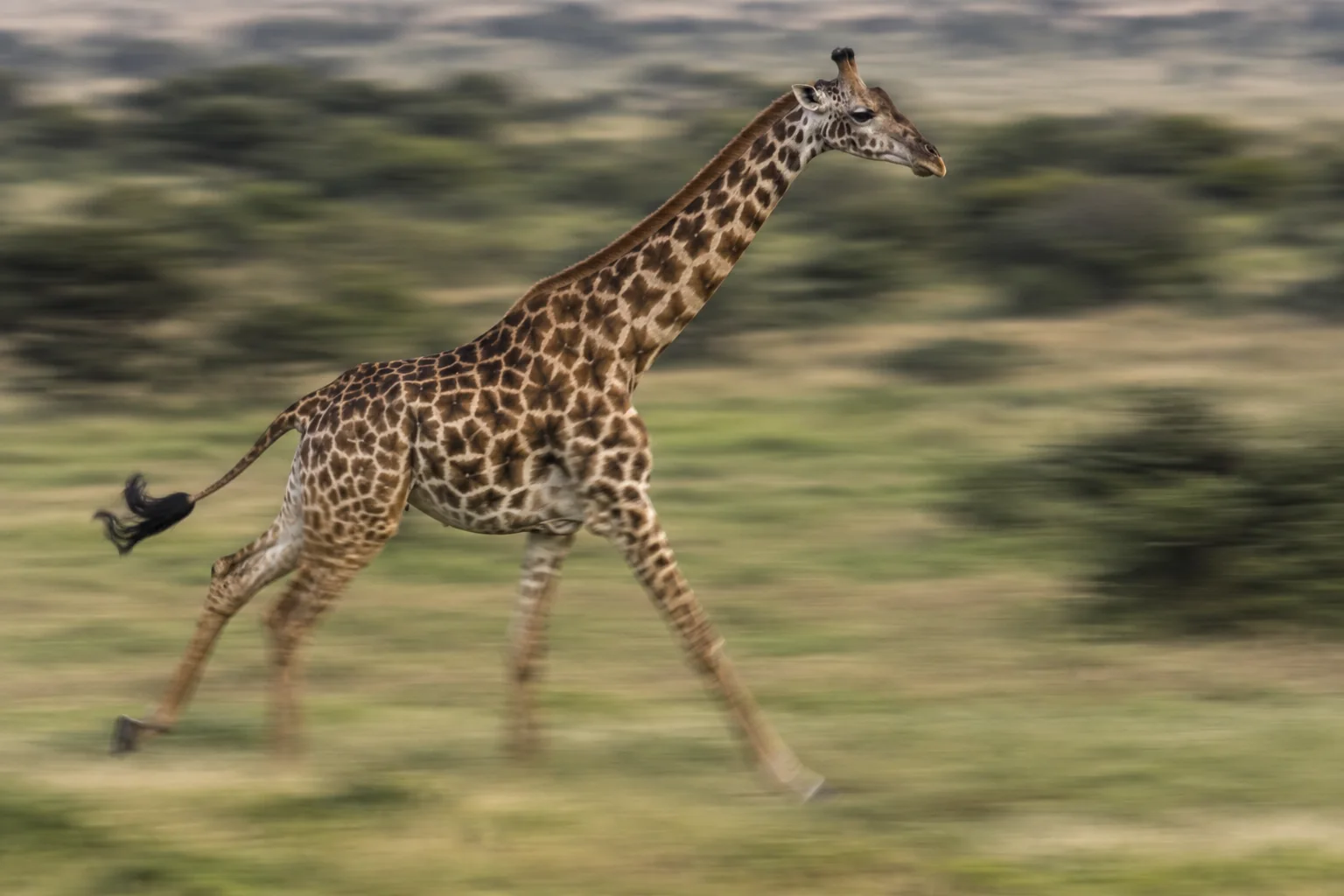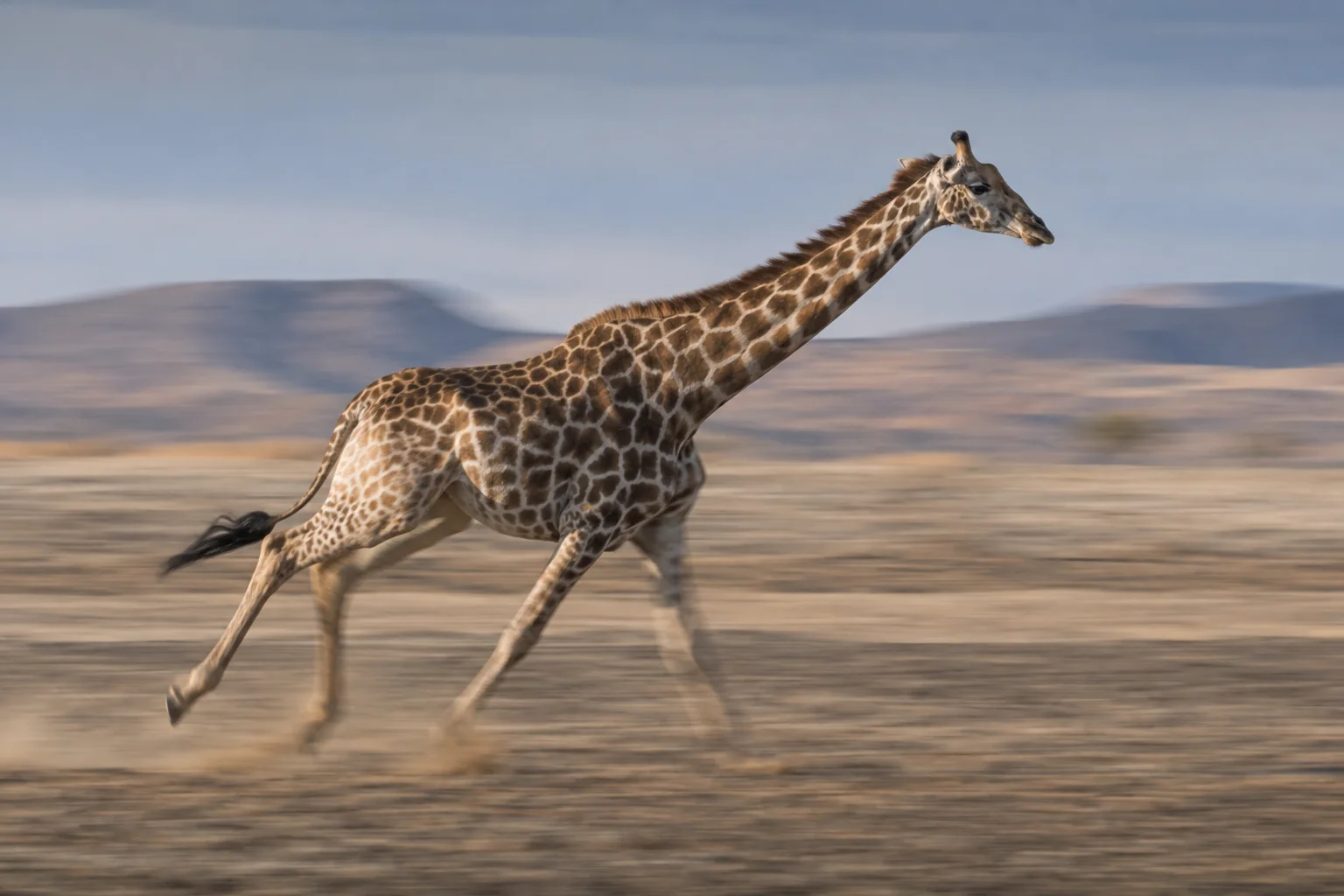
A neat “60 km/h” answer hides the most important scientific detail: no checked field study here documented a giraffe reaching that number. The clearest modern study instead measured 3.4–6.9 m/s (12–25 km/h), because its purpose was to explain running mechanics, not stage a top-speed trial. Both statements can be reported—so long as a reference claim is not mistaken for a record.
How fast can a giraffe run?
Giraffes are commonly said to reach 60 km/h, or about 37 mph. ARTIS Royal Zoo gives 60 km/h as the reticulated giraffe's top speed. Its species page provides no timing method, sample, duration or uncertainty. The number is therefore best treated as a rounded reference claim, not a verified world record.
A transparent modern measurement answers a narrower question. Basu, Deacon, Hutchinson and Wilson recorded adult free-roaming giraffes at 3.4–6.9 metres per second. That converts to 12.2–24.8 km/h, or 7.6–15.4 mph. The animals were not pushed through a maximum-speed test, so 6.9 m/s is the fastest analysed stride in that dataset—not the fastest a giraffe can ever run.
This distinction is the same one that helps keep other giraffe facts honest: a maximum claim, a typical value and a study observation are not interchangeable. Nor does a speed measurement prove why an animal ran or whether it escaped a giraffe predator.
Three different answers hiding behind one question
| Kind of number | What it means | What we can say here |
|---|---|---|
| Common upper figure | A value repeated by a reference source | 60 km/h (37 mph), with no method stated on the checked zoo page |
| Observed study range | Speeds actually retained and analysed under one protocol | 3.4–6.9 m/s, equal to 12.2–24.8 km/h (7.6–15.4 mph), in Basu et al. (2019) |
| Physiological maximum | The fastest an animal could achieve under defined conditions | Not established by the evidence reviewed for this guide |
A physiological ceiling would depend on the individual, motivation, health, terrain, acceleration distance, measurement error and definition of “maximum.” Extra decimal places would not make those missing details appear.
What speeds have researchers actually measured?
The available studies did not all ask the same question. Their numbers should not be ranked as if they came from one race.
| Source and date | Animals and method | Reported speed | What the number establishes |
|---|---|---|---|
| ARTIS species page, checked 2026 | Institutional reference page; no timing method displayed | 60 km/h (37 mph) “top speed” | A current institutional reference-page claim, not a documented measurement record |
| Alexander, Langman & Jayes, 1977 | Ten wild ungulate species, including giraffe, filmed from a pursuing vehicle while induced to run as fast as possible | Publisher summary: 10–14 m/s maxima for all included species except buffalo at 7 m/s | An early cross-species fast-locomotion study; the accessible summary does not expose an exact giraffe sample or species row |
| Basu, Deacon, Hutchinson & Wilson, 2019 | 120-frame-per-second lateral UAV video; 25 representative strides from four similarly sized adults | 3.4–6.9 m/s; mean 5.0 m/s | The analysed range and mean for steady running strides, not a maximum trial |
The 1977 primary study sought fast running and analysed film for speed and stride variables. But its accessible publisher summary reports a range across species. Assigning the top of that range to giraffes would require the species-level table and trial details.
The arithmetic behind the modern field figures is transparent:
- metres per second × 3.6 = kilometres per hour;
- metres per second × 2.23694 = miles per hour;
- 3.4 m/s becomes 12.24 km/h or 7.61 mph;
- 6.9 m/s becomes 24.84 km/h or 15.44 mph;
- 60 km/h becomes 16.67 m/s or 37.28 mph.
Rounding those values to one decimal place avoids implying that the field method established speed to the last hundredth.
How can video become a speed measurement?
In the 2019 running study, 35 southern giraffes of different ages, sizes and sexes were available across three sites in South Africa's Free State Province. Researchers filmed more than 50 stride sequences. Their final kinematic analysis used 25 representative strides from four similarly sized adults.
The camera recorded from the side at 120 frames per second. For each retained stride, researchers divided horizontal distance at the withers—the high point above the shoulders—by stride duration. They excluded strides in which speed changed by 20% or more.
A scale is essential
Pixels are not metres. The team used a segment of the hind limb as a scale, estimating its length from close photographs, markers set two metres apart, or identifiable ground features in a three-dimensional terrain model. Natural coat markings helped them follow body points consistently from frame to frame.
Each option introduced uncertainty. Repeated close photographs were the most precise calibration. Using natural features in the terrain model added about 5% calibration error relative to that method. The mean digitising error was ±1.6 pixels, corresponding to a mean calibrated error of ±0.01 m.
The team also tested the UAV method on a human treadmill runner. The video method read low by 13% on average across conditions. Error was about 8% with the subject centred at eight metres and 17% when closer and off-centre. These exact validation errors cannot simply be transferred to a much larger giraffe, although the authors expected comparable accuracy when the animal remained central.
This is why “measured” should never mean “perfect.” It means the distance, time, scale and known sources of error are available for scrutiny.
How does a giraffe gain speed?
Speed is the product of two ingredients: stride length × stride frequency. Stride length is the forward distance travelled in one complete cycle. Stride frequency is how many cycles occur each second.
Across the 25 analysed strides, each 1 m/s increase in speed was associated with about 0.55 m more stride length and 0.05 more strides per second. Both relationships were statistically significant. In plain language, the adults gained most of their extra speed by covering more ground per stride, while their stride rhythm increased only modestly.
Long limbs help make those long strides possible, but height is not a stopwatch. The proportions described in our giraffe height guide differ among adults, females, males and calves. The running analysis deliberately compared similarly sized adults; it was not designed to test whether the tallest animal was fastest.
The study also measured duty factor: the fraction of a stride for which a foot remains on the ground. It fell as speed rose. The researchers did not measure running forces with a force plate, so their proposal that footfall overlap might keep forces tolerable remains an interpretation.
What is the neck doing?
The neck angle and body pitch each changed over a stride, but the neck pattern varied between trials. The authors proposed that the heavy head and neck may sometimes be stabilised partly independently of the pitching trunk. That is more cautious than saying the neck is a proven counterweight or engine.
The running study used one overall neck angle even though the neck bends along many vertebrae. The authors identified a more detailed curved-line analysis as future work. For the anatomy and competing evolutionary explanations, see our giraffe neck guide.
Is a giraffe's walk the same as its run?
No. Descriptions that say giraffes “run by pacing” blur two different gaits.
A separate 2019 experiment used synchronised video and force plates with three adult reticulated giraffes in a UK zoological park. The researchers classified the walk as lateral sequence with lateral couplets: a hind foot was followed by the forefoot on the same side, but those same-side feet did not land simultaneously. Read the walking study.
The free-roaming adults in the running study used a rotary gallop. In a gallop, the hind feet form one functional pair and the forefeet another; “rotary” means the leading side differs between those pairs. The researchers described the adults' gallop as grounded, because they did not observe a phase in which all four feet were airborne. Brief aerial phases appeared in juveniles, which were not included in the adult analysis.
There is an important sampling limit: the far-side feet were often hidden in the single side view, and all contact and lift-off events were visible for only one complete stride. The broader footage supported the adult grounded gallop description, but it does not justify claiming that every giraffe of every age always uses one identical sequence.
Walking, running and social travel answer different questions. The flexible group patterns in our giraffe behaviour guide do not reveal an individual's speed or gait just because several animals were moving together.
Do long legs make giraffes unlimited runners?
Long legs offer reach and stride length, but they also change the leverage that muscles work against. In a 2022 study, Basu and Hutchinson selected 14 walking steps from one 780 kg captive adult. They combined that animal's forces and motion with a forelimb model built from a separate 880 kg, seven-year-old adult male cadaver and scaled to match the living subject.
The whole-stance effective mechanical advantage estimate was 0.34 ± 0.05. For comparison with smaller mammals, the paper also calculated a mid-stance value of 0.29 ± 0.05: about 24%, or roughly one-quarter, of the 1.3 value extrapolated for a 780 kg mammal. See the open-access primary study.
Effective mechanical advantage compares the muscle's internal lever arm with the external lever created by the ground force. A low value means the muscles need to produce more force to oppose a given external effect. The authors proposed this as a trade-off of elongated limbs and a constraint on athletic performance.
It is not a direct measurement of top speed. The experiment concerned straight walking, and the running study did not record ground forces. A 474-species scaling study proposed that finite acceleration time helps explain why the largest animals are not the fastest. That cross-species model supplies context, not a giraffe-specific limit.
What about turning?
Neither study measured how tightly or quickly a giraffe can turn at speed. In fact, the running analysis removed strongly accelerating or decelerating strides and focused on relatively flat, open ground. Its authors named high-speed turning as a future question.
Turning ability cannot be read directly from height, a straight-line speed, or a dramatic video. It would require defined measures such as entry speed, turn radius, angular velocity, footing and time lost through the turn. Until those data exist, “giraffes cannot turn well” is an intuition, not a result from these experiments.
Terrain belongs beside the number too. The study's open, relatively flat dry-season sites do not cover every surface across the giraffe's habitats and range.
What do the studies not tell us?
The modern field study gives a valuable window onto steady galloping, but it does not establish:
- a universal maximum for every giraffe species, sex, age or body size;
- how quickly a giraffe accelerates from rest or slows down;
- how long any measured speed can be sustained;
- how health, slope, substrate, heat or wind change performance;
- turning speed or manoeuvrability;
- whether a particular running speed causes escape from a predator;
- the running ground forces or a direct physiological failure point.
The animals also ran under different prompts. At one site, familiar giraffes followed a vehicle whose speed was varied. At two less-habituated sites, UAV sound and proximity induced short gallops. Individuals were asked to run no more than twice daily and for less than a minute at a time. Those are ethically and scientifically important conditions, not proof of a universal sprint duration.
What to remember
Use 60 km/h (37 mph) as a commonly repeated, rounded upper figure—not as a verified record. The clearest modern field study observed 3.4–6.9 m/s (12.2–24.8 km/h; 7.6–15.4 mph) in 25 steady strides from four similarly sized adults. Those adults used a grounded rotary gallop and gained speed mainly through longer strides. Their true physiological ceiling, endurance and turning performance remain open measurement questions.
Frequently asked questions
Can a giraffe really run 60 km/h?
Reputable institutions repeat it, but the source checked here gives no timing method. The 2019 field study did not approach 60 km/h or test maximum speed. The honest answer is “commonly reported, not verified here as a measured record.”
Why does a running giraffe look slow?
Large animals can cover substantial ground with each long stride while cycling their legs less frequently than a smaller animal. In the measured adults, stride length rose much more than stride frequency as speed increased. That can create a slow-motion impression even while the animal is moving quickly.
Do giraffes move both legs on one side together?
Not exactly. During the measured walk, a hind foot was followed by the forefoot on the same side, but the footfalls were not simultaneous, so it was not a true pace. The studied adults switched to a grounded rotary gallop when running.
Can a giraffe outrun a lion?
Comparing two quoted top speeds cannot predict an encounter. Acceleration, distance, footing, turning, the animals' condition and the decisions of both predator and prey matter. The locomotion studies reviewed here did not stage predator chases or measure escape success.
Sources
Sources and live authority pages checked 7 September 2026.
- Basu, C. K., Deacon, F., Hutchinson, J. R. & Wilson, A. M. (2019). The running kinematics of free-roaming giraffes, measured using a low cost unmanned aerial vehicle (UAV). PeerJ, 7, e6312.
- Alexander, R. McN., Langman, V. A. & Jayes, A. S. (1977). Fast locomotion of some African ungulates. Journal of Zoology, 183, 291–300. Publisher abstract and summary accessed; the species-level full text was not available through the checked route.
- Basu, C., Wilson, A. M. & Hutchinson, J. R. (2019). The locomotor kinematics and ground reaction forces of walking giraffes. Journal of Experimental Biology, 222, jeb159277.
- Basu, C. & Hutchinson, J. R. (2022). Low effective mechanical advantage of giraffes' limbs during walking reveals trade-off between limb length and locomotor performance. Proceedings of the National Academy of Sciences, 119, e2108471119. DOI
10.1073/pnas.2108471119; open study linked above. - Hirt, M. R., Jetz, W., Rall, B. C. & Brose, U. (2017). A general scaling law reveals why the largest animals are not the fastest. Nature Ecology & Evolution, 1, 1116–1122.
- ARTIS. Reticulated giraffe species page, linked above. Used only for the displayed 60 km/h reference claim; no measurement method is stated on the page.