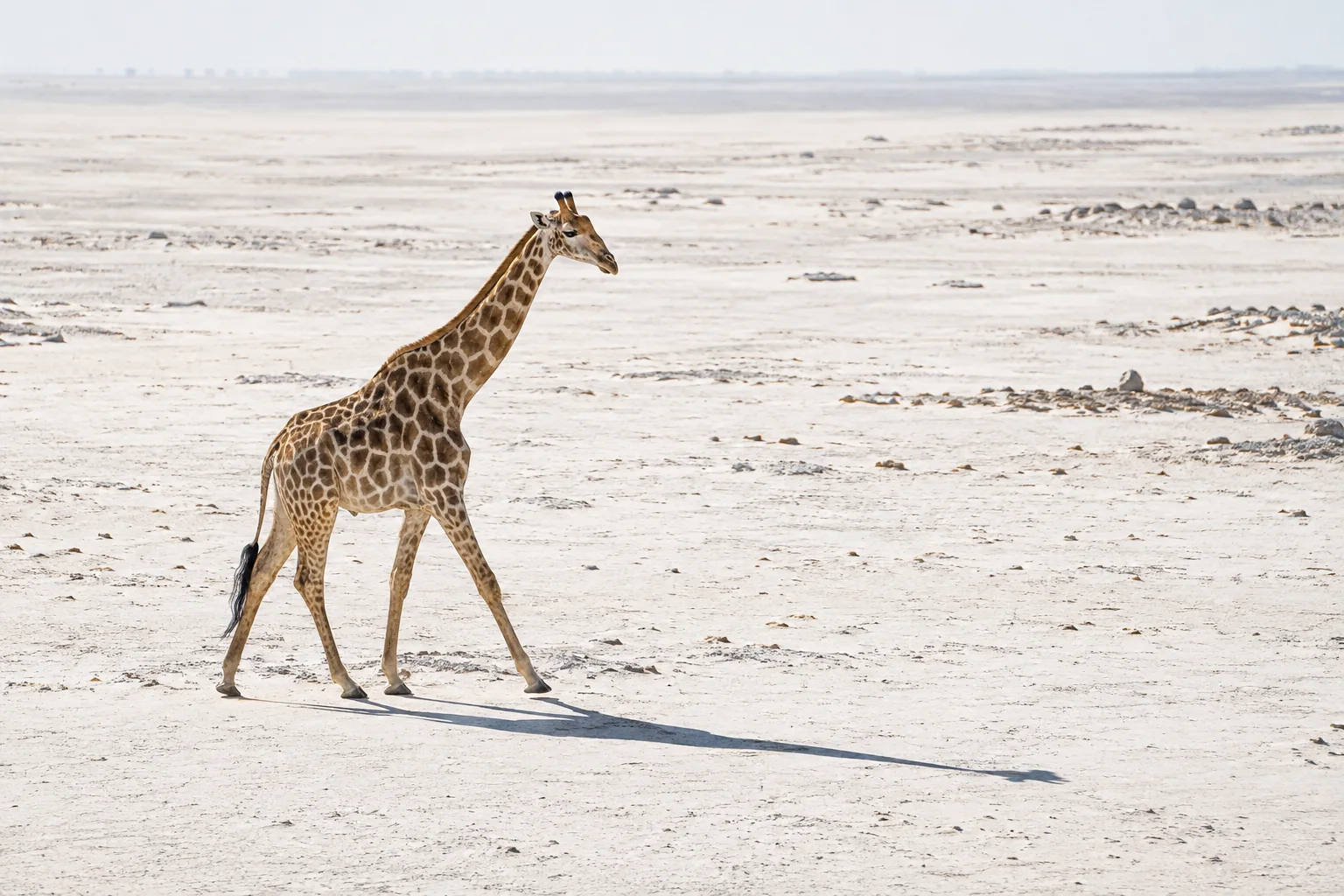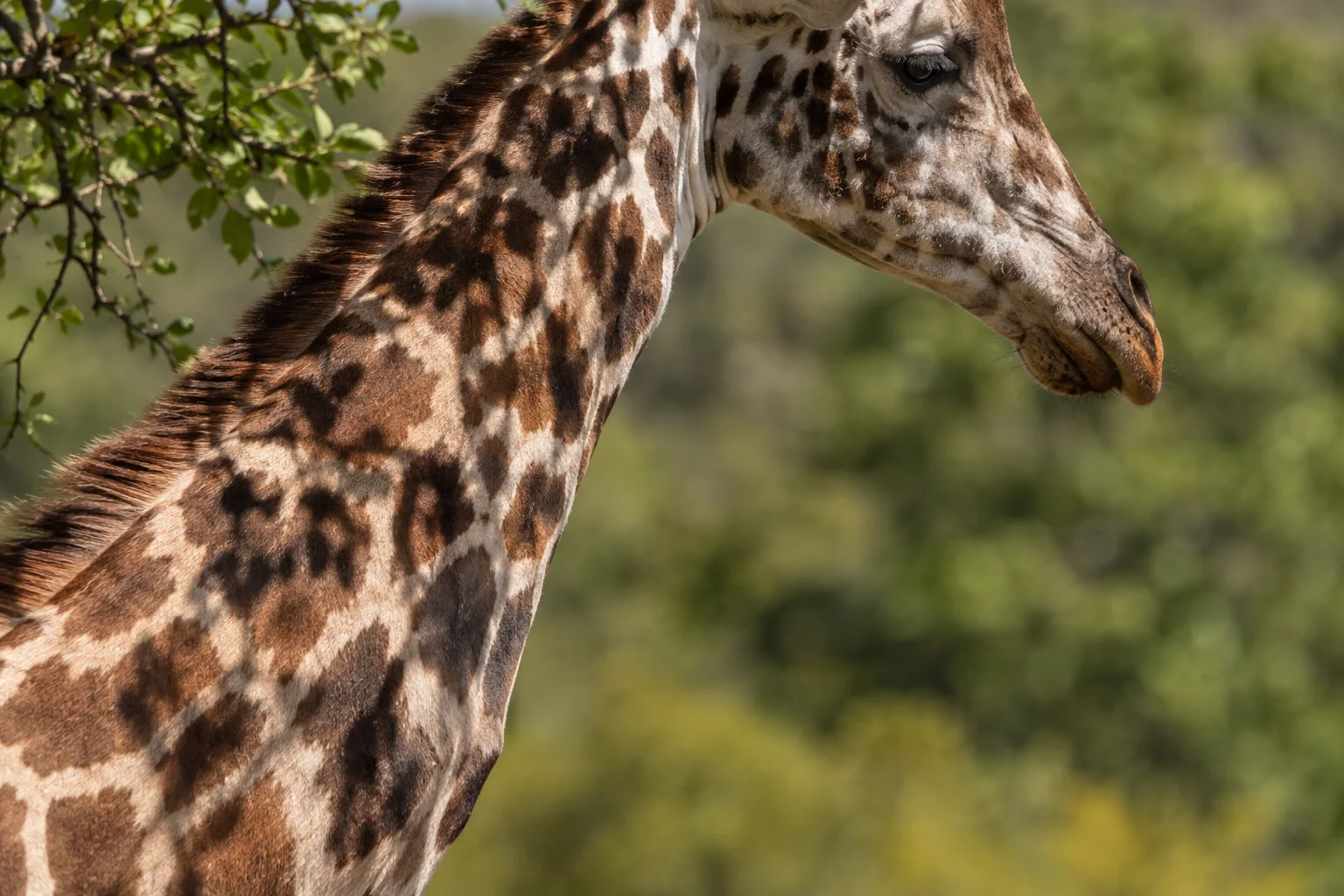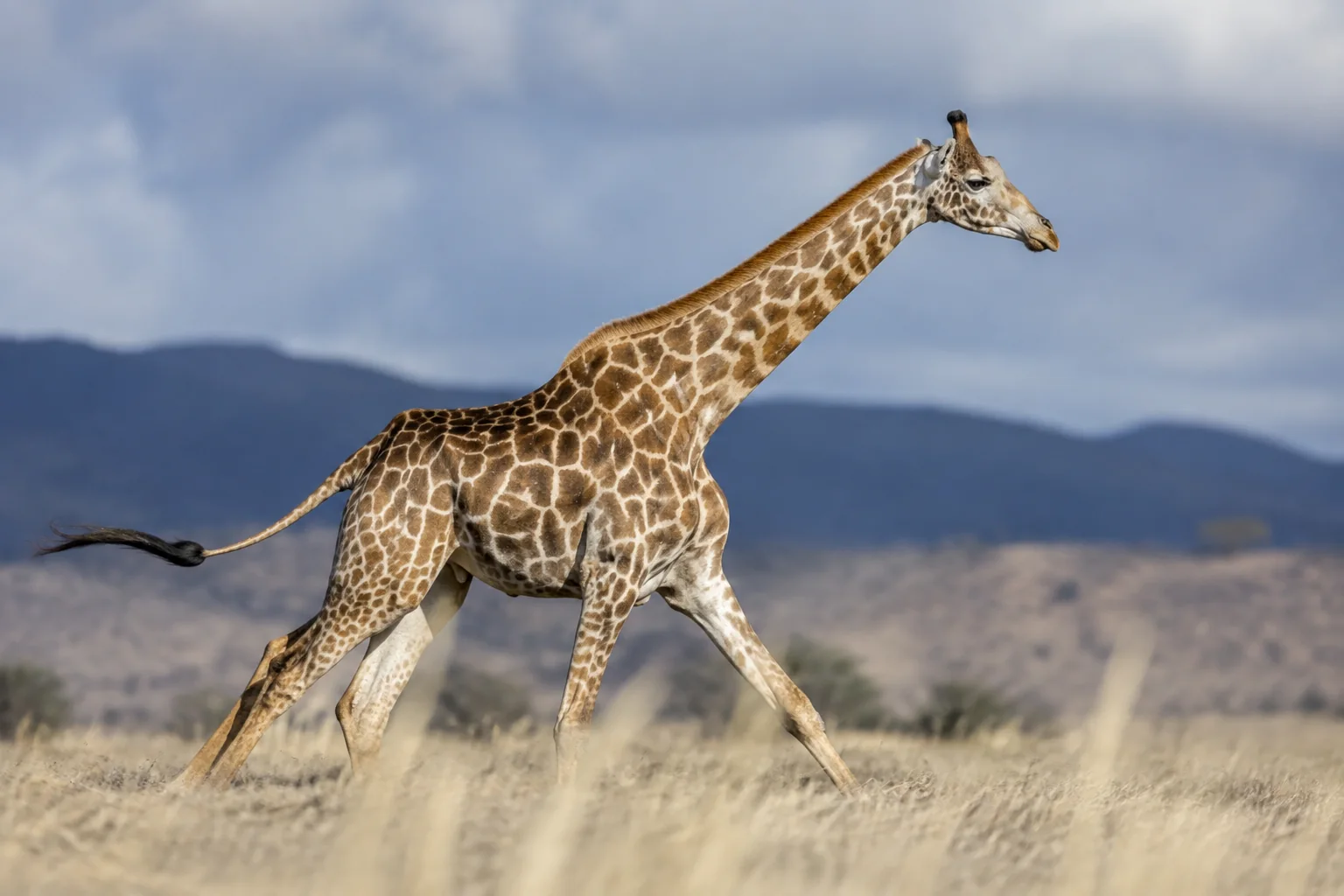
A giraffe can carry a conspicuous skin lesion without showing the walking changes a viewer might expect. Another can walk with a wire-snare wound yet take shorter, less symmetrical steps. The difference matters: judging harm by appearance alone can mislead us, but so can treating apparently ordinary walking as proof that an animal is well. A study of wild Nubian giraffes put part of that uncertainty into measurable terms.
Do skin disease and snare wounds change how giraffes walk?
The clearest walking differences were associated with snare wounds, not the mainly neck-located skin lesions studied here. That is a finding about selected movements in one population, not a general health verdict.
The focal paper is Evaluating the effects of giraffe skin disease and wire snare wounds on the gaits of free-ranging Nubian giraffe, by L. M. Bernstein-Kurtycz, N. T. Dunham, J. Evenhuis, M. B. Brown, A. B. Muneza, J. Fennessy, P. M. Dennis and K. E. Lukas. It appeared in Scientific Reports, volume 13, article 1959, on 3 February 2023, DOI 10.1038/s41598-023-28677-y.
The team made an important practical contribution: turning short field videos into comparable measurements of footfalls and neck movement. Rather than relying on impressions of difficulty, they asked which parts of walking differed between visible-condition groups.
Nubian giraffes belong to the northern giraffe species. Their conservation makes careful interpretation consequential. Our giraffe health guide places movement research alongside the other evidence involved in professional health assessment.
Which giraffes were actually measured?
Researchers first piloted their method with four Masai giraffes at Cleveland Metroparks Zoo. They then used footage collected opportunistically during wider research in Uganda's Murchison Falls National Park, from July 2015 to August 2016.
The field observation pool included 52 adult males. After selecting usable footage, Table 1 reports 115 limb-analysis strides from 33 giraffes and 71 neck-analysis strides from 29 giraffes. These are different denominators: 52 was not the number contributing to every analysis, and 115 was not a herd of 115 independent animals.
For limb analysis, the table separates four groups: ten giraffes with neither visible condition, ten with skin disease alone, four with snare wounds alone, and nine with both. The particularly small snare-only group matters when interpreting its results.
The paper calls the first group “healthy”, but defines that as no visible skin-disease lesions or snare wounds. That does not exclude hidden illness or a difficult-to-see old injury. Giraffe skin disease, abbreviated GSD, was classified as present or absent, not graded by severity. Lesions were predominantly on the neck.
Filming and image selection also shape the evidence. Walking was recorded on flat ground, and feet had to be sufficiently visible to identify contact with the ground. Neck measurements required a suitable side view. An animal that could not be observed walking clearly might be missing from the analysis. As with giraffe photographic surveys, what enters the dataset is part of what the result means.
What can a video measure—and what can it not?
The researchers marked the frames in which each foot touched down and lifted off. They measured stride length relative to shoulder height, giving a body-size-scaled distance instead of pretending every giraffe had the same proportions. Dividing that distance by stride duration produced relative walking speed, not kilometres per hour.
They also recorded the timing between same-side hind and front footfalls, the number of supporting limbs, and left–right differences in ground-contact duration. For giraffes with unilateral snare injuries, the asymmetry calculation was oriented to the injured side. These are measurements of kinematics: movement and timing.
Our comparison below separates observations from explanations and outcomes. It is an original reading aid, not a study figure.
| Observation or outcome | What it can establish here | What would require more evidence |
|---|---|---|
| Visible lesion or snare wound | Which observed condition group an animal entered | Cause, hidden damage or pain severity |
| Footfalls and stride length | Differences in the selected walking movements | Running capacity, endurance or daily distance |
| Less ground-contact time on the injured side | An asymmetry compatible with a compensatory movement pattern | How much force the injured limb actually carried |
| Unmeasured outcomes: feeding, survival or recovery | Not established by this analysis | Whether the walking difference changes long-term health or survival |
Repeated strides from one animal share that animal's characteristics. The mixed models included GSD and snare presence as fixed factors, with individual nested within video clip as a random intercept, as reported in Methods. This grouping was intended to account for shared observations. Speed was used as a continuous adjustment variable (covariate) only in the supporting-limb and neck-range models. Follow-up group comparisons were adjusted for multiple comparisons; the main text does not report a GSD-by-snare interaction test. The results remain observational.
For a different question—how researchers measure faster movement—see giraffe running speed. A result about ordinary walking should not be presented as a test of escape performance.
What were the clearest findings?
Compared with giraffes in the no-visible-condition group, those with snare wounds alone had significantly shorter relative strides, slower relative speeds, altered same-side footfall timing and greater asymmetry after the reported comparison adjustment.
The size of one difference is easier to understand than a significance label alone. Table 5 gives model-estimated stride lengths of 1.06 shoulder heights for snare-only animals, versus 1.24 for the comparison group. Their respective 95% confidence intervals were 0.96–1.17 and 1.16–1.33. These intervals describe uncertainty around estimated group means, not the range containing 95% of individual giraffes. Neither value is a threshold for diagnosing injury.
Giraffes with both GSD and snare wounds also differed significantly from the comparison group in footfall timing and asymmetry. The adjusted comparisons did not establish the same shorter-stride and slower-speed contrasts for that combined group. Collapsing the two injured groups into a single result would lose information.
The published results and tables report no significant GSD effect on the measured limb variables. For neck movements, adjusted pairwise comparisons also found no significant group differences. There is a reporting discrepancy worth preserving: the Results text attributes a preliminary neck-angle signal to GSD, while Table 6 places that signal under snare wounds. Table 7 separately reports no significant adjusted pairwise contrasts. Those comparisons answer a different statistical question; they do not resolve the conflicting attribution.
The authors interpret reduced contact on the injured side as compatible with reducing loading on an injured limb. That is a plausible mechanical explanation, not a direct force measurement: there were no force plates under these wild giraffes.
Does the absence of a detected effect mean skin disease is harmless?
No. A non-significant result says the analysis did not establish that particular difference. It does not demonstrate that the groups are biologically equivalent, that no individual is affected, or that another measurement would show nothing.
Three limits are especially important. Location: mainly neck lesions cannot settle the effects of lesions around a limb. Selection: adult males walking visibly on flat ground do not represent every sex, age, injury severity or behaviour. Resolution: recording presence or absence may combine conditions that differ in severity, duration and biological cause.
The study also did not measure pain, the energy cost of movement, feeding success, survival or treatment outcomes. Its Discussion considers broader welfare and conservation implications, but those implications should remain distinct from the recorded endpoints. A walking video alone cannot decide whether veterinary intervention is warranted.
The positive contribution is precision: the work identifies detectable movement differences associated with snare wounds while avoiding the assumption that every striking skin lesion must produce the same gait pattern. That helps sharpen questions about threats to giraffes, without ranking all threats by how dramatic they look.
How does this connect to other giraffe research?
Finding an organism is different from measuring its effects
Wanda, Mjingo, Mwega and Malago's 2025 study examined skin-lesion biopsies from ten Masai giraffes in Tanzania's Ruaha National Park. Microscopy detected spirurid nematode larvae in six biopsies. Those six entered molecular analysis; three were positive in a targeted DNA test. The reported partial 28S rDNA sequence closely matched Thelazia callipaeda references.
This adds evidence about organisms present in some lesions. It does not establish the cause of every condition called GSD: animals were purposively sampled from lesion-bearing giraffes, without unaffected controls, and the molecular identification relied on a partial genetic marker.
The connection is useful precisely because the studies do not complete each other's conclusions. The Ruaha samples and Ugandan gait videos came from different giraffe taxa, places and animals. The gait study did not confirm those parasites in its subjects. Together, they suggest how future work could connect a better-characterised lesion with a measured functional consequence—not that this causal chain has already been demonstrated.
A repeatable measurement is not a complete health assessment
Clavadetscher and colleagues' 2021 photographic study developed a seven-level hip body-condition score. The same observer scored photographs of 141 giraffes twice, two weeks apart; 87.2% received identical scores. That supports consistency for that observer, not agreement among different scorers.
This is a methodological connection, not evidence that low body condition caused the walking patterns in the gait study. Both approaches make a defined observation more systematic. Neither measures the whole animal's health, and their outputs are not interchangeable. Our body-condition commentary explains the separate problems of image selection, repeatability and biological validity.
Two research questions worth pursuing
These are editorial proposals, not findings, claims of novelty or requests attributed to the researchers. Bernstein-Kurtycz and colleagues already proposed studying lesion location and severity; the questions below build on that foundation.
Does movement change as the same animal's condition changes?
Repeat observations could ask whether changes in a documented lesion or wound precede consistent changes in gait, alongside independent professional condition assessments. Comparing an animal with its own earlier record would help separate persistent individual differences from changing condition.
The study would need comparable camera views and terrain, records of speed, season and other injuries, and explicit handling of missing observations. Disappearance from view cannot automatically mean recovery or death. Care must never be delayed to create a comparison, and injuries must never be induced. Temporal co-change would strengthen a hypothesis, not prove causation by itself.
Do several signals together predict more than appearance alone?
An existing photo-identification study could compare how well initial lesion appearance, gait and combined observations predict the proportion of observation time spent browsing over the following 30 days. Separate observers would score browsing with the initial measurements withheld, using standardised observation periods and recording visibility and missing follow-ups. That provides an independently recorded behavioural outcome—not a health judgement assembled from the same initial signs.
Testing predictions on different animals or later periods would check whether apparent improvements carry over. Suitable body-condition images might add another predictor; the observation plan would not require research-only immobilisation. Seasonal browse availability, observation effort and uneven visibility would need accounting for. Browsing time does not measure food intake, but this bounded comparison could reveal which signals help researchers anticipate subsequent browsing behaviour.
What to remember
- Visible injury, walking mechanics and overall welfare are related questions, not interchangeable answers.
- Table 1 reports 33 giraffes contributing 115 limb strides; repeated steps do not enlarge the independent animal sample.
- Snare-only animals showed the clearest differences in stride length, relative speed, timing and symmetry.
- Mainly neck-located GSD did not significantly affect measured limb movements here; that does not establish harmlessness elsewhere.
- Better-characterised lesions and repeated observations could connect appearance with subsequent everyday behaviour.
Explore the injury and lameness evidence area, the giraffe science hub and its research library for the original paper and related evidence.
Frequently asked questions
Can giraffe skin disease stop a giraffe walking normally?
Location and severity matter. This study's mainly neck-affected adult male sample showed no significant GSD effect on the limb variables measured; it did not settle the question for limb lesions elsewhere.
What did snare wounds change in this study?
Shorter relative strides and slower relative speeds distinguished the snare-only group from the no-visible-condition group. Both snare groups showed altered timing and symmetry; the combined GSD-and-snare group did not share every significant contrast.
Does a normal-looking gait mean a giraffe feels no pain?
No. This analysis did not measure pain. Neither a still photograph nor the absence of a detected walking difference can establish an individual animal's comfort or treatment needs.
Did researchers identify the cause of the Ugandan skin lesions?
Not in this gait analysis. Separate parasite research in Tanzania provides evidence about some sampled lesions, but does not identify the cause of the Ugandan subjects' lesions or demonstrate an effect on their movement.
Sources
- Bernstein-Kurtycz et al. — focal study, Scientific Reports (2023). Full open-access main article, figures and tables checked. The linked supplementary workbook was not accessible in this review; no raw-data reanalysis is claimed.
- Wanda et al. — spirurid nematodes in Ruaha giraffe lesions (2025). Open full text checked for sampling, histology, molecular identification and causal limits.
- Clavadetscher et al. — photographic body-condition scoring (2021). Primary methods, repeatability results and limitations checked; its health-measurement question is distinct from gait.
Sources checked 10 September 2026. The comparison and proposed questions are original editorial interpretations, not author endorsements or external peer review.