The northern giraffe has gained numbers in a recent continent-wide assessment without regaining anything like its former security. Its remaining populations include animals sharing agricultural landscapes in Niger, groups scattered across Central Africa, and Nubian giraffes in East Africa. Saving one population cannot substitute for conserving the others: they occupy different places, face different pressures and carry distinct parts of the species' history.
What is the northern giraffe?
The northern giraffe, Giraffa camelopardalis, is one of the four giraffe species recognized in the IUCN specialist group's 2025 taxonomic framework. It contains three subspecies: West African, Kordofan and Nubian giraffe. “Northern” is a species name, not a label for any giraffe seen in the northern part of a country.
The distinction matters when reading older sources. The same scientific name, Giraffa camelopardalis, was also used for all giraffes under the earlier one-species classification. A historical paper using that name might therefore concern a population now assigned to another species. Check the place and the population described, not just the Latin heading.
IUCN's August 2025 announcement separated the taxonomic revision from the upcoming Red List assessments it would inform. Recognition as a species is not itself an extinction-risk category. The endangered-status guide explains that distinction; a proposed category in a conservation report should not be presented as a newly completed official assessment.
The three subspecies and where they live
The natural-range countries below follow the June State of Giraffe 2025 compilation. They describe a fragmented distribution, not continuous occupation of those countries.
| Subspecies | Scientific name | Natural-range countries in the report |
|---|---|---|
| West African | G. c. peralta | Niger |
| Kordofan | G. c. antiquorum | Cameroon, Central African Republic, Chad, Democratic Republic of Congo, South Sudan |
| Nubian | G. c. camelopardalis | Ethiopia, Kenya, South Sudan, Uganda |
South Sudan appears twice because the two subspecies have different distributions there. For Kordofan giraffes, the report relies on a 2017 observation and notes the absence of subsequent systematic surveys. That is not evidence that exactly one survives today. Source: northern-giraffe chapter, State of Giraffe 2025.
West African giraffe: a Niger population, not a regional synonym
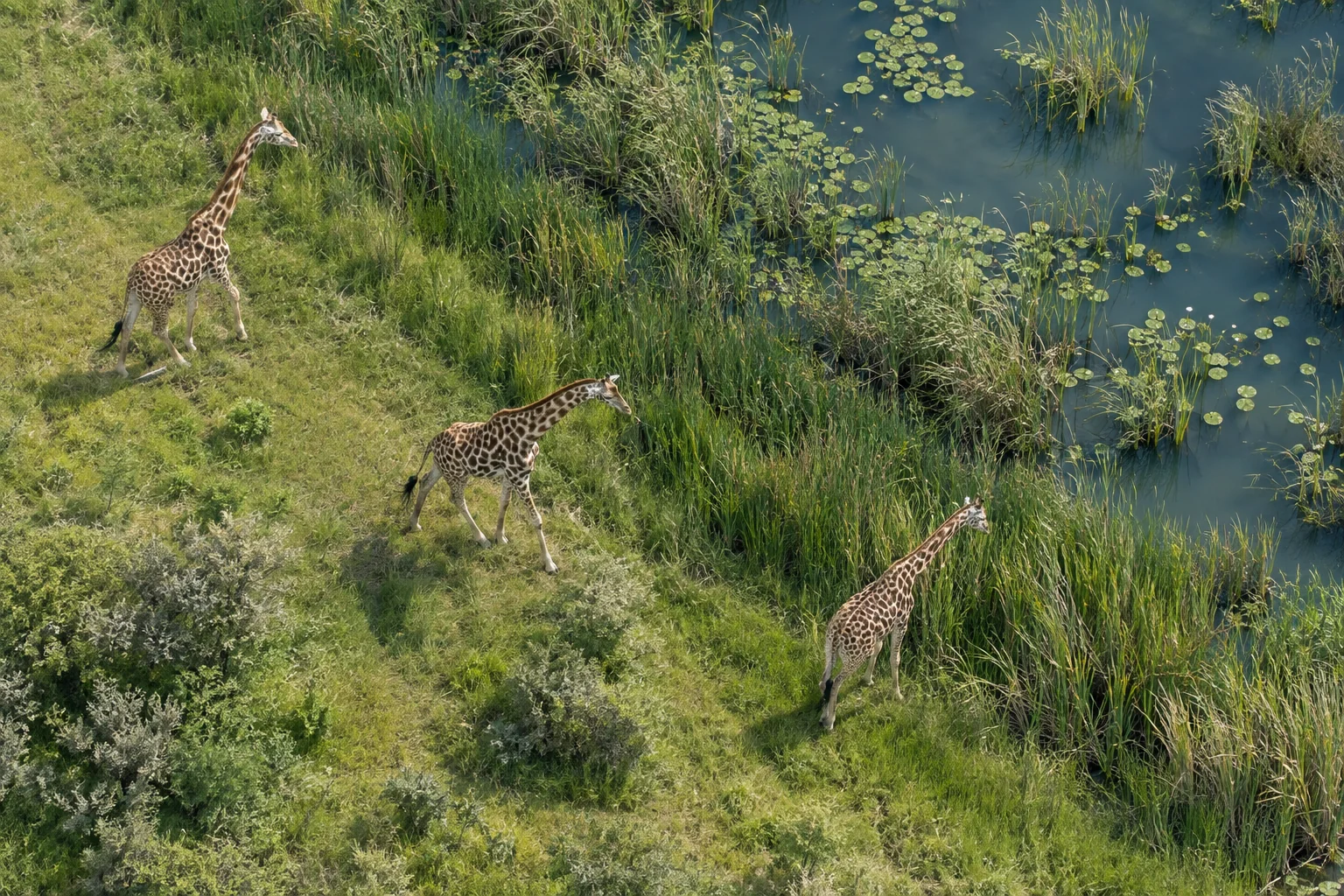
West African giraffe means this particular subspecies, not every giraffe occurring in West Africa. Its remaining natural population is in Niger. The well-studied “Giraffe Zone” illustrates a distinctive conservation setting: giraffes persisted among agricultural land and people rather than exclusively inside a national park.
That setting makes everyday land use part of the conservation question. The relevant habitat is not simply an attractive patch of vegetation on a map; it includes the places through which animals can move and the land people use. The Niger monitoring case below shows why this population is important without calling coexistence automatic or free of costs.
Kordofan giraffe: Central African strongholds and gaps
Chad is the principal stronghold in the 2025 compilation, while information for parts of the Central African Republic and South Sudan is much thinner. Treating the range as five equally well-known national populations would hide that difference.
For Kordofan giraffe conservation, a stronghold and a poorly surveyed remnant pose different tasks. In the first, managers can ask whether numbers and occupied habitat are being maintained. In the second, establishing where animals remain may be an immediate priority. Neither question is answered by a species-wide growth percentage. Equally, a lack of recent observations should not be casually converted into either proof of extinction or assurance that a population is stable.
Nubian giraffe: one subspecies with regional differences
Nubian giraffes include populations historically called Rothschild's giraffes. The name change does not mean every Nubian population has the same origin or management history. Nor does an animal become a different subspecies merely because it has been moved to another reserve.
The contrast is especially important in Kenya. Muneza and colleagues' 2024 review describes a population predominantly outside its historical range and/or restricted to closed protected areas. “Extralimital” means outside that historical natural range; it is not another word for captive. Such populations need to be understood through both their current habitat and their documented origin.
How many northern giraffes are left?
The June 2025 State of Giraffe estimate was 7,037 northern giraffes, divided into 669 West African, 2,391 Kordofan and 3,977 Nubian giraffes. Its five-year comparison reported a 19% increase from the 2020 estimate, while the thirty-year comparison was approximately 70% below the 1995 baseline. These are dated report estimates, not a simultaneous census or a current live total.
The short and long comparisons answer different questions. A recent improvement does not erase a much larger earlier decline. And a combined increase does not mean every locality or subspecies improved at the same rate.
Later national evidence updates part of that picture. Kenya's 2025 National Wildlife Census, Table 4.7, reports 1,388 Nubian giraffes in Kenya, compared with 1,040 in its 2021 column. This national compilation combines survey methods and observation dates; it is not a new global northern-giraffe estimate. Inserting one revised country figure into the older global sum would create a number that no source published. The population guide tracks the dated sources separately.
The northern giraffe's low total is consequential, but it is not, by itself, a defensible way to rank it as the “most threatened” species. Risk also depends on population change, distribution, fragmentation and the evidence used in a formal assessment. A conservation profile is more informative when it names those conditions than when it awards a superlative.
Can you identify a northern giraffe by its coat?
A coat photograph is not a guaranteed species diagnosis. The 2025 taxonomic assessment did not use pelage characteristics to decide giraffe taxonomy, noting the limited systematic evidence and variation within populations. It evaluated genetic, morphological and biogeographic evidence together. Its treatment also placed Rothschild's giraffe within Nubian giraffe rather than retaining it as a separate subspecies.
For someone labelling a photograph, known population origin is more useful than a promise about “white socks” or patch colour. Where the animal was photographed may not establish origin if animals have been translocated. If that history is unknown, “giraffe” can be a more accurate caption than a confident but unsupported subspecies label.
This is separate from recognizing an individual through its markings. A pattern can help researchers match two photographs of the same animal without functioning as a universal key to species. The coat-pattern science guide explains why individual identification and taxonomic classification should not be confused.
What threatens northern giraffes?
Habitat loss and fragmentation, illegal killing, insecurity and limits on movement recur across the northern giraffe's conservation literature. Their importance differs between landscapes; “Africa is dangerous” is neither a useful explanation nor a description of every place these animals live.
For a browsing animal, conserving habitat means asking what vegetation is available and whether the animal can reach it. A protected boundary alone does not answer questions about accessible food, neighbouring land or opportunities to move. That is why protecting giraffe habitat involves more than calculating the area enclosed.
The Kenyan review identifies habitat fragmentation and infrastructure development among continuing concerns. In a closed population, maintaining numbers and maintaining options for future movement are not necessarily the same achievement. Management may need to consider how the population fits its available habitat, not merely whether it has increased.
In poorly accessible parts of the northern range, insecurity can obstruct both protection and research. An old estimate may persist in a database because obtaining a new one is difficult. That uncertainty does not make the animals less important; it changes what can responsibly be said about their present status.
Genetic isolation adds another question, but it should not become a blanket diagnosis. Separate groups do not all have identical levels of diversity or recent inbreeding. The South Sudan research below is a concrete example of why population-specific evidence matters. Neither small numbers nor retained diversity alone supplies a complete prognosis.
What conservation evidence shows
Niger: recovery survives a correction to the records
Vukelić and colleagues' long-term study, first published online in November 2025 and appearing in a 2026 issue, analysed annual photographic records from 2005–2019. Rechecking identities removed false extra animals, yet the corrected models still supported positive population growth. The model estimated 562 giraffes in the Giraffe Zone in 2018; that was a year-specific estimate, not the total number of identities accumulated over fifteen years.
The area was not formally protected during the study; the paper notes a reserve established in December 2024. It therefore supports an important case of growth in a human-used landscape, not a claim that the place remains unprotected or that one intervention was experimentally proved responsible.
For readers, the constructive lesson is that correcting an overcount need not destroy a recovery story. It can make the story more credible. The survey-methods guide explains how repeated photographs become population evidence and why an image database is not automatically a census.
Kenya: management creates responsibilities beyond relocation
The Kenyan Nubian review places conservation translocations within the history of population recovery, while also describing closed and fragmented populations. Its broad account is evidence that managed populations matter to the subspecies. It should not be stretched into a claim that moving any giraffe anywhere is beneficial.
A conservation translocation needs a suitable destination, a justified choice of animals and follow-up. For northern giraffes, population identity and origin make those questions especially relevant. Successful arrival is one milestone; continued survival, reproduction and habitat suitability are the outcomes needed to judge establishment.
This also changes how a range map should be read. A new dot can document a real conservation achievement without showing that an animal could travel naturally between that site and the others. Re-established populations and landscape connectivity are related goals, not identical results.
South Sudan: conserving diversity that a headcount misses
Van Giessen and colleagues' 2026 genomic study added samples from Boma and Badingilo to wider Nubian comparisons. It distinguished regional groups associated with Ethiopia–South Sudan, Kenya and Uganda, and found substantial retained genetic diversity in the sampled South Sudan animals.
Those findings identify an important part of the subspecies' genetic inheritance. They do not establish a rising population, guarantee long-term viability or demonstrate a functioning crossing route over the White Nile today. Signals of historical gene flow and evidence of present-day movement are different things.
The fuller South Sudan genetic-diversity article examines that distinction. For the species profile, the central point is practical: a population's importance cannot be read solely from its share of the northern giraffe total. Conserving distinct regional populations preserves more than an interchangeable number of animals.
What to remember
- Northern giraffe comprises three subspecies with distinct ranges: West African, Kordofan and Nubian.
- The 7,037 figure belongs to a June 2025 compilation; it is not a live count.
- Recent aggregate gains coexist with fragmentation, local uncertainties and a much larger historical decline.
- Niger's monitoring, Kenya's managed populations and South Sudan's genetics provide different kinds of conservation evidence.
- Coat patterns, taxonomic recognition and extinction-risk categories answer different questions.
Frequently asked questions
Is Rothschild's giraffe the same as Nubian giraffe?
Under the 2025 framework, the former Rothschild's subspecies is included within Nubian giraffe. “Nubian” therefore covers more than just the populations formerly labelled Rothschild's.
Are all giraffes in northern Kenya northern giraffes?
No. “Northern” is a taxonomic name, not a compass description. Kenya has more than one giraffe species, and a reliable label needs population identity rather than the word “north” in a location.
Do northern giraffes live only in protected areas?
No. The Niger case studied giraffes in a human-used landscape outside formal protection during the monitoring period. Conversely, the Kenyan review describes many Nubian populations in closed protected areas. Neither setting describes the entire species.
Does the recent increase mean northern giraffes are safe?
No. An aggregate increase is encouraging but does not resolve local habitat limits, isolation or missing information. It also does not cancel the longer decline or itself create a new official Red List category.
Sources
Sources checked on 6 September 2026. Population figures refer to the June 2025 report version, unless another source and period are specified. The research library provides further pathways into giraffe conservation evidence.
- IUCN SSC GOSG (2025), An Evaluation of the Taxonomic Status of Giraffe, and the accompanying IUCN announcement, linked above.
- GCF, State of Giraffe 2025: version record.
- Vukelić et al., Niger monitoring study.
- Muneza et al. (2024), Nubian giraffe in Kenya. The accessible abstract supports the limited description here.
- Van Giessen et al. (2026), South Sudan genomic study.