The West African giraffe survived a collapse to only a few dozen animals and then increased for decades. That recovery is consequential, but it is not the same as security. Almost the entire subspecies remains concentrated in one human-used landscape in Niger, while the newest continental synthesis relies partly on an older count and prints figures that do not agree with one another.
What is the West African giraffe?
The West African giraffe is Giraffa camelopardalis peralta, one of three subspecies of the northern giraffe. In the taxonomic framework adopted by the IUCN SSC Giraffe and Okapi Specialist Group in August 2025, northern giraffe is one of four giraffe species; its other subspecies are Kordofan and Nubian giraffes. The name “West African giraffe” therefore identifies a lineage, not every giraffe that once lived in the western half of the continent.
That distinction also explains why older sources can be confusing. Many used Giraffa camelopardalis for all giraffes under a one-species classification. The current specialist-group framework retains that binomial specifically for northern giraffe and adds peralta for this subspecies. Our giraffe taxonomy and genetics guide explains how the evidence and naming changed.
IUCN's 2025 announcement made another distinction clear: recognising four species does not itself assign four new Red List categories. The existing 2018 subspecies assessment lists the West African giraffe as Vulnerable. A recommendation in a later conservation report to retain that category is not a completed new IUCN assessment.
Appearance is a clue, not a diagnosis
Public field descriptions often portray northern giraffes as having chestnut patches separated by pale cream lines, with relatively unmarked lower legs—the familiar “white socks.” Colour varies, and GCF's northern-giraffe profile describes a species-level tendency rather than a foolproof key for peralta.
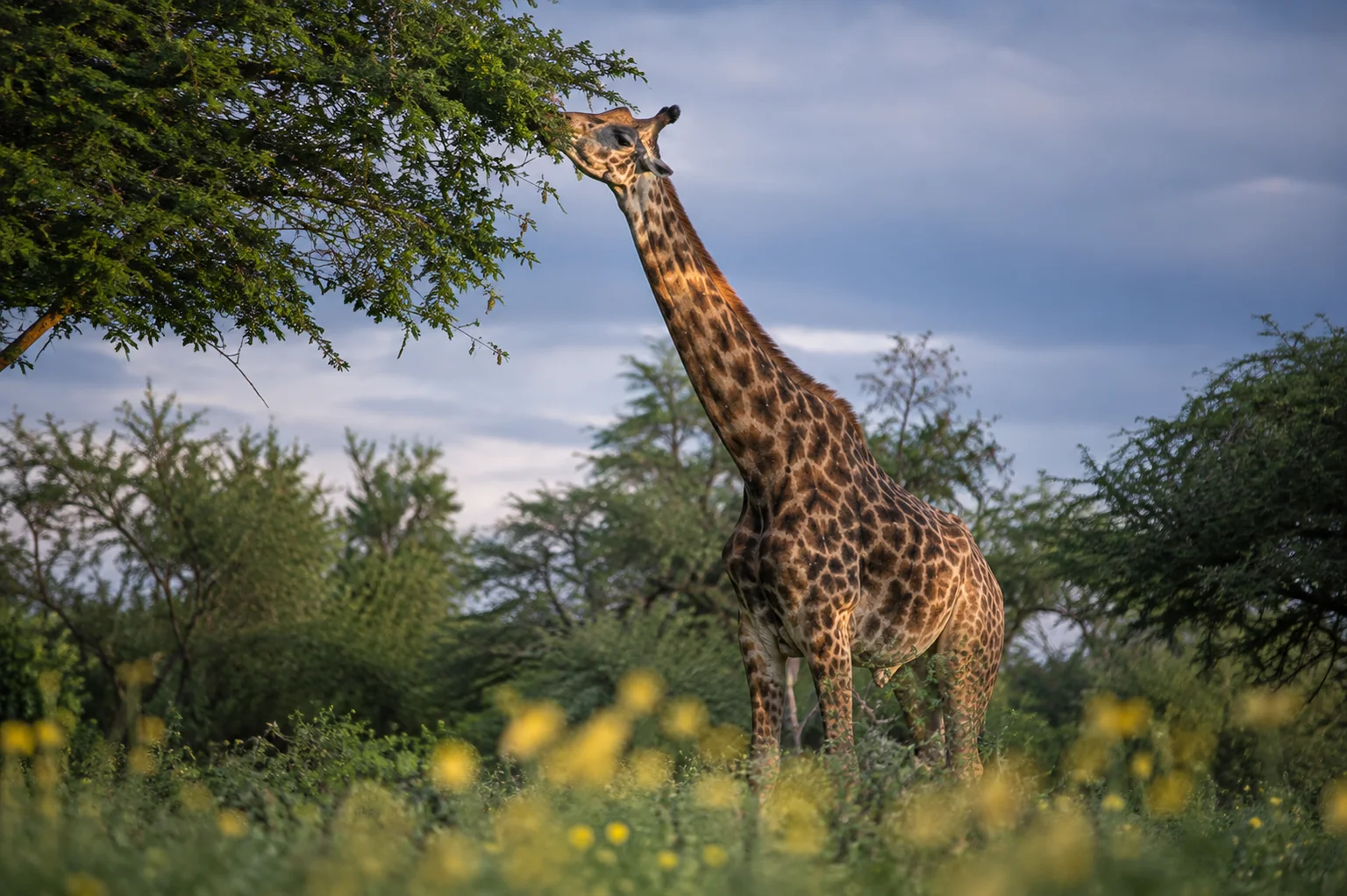
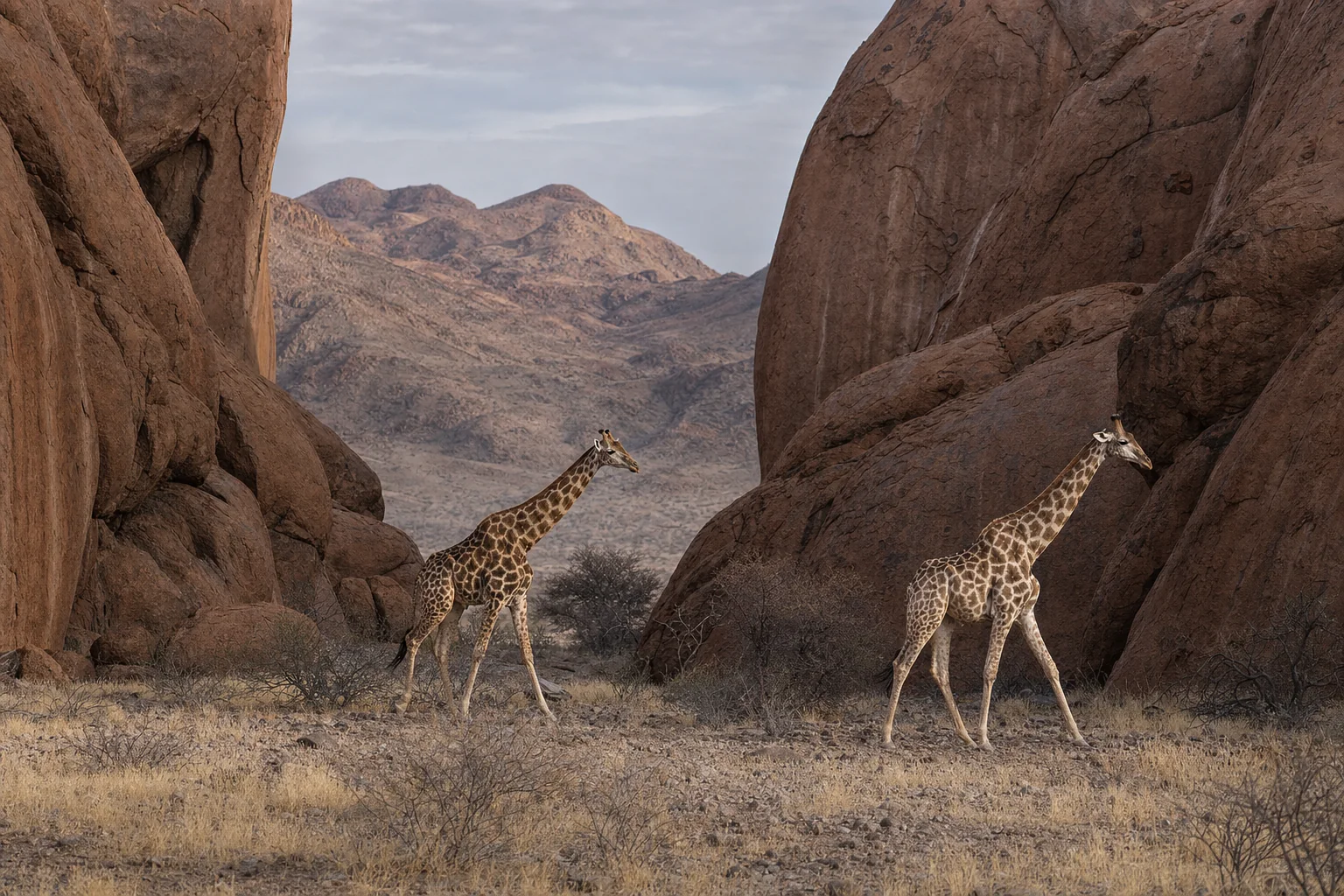
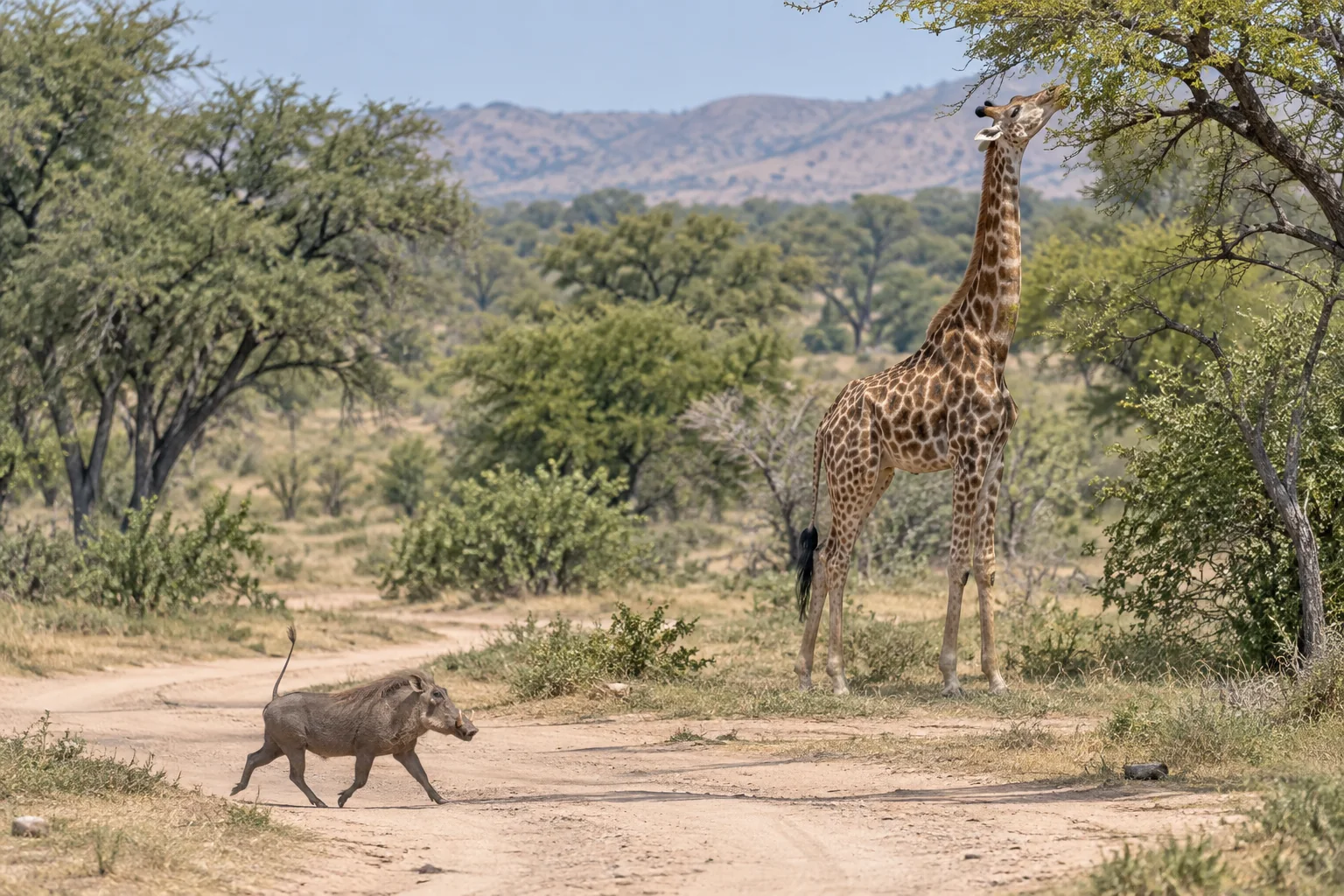
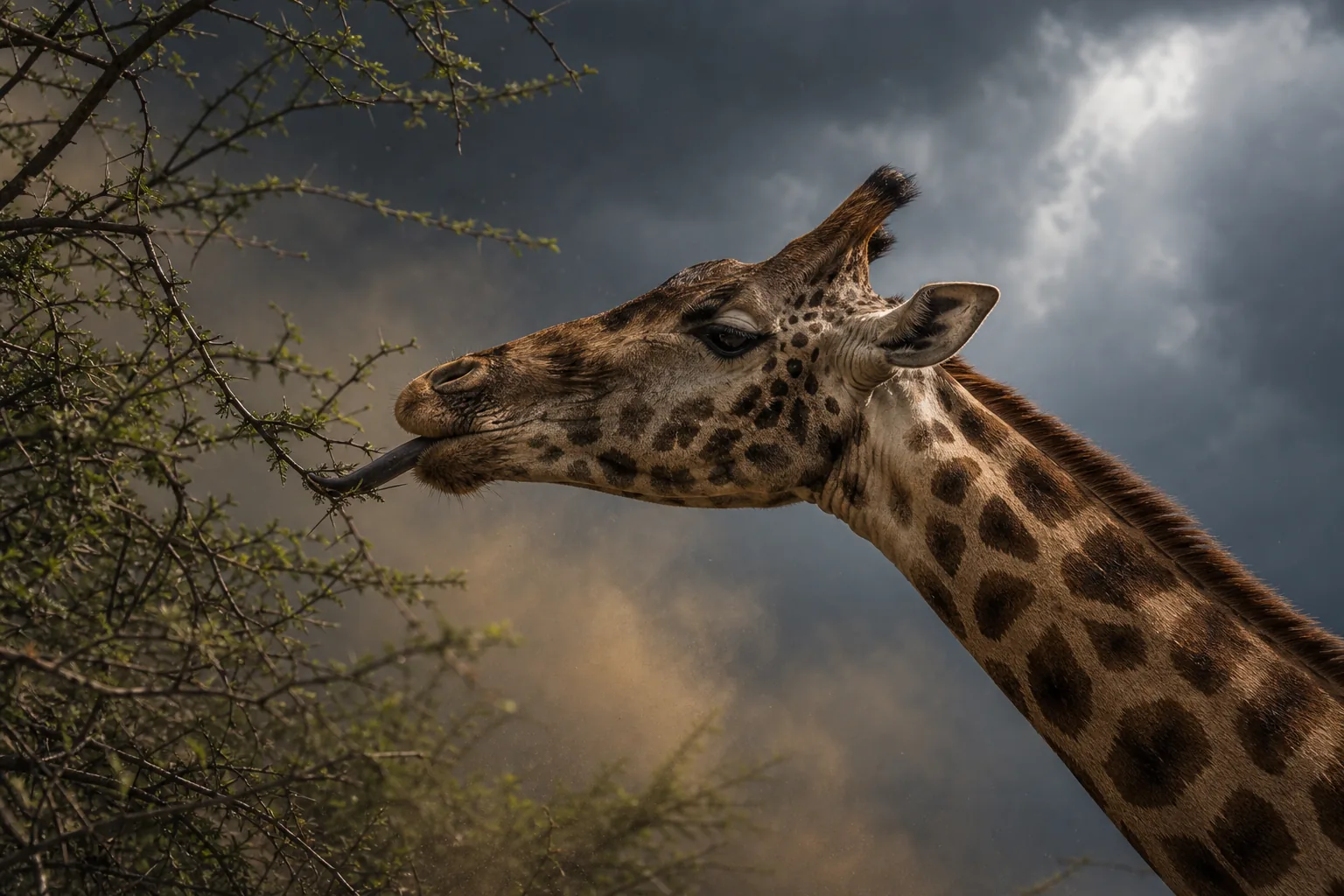
A pale coat or clean-looking lower leg cannot establish subspecies on its own. Individual variation, lighting, image processing, overlapping descriptions and an animal's movement history all limit visual certainty. Known population origin is stronger evidence; genetics can answer narrower ancestry questions. Coat patterns are still excellent for matching photographs of the same animal, as the coat-pattern science guide explains, but individual recognition and taxonomy are different tasks. The illustration above is not identification evidence.
Where does the West African giraffe live?
At the beginning of the twentieth century, West African giraffes still occurred across a broad Sudano-Sahelian belt from Senegal towards Nigeria. Hunting, habitat loss and fragmentation reduced that range until the surviving natural population was confined to Niger. This history is part of a wider four-species giraffe story, but its present conservation meaning is unusually concentrated: one country now holds the subspecies' remaining natural range.
The June State of Giraffe 2025 report lists Niger as the natural-range country. It also reports five animals in semi-captive facilities in Burkina Faso and Nigeria as extralimital—outside the mapped natural range used for its main estimate. Those reported animals do not establish restored wild populations in either country.
One natural range, two main population contexts
Most West African giraffes live in the Giraffe Zone southeast of Niamey, a landscape of plateaus, seasonal vegetation, farms, villages and livestock. It was not a formally protected national reserve during the long monitoring study discussed below. “Outside a park” did not mean outside human influence or management. It meant that giraffe persistence depended on a shared landscape rather than separation behind a protected-area boundary.
A much smaller population was established farther east in the Gadabedji Biosphere Reserve using animals moved in 2018 and 2022. This does not mean giraffes occupy the space between the two areas continuously, or that the populations are equally secure.
How many West African giraffes are left?
The most recent all-range synthesis, published in June 2025, reports 669 West African giraffes in Niger. That is a dated compilation, not a live counter or a simultaneous census. The giraffe population guide explains why year, method and coverage belong beside any wildlife number.
| Evidence date | Figure | What the figure represents | Main limitation |
|---|---|---|---|
| 1995 | 70 | Historical Niger baseline used in State of Giraffe 2025 | A reconstructed comparison point, not directly interchangeable with every later method |
| 1996 | 49 | Widely cited documented low in the demographic and genetics literature | Different date and evidence lineage from the report's 1995 baseline |
| 2018 | 562 (95% CI 524–600) | Modelled Giraffe Zone abundance after photo-ID records were cleaned | Does not include a later secondary population or provide a 2019 estimate |
| 2019 input | 656 | Giraffe Zone figure carried into the 2025 report | Report itself calls this input outdated; method differs from the 2018 model |
| June 2025 report | 669, printed with 537–613 | Niger total presented in the continental synthesis | Point estimate lies outside its accompanying printed range |
Why these numbers do not form a clean census series
The visible problem in the last row must not be tidied away. Table 1 of the inspected report prints 669 beside a range of 537–613; 669 is higher than the stated upper bound. The West African chapter repeats the same pair. Without a source correction, a reader cannot know whether the point estimate, the range or both require amendment.
The report also says the Giraffe Zone figure of 656 comes from 2019 and that insecurity has made accurate reassessment infeasible. This means 669 is best described as the report's June 2025 synthesis figure, not as 669 animals observed in 2025. The report's five-year increase of 12% likewise compares compiled benchmarks; it should not be converted into a current herd size or births-since-2020 calculation.
These limits do not erase the large recovery since the 1990s. They change how precisely its latest endpoint can be stated. The table is an evidence chronology, not a statistically uniform series.
What does the recovery evidence actually show?
A counting correction strengthened the evidence for growth
Vukelić and colleagues reanalysed annual photographic surveys from 2005–2019. Pattern-recognition software and human checking found 145 duplicate “ghost” identities among 979 giraffes previously identified across the fifteen-year archive. Removing those duplicates left 834 individual identities across the full study period—not 834 giraffes alive in one year.
The corrected capture–mark–recapture model estimated 562 giraffes in the Giraffe Zone in 2018, with a 95% confidence interval of about 524–600. It still found positive growth across the study period, with an estimated annual population growth rate of 1.12. No 2019 abundance was published because the final year's model parameters were confounded.
The older complete-enumeration approach increasingly overestimated abundance as the archive grew, partly because animals not seen again were retained unless death was confirmed. Yet the corrected analysis still supported recovery. Method determines what a count can mean; the giraffe survey-methods guide follows that distinction.
Recovery history is not a single-intervention experiment
The demographic rise occurred during years of government protection, local monitoring, conservation partnerships and unusually low natural-predator pressure in the Giraffe Zone. Earlier photo-identification research described high survival and positive growth, while also warning that habitat pressure and human–giraffe conflict could limit continuation.
Those observations make several explanations plausible, but do not isolate one organisation, policy or activity against a controlled alternative. A strong recovery was recorded during sustained protection and monitoring; the historical series does not prove that any single intervention caused the full increase.
How do West African giraffes live alongside people?
The Giraffe Zone is a Sahelian mosaic, not empty wilderness. Giraffes move among tiger-bush vegetation, wooded drainage areas, cultivated fields and settlements. Earlier research described seasonal movement onto the Fakara Plateau during wetter months and towards North Dallol Bosso in the dry season, with an intermediate area functioning as a movement corridor. This makes the location and timing of browse as important as the simple number of trees.
West African giraffes browse woody plants. A 2021 dry-season study used direct observation, browsing signs and microscopic analysis of droppings in three outlying Niger areas. It recorded 23 consumed plant species across ten families; Faidherbia albida, Combretum glutinosum and Balanites aegyptiaca were prominent in its results. That local seasonal sample is useful evidence, not a universal menu for every giraffe or month. For the general feeding mechanism, see what giraffes eat.
Living alongside people is neither automatic harmony nor permanent conflict. Farms and managed trees can provide browse, while giraffes may damage cowpea or mango crops. Livestock, wood cutting, settlement and infrastructure can alter vegetation and movement. The 2015 Niger strategy joined population viability to coexistence and monitoring; it stated a goal, not proof that every household experiences equal costs or benefits.
Why do genetics and a second population matter?
Retained diversity does not mean genetic security
A 2022 conservation-genomics study analysed mitochondrial sequences and 26 whole genomes across the three northern giraffe subspecies. Ten of those genomes were West African giraffes, including five newly sequenced for the study. The analyses distinguished West African giraffes from Kordofan and Nubian giraffes and found no further population structure within the sampled West African group.
Their genomic diversity was more substantial than might be expected after such a severe recent census decline when compared with other giraffe subspecies. But the study also found lower median heterozygosity and a higher recent inbreeding signal in West African giraffes than in the other northern subspecies it sampled. Both results can be true: useful variation has persisted, while a small, related population can still accumulate future genetic risk.
Genomic effective population size is not a headcount, and ten genomes cannot represent every living animal. The appropriate conclusion is continued genetic monitoring, particularly when a few founders establish a new group. Readers can explore the broader evidence in the genetic-isolation research area.
A second population spreads risk only if it persists
Niger's 2015 strategy made the creation of additional populations part of its stated conservation goal. The underlying logic is straightforward: when almost every animal occupies one landscape, drought, disease, insecurity or rapid habitat change can affect a large share of the subspecies at once. A geographically separate group can reduce that concentration risk and restore part of the former range.
The 2024 Operation Sahel case report documents twelve giraffes moved to Gadabedji in 2018 and 2022, no reported mortalities during the operations or reported post-release period, and five calves recorded by the end of 2023. These are encouraging early outcomes, not proof of long-term population viability. The Operation Sahel evidence commentary explains why establishment must be judged over a longer ladder of survival, reproduction, recruitment and manageable effects on the source population.
A later Sahara Conservation field update reports 13 giraffes tracked in Gadabedji during 2024, four losses following heavy rain and flooding, and two births. Those events should not be added to or subtracted from earlier totals to manufacture a current herd count. They show instead why a secondary population needs long-term monitoring: it creates another future, not immunity from hazards.
What threatens the recovery now?
The central risks arise from concentration, habitat change and incomplete information. Habitat loss, degradation and fragmentation can reduce browse or interrupt seasonal movement. Expanding cultivation, grazing, wood cutting, roads and settlements can change the same shared landscape on which people and giraffes depend. Crop damage can impose costs on particular households even where illegal killing remains uncommon.
Insecurity creates a second layer of risk by affecting both animals and the ability to observe them. An old population input can persist precisely because a new survey is unsafe or impracticable. Better information is therefore part of conservation, but the solution is not simply collecting more photographs: the fifteen-year reanalysis shows that large unstandardised archives can create confident errors without careful identity checking and statistical treatment.
Finally, recovery should be assessed at more than one scale. A rising subspecies estimate, a persistent Giraffe Zone population, a continuing Gadabedji group and maintained genomic diversity are related but distinct outcomes. Credible progress would show that each continues through time without turning a short-term birth report, a strategy recommendation or a programme narrative into more evidence than it is. The habitat-protection guide provides the wider landscape context, while the endangered-status guide keeps current assessment labels separate from recommendations.
What to remember
- The West African giraffe is Giraffa camelopardalis peralta, a subspecies of northern giraffe in the 2025 GOSG framework.
- Its remaining natural range is in Niger, and almost all reported animals are concentrated in the Giraffe Zone.
- The demographic recovery from a 1990s low is well supported, including after duplicate photographic identities were removed.
- The June 2025 report's 669 point estimate conflicts with its printed 537–613 range, and its main Giraffe Zone input dates to 2019.
- Retained genomic diversity, a higher recent inbreeding signal and strong geographic concentration can all be true at once.
- Gadabedji matters as a second population, but early survival and births are not a current count or proof of long-term viability.
Frequently asked questions
Is the West African giraffe a separate species?
Not in the IUCN SSC specialist group's 2025 framework. It is one of three subspecies within the northern giraffe species, Giraffa camelopardalis. Older sources may use the same species name for all giraffes under a one-species system.
Do West African giraffes still live across West Africa?
Their remaining natural range is in Niger. The 2025 report also mentions five animals in semi-captive facilities in Burkina Faso and Nigeria, but does not count those as restored natural-range wild populations.
Are there exactly 669 West African giraffes?
That is the point estimate printed in the June 2025 synthesis, not a live census. The same source prints a conflicting range of 537–613 and says its principal Giraffe Zone input dates to 2019, so “exactly” would overstate the evidence.
Has the West African giraffe recovered?
It has recorded a major numerical recovery from its 1990s low, and a corrected analysis still found positive growth through 2018. Recovery does not mean the subspecies is secure: its restricted distribution, habitat pressures, insecurity, measurement limits and small secondary population remain consequential.
Sources
Sources were checked on 7 September 2026. Counts are presented with their evidence dates and are not combined into a new current total.
- IUCN SSC GOSG (2025), An Evaluation of the Taxonomic Status of Giraffe.
- Niger Ministry of Environment and collaborators (2015), West African giraffe conservation strategy.