The Kordofan giraffe’s range-wide estimate rose slightly over five years, yet that summary hides radically different local stories. Most of the estimated animals were in one country; Cameroon’s total was reported as falling, the Democratic Republic of Congo’s as rising, and evidence from two other countries remained sparse. For this fragmented subspecies, the total matters—but where the animals persist and how well each population is known matter just as much.
What is the Kordofan giraffe?
The Kordofan giraffe is Giraffa camelopardalis antiquorum, one of three subspecies of the northern giraffe. The other two are the Nubian and West African giraffes. Under the framework adopted by the IUCN SSC Giraffe and Okapi Specialist Group on 21 August 2025, northern giraffe is one of four giraffe species; Kordofan giraffe is not a fifth species.
The specialist group’s 2025 taxonomic assessment rated antiquorum “likely distinct” at subspecies level. Genetic evidence separates it from the other northern-giraffe subspecies, while the available cranial analysis did not distinguish it from West African giraffe. That combination is why the cautious rank matters: distinct evidence does not have to imply full species status. The giraffe taxonomy and genetics guide explains the wider four-species decision.
Taxonomy and extinction risk are also separate decisions. The latest completed IUCN Red List subspecies assessment located and verified for this article classified Kordofan giraffe as Critically Endangered in 2018. The June 2025 conservation synthesis recommended Endangered after correcting how historical South Sudan numbers had been assigned. That recommendation is not a completed new Red List assessment. IUCN’s adoption announcement says new species-level assessments will follow the taxonomic work; it did not replace the 2018 assessment on the day the taxonomy changed. See are giraffes endangered? for the assessment hierarchy.
A photograph is not the taxonomic evidence
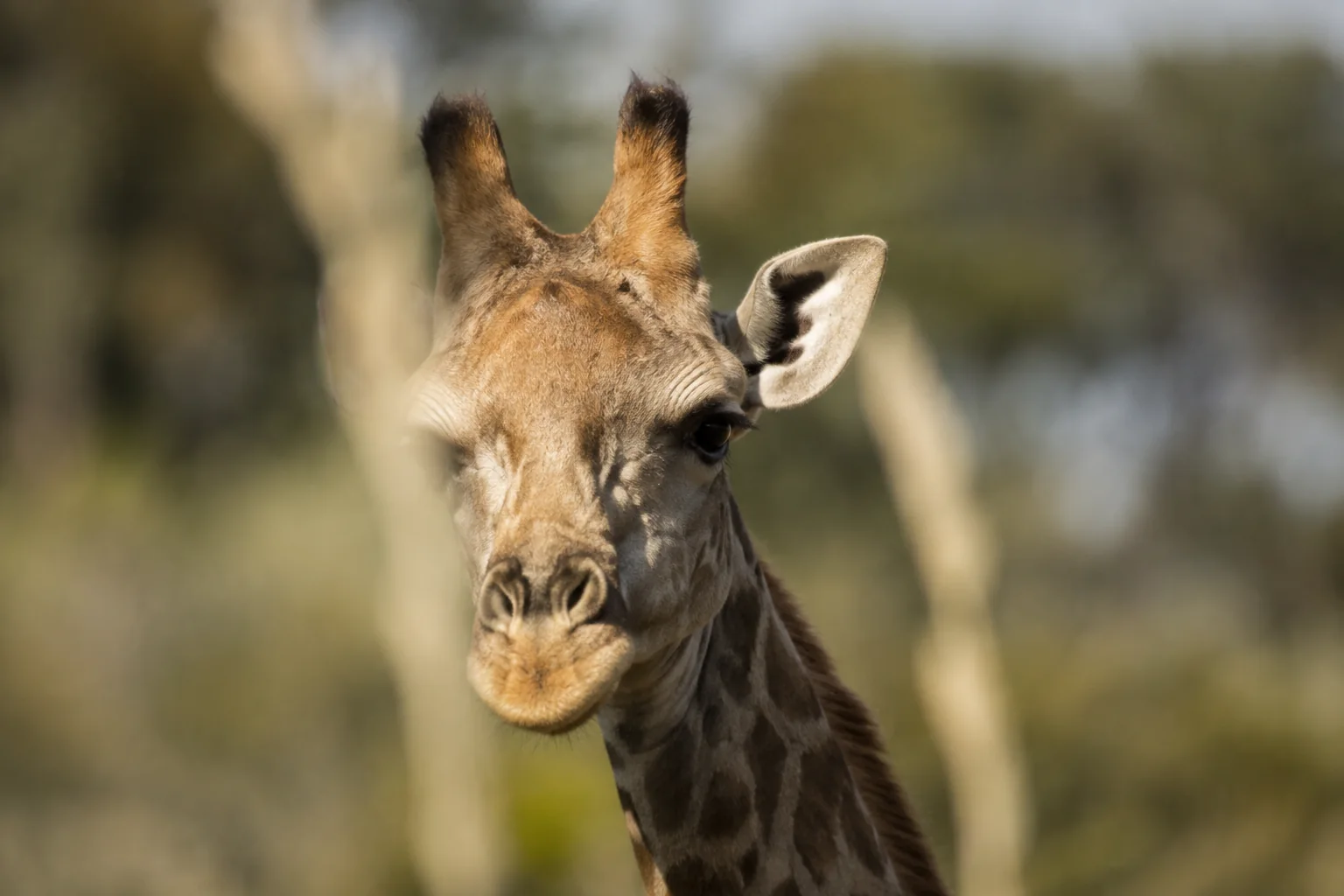
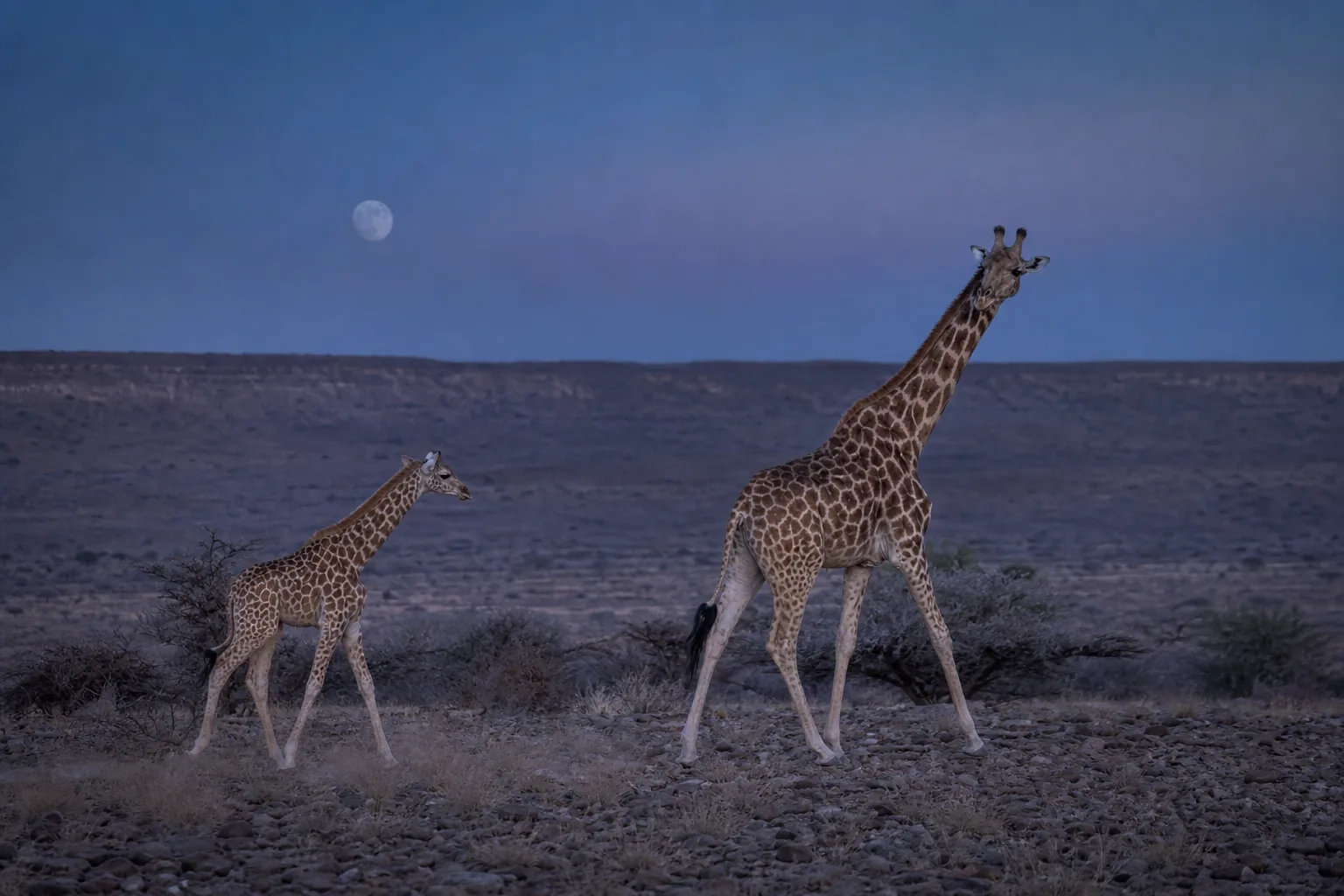
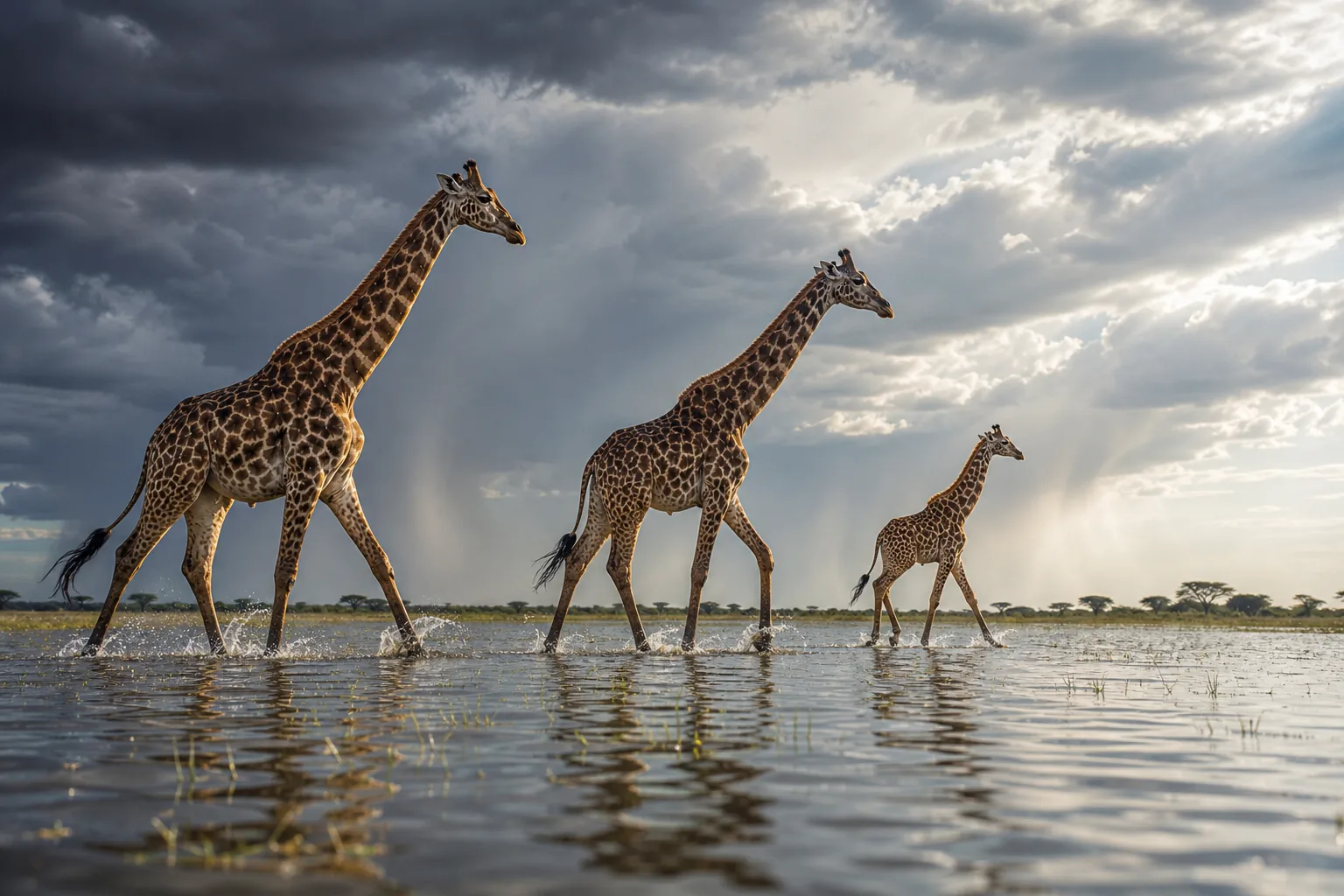
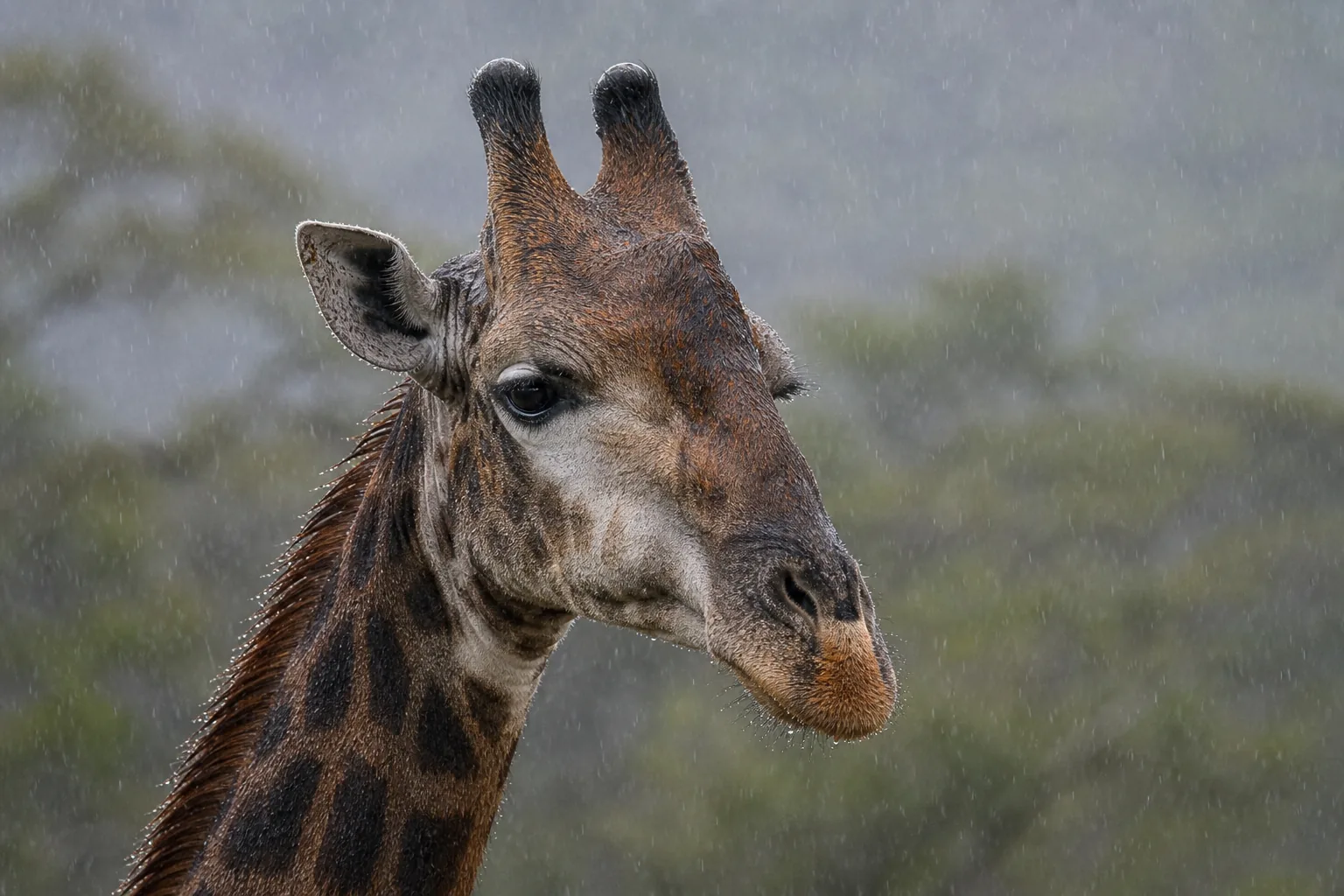
The 2025 specialist-group decision relied on genomic evidence for Kordofan subspecies distinctiveness. The available cranial analysis did not separate Kordofan from West African giraffe, and the report provides no standalone coat-pattern key. Cranial non-separation is not evidence about pelage, and the report did not test whether a photograph alone can diagnose the subspecies. A picture without reliable population history should therefore be labelled cautiously.
This does not make coat patterns useless. Researchers can use an individual’s stable markings to match its photographs over time, as the coat-pattern science guide explains. Matching one animal and diagnosing its subspecies are different tasks. The illustration above is generic and provides no identification evidence.
Where does the Kordofan giraffe live?
The June State of Giraffe 2025 synthesis lists five natural-range countries: Cameroon, Central African Republic, Chad, Democratic Republic of Congo and South Sudan. That list is not a claim of continuous occupation. The surviving distribution consists of separated populations and uncertain remnants across Central and East Africa.
A range-country list and a current occupancy map answer different questions. Five countries appear in the 2025 natural-range list, but that does not mean giraffes occupy all suitable habitat between known populations. A country can remain part of the natural range even when its most recent evidence is a small estimate or an old presence record.
Chad is the stronghold, not a proxy for the whole range
Chad accounted for 69% of the compiled June 2025 estimate. Its 1,657 animals were concentrated mainly in a major protected stronghold, with smaller populations elsewhere in the wider landscape. This concentration is encouraging where the population is increasing, but it also means range-wide totals are heavily influenced by one country.
The other populations cannot be treated as spare copies. Cameroon holds several fragments; the DRC population is isolated from the western populations; and information from Central African Republic and South Sudan remains limited by access and insecurity. The four-giraffe-species overview supplies the continental context, but Kordofan conservation has to be read at population scale.
How many Kordofan giraffes are left?
The June 2025 report estimated 2,391 Kordofan giraffes, with a stated range of 1,691–3,536. It classified the five-year change from its 2020 baseline as stable at +4%, while the thirty-year comparison was about 70% below the 1995 baseline. These are report comparisons, not a live count or a uniform census series.
| Country | June 2025 report figure | Reported direction from 2020 | What the evidence means |
|---|---|---|---|
| Cameroon | 617 (526–738) | Decreasing, -19% | Newer coverage improved knowledge, but the national synthesis still reported a decline |
| Central African Republic | 10 (8–12) | Decreasing, -80% | Approximation without a recent survey; the chapter text contains an internal 0 (8–12) inconsistency |
| Chad | 1,657 (1,050–2,679) | Increasing, +25% | Stronghold holding 69% of the compiled total |
| Democratic Republic of Congo | 106 | Increasing, +71% | One isolated population complex with intensive monitoring |
| South Sudan | Presence represented as 1 in Table 1 | Decreasing, -99% (reported); current direction uncertain | Based on a 2017 observation and no subsequent systematic survey reported |
What the total can and cannot mean
The report combined ground and aerial surveys, individual-registration programmes, published studies, government and stakeholder data, and informed estimates. It assigned information-quality scores and sometimes constructed ranges around figures without reported uncertainty. The ranges in the table are therefore not all statistical confidence intervals.
The country figures do sum to 2,391, but arithmetic does not make their evidence equally current or precise. South Sudan’s single 2017 observation should not become “exactly one alive in 2025.” Central African Republic’s 10 is an approximation, not a recent enumeration. The giraffe population guide explains why dates, methods and coverage must travel with any total.
Better survey coverage can also change an estimate without the population changing by the same amount. For that reason, the report’s +4% range-wide comparison cannot be converted into births, annual growth or improvement in every country. The table is best read as a June 2025 evidence snapshot with heterogeneous inputs.
What does the Cameroon evidence show?
A Bénoué-complex study used photographs from opportunistic sightings and camera traps to identify individuals in two sampled areas. Records covered 2016–2021 in Bénoué National Park and 2019–2021 in neighbouring Hunting Zone 18. The researchers identified 26 and 23 individuals, then estimated about 27 and 26 animals respectively using a capture–recapture method.
Those figures are valuable local baselines, not a current Cameroon total. Camera placement was concentrated, handheld photographs were collected ad hoc, and the multi-year sampling window could challenge the model’s closed-population assumption. The researchers themselves called for larger, systematic deployments. The difference from an earlier aerial observation of six in Bénoué was interpreted as a sampling artefact rather than proof of a real increase. The giraffe survey-methods guide shows why improved detection can revise a number without demonstrating demographic growth.
No matched animal does not prove no movement
No individual was photographed in both sampled areas. The authors proposed that farmland and a highway between them may restrict movement. That is a plausible fragmentation hypothesis, not direct proof of an impassable barrier: the sampling covered limited parts of a much larger complex, and non-detection is not the same as absence.
The responsible conclusion is that connectivity needs direct study. Repeatable camera coverage, telemetry or genetics could test whether animals move between fragments and whether reproduction connects them over generations. This is exactly why local evidence should not be stretched into range-wide certainty.
What does Garamba show about space and recovery?
The DRC’s Kordofan giraffes persist in the Garamba complex, geographically separated from the western populations. A 2019 spatial-ecology study built individual photo records from 2016–2017 field data and analysed GPS harness data from eight adults. Six had enough data for the main autocorrelation-aware home-range analysis.
The study’s average estimated home range was 934.3 km² using that analysis, compared with 268.8 km² under a conventional kernel calculation. The difference is a methods lesson, not two rival herd sizes. With only six data-rich tracks, the study demonstrates that some Garamba animals used large areas; it does not define the space needs of every Kordofan giraffe across every season and habitat.
The same paper estimated 45 giraffes in Garamba at that time. Later operator monitoring reported 22 in 2012, 70 confirmed in 2021, 92 in 2024 and an estimated 105 in April 2025. African Parks’ dated update is evidence of a reported local recovery, not a controlled test showing that one intervention caused every increase. Nor should 105 be added to the June report’s 2,391; that synthesis already includes a DRC input of 106.
Garamba therefore carries two simultaneous lessons. A very small isolated population can grow under sustained monitoring and protection, and recovery does not erase the risks created by its history or separation. Protecting numbers and preserving movement options are related but different goals within giraffe habitat conservation.
What does genetics add beyond a headcount?
The 2022 conservation-genomics study analysed 119 mitochondrial sequences and 26 whole genomes from northern giraffes. Its population analyses separated the three northern subspecies and suggested differentiation between Kordofan samples from the eastern and western parts of the range.
The authors found moderate genome-wide heterozygosity in Kordofan giraffes compared with other giraffe species, alongside a higher recent inbreeding signal in the sampled Garamba animals. They also inferred a gradual decline in effective population size over roughly the last 10,000 years. These statements answer different questions. Heterozygosity describes variation in sampled genomes; an inbreeding signal concerns shared recent ancestry; effective population size is a genetic parameter, not the number of living giraffes counted in a park.
None of those findings establishes the current genetic health of all 2,391 estimated animals. The Garamba signal came from one isolated population, while east–west differentiation makes it especially unsafe to generalise from that sample to Chad or Cameroon. The useful conservation message is to retain multiple populations and monitor them separately. The genetic-isolation evidence area connects this case to the broader research.
What threatens Kordofan giraffes?
Illegal killing, habitat loss and fragmentation, and insecurity recur across the Kordofan literature. Their relative importance is not identical everywhere. In one place, direct protection may be the urgent constraint; in another, land conversion may narrow access to seasonal browse or separate neighbouring groups. Roads and farms can affect movement without every road or field functioning as a complete barrier.
Insecurity creates both biological and evidential risk. It can increase pressure on wildlife and make field surveys dangerous or impossible. The result may be a stale number, a wide uncertainty range or only a presence record. Missing data do not prove that a population is extinct, stable or recovering; they limit the confidence of all three claims.
Fragmentation also changes the meaning of a range-wide improvement. Growth in Chad or Garamba cannot compensate biologically for the disappearance of a distinct population elsewhere. The population-decline evidence area helps separate local counts, demographic trends and continental compilations.
What would conservation progress look like?
Progress would be visible in several forms: repeated population estimates made with comparable methods; survival and recruitment across age classes; occupied habitat that remains usable; evidence of movement where connectivity is expected; and genetic monitoring where small groups have been isolated. No single metric substitutes for the rest.
The strongest current signals are uneven. Chad’s large stronghold and Garamba’s reported increase matter. Cameroon’s newer surveys improve the baseline even where the national trend is concerning. In Central African Republic and South Sudan, establishing recent distribution and abundance may be the first need, subject to safety and wildlife-protection constraints.
This population-by-population view is less tidy than a single “2,391 left” headline, but more useful. It allows later evidence to update one country without pretending that the whole range was surveyed again—and it keeps a hopeful local trend from obscuring severe historical decline and continuing gaps.
What to remember
- The Kordofan giraffe is Giraffa camelopardalis antiquorum, a subspecies of northern giraffe in the specialist group’s 2025 framework.
- Its natural range spans five countries, but the remaining distribution is fragmented rather than continuous.
- The June 2025 synthesis estimated 2,391, with 69% of that figure in Chad.
- A +4% five-year range-wide comparison coexists with decline in Cameroon, increase in Chad and DRC, and sparse evidence elsewhere.
- Cameroon’s photo-based local estimates and Garamba’s GPS study answer narrower questions than a national or range-wide census.
- Moderate genomic diversity, east–west differentiation and a higher inbreeding signal in sampled Garamba animals can all be true at once.
Frequently asked questions
Is the Kordofan giraffe a separate species?
No, not in the IUCN SSC specialist group’s 2025 framework. It is a likely-distinct subspecies of northern giraffe, Giraffa camelopardalis. Older and alternative taxonomies may use different ranks, so the framework and date should be stated.
Where are most Kordofan giraffes?
Chad held 1,657, or 69%, of the June 2025 compiled estimate. The same report also listed populations or presence in Cameroon, Central African Republic, Democratic Republic of Congo and South Sudan.
Are there exactly 2,391 Kordofan giraffes?
No. That is the point estimate in a June 2025 synthesis, with a stated range of 1,691–3,536. It combines evidence of different methods, dates and quality; it is not a simultaneous headcount.
When was the Kordofan giraffe assessed as Critically Endangered?
The latest completed IUCN subspecies assessment located and verified for this article dates to 2018 and classified it as Critically Endangered. A 2025 report recommended Endangered after revising historical population assignment, but that recommendation is not a completed Red List reassessment.
Can a Kordofan giraffe be identified by its spots?
The 2025 taxonomic report supplies no standalone coat-pattern key; its case for subspecies distinctiveness relied on genomic evidence. Coat patterns can still identify an individual across photographs, while population origin or genetic evidence addresses taxonomic identity.
Sources
Sources checked on 7 September 2026. Population figures retain the dates and limits of the source that published them.
- IUCN SSC Giraffe and Okapi Specialist Group (2025), An Evaluation of the Taxonomic Status of Giraffe, linked in the identity section above.
- IUCN SSC (2025), adoption announcement for the four-species framework, linked in the identity section above.
- Fennessy & Marais (2018), IUCN Red List assessment of the Kordofan giraffe, linked in the identity section above.
- Giraffe Conservation Foundation (2025), State of Giraffe 2025, version 2.
- Coimbra et al. (2022), conservation genomics of West African and Kordofan giraffes.
- D’haen et al. (2019), population structure and spatial ecology in Garamba.
- Parks et al. (2023), preliminary population estimates in two areas of Cameroon’s Bénoué complex.
- African Parks, dated Garamba population and monitoring update, linked in the Garamba section above.