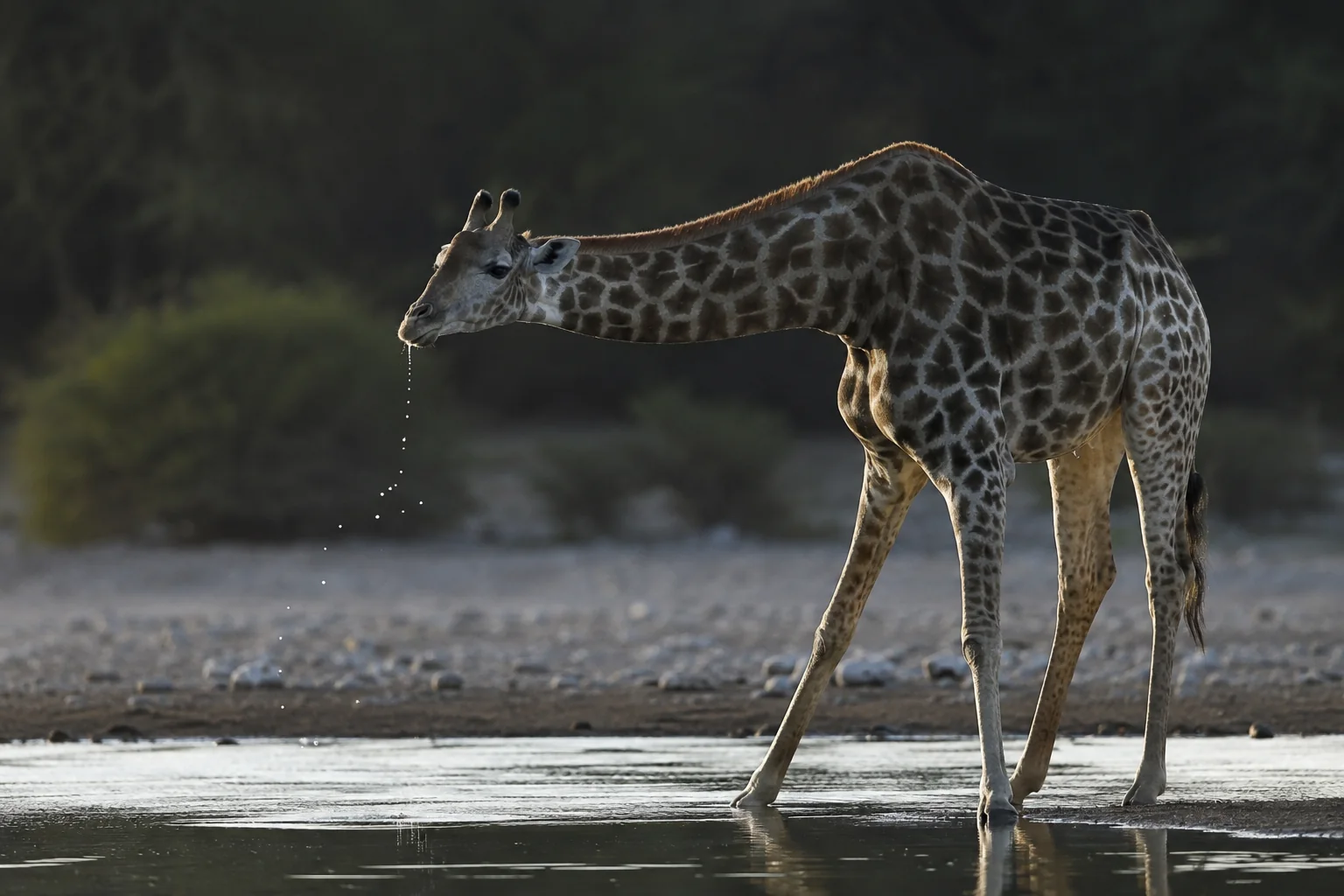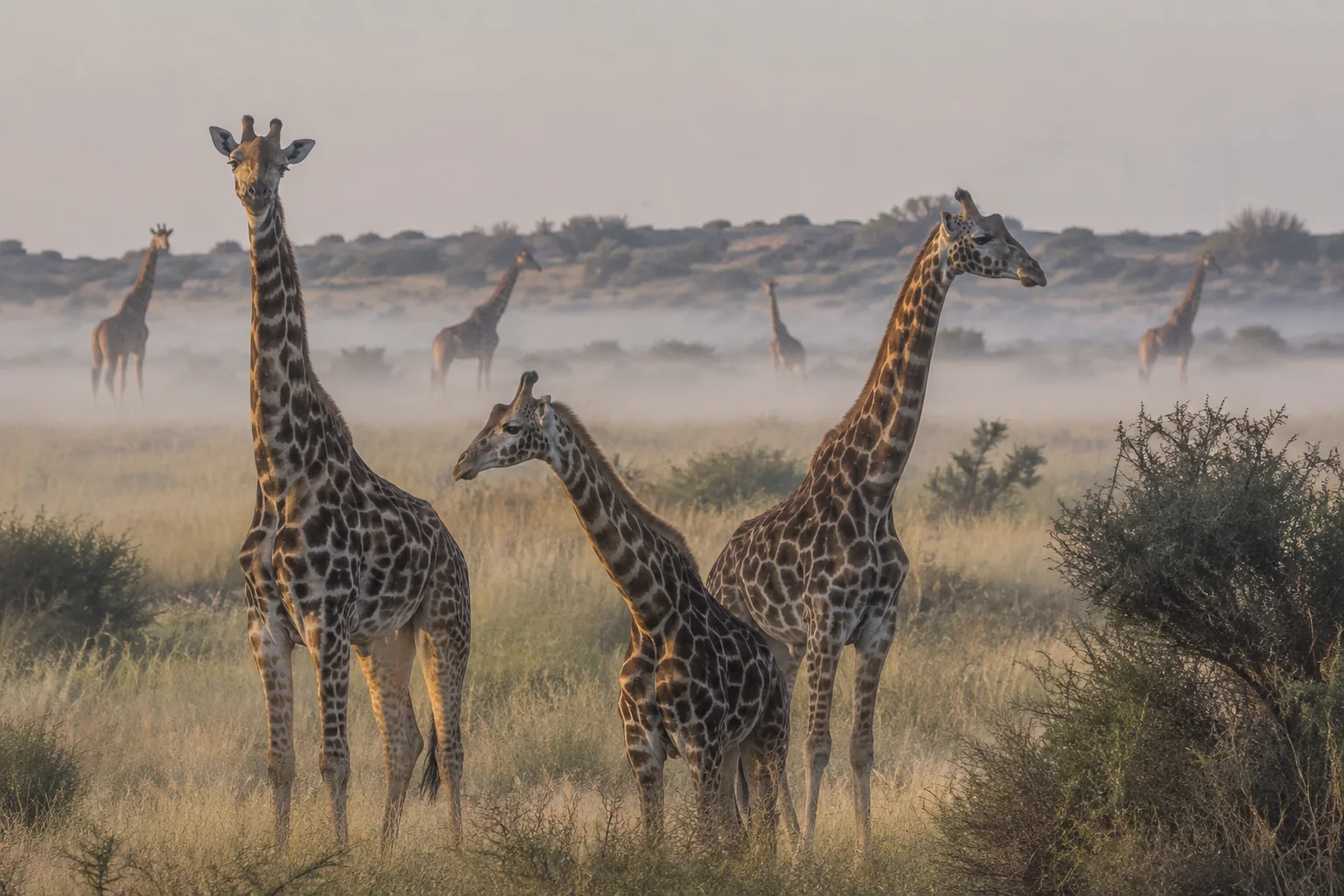
An animal missed by an aerial survey can reappear in a conservation assessment without a single calf being born. That distinction mattered in Cameroon’s Bénoué National Park, where photographs identified 26 Kordofan giraffes—well above the six animals reported by an earlier aerial count discussed in the research.
The photographs offered evidence of a larger surviving population than that older number suggested. They did not demonstrate a population increase. Connor Parks, Samuel Penny and colleagues instead interpreted the difference as a consequence of how the animals had been searched for. Their study also identified 23 giraffes in a nearby managed area, with no individual photographed in both places.
The resulting preliminary population assessment was both useful and deliberately provisional. It assembled an identifiable set of animals that future surveys could return to, while exposing two questions that a photograph collection could not settle alone: how many giraffes remained beyond its coverage, and whether the two populations were connected.
Building a census from imperfect opportunities
The researchers did not begin with a uniform survey covering the whole landscape. They combined images taken during tourism and management activities with photographs from camera traps. The national park’s collection spanned 2016–2021; photographs from the neighbouring area covered 2019–2021.
That combination made use of observations that might otherwise have remained disconnected records. Across both places, there were 998 giraffe images. Most came from camera traps in the park, with the rest taken during opportunistic encounters. Eight park cameras had supplied 611 active camera days during 2019–2021.
A thousand photographs are not a thousand giraffes. Several images can show the same animal standing in front of a camera, and a familiar animal can return on many different days. The team therefore sorted images into encounters and used coat patterns to recognize individuals. GiraffeSpotter software proposed matches, which a researcher subsequently checked.
The side of the animal mattered. A giraffe’s left and right flanks present different patterns; treating the two as interchangeable could create false identities. The researchers favoured left-side photographs and used encounters showing both sides to connect other images when needed. Identification turned a large image collection into a much smaller, more informative catalogue: 26 distinct giraffes in the park and 23 in the neighbouring area.
Those records were the study’s firm observational foundation. They documented animals encountered during the respective study periods. They did not, by themselves, establish that every photographed animal was alive and present on one particular census date.
From recognized individuals to an estimated population
Repeated identification also allowed the researchers to ask how many animals they might have missed. The underlying logic is that repeated encounters with familiar individuals contain information about the size of the pool being sampled. If most subsequent sightings are of giraffes already recognized, the unseen portion may be relatively small. If new individuals keep appearing, a larger pool remains plausible.
The team applied a non-spatial capture–recapture estimator. Here, “capture” means a photographic record, not physically catching a giraffe. The analysis used the pattern of initial and repeat sightings to estimate abundance, rather than mapping the animals’ movements around individual cameras.
The results were approximately 27 giraffes in the national park and 26 in the neighbouring managed area. These were close to the 26 and 23 recognized individuals, respectively. The paper reported model-based 95% confidence intervals of roughly 24–31 and 23–30.
Those intervals describe uncertainty within the estimation approach. They do not include every possible error arising from where photographs were taken or from changes in the population over several years. Their apparently narrow range therefore should not be read as proof that the researchers had effectively counted the entire landscape.
In particular, the national park observations came from an area amounting to only about 4% of the park. The authors explicitly considered it possible that additional giraffes living elsewhere remained undetected. Their account presents the work as a baseline and a reason to extend monitoring, rather than a definitive census of all available habitat.
Cameras can favour the animals that visit them
The cameras were concentrated at places likely to attract giraffes, including natural salt licks. This is an understandable way to obtain photographs of a sparsely encountered animal. It also makes the interpretation depend on which animals can and do visit the sampled places.
An attractive site need not invalidate an abundance estimate. But a model that assumes equal chances of observation needs that assumption to be plausible for the population it describes. Animals consistently using other parts of the park could remain effectively outside the camera sample, even while animals near the cameras are photographed repeatedly.
The authors argued that equal access to the attraction supported their method. Their own discussion also acknowledged the limited coverage and the possibility of missing animals elsewhere. Both points belong in the interpretation: the study recovered useful information from available photographs, while a broader sampling design would be needed to test how representative those photographs were.
A separate waterhole study in Namibia makes the general issue concrete. Christophe Bonenfant, Ken Stratford and Stéphanie Périquet analysed 21 days of giraffe photographs from a fenced reserve and found that estimates varied greatly with the model used. Accounting for unequal detection and the effect of a previous visit brought the preferred estimate close to the number of identified animals. The connection is methodological, not a transfer of Namibia’s result to Cameroon: repeated photographs contain behavioural and sampling patterns that an abundance model must handle. Our waterhole commentary explains that comparison.
A long collection period creates another difficulty
Gathering images over several years increased the chance of encountering giraffes. It also made a central model assumption harder to defend. A closed-population analysis assumes that births, deaths and movements do not change membership in the population being estimated.
The Bénoué researchers found no reported deaths during patrols, no reports of dispersal across the park boundary, and little photographic evidence of births. They used those observations to support their assumption of closure. Nevertheless, a failure to observe a death or a movement is not equivalent to showing that neither occurred.
This is a different problem from merely failing to photograph every animal. A giraffe seen early in the collection period could disappear before another individual was first recorded. Combining their histories then raises questions about what moment, or period, the final population estimate represents. The park and neighbouring area were also sampled over different spans of years, so their estimates are not perfectly synchronized snapshots.
The study remains informative under these limits. It provides named-by-pattern individuals, evidence of their repeated presence and a preliminary abundance estimate. A subsequent systematic survey over a shorter, clearly defined period could build on that foundation while reducing uncertainty about turnover.
Two catalogues, no shared giraffe
Comparing the two identity catalogues produced another finding: no giraffe appeared in both. That absence suggested that the areas might function as separate population fragments, despite being part of the same broader conservation landscape.
The authors discussed intervening agriculture and a major road as possible barriers. They did not track giraffes attempting to cross them. Nor did cameras continuously observe every animal along every possible route. An animal could move without being photographed at both ends, especially where coverage was limited and collection periods differed.
The appropriate conclusion is therefore that the study detected no exchange. Complete isolation remained a hypothesis requiring other evidence. Tracking could show whether animals crossed the intervening landscape, while genetic work could reveal relationships and exchange on a different timescale. These approaches would answer questions the identity catalogues first made worth asking.
For conservation, this difference matters. Two small groups could belong to a larger connected population, or each could have to persist largely through its own births and survival. The practical significance of their numbers depends partly on which situation applies.
A baseline that future surveys can improve
The earlier aerial count and the new photographic assessment should not be placed on a graph and labelled recovery. The focal paper itself rejects that interpretation. Different search methods, coverage and observation periods can yield different estimates without documenting a biological increase.
The strongest next comparison would preserve a clear design through time: repeat systematic photographic surveys, extend coverage beyond the initially sampled area, and use the individual histories to distinguish continued presence from losses and new arrivals. The existing catalogue makes that more feasible by giving future observers a starting set of recognizable animals.
Equally, the absence of shared identities should guide investigation rather than close it. Testing movement and genetic exchange would reveal whether conservation must address two largely isolated populations or protect connections within a broader one.
The photographs changed what was known about giraffes in Bénoué. They showed that an earlier small count had been inadequate as a description of the surviving animals. Their lasting value is that they made those animals individually traceable, giving future work a way to measure change instead of guessing it from incomparable totals.
Sources
Parks, Connor; Penny, Samuel; Mengamenya Goue, Achile; Nyugha, Denis; Pauline, Tiwa T.; Vannier, Xavier; and Johnson, Caspian (2023, online publication). “Preliminary population estimate of Kordofan giraffe (Giraffa camelopardalis antiquorum) in two areas of the Benoué complex, Cameroon.” African Journal of Ecology, e13249. Paper and DOI. Open full paper.
Bonenfant, Christophe; Stratford, Ken; and Périquet, Stéphanie (2023). “Counting giraffes: A comparison of abundance estimators on the Ongava Game Reserve, Namibia.” Hystrix, the Italian Journal of Mammalogy, 34, 1–7. Paper and DOI.