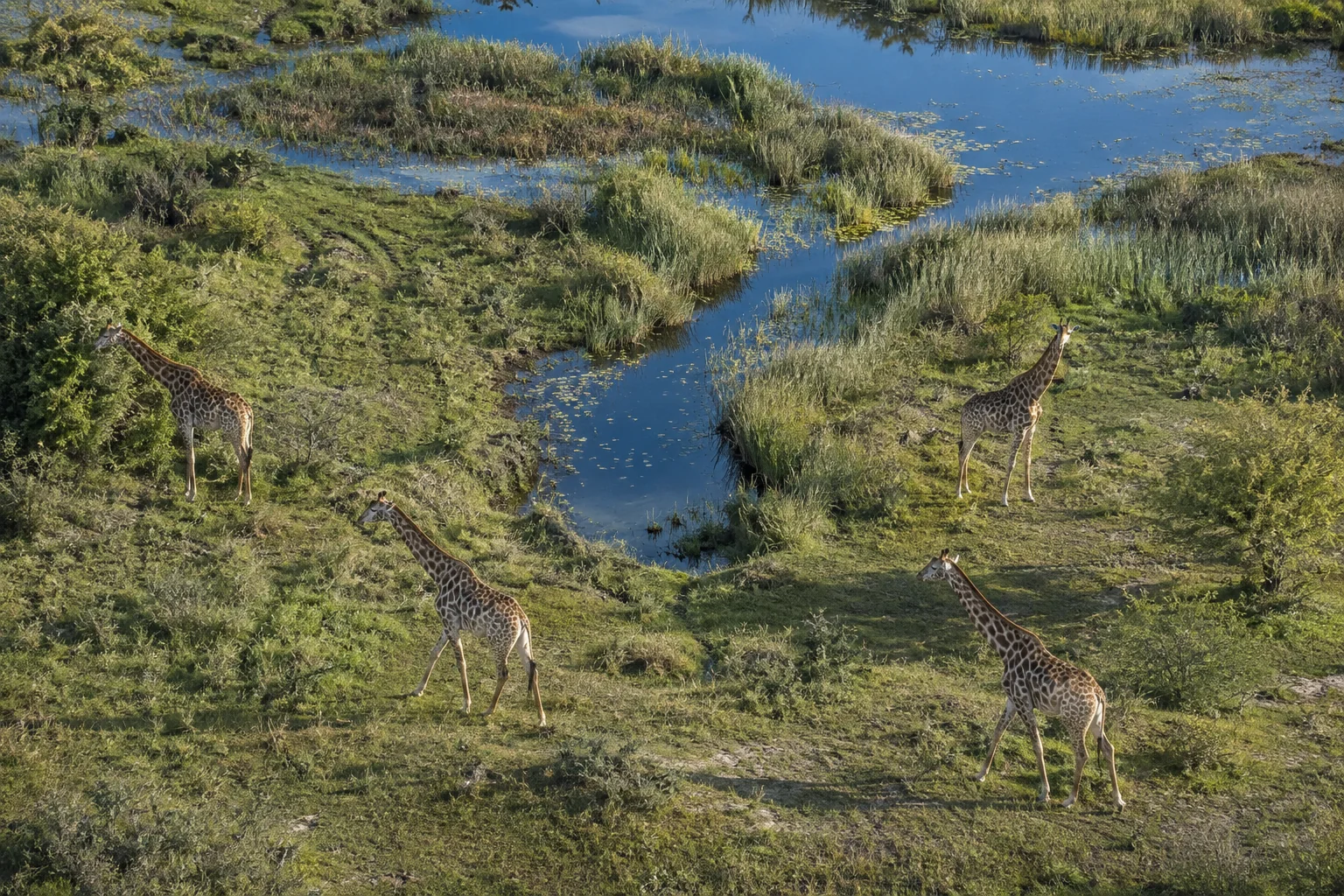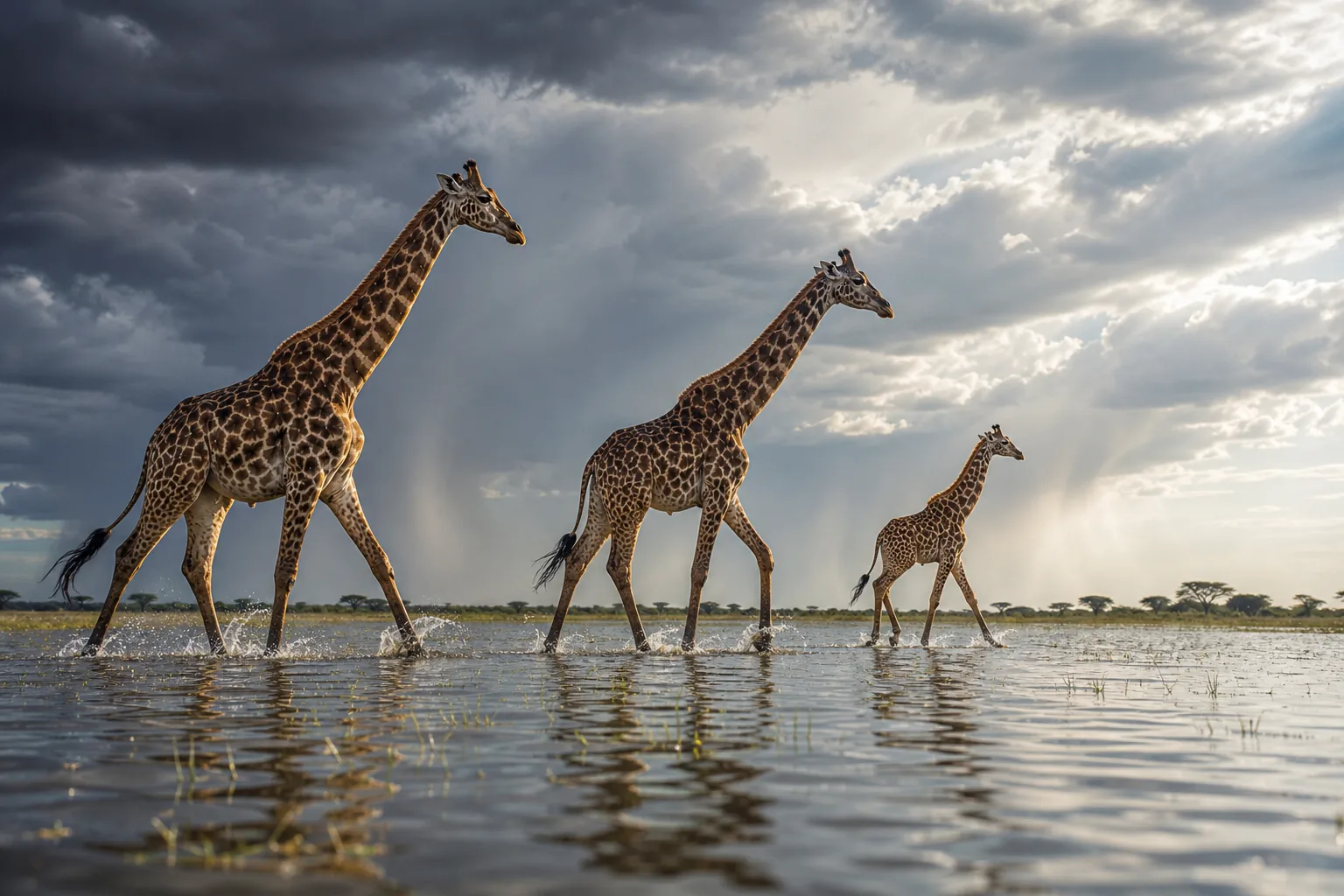
Rain does not simply add resources to a giraffe's surroundings. It can change which resources the animal can reach. In a landscape that floods, the same ground can serve different purposes across the year—even though its position on a conservation map never changes.
Rachael Kelday Clark and colleagues investigated that seasonal mismatch around Zakouma National Park in Chad. Their 2023 tracking study found that female Kordofan giraffes ranged more widely in wet months. The areas they used most intensively also overlapped less with the national park. A protected area that contains important dry-season habitat can therefore cover a smaller share of the animals' seasonal needs once conditions change.
Following the same giraffes across seasons
The team used hourly GPS locations from 17 adult females, collected between January 2019 and February 2022. Collaboration between Chad's government, African Parks and the Giraffe Conservation Foundation made the tracking possible. Comparing individuals across seasons let the researchers investigate changing space use without treating every recorded position as a different animal.
They estimated both broader seasonal ranges and smaller core areas: the parts of a range where use was concentrated. The average share of those core areas inside Zakouma fell from about 91% in the dry season to 67% in the wet season. The broader-range overlap difference was not statistically clear, although wet-season ranges were larger. Core habitat and the wider area an animal traverses answer different planning questions.
Consider a giraffe whose occasional movements remain within a large protected boundary, while its principal feeding or resting areas shift outside it. Counting whether the animal ever enters the park would conceal that change. Counting GPS fixes inside would answer another question again: how frequently it was recorded there. The study's area comparison addresses where concentrated use occurs, rather than providing a timetable of hours spent under protection.
Moving farther without changing preferences
The authors link the seasonal expansion to flooding and changing forage accessibility. A finer analysis, comparing hourly movements with available alternatives, did not detect seasonal changes in habitat preferences. That combination is revealing: giraffes can seek similar kinds of places while travelling across a different part of the landscape to reach them.
Movement itself is not a simple score of habitat quality. In a separate pan-African analysis of giraffe ranges, Michael Butler Brown and colleagues found smaller home ranges associated both with greater vegetation productivity and with greater human disturbance. Concentrated food can reduce the need to travel; restrictions can reduce the opportunity. The continental study places the Zakouma question in a wider context, but a small range alone does not distinguish those explanations.
This is why a useful giraffe habitat map needs more than a boundary around places where animals have been seen. It needs to preserve the relationships among resources, access and season. A route that appears unnecessary in a dry-month survey may matter when familiar ground becomes difficult to use.
Protection beyond a static boundary
The practical implication is to investigate seasonal connections before they are severed. For Zakouma, the paper recommends monitoring important wet-season habitat and working with surrounding communities on land use and coexistence. Movement beyond the national park is not automatically movement into wholly unprotected land: the surrounding Bahr Salamat Wildlife Reserve has a different protection status.
The tracking did not measure whether crossing the park boundary increased deaths, nor did it test a conservation intervention. A useful next comparison would connect seasonal movements with actual hazards and changes in land use. Repeating observations of forage and flooding would also help separate the proposed drivers of the shift.
For managers, the value is a change in where—and when—to look. Keeping a giraffe population within reach of usable habitat may require protecting a seasonal connection outside the park, even when the park remains central to its survival through the rest of the year.
Sources
- Rachael Kelday Clark, Julian Fennessy, Sara Ferguson, Chiara Fraticelli, Naftali Honig, Thomas A. Morrison and Michael Butler Brown. “Seasonal dynamics impact habitat preferences and protected area use of the critically endangered Kordofan giraffe (Giraffa camelopardalis antiquorum).” African Journal of Wildlife Research 53, 119–134 (2023). DOI. Full paper on co-author Michael Butler Brown's website.
- Michael Butler Brown and colleagues. “Ranging behaviours across ecological and anthropogenic disturbance gradients: a pan-African perspective of giraffe (Giraffa spp.) space use.” Proceedings of the Royal Society B 290, 20230912 (2023). DOI. Public full paper at NSF.