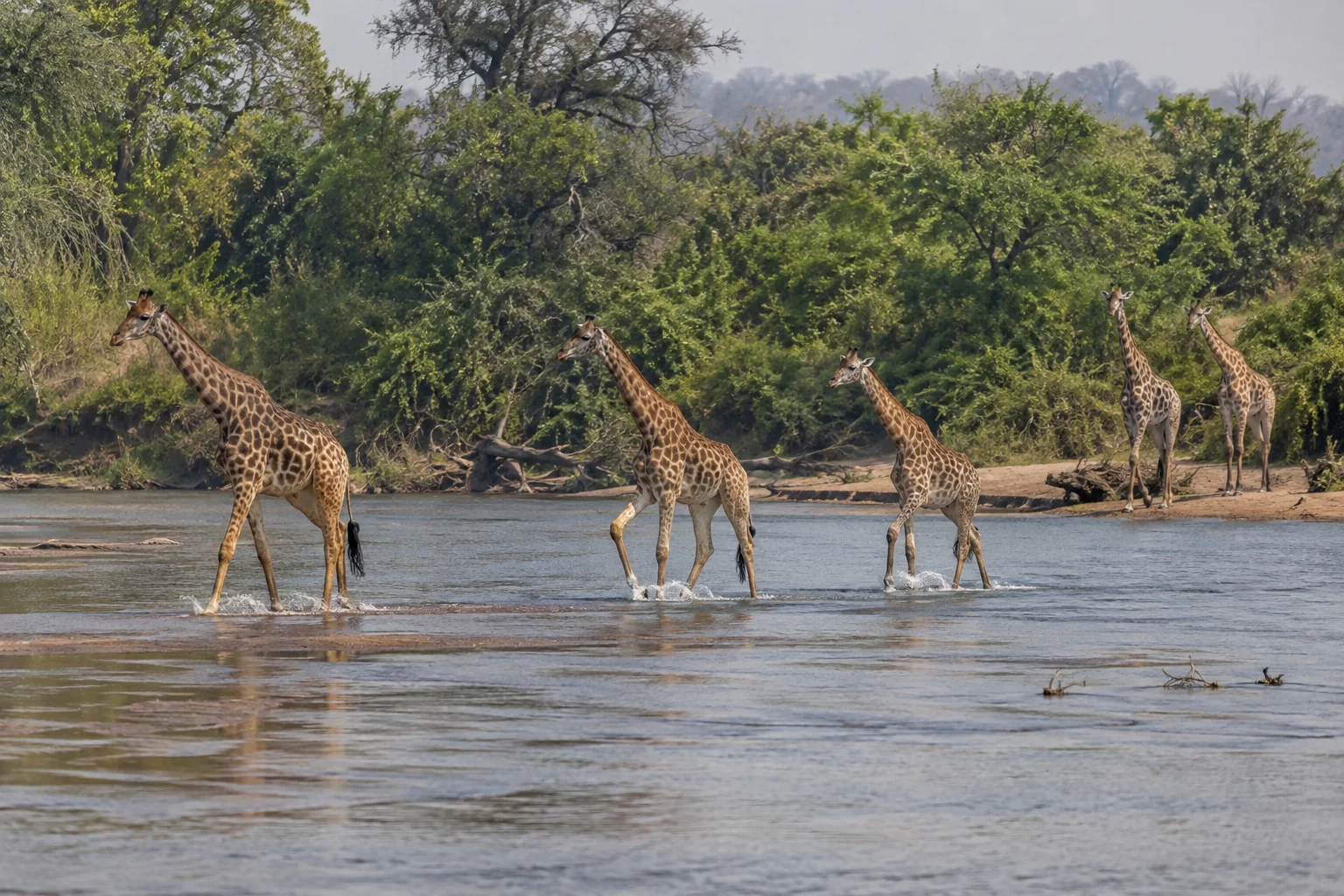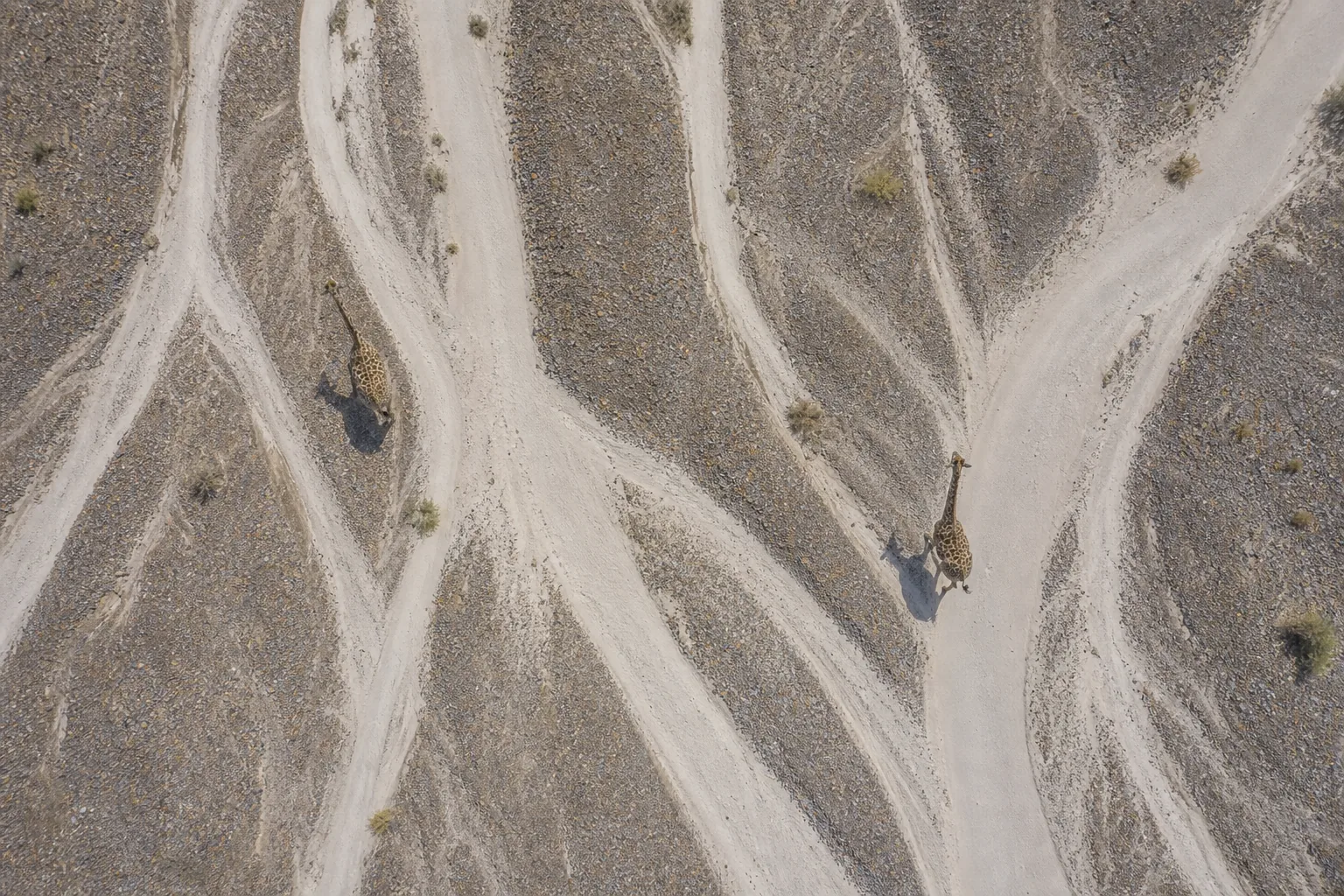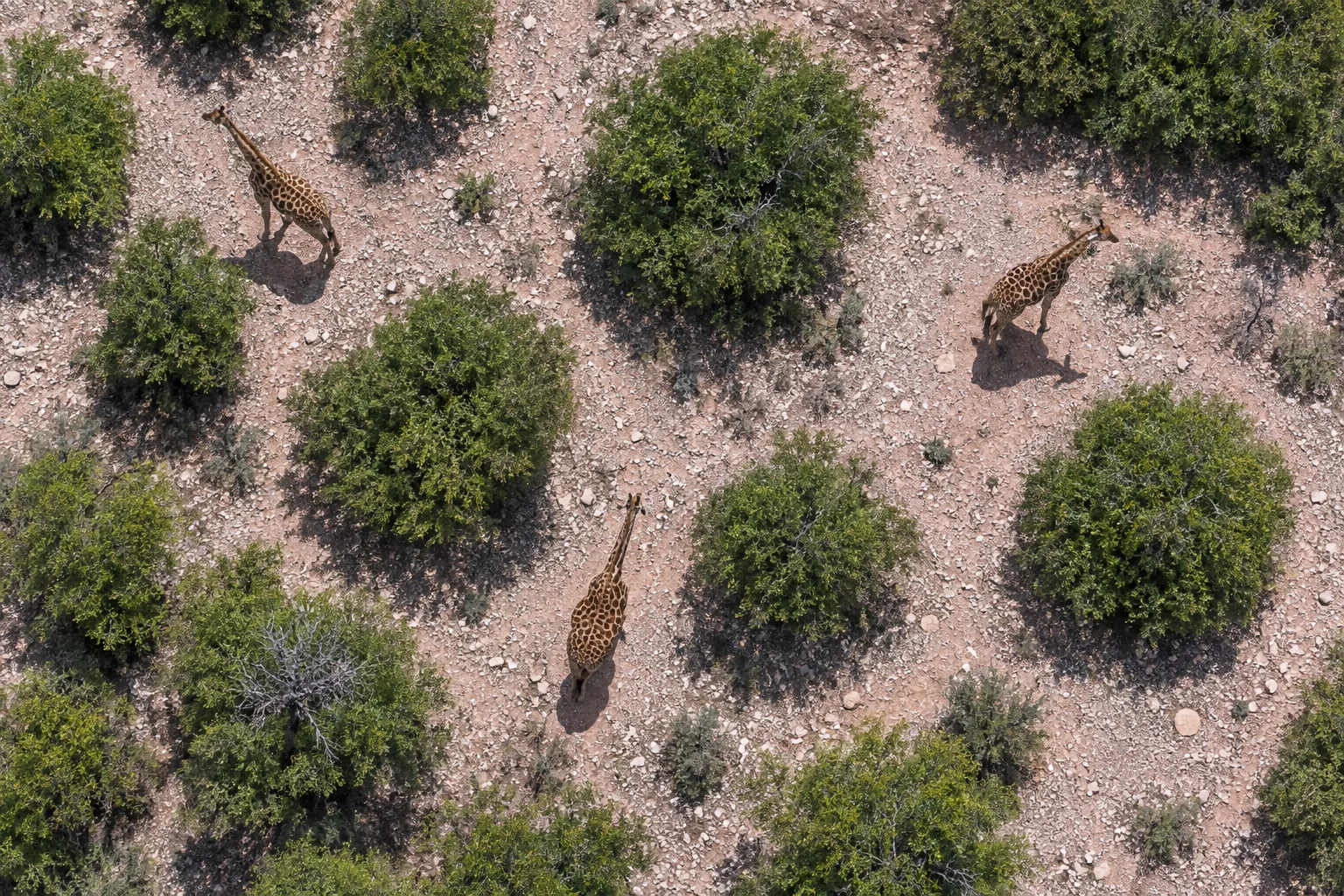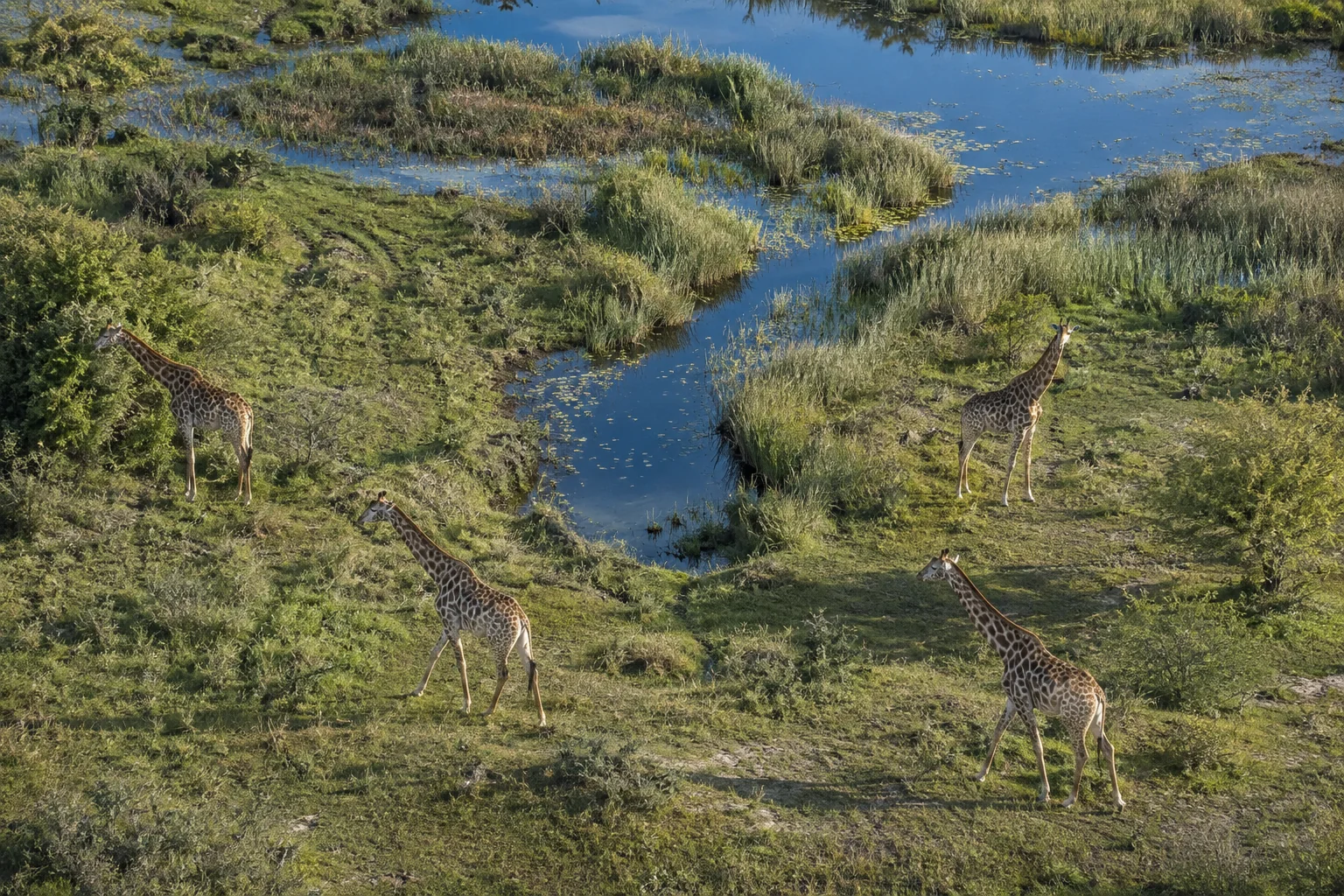
A giraffe that travels little may have everything it needs nearby. It may also have few places left to go. Those possibilities look similar on a movement map, yet they imply very different things about the animal’s surroundings. Understanding the difference matters whenever conservationists use tracking to judge whether a landscape is serving giraffes well.
Michael Butler Brown and a large international team brought together tracking records from across Africa to investigate that problem. Their 2023 study made comparisons possible across environments that a single field project could never represent: wet savannas, much drier country, protected areas and landscapes extensively used by people.
A home range is a pattern of use
A home range is the area an animal uses repeatedly over a period of time. It is not a territory that the animal necessarily defends, or an amount of land that belongs exclusively to it. Several giraffes can use overlapping ground.
Nor is its area interchangeable with distance travelled. An animal can walk a considerable distance while repeatedly visiting feeding places inside a compact range. Another may use a broad area but make relatively direct journeys between its parts. Brown and colleagues therefore estimated both the area giraffes used and their average daily travel.
They began with a much larger collection of tracking deployments and retained records long enough to span several months. For the home-range comparison, they also needed animals whose movements were consistent with repeatedly using a range. Animals continually shifting into new areas would not answer the same question. The main Results section reports 148 qualifying giraffes at 22 sites.
That choice gives the study a clear scope. Its range estimates describe resident space use, including variation across seasons, rather than all possible giraffe movement strategies. The distinction becomes particularly useful beside research on partial migration in Uganda, where some giraffes repeatedly shifted between separate seasonal ranges while others stayed resident.
Making unlike tracking records comparable
A position recorded at noon is not independent of the position recorded an hour earlier. The giraffe had to travel between them. Treating a dense cluster of fixes as hundreds of unrelated observations can make an estimate seem more precise than the actual movement record warrants.
The team used movement models that account for this connection through time. The same approach could accommodate differences in recording intervals and gaps caused by tracking-device performance. It produced an estimated area of regular use, together with uncertainty around that estimate.
The next comparison also retained that uncertainty. An imprecise estimate did not carry the same weight as a well-supported one when the scientists related space use to environmental conditions. This matters because comparing a few published averages, each calculated differently, could confuse biology with differences between methods.
For each tracked giraffe, the researchers assembled measures of vegetation productivity, woody vegetation, human influence and protected-area use. Satellite greenness provided an indicator of plant productivity; it did not measure every leaf the animal ate. The human-footprint measure combined forms of development and human land use, so it could reveal a broad relationship without identifying the effect of every individual road or fence.
Food that is plentiful, food that is patchy
The reported home-range estimates stretched from roughly 13 to 3,859 square kilometres. The model-based mean in the Results was about 356 square kilometres. That wide spread is the important biological fact: an average cannot describe every animal’s circumstances.
Giraffes generally used smaller ranges in more productive environments. A plausible explanation is straightforward. When usable resources are concentrated and reliable, animals can find them without covering as much ground.
Variation in those resources mattered as well. Where productivity and woody vegetation varied more across the places and times a giraffe experienced, ranges tended to be larger. Reaching a changing patchwork of food can require more space than feeding within a consistently productive area.
This helps explain why a dry landscape cannot be assessed simply by measuring how much land it contains. The distribution of useful plants may matter as much as the total area. Our habitat guide introduces the difference between a species’ geographical range and the space used by an individual.
When a small range has another explanation
Greater overall human footprint was associated with smaller home ranges and less daily movement. At the broad scale of the analysis, human-dominated landscapes appeared to constrain the animals’ opportunities to move.
However, greater variation in human footprint was associated with more expansive movement. An animal using a mixture of developed and less disturbed ground may need to navigate among separated feeding places. Uniformly high disturbance and a patchwork of disturbance need not produce the same pattern.
These are associations across real landscapes. They do not show that every small range is a sign of poor welfare, or that every long journey indicates abundant opportunity. The same physical outcome can arise through different processes.
Protected-area use brought a related complication. The main model and Discussion reported a negative relationship with range size, contrary to the authors’ initial expectation of larger ranges where movement faced fewer restrictions. Productive food inside protected areas could help explain smaller ranges; boundaries and development around them could also contribute. Interactions with productivity made the relationship more complex still.
The research therefore supports reading a range estimate alongside its surroundings. It does not supply a universal land allowance per giraffe.
Following the animals whose choices differ
Brown and Douglas Bolger’s Uganda migration study makes that point at a smaller scale. Photographs of identified animals showed seasonal movements between vegetation communities, with males more likely to make those transitions. Detailed GPS records revealed residents and seasonal migrants living within the same park.
That earlier work and the continental analysis are connected parts of a research programme, with potentially overlapping tracking populations. They should not be counted as wholly separate confirmation. Their value together is explanatory: an average for a species, or even for one park, can conceal different ways of using the landscape.
A useful next step would connect movement to direct measures of food and individual outcomes. Do animals with constrained ranges maintain body condition and reproduce as successfully as animals with broader access? Repeated monitoring would need to distinguish age, reproductive state and changing vegetation from the effects of barriers themselves.
Another comparison could follow changes where an existing barrier becomes more permeable. If movement expands, researchers could then ask whether the animals gain access to useful resources. Increased movement alone would not establish a benefit.
The continental study makes such local questions better informed. Its achievement is to show that giraffe space use responds both to where resources are and to how freely animals can reach them. A map becomes more useful when the reasons behind its boundaries are part of the explanation.
Sources
Michael Butler Brown, Julian T. Fennessy, Ramiro D. Crego, Christen H. Fleming, Joel Alves, Karolina Brandlová, Stephanie Fennessy, Sara Ferguson, Morgan Hauptfleisch, Pavla Hejcmanova, Rigardt Hoffman, Peter Leimgruber, Symon Masiaine, Kylie McQualter, Thomas Mueller, Ben Muller, Arthur Muneza, David O’Connor, Adriaan Jacobus Olivier, Thomas Rabeil, Steven Seager, Jenna Stacy-Dawes, Louis van Schalkwyk and Jared Stabach (2023). Ranging behaviours across ecological and anthropogenic disturbance gradients: a pan-African perspective of giraffe (Giraffa spp.) space use. Proceedings of the Royal Society B 290, 20230912. DOI · Author-hosted full paper.
Michael B. Brown and Douglas T. Bolger (2020). Male-Biased Partial Migration in a Giraffe Population. Frontiers in Ecology and Evolution 7, 524. Full paper.