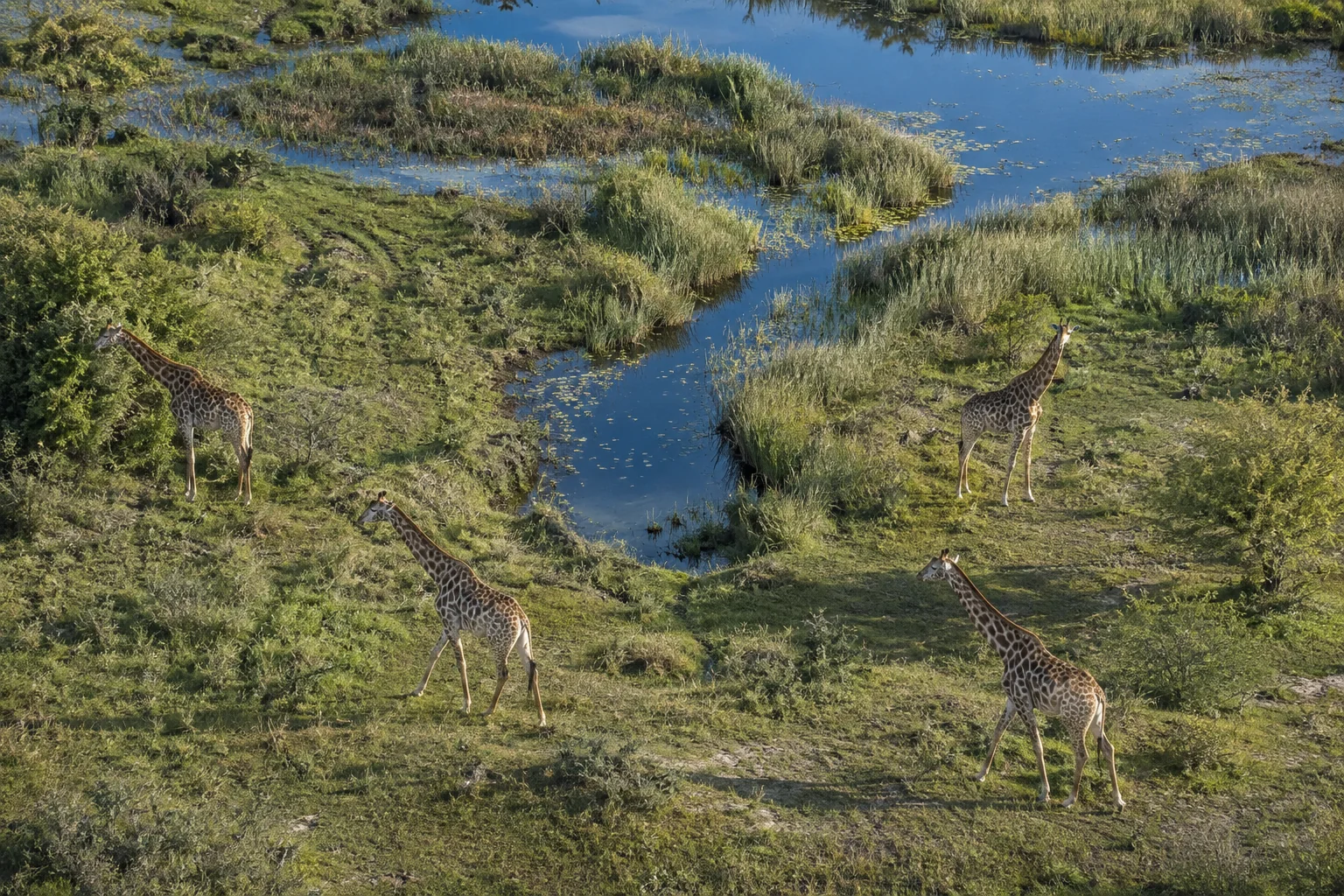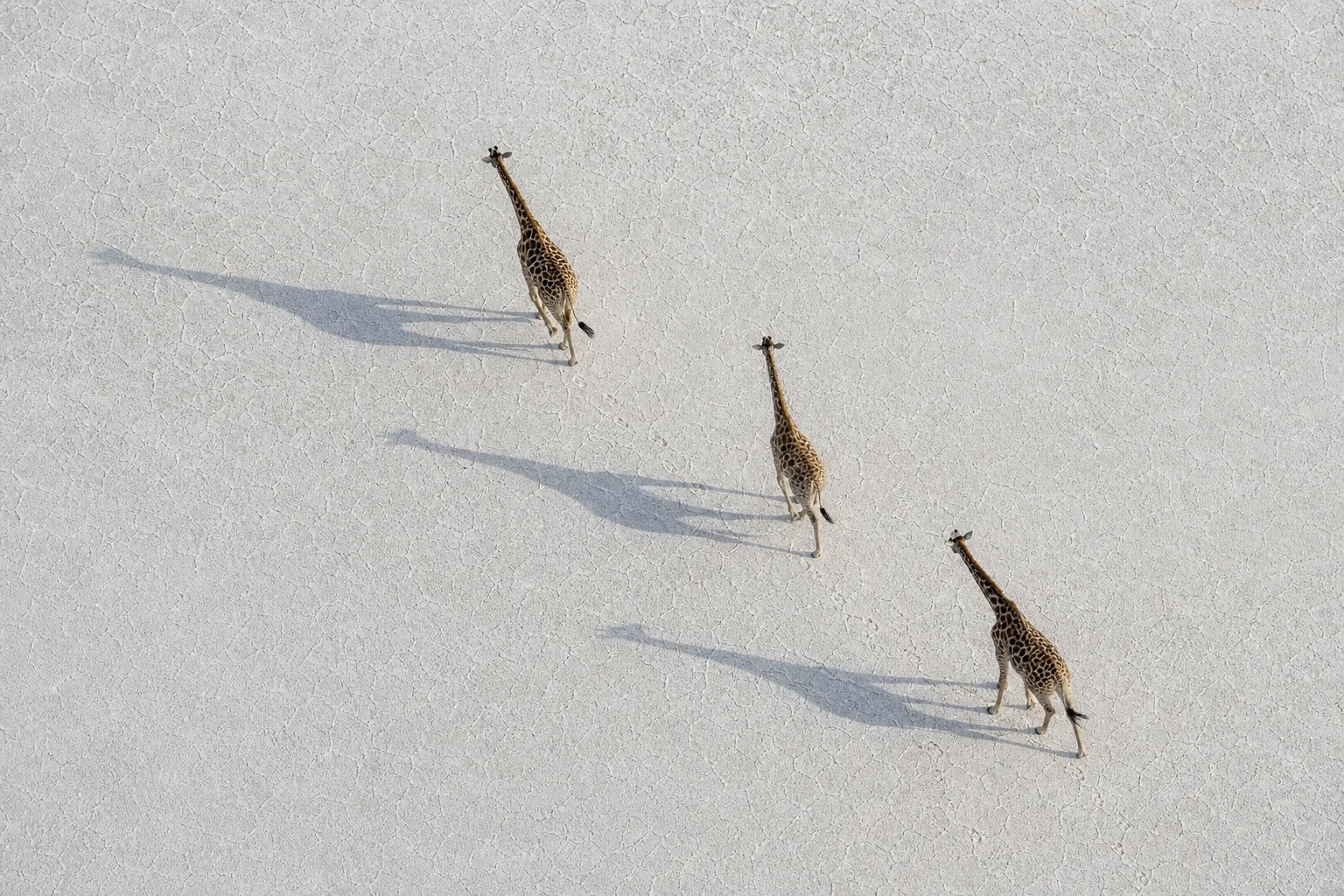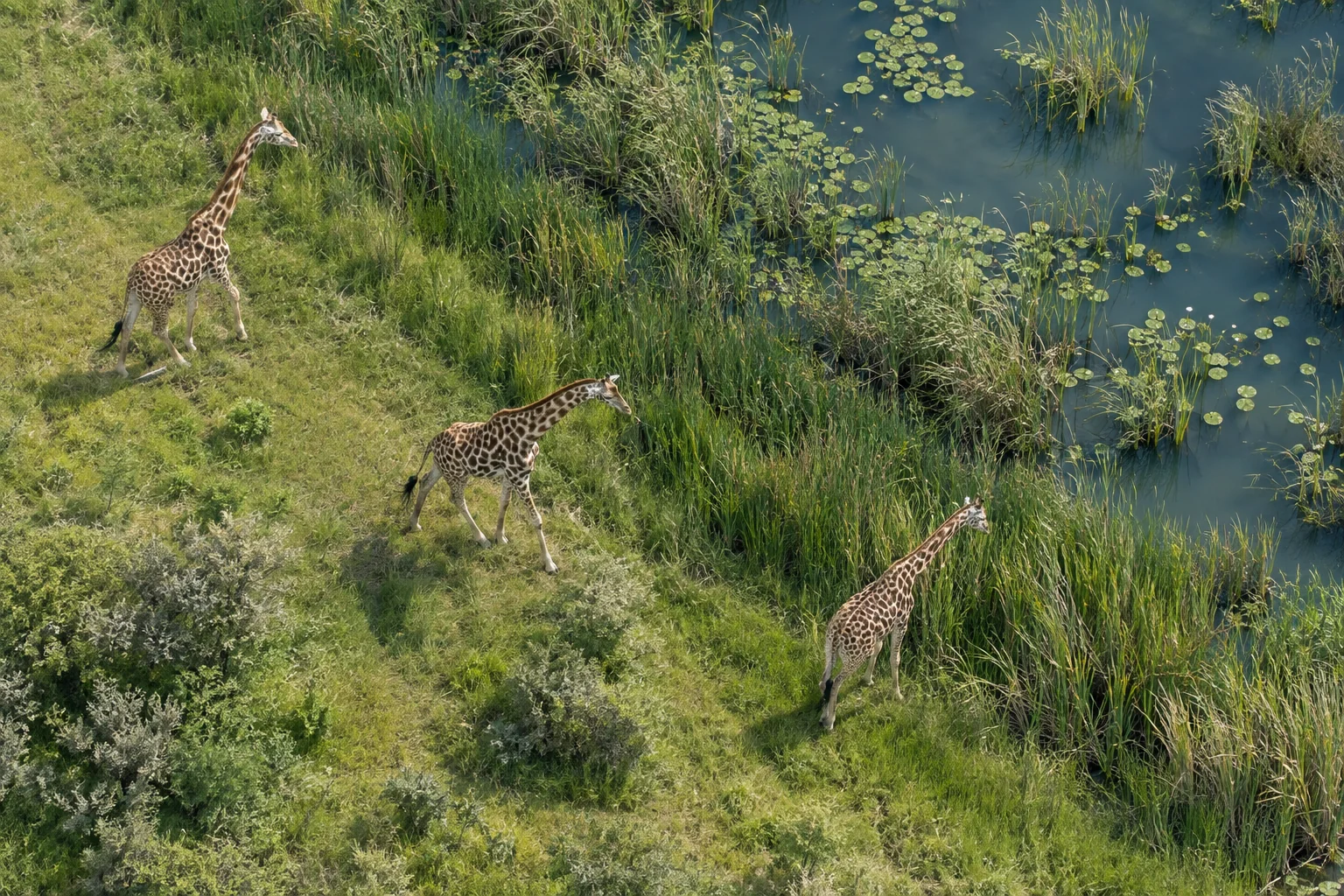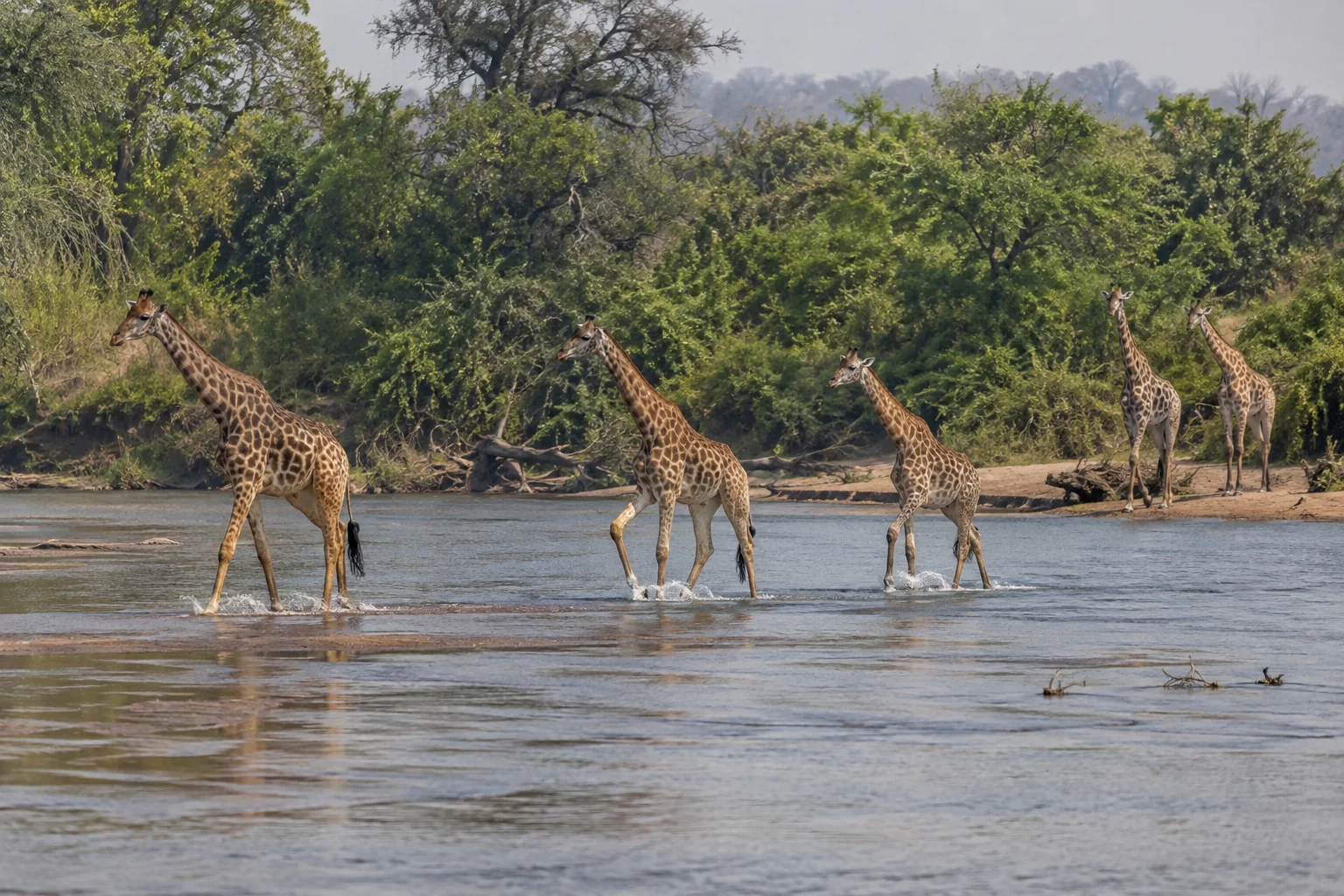
A seasonal journey does not have to involve an entire herd moving together. Within one giraffe population, some animals can remain in familiar feeding areas while others leave and return as conditions change. If researchers treat them all as permanent residents, they can miss the habitats that the moving animals depend on.
Michael B. Brown and Douglas T. Bolger investigated this possibility in Uganda’s Murchison Falls National Park. Their 2020 paper combined two kinds of evidence: the detailed movements of a few tracked giraffes and repeated photographs of more than a thousand individuals. Together, these showed that the population contained both residents and seasonal migrants.
Two kinds of woodland, several ways to use them
The study compared two broad vegetation communities. One was rich in acacias and other plants used by browsing giraffes. The other contained a different mixture of broadleaf trees. The researchers surveyed the plants around giraffe observations and had collected specimens checked by botanists at Makerere University’s herbarium.
The differences mattered because leaves do not remain equally available throughout the year. A tree can be abundant in a landscape while supplying less foliage during a dry period. Several plant species can also respond differently to the same change in rainfall.
Satellite measurements confirmed a strong seasonal pattern of greenness, dropping during the dry season and rising after rain. Those measurements included signals from grass as well as trees. They helped establish the timing of vegetation changes without directly measuring the quality of the leaves giraffes selected.
Within this setting, there were three broad strategies: residence in the acacia-rich community, residence in the broadleaf community, and seasonal movement between the two. The last pattern is called partial migration because only part of the population migrates.
What makes a journey a migration?
A giraffe can walk a long way without migrating. It may explore, search for food or travel within a large home range. Migration requires a more specific pattern: a shift to a distinct seasonal range, followed by a return.
Brown and Bolger fitted GPS devices to giraffes in 2018, but only eight devices provided records suitable for following the key seasonal transition. All eight usable records came from females. The researchers therefore could describe individual movement strategies from the tracking data, but could not use that surviving GPS sample to compare the sexes.
They examined how far each animal was from its starting position through time. A resident’s distance varies as it moves around familiar ground. A migrant’s record shows a sustained displacement to a different area and then a return. To avoid classifying brief excursions as migration, their analysis required a substantial shift and at least three weeks in the seasonal range.
Four females were classified as residents, two in each vegetation community. Four made seasonal movements, including one classified as a mixed migrant. Their modelled separation between seasonal ranges was roughly 13–30 kilometres. The distance describes the separation of ranges, not every kilometre walked along the journey.
The migrants generally moved into broadleaf habitat as the dry season began and returned towards their wet-season habitat after the rains resumed. Their trajectories therefore added something that occasional sightings could not: sustained use of a different place, with a seasonal return.
The male bias came from photographs
The larger part of the investigation used 20 photographic surveys between December 2014 and December 2017. Giraffes’ distinctive coat patterns allowed the researchers to recognise individuals across visits. After filtering the records, they had 9,374 encounters with 1,453 giraffes.
Those numbers answer different questions. Thousands of encounters provide repeated evidence about movement, but they do not represent thousands of independent animals. Recognising a returning individual is precisely what makes the survey informative.
The analysis estimated the probability of moving between the two habitat sectors while accounting for the chance of seeing an animal. That correction mattered: giraffes were less likely to be detected in one sector than the other. Without it, a change in visibility could be mistaken for movement or disappearance.
Males had higher estimated probabilities of moving between sectors in both seasonal directions. The direction changed with season: towards broadleaf habitat during the transition into the dry season, and back towards the acacia-rich sector in wetter periods.
This evidence makes the title’s male bias understandable. It came from the broad photographic comparison, not from eight GPS-tracked females. The two datasets also covered different periods, so their agreement concerned a recurring movement pattern rather than simultaneous measurements of the same journey.
Why leave when other giraffes stay?
The study establishes the mixture of strategies more clearly than it establishes their causes. Brown and Bolger considered several explanations.
Food competition could affect individuals differently. Larger males need more total food, and males and females did not always consume the same mixture of plants. In the acacia-rich sector, females were observed eating proportionally more acacias, while males used more of another food tree, Crateva adansonii. Dry-season changes could therefore alter the feeding opportunities of the sexes differently.
Mating opportunities might contribute as well. Males that move could encounter a different distribution of females or avoid competition with other males. However, the authors noted a complication: the broadleaf sector was female-biased in every season. That alone could not explain why male movements into it were concentrated in the dry season.
The observations support these as hypotheses to investigate. They did not track each animal’s food intake, establish dominance relationships across the population or measure the reproductive success of migrants against residents.
Nor did the study show a clear seasonal pattern in adult and subadult survival that would identify one strategy as superior. Animals can respond differently to the same environment without one response being universally better.
Keeping more than one seasonal option available
A later continental tracking study, involving Brown and collaborators, found that giraffe ranges varied with both resource productivity and human disturbance. Its main comparison focused on animals with resident ranging behaviour. Read beside the Ugandan work, it shows why a single average area cannot capture every giraffe’s requirements. The projects also drew on related tracking programmes, rather than wholly independent sets of populations.
For conservation planning, the partial-migration result identifies a particular need: assess combinations of habitats across seasons. Protecting a place where giraffes are numerous in wet months may overlook a second habitat used by seasonal migrants when food changes.
The authors propose monitoring whether movement probabilities change as population density changes. That could help test whether competition contributes to migration. Repeated vegetation and feeding observations would be needed to separate crowding from year-to-year changes in plant resources.
Longer individual histories could answer another question: does a giraffe remain a migrant throughout its life, or change strategy with age, condition or reproduction? Following the same animals through several cycles would be more revealing than assigning a permanent label from one year.
Brown and Bolger’s work makes the population easier to understand because it preserves that variation. Giraffes occupying the same park need not be using the same landscape in the same way.
Sources
Michael B. Brown and Douglas T. Bolger (2020). Male-Biased Partial Migration in a Giraffe Population. Frontiers in Ecology and Evolution 7, 524. DOI and full article · Publisher PDF.
Michael Butler Brown and colleagues (2023). Ranging behaviours across ecological and anthropogenic disturbance gradients: a pan-African perspective of giraffe (Giraffa spp.) space use. Proceedings of the Royal Society B 290, 20230912. Full paper.