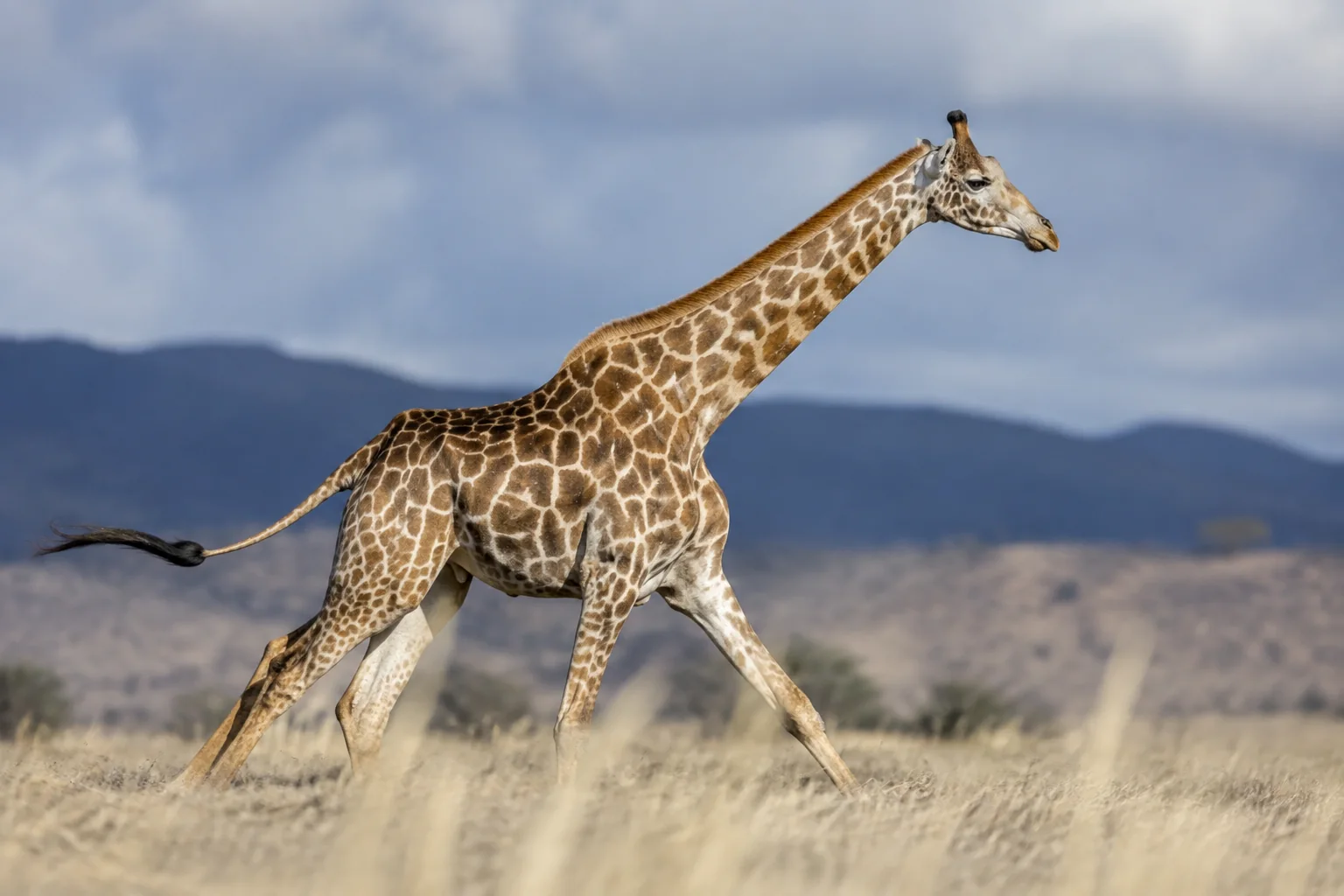
A giraffe with damaged skin and old claw marks seems to offer a simple story: disease weakened it, and a lion took advantage. The photograph cannot establish that sequence. The lesions might have developed after the attack, and the animal is standing there precisely because it survived.
Arthur Muneza and colleagues examined that problem in Tanzania's Ruaha National Park. Their study, published online in 2021, found only weak evidence of an association between severe skin disease and marks attributed to lions. Age and sex showed clearer relationships with the presence of marks. The findings make a strong case for asking what a scar records before using it to measure predation on giraffes.
Reading an encounter from a photograph
The team repeatedly photographed giraffes along road transects during May–August 2015, matching individuals by their coat patterns. They recorded skin-lesion severity alongside claw marks, bite marks and damaged tails. Their statistical model accounted for differences in the likelihood of encountering individual animals. Its comparisons concerned adults and subadults; calves were excluded because their movements depend on their mothers.
That is more informative than collecting striking photographs. Repeated identification helps prevent the same conspicuously injured animal from becoming several apparent cases, while allowing researchers to compare animals that differ in more than skin condition.
Even so, matching lesions to scars is not the same as watching a disease change the outcome of an attack. Imagine two otherwise comparable groups. One could accumulate more scars because lions attack it more often. Another could accumulate more scars because its members escape more often. Both routes can produce the same observation: more marked animals walking around afterwards.
An animal without a visible scar is ambiguous too. It may never have encountered a lion, or it may have escaped without a lasting mark. An animal killed during an attack cannot enter this photographic comparison at all. The missing cases are central to the question, rather than a small correction to the count.
The missing step between lesions and vulnerability
If skin disease affects escape, one plausible connection is impaired movement. A separate study led by Laura Bernstein-Kurtycz examined that step by measuring walking gaits in wild adult male Nubian giraffes in Uganda. Giraffes with snare wounds alone walked more slowly and took shorter relative strides than the comparison animals. Skin disease showed no significant effect on the measured limb movements, but lesions in that sample were mainly on the neck. Those results cannot settle the effect of severe lesions on a Ruaha giraffe's legs. The gait study asks about movement; the Ruaha study asks about marks left by past encounters.
Putting the two questions together clarifies what a more decisive investigation would need. Researchers would have to establish an animal's condition before an encounter, measure any change in movement, and follow what happened afterwards—including deaths. Otherwise, an apparent relationship can mix susceptibility to attack with the capacity to survive it.
That distinction changes the conservation question. A conspicuous lesion deserves investigation, but its appearance alone cannot tell managers how much it contributes to mortality. Nor does an uncertain association establish that the disease is harmless. The useful outcome of the scar study is a more precise target for monitoring: connect an individual's health history to an encounter and its outcome, rather than letting the scar stand for all three.
Sources
- Arthur B. Muneza, Daniel W. Linden, Michael H. Kimaro, Amy J. Dickman, David W. Macdonald, Gary J. Roloff, Matt W. Hayward and Robert A. Montgomery. “Exploring the connections between giraffe skin disease and lion predation.” Journal of Zoology 316, 49–60 (2022; first published online 2021). DOI. Public author manuscript at NOAA.
- Laura M. Bernstein-Kurtycz, Noah T. Dunham, Janny V. Evenhuis, Michael B. Brown, Arthur Muneza, Julian Fennessy, Patricia M. Dennis and Kristen E. Lukas. “Evaluating the effects of giraffe skin disease and wire snare wounds on the gaits of free-ranging Nubian giraffe.” Scientific Reports 13, 1959 (2023). Full paper and DOI.