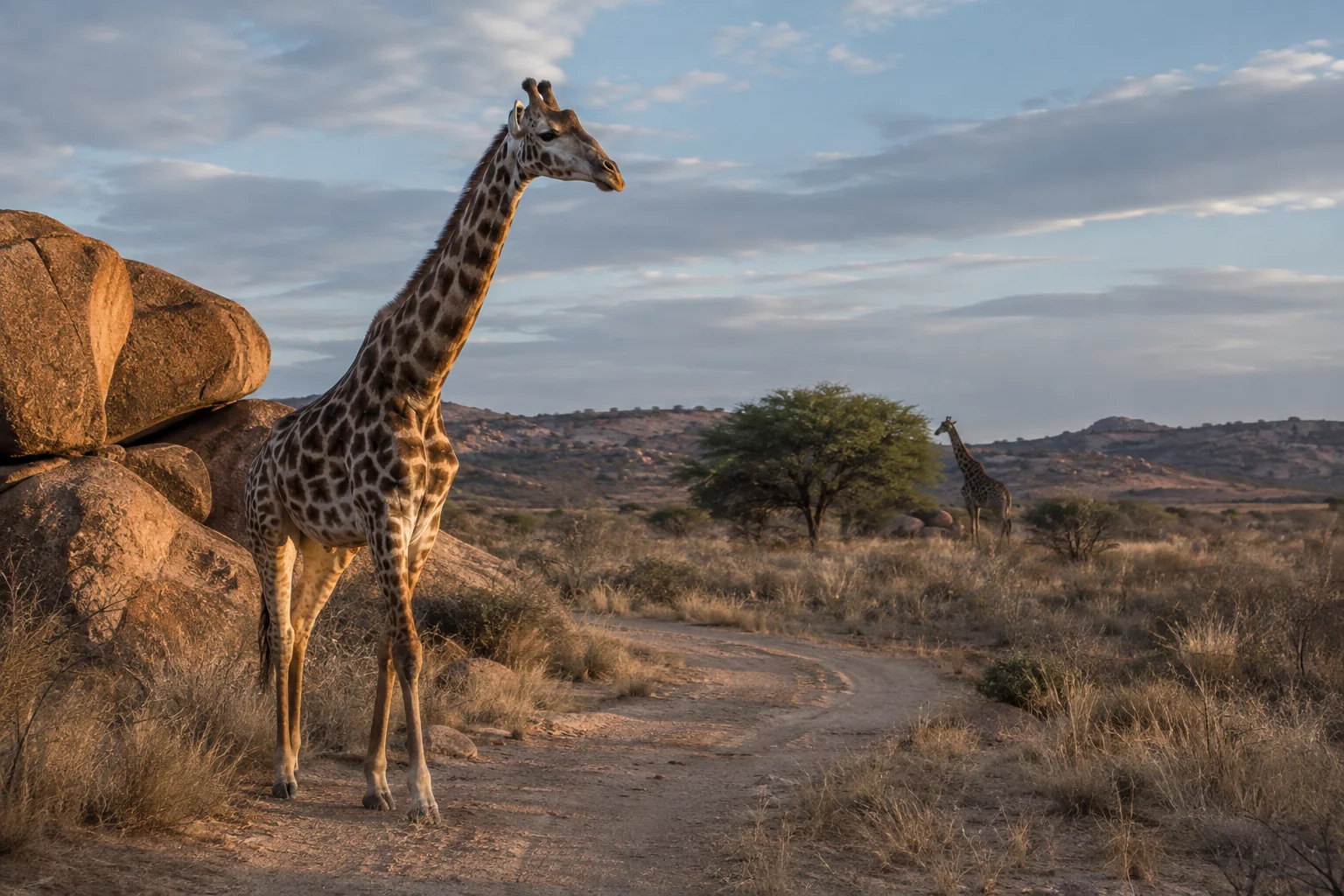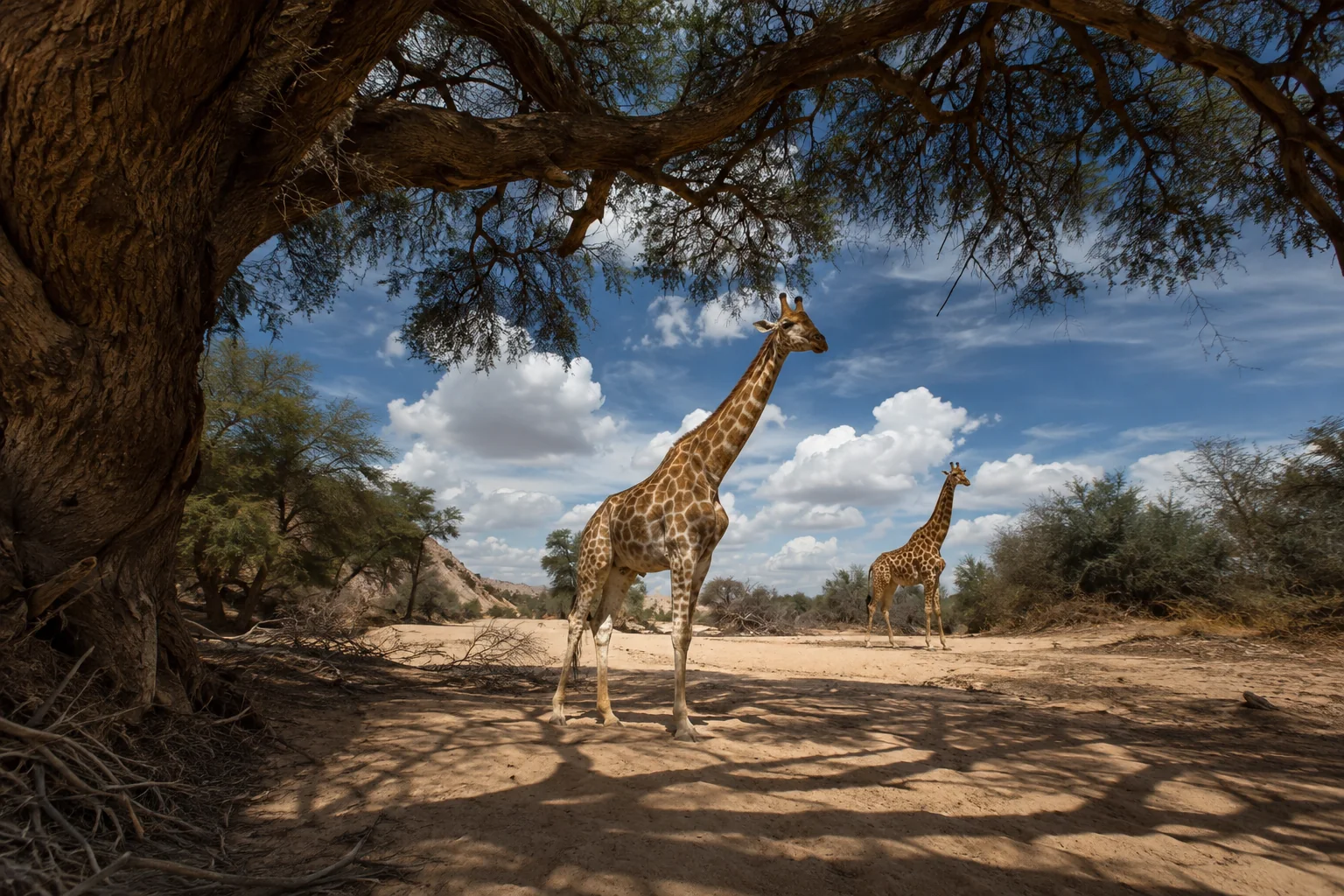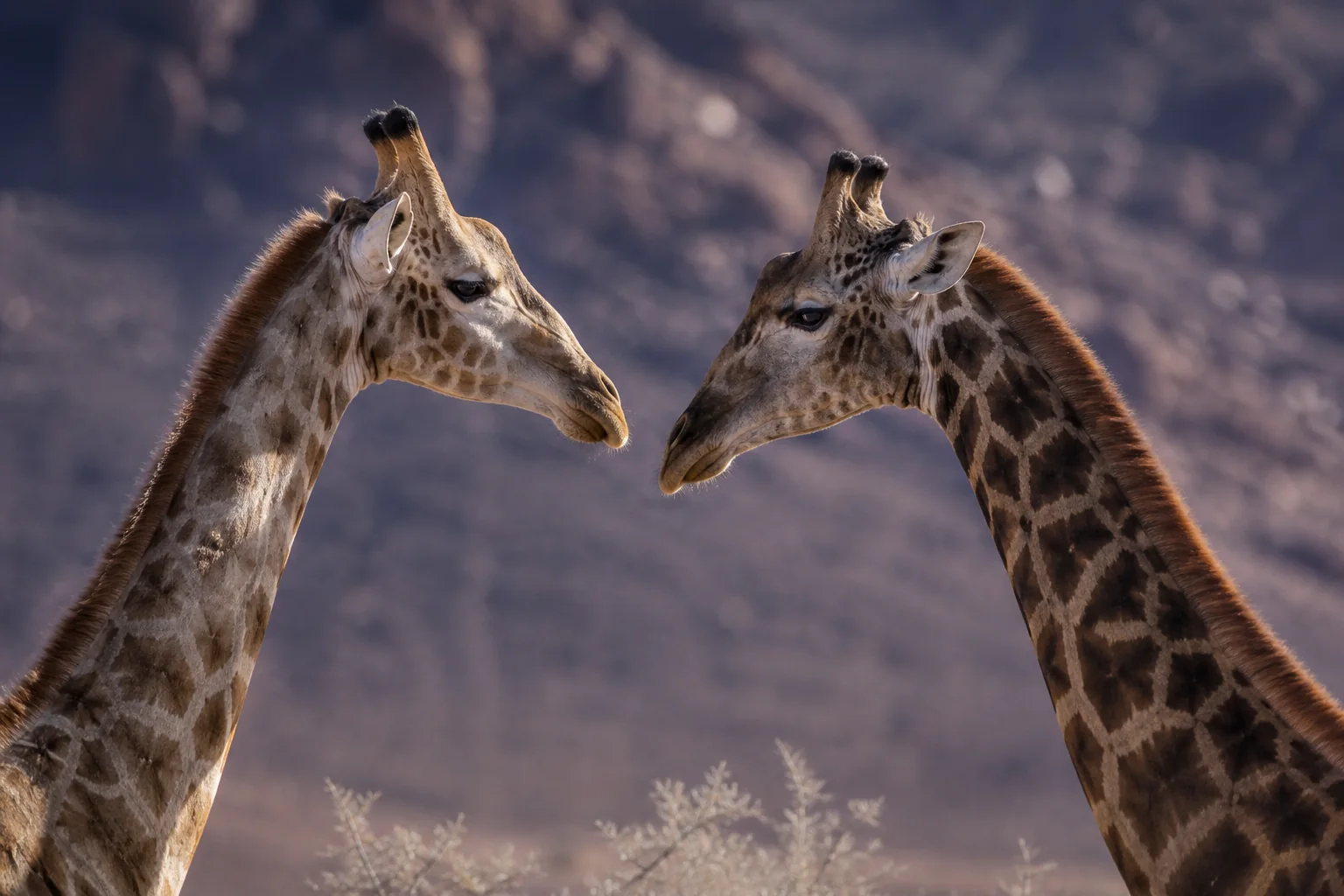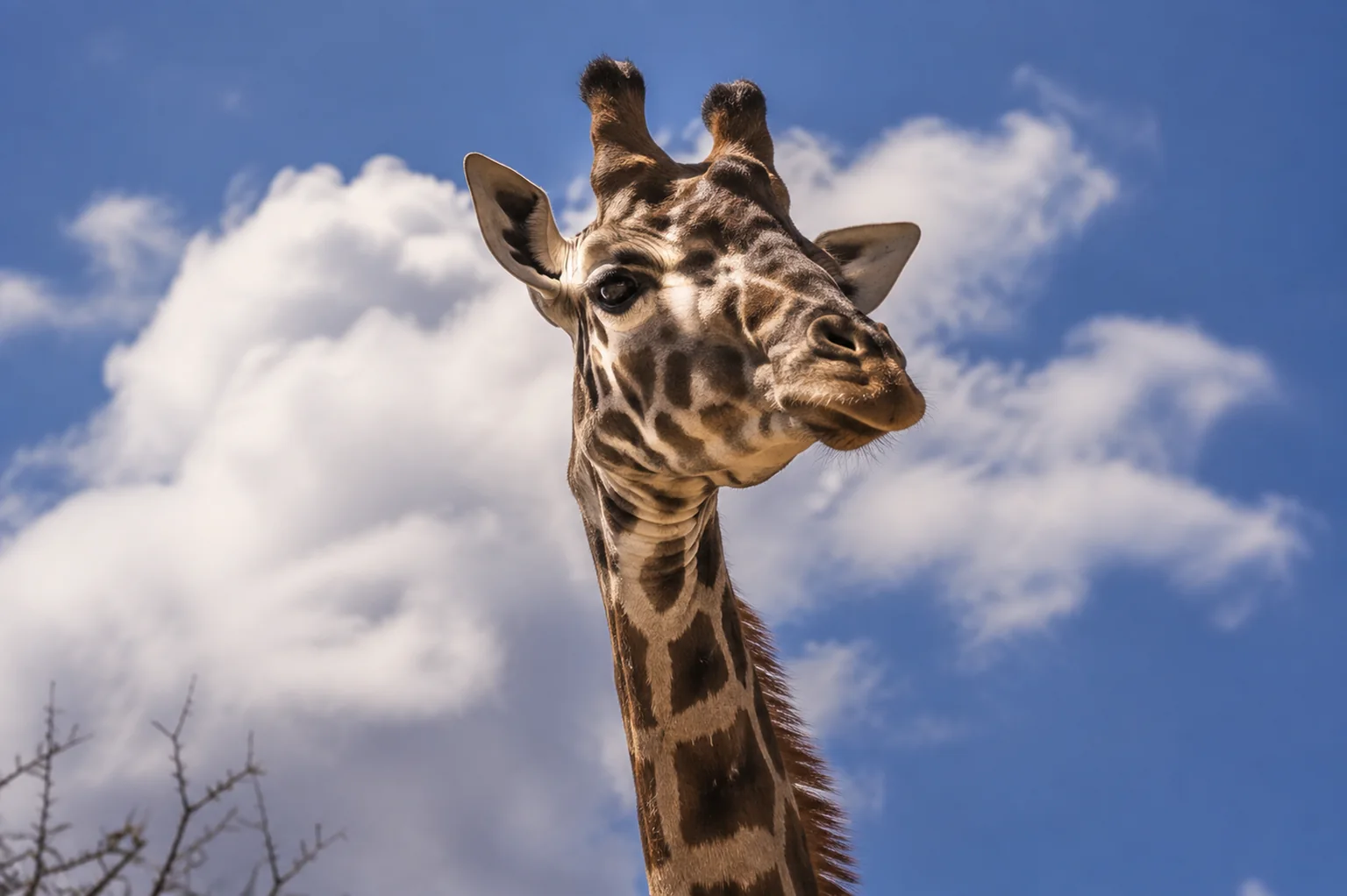
A newborn male giraffe is not simply a miniature version of the broad-necked adult he may become. Nor does a female calf begin life with all the proportions that distinguish adult females. The differences develop as parts of the body grow at different relative rates.
That process was the subject of a 2024 study by Douglas Cavener and colleagues. Using photographs of Masai giraffes whose birth dates were known, the researchers reconstructed changes in the neck, trunk and legs across development. They found no detectable differences in the measured body proportions at birth, followed by several distinct patterns of divergence between the sexes.
The finding changes how an adult comparison should be read. A proportionally longer neck can arise partly because the legs follow a different growth trajectory. Understanding the neck therefore requires following the animal around it.
Turning photographs into a growth series
The team assembled 357 usable photographs of 179 Masai giraffes in North American zoos and safari parks. Each individual contributed between one and five images, taken at different ages. Birth records supplied the age information that photographs of most wild adults cannot provide.
The researchers measured distances between recognizable anatomical landmarks in pixels. A pixel length from one photograph cannot be compared directly with a pixel length in another photograph taken from farther away. A ratio within the same animal can: neck length divided by foreleg length remains meaningful despite the image's overall scale.
That only works if perspective and posture are controlled. The animal had to face sideways to the camera, with the relevant landmarks visible. Fewer than one percent of the images gathered met the study's criteria. The team also adjusted the neck measurement to a common angle, because raising the head changes the distance between the selected landmarks even when the underlying bones have not grown.
Their growth models allowed curves rather than forcing a straight-line relationship between age and proportions. They also accounted for repeated photographs of the same giraffe, so one well-photographed animal was not treated as several independent individuals.
This was a substantial age series, but not a continuously measured growth record for every giraffe. The curves combine comparisons across individuals with the repeated observations available for some of them.
Similar beginnings, different trajectories
In both sexes, the neck and trunk together grew faster relative to the combined lengths of the forelegs and hindlegs during the early years. Within the neck-and-trunk combination, the neck made the larger proportional gain. A calf's short-necked appearance therefore changes through growth shared by males and females.
The sexes then began to diverge in particular relationships. One clear example was trunk length relative to foreleg length. In the fitted curves, both sexes initially increased this ratio. After about five years, the male curve turned downward, consistent with a greater subsequent contribution from foreleg growth. The female curve continued upward for longer.
The neck's width followed another trajectory. Relative to neck length, width decreased early in life in both sexes as the neck elongated. The male curve eventually flattened and rose, while the female curve continued downward. Adult males consequently had wider necks relative to their length.
These were not all changes that appeared at one birthday. The plotted comparisons first detected a difference in withers height relative to rump height at about four and a half years, and in neck width relative to length at about six. Other relationships separated later. Those thresholds describe this sample and statistical analysis; they are not universal ages at which an individual giraffe suddenly changes form.
Nor does a declining ratio mean that a body part is shrinking. A trunk can continue to lengthen while becoming shorter relative to a foreleg that is growing faster. The study concerns allocation of growth across the body, not just how many centimetres each component adds.
Why the comparison length matters
Adult females had longer necks relative to their forelegs, even though adult males are generally larger animals. The distinction between absolute length and proportional length is essential: the animal with the longest neck in metres need not devote the greatest share of its stature to neck length.
The team checked more than one reference measurement. Using the withers, the ridge above the shoulders, instead of the indentation where neck and chest meet produced the same adult direction. But the female advantage was not significant when neck length was compared with hindleg length in the adult analysis.
That result helps explain the discovery. The difference is a relationship among body parts, with the unusually long male forelegs contributing to the contrast. It cannot be reduced to a claim that females have more elongated necks by every possible measure.
To check whether the adult pattern was particular to captivity, the researchers compared 79 captive adults with 98 wild adults photographed in Tanzania. The wild animals' exact ages were unknown, so size and mature appearance were used to select animals judged likely to be older than eight years. Females again had longer necks relative to forelegs and longer trunks in the relevant comparisons, while males had proportionally longer forelegs and wider necks.
The agreement supports using the captive series to investigate a pattern also found in wild adults. It does not establish that all populations grow at identical rates or that nutrition and other environmental conditions have no influence.
Growth is a clue to mechanism, not a history of selection
The delayed emergence of differences led the authors to propose that hormonal changes around maturation could contribute. They did not measure hormones. The study identifies the developmental period and anatomical relationships that such a mechanism would have to explain.
A separate analysis of giraffe skulls offers a useful comparison from another region of the body. Nikolaos Kargopoulos and colleagues grouped skulls by dental development, tooth wear and closure of the joints between skull bones. Female skulls in their subadult categories were already broadly similar to adult ones, whereas male subadult skulls remained more distinct from male adults.
That comparison uses estimated age categories rather than the known birthdays available in the photographic study. It nevertheless reinforces a practical point: developmental timing can contribute to differences between adult males and females, and different parts of the animal need their own measurements. Skull maturity cannot be substituted for completion of every change in body proportions.
Cavener and colleagues proposed different possible benefits for the resulting forms, including maternal demands and feeding reach in females, and competition between males. The photographs did not test which individuals obtained more food, won contests or produced more offspring. They also cannot establish the historical order in which selection lengthened the giraffe neck and modified its other proportions.
What they do establish is a developmental problem worth explaining. Male and female Masai giraffes arrive at different adult shapes from similar proportional beginnings. The neck's story unfolds together with those of the trunk and legs, through years of coordinated but unequal growth.
Sources
- Douglas R. Cavener, Monica L. Bond, Lan Wu-Cavener, George G. Lohay, Mia W. Cavener, Xiaoyi Hou, David L. Pearce and Derek E. Lee (2024). “Sexual dimorphisms in body proportions of Masai giraffes and the evolution of the giraffe’s neck.” Mammalian Biology. Full paper.
- Nikolaos Kargopoulos, Jesús Marugán-Lobón, Anusuya Chinsamy-Turan, Bernard R. Agwanda, Michael Butler Brown, Stephanie Fennessy, Sara Ferguson, Rigardt Hoffman, Fredrick Lala, Arthur Muneza, Ogeto Mwebi, Moses Otiende, Alice Petzold, Sven Winter, Abdoul Razack Moussa Zabeirou and Julian Fennessy (2026). “The variability of giraffe skull morphology.” Journal of Anatomy. Related study.