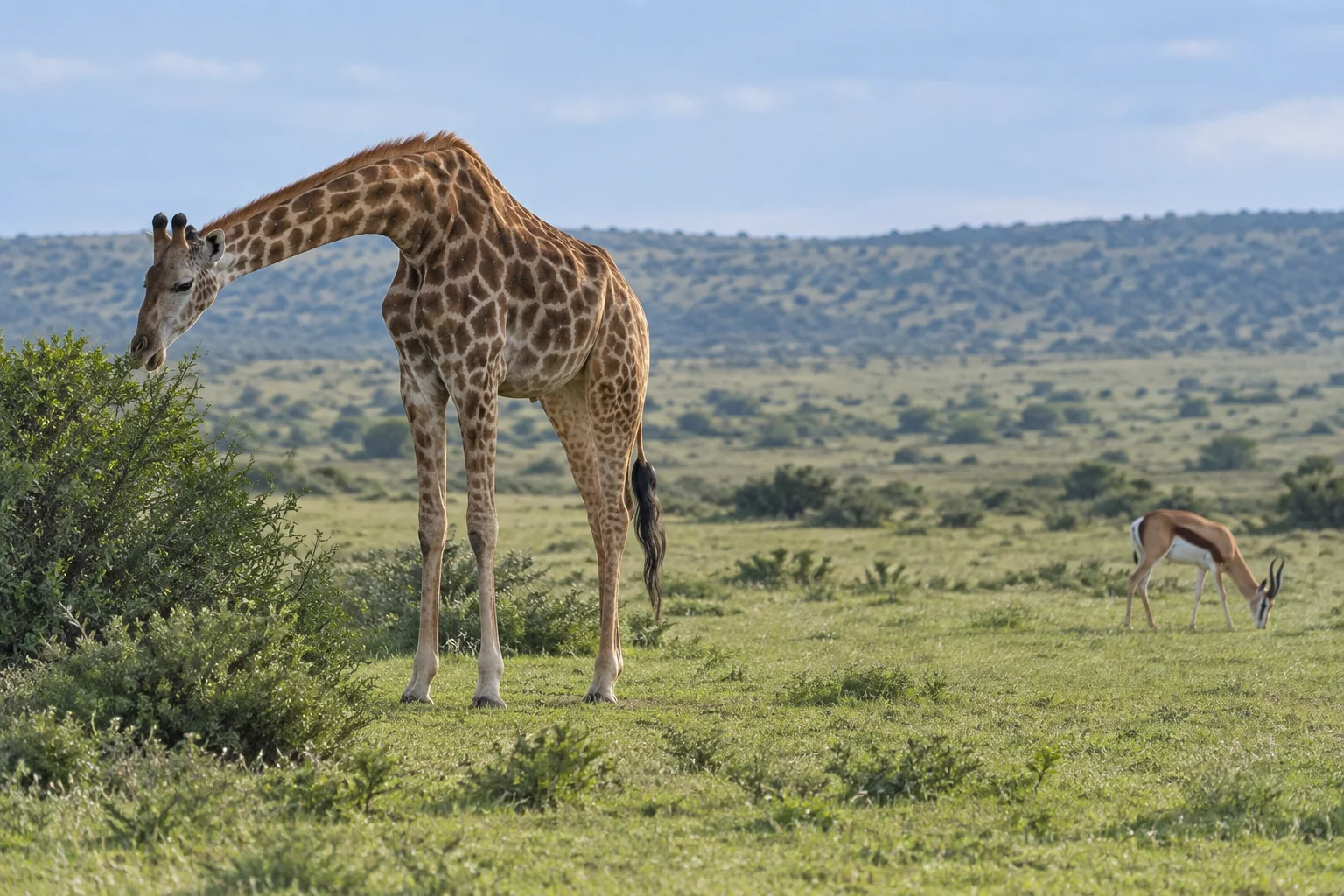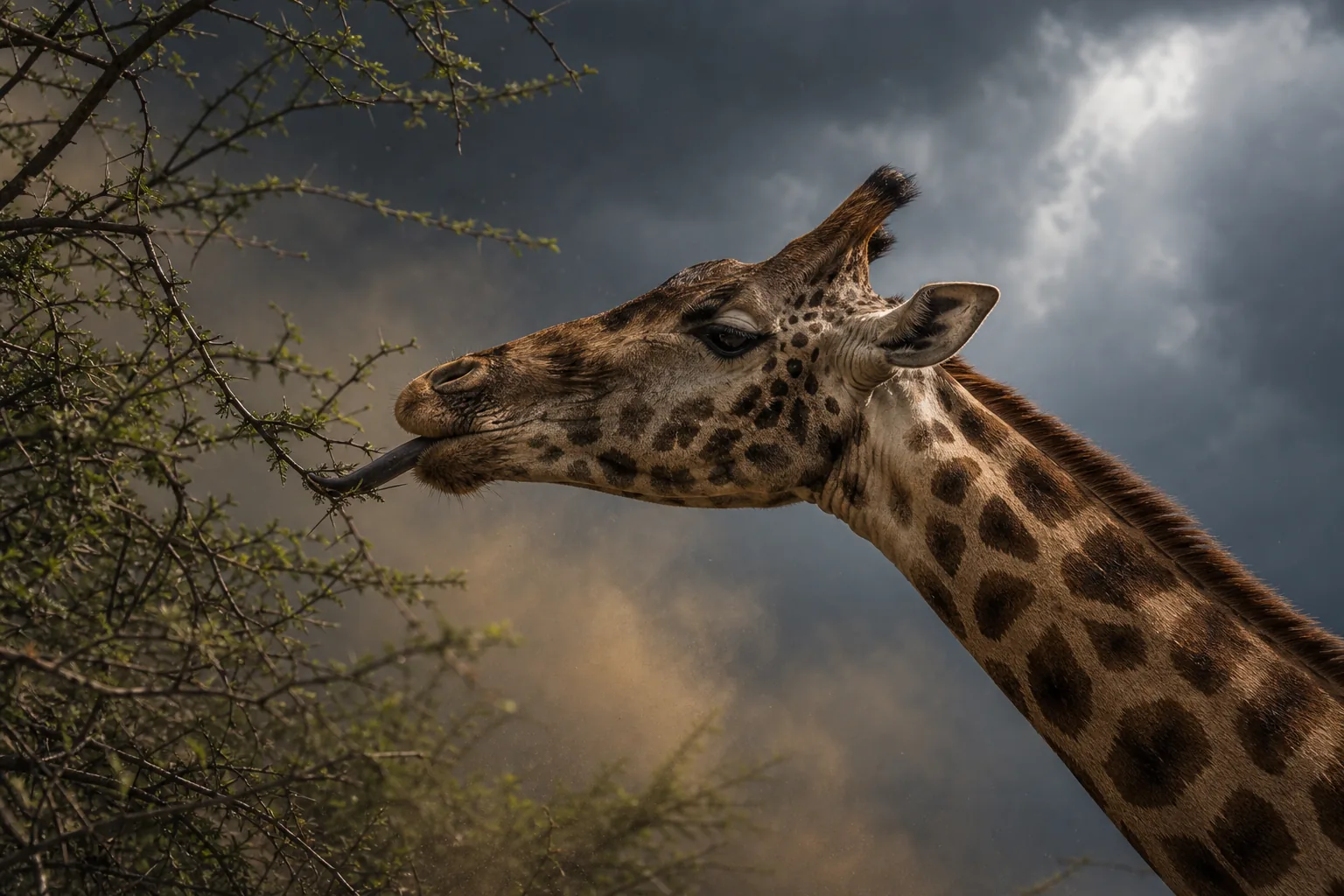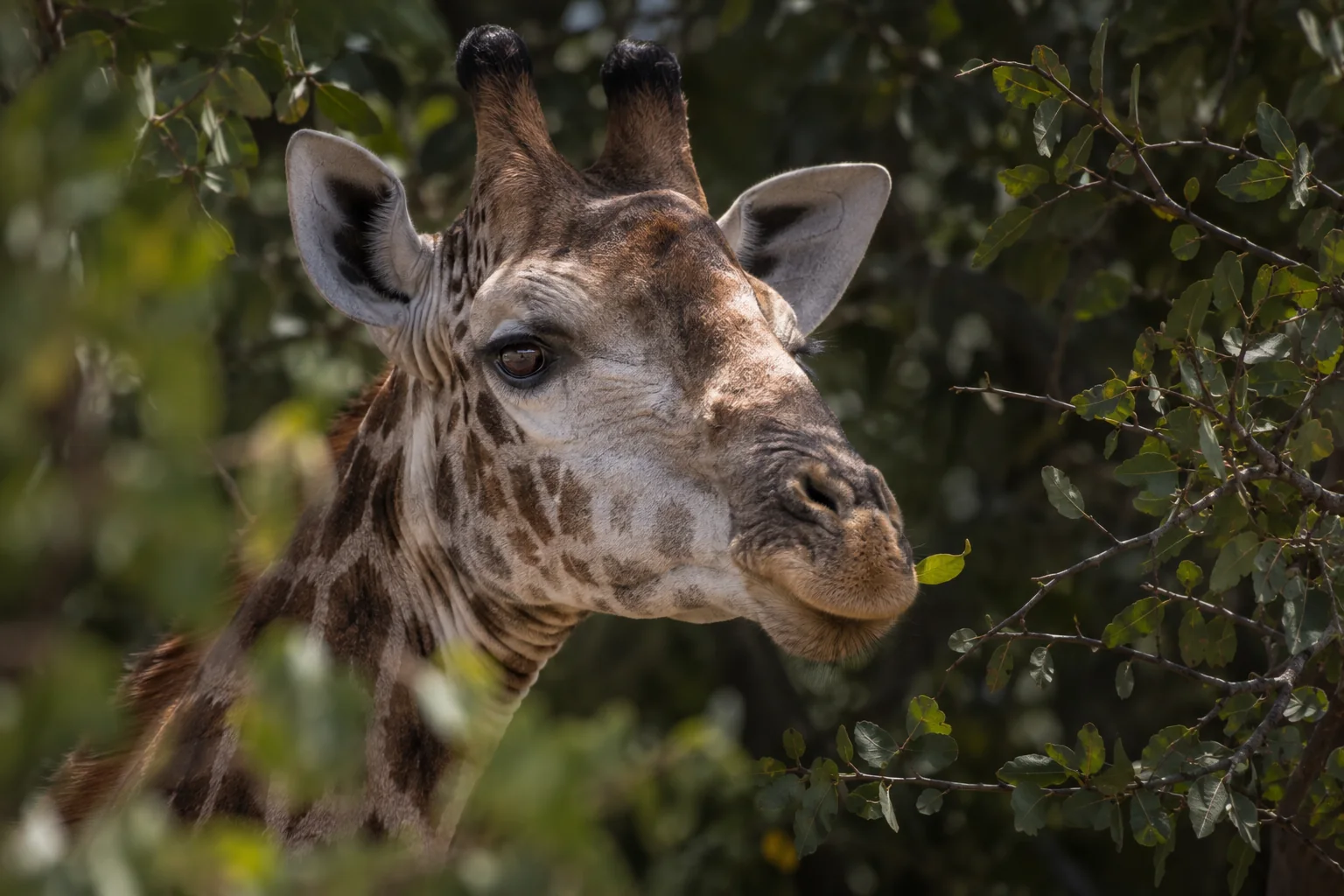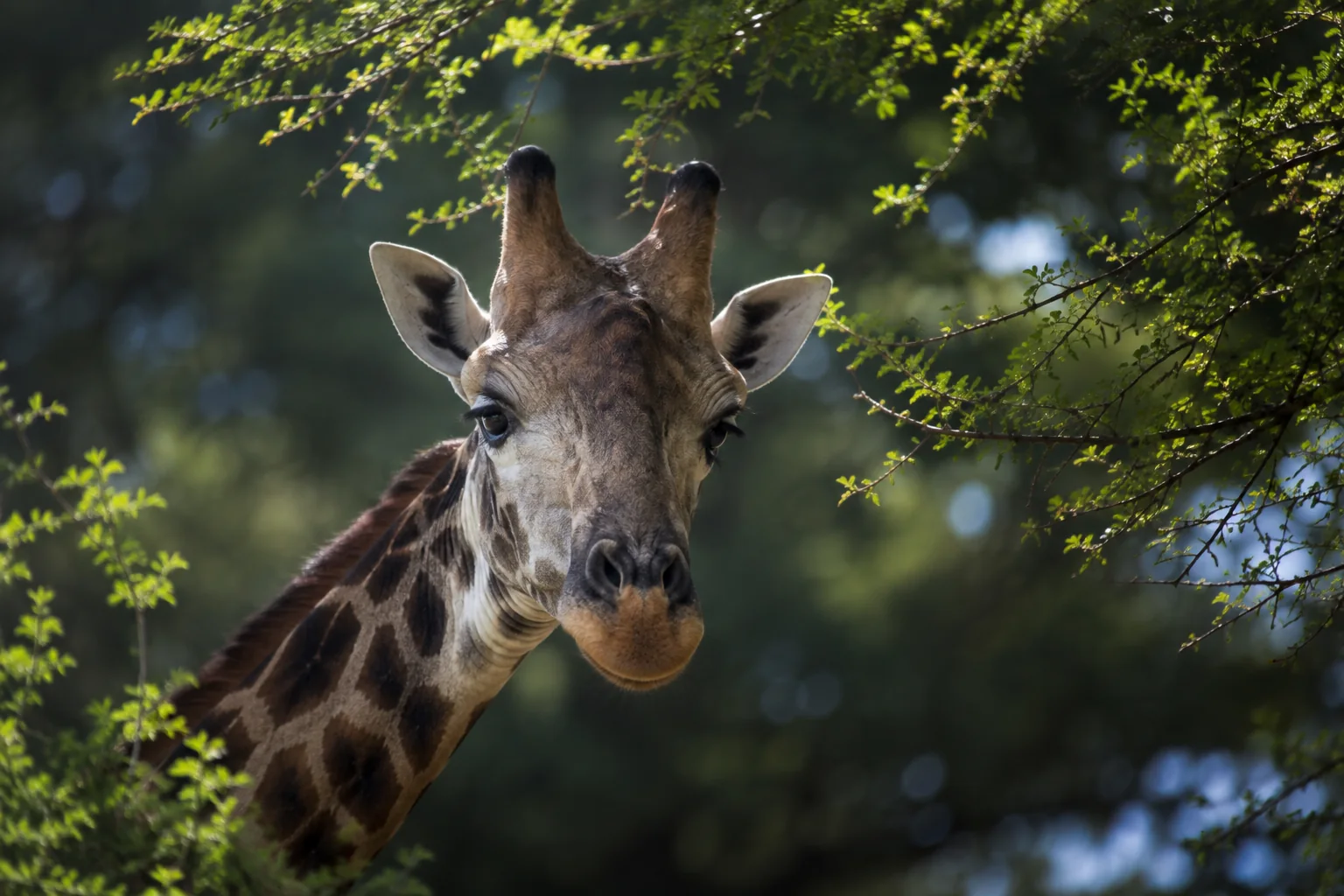
A giraffe and a dik-dik can both be described as browsers without eating the same dinner. Their different heights make one explanation obvious: they can reach different parts of a shrub. But a large comparison of African herbivore diets found another distinction hidden inside that broad label. Animals also differed in which plants they ate, and in how strongly each plant contributed to their diet.
That matters because a savanna contains many more feeding opportunities than the categories grass and leaves suggest. If several species all count as browsers, a habitat assessment can make their food requirements look interchangeable. Johan Pansu and colleagues’ 2022 study showed why that shortcut loses information. Even herbivores in the same feeding group usually left different combinations of plant DNA in their dung. Giraffes were part of that pattern, sharing some foods with smaller neighbours while using others in different proportions. The full study makes plant identity a central part of the question of how animals share a landscape.
Reading a meal after it has been eaten
The team assembled 3,928 fresh dung samples from 30 herbivore species at ten savanna sites in seven countries. Sampling took place between 2013 and 2018, with several sites revisited in different seasons or years. This breadth was important. A difference between two species at one place could reflect a temporary food shortage or the peculiar vegetation of that site. Repeated differences across contrasting savannas would be harder to dismiss as a local accident.
The researchers extracted plant DNA and sequenced a short chloroplast marker. Matching those sequences against reference libraries allowed them to identify food plants, sometimes to species and sometimes only to a broader group. Their final collection contained 893 plant taxa from 124 families. Here, a taxon means a distinguishable DNA category; it does not always mean one separately identified plant species.
For each dung sample, they calculated how much of the retained plant sequence data came from each category. This measure, relative read abundance, offers a way to compare the composition of diets. It is not a direct weighing of swallowed leaves. Differences in DNA recovery and amplification can make some plants more visible than others, and a sequence percentage should not be translated automatically into a percentage of food mass, energy or protein.
The analysis nevertheless gained power from applying a broadly consistent method across many animals and sites. Laboratory controls and filtering helped remove contamination and unreliable sequences. One site, Addo, used a sufficiently different processing method that the authors excluded it from some comparisons of dietary diversity and food-web structure. They also generally required at least ten samples for a species in a sampling period, and checked whether relaxing that threshold changed the central finding.
The unit being compared was a species at a particular place and time. This distinction prevents a common misunderstanding: the project did not discover one permanent diet for each species. It compared the mixtures animals were actually eating under particular conditions.
Nearly identical labels, different mixtures
Giraffes contributed 64 samples across two sites and four sampling periods. Their mean grass contribution was only 0–1% of plant DNA reads, depending on the population and period. That firmly placed these samples at the browsing end of the spectrum. Yet legumes varied from 36% to 79% of reads, showing substantial variation even within a consistently nongrass diet.
The paper’s figures make the difference between a feeding label and a complete diet especially clear. In the broad grass comparison, giraffes sit alongside several other almost exclusive browsers. In plots comparing the entire mixture of food plants, the same species can separate from one another. The axes in those plots are summaries of compositional difference, not feeding height or distance travelled: samples plotted farther apart have more different plant mixtures.
At Laikipia, for example, giraffe and dik-dik samples could be distinguished within the browsing group. At Hluhluwe-iMfolozi, giraffes also differed from the other browser included in the figure’s four-species comparison, nyala. The message is not that every meal was unique or that the animals avoided all shared foods. It is that the average combination of food plants differed enough to distinguish species that a simple grass-versus-browse classification groups together.
A specific example from Laikipia explains how this can happen. In March 2015, giraffes, greater kudu and dik-diks all ate the shrub Senegalia brevispica. Its DNA contributed substantial shares of all three diets. Yet Euclea divinorum contributed much more strongly to giraffe and kudu samples than to dik-dik samples, whereas Senegalia mellifera contributed much more strongly to giraffe and dik-dik samples than to kudu samples.
There is no single line dividing those three menus into foods used by one animal and forbidden to another. The difference lies in overlapping combinations. Shared use of one shrub can coexist with different use of other plants. Feeding at different heights within the shared shrub remains possible too; the dung analysis adds another dimension without measuring or replacing that mechanism.
A repeated pattern, with informative exceptions
Across the entire dataset, 700 of 723 pairwise comparisons found statistically distinguishable diets between herbivore species living at the same site in the same sampling period. That is 97%, after adjustment for multiple comparisons. Restricting the analysis to the better-sampled comparisons produced a similar result.
This percentage describes the frequency of detectable differences. It does not mean that diets were 97% different, that 97% of food plants were exclusive to one herbivore, or that every species avoided competition. Some diets overlapped extensively while their average compositions still differed. The magnitude of separation varied, which became a question in its own right.
Differences tended to be stronger when rainfall was lower, and between species with more different body sizes. The rainfall relationship fits an ecological possibility: when food is scarce, species may depend more heavily on resources they are particularly capable of obtaining or processing. When food is abundant, their choices can overlap more. But rainfall was an environmental predictor, not an experimental manipulation of competition.
One of the weaker patterns occurred in Gorongosa, where several abundant herbivores had broad, variable and overlapping diets. The authors interpreted that result in the context of a community recovering from severe historical losses of large mammals. It suggested that altered interactions among species could change dietary separation. It was not a giraffe result, and it did not establish that one process explained every diet in the recovering community.
These departures make the broad result more useful. Plant partitioning was widespread, but its strength depended on context. A label such as browser cannot supply either the exact plants an animal will eat or the degree of dietary overlap it will have with its neighbours.
Distinct diets are evidence about coexistence, not its final explanation
The study’s larger motivation was a difficult ecological problem: how do many large herbivores persist together while consuming apparently similar resources? Eating different plant mixtures offers a plausible part of the answer. If two species rely on somewhat different foods, each may place less pressure on the resources most important to the other.
The observations do not, by themselves, prove that competition caused those differences or that the differences are sufficient to keep both populations alive. Animals may encounter different plants because they use different parts of a landscape. Predation risk, access to cover, seasonal movement and other influences can also affect where they feed. The researchers deliberately collected interspersed samples over comparatively limited areas, but shared access in principle does not guarantee that every individual encountered the same plants.
Nor did the DNA reveal which leaf height or plant part had been selected. A giraffe could differ from a smaller browser in plant species, feeding height and patch choice simultaneously. Those explanations need not compete with one another.
For conservation, the practical implication is that the vegetation beneath a broad habitat category deserves attention. A landscape with abundant woody cover may still differ in the food plants available to giraffes and to neighbouring browsers. That is an inference about what habitat assessments should examine, rather than a habitat-management treatment tested in this experiment.
A separate satellite study of reticulated giraffe habitat illustrates the complementary scale of the problem. It used tracked giraffes and remotely sensed vegetation and terrain to identify potentially suitable areas. Its predictions performed less well against independent occurrence datasets than within the original data. Plant-level diets were not part of that study, so the DNA results cannot explain its prediction errors. Together, however, the papers show why finding plausible habitat and understanding the resources inside it are distinct tasks. Our commentary on the satellite models follows the first task in detail.
The dietary study leaves giraffes recognizably as browsers while making that description less complete. They share foods with smaller animals, yet assemble those foods into different mixtures. Understanding that pattern requires looking beyond the amount of browse to the identity of the plants, and beyond a species’ general reputation to what a particular population eats in a particular season.
Sources
Johan Pansu, Matthew C. Hutchinson, T. Michael Anderson, Mariska te Beest, Colleen M. Begg, Keith S. Begg, Aurelie Bonin, Lackson Chama, Simon Chamaillé-Jammes, Eric Coissac, Joris P. G. M. Cromsigt, Margaret Y. Demmel, Jason E. Donaldson, Jennifer A. Guyton, Christina B. Hansen, Christopher I. Imakando, Azwad Iqbal, Davis F. Kalima, Graham I. H. Kerley, Samson Kurukura, Marietjie Landman, Ryan A. Long, Isaack Norbert Munuo, Ciara M. Nutter, Catherine L. Parr, Arjun B. Potter, Stanford Siachoono, Pierre Taberlet, Eusebio Waiti, Tyler R. Kartzinel and Robert M. Pringle (2022). “The generality of cryptic dietary niche differences in diverse large-herbivore assemblages.” Proceedings of the National Academy of Sciences 119, e2204400119. Full primary paper.
R. D. Crego, J. Fennessy, M. B. Brown, G. Connette, J. Stacy-Dawes, S. Masiaine and J. A. Stabach (2024). “Combining species distribution models and moderate resolution satellite information to guide conservation programs for reticulated giraffe.” Animal Conservation 27, 160–170. Primary paper.