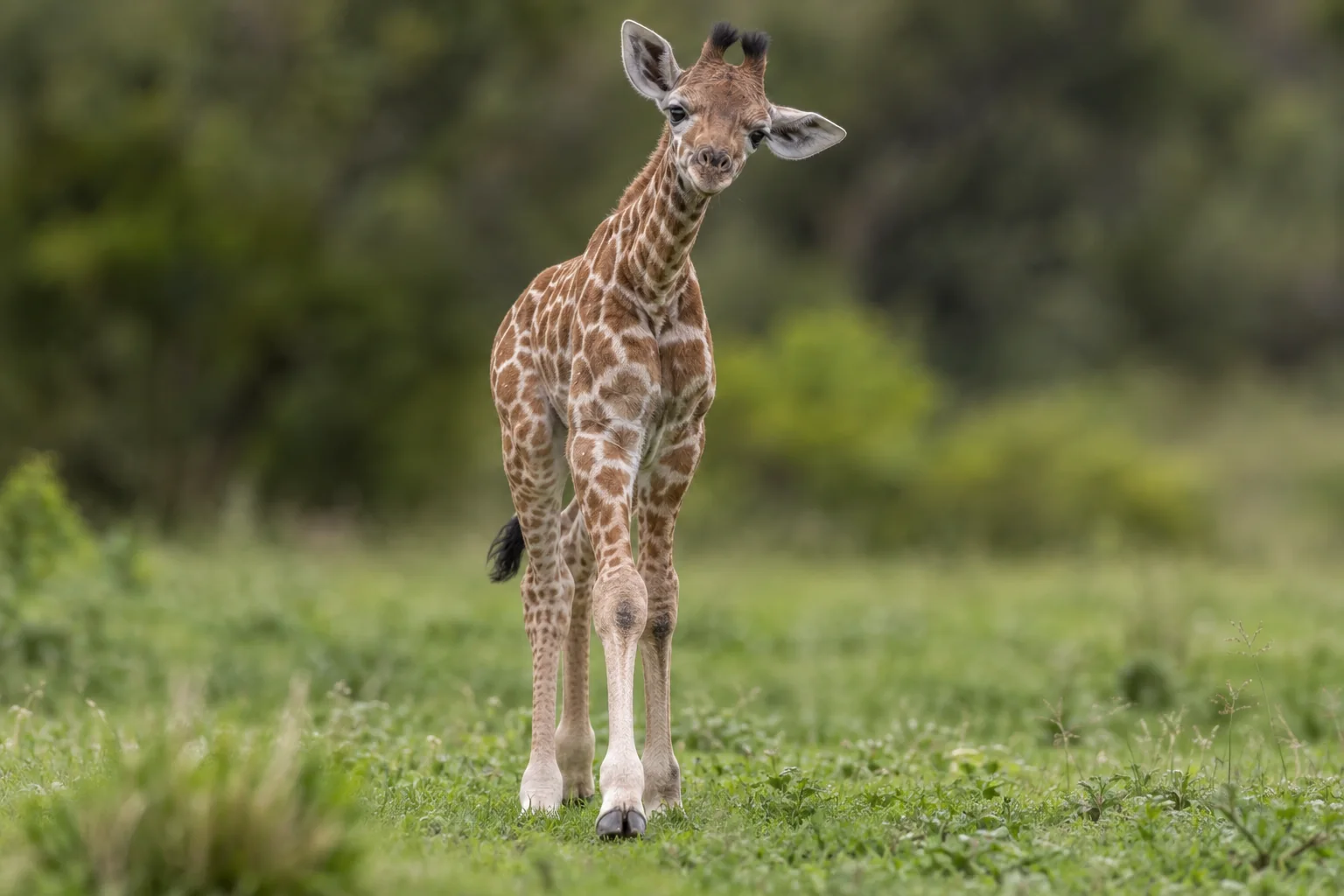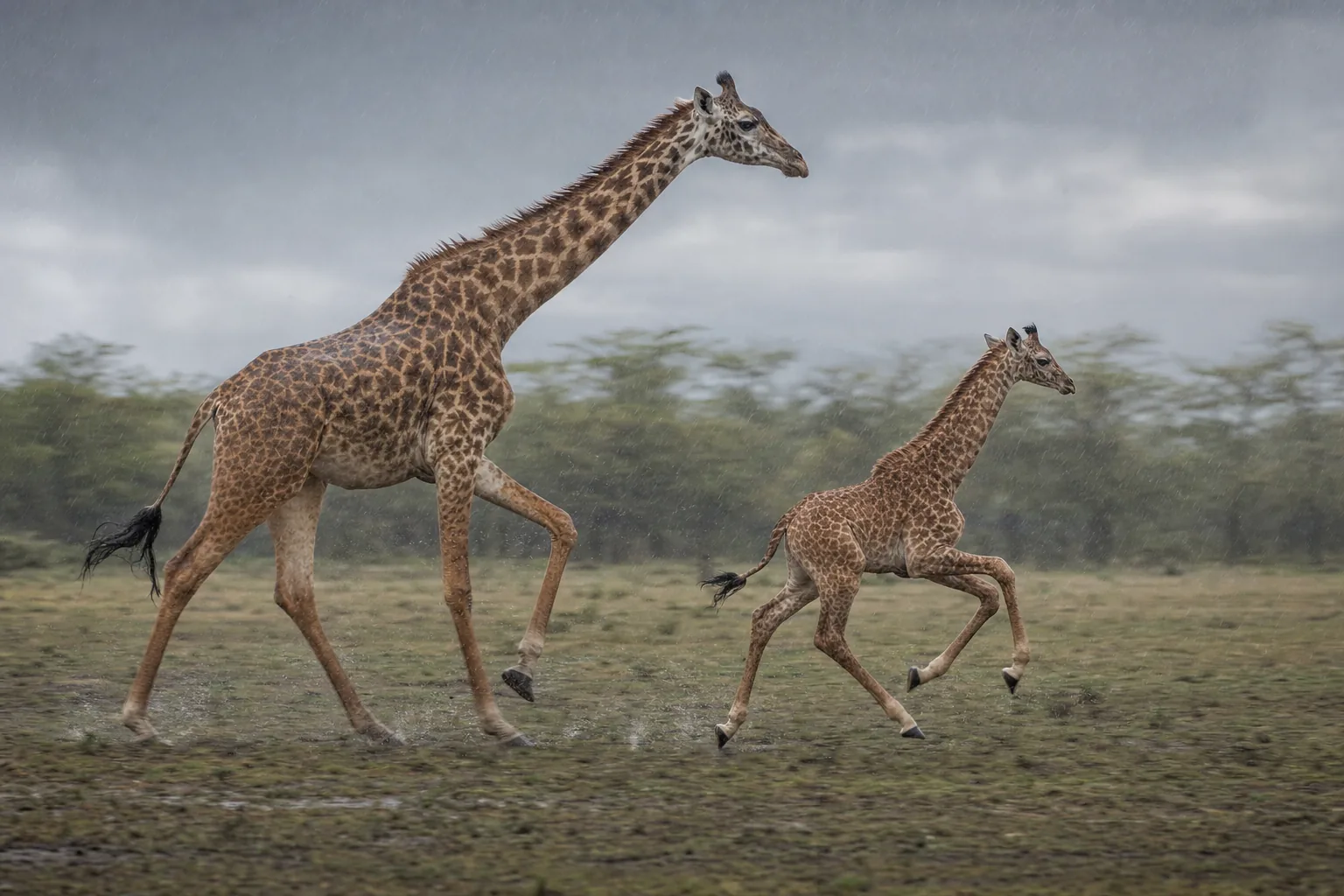
A giraffe can spend more than a year pregnant to produce a single calf. That long wait is one reason a birth announcement, however welcome, cannot tell us on its own that a population is recovering.
The familiar answer is about fifteen months. But three different timelines often get folded into that one fact: the length of a pregnancy, a female's age when she first gives birth, and the wait between one calf and the next. Keeping them separate makes giraffe reproduction much easier to understand.
For the newborn's dramatic arrival, first steps and early care, start with our baby giraffe guide. Here, the question is what happens before and between those births.
How long are giraffes pregnant?
The Association of Zoos and Aquariums gives approximately 450 days, or fifteen months, in its 2025 giraffe care manual. That is a useful reference, not a due date that every giraffe follows.
A 2005 study by Susan del Castillo and colleagues followed seven female giraffes in a large managed enclosure. Among females whose calf survived, gestation averaged 448 days. The researchers used hormones measured in dung to investigate reproductive condition, rather than simply judging a female's appearance. Read the study's primary abstract.
A dated zoo record offers another kind of evidence. Chester Zoo reported that Orla gave birth on 12 March 2024, following a 472-day pregnancy. That is the zoo's account of one pregnancy, not a new species average or a verified maximum. Its announcement does not explain how conception was dated. See the original Chester birth report.
These figures should not be blended into a fresh average. One is a professional reference, one a result from a small study, and one an individual report. Together they explain why “roughly fifteen months” is more honest than an exact countdown.
Older research also often uses Giraffa camelopardalis for giraffes collectively. Our four-species guide explains the newer classification. An older paper's broad name does not mean its sample represented every species now recognised.
The three reproductive clocks
When comparing giraffe facts, ask where the clock starts and stops. The following distinctions prevent a striking number from answering the wrong question.
| Measure | Where the clock starts and stops | What it tells you |
|---|---|---|
| Gestation | Conception to the calf's birth | Time spent pregnant |
| Age at first birth | The female's own birth to her first calf | When she first completed reproduction |
| Interbirth interval | One calf's birth to the next calf's birth | The pace of successive births |
Sexual maturity is a separate milestone: the capacity to reproduce, not proof that reproduction has happened. Likewise, a mating observation is not proof of conception, and a return to ovarian cycling after birth is not proof of a new pregnancy.
This matters when a headline says a giraffe is “ready to breed” or “pregnant again.” Those statements concern different events. Neither tells us, without follow-up, when another calf will arrive or whether it will survive.
The comparison also explains why an animal can have a long pregnancy without giving birth at exactly the same interval throughout life. The time before the next conception is part of the birth interval too.
How do giraffes find a receptive mate?
One of the most conspicuous behaviours involves a curled upper lip. A male may take a female's urine into his mouth and perform flehmen, a response involved in sampling chemical cues associated with reproductive receptivity.
Lynette Hart and Benjamin Hart described this behaviour in giraffes observed in Namibia's Etosha National Park. Their 2023 study of flehmen and giraffe behaviour connects the behaviour with the vomeronasal organ, a specialised chemical-sensing structure.
The lip curl is not a human-like grin, and it should not be described as a pregnancy test. It concerns information available during courtship; a photograph of the behaviour does not establish a subsequent mating or conception.
Courtship is also only one part of a giraffe's social life. The social-behaviour guide covers relationships and changing groups without assuming every interaction is reproductive.
At what age does a female first give birth?
There is no single birthday at which every female becomes a mother. The distinction between physiological maturity and a recorded first birth is particularly important here.
Fred Bercovitch and Philip Berry examined 33 years of records from one wild Thornicroft's giraffe population in Zambia. Their study reported an age at first birth of 6.4 years, slightly later than in captivity. The publisher dates Reproductive life history of Thornicroft's giraffe in Zambia to 2010, despite the 2009 embedded in its DOI.
That finding is a population-specific reference, not a universal minimum. It also cannot be translated directly into an age at sexual maturity. Growth, reproductive opportunity and the first pregnancy lie between a female's own birth and the birth of her first calf.
Comparing wild and zoo records requires care. An earlier first birth under managed care does not, by itself, identify which difference in conditions caused it. Nor does an unusually young record describe what most females do.
Thornicroft's giraffes are also called Luangwa giraffes. The Masai giraffe profile explains how that population fits within current species and subspecies names.
How often do giraffes have calves?
The same long-term Zambian study reported births an average of 677.7 days apart, approximately 22 months. This measures the interval between calves, not a twenty-two-month pregnancy. It should remain attached to that study population rather than becoming a rule for all giraffes.
Nursing does not necessarily have to end before another pregnancy begins. In the seven-female study described above, ovarian cycles resumed as early as 39 days after birth while nursing continued. That is an observation of renewed cycling, not evidence that conception always happens quickly or happened on that day.
The AZA manual says lactation, or milk production, lasts six to twelve months. Because nursing and pregnancy can overlap, adding every month of nursing onto fifteen months of gestation would produce a misleading universal birth schedule.
Think of the reproductive timeline as overlapping processes, not a queue of fixed-length steps. A female can be supporting a calf while pregnant again, but that does not mean she produces one calf every calendar year. Individual intervals and averages are different kinds of information.
This is also why a lifetime calf total cannot be calculated reliably by dividing a maximum giraffe lifespan by fifteen months. That shortcut counts years before the first birth as reproductive years, ignores time before subsequent conceptions, and assumes every pregnancy ends in a surviving calf.
Is there a giraffe breeding season?
Giraffes can reproduce throughout the year, but that does not mean every month has identical consequences in every landscape.
Derek Lee, Monica Bond and Douglas Bolger studied 449 individually identified calves across five Tarangire sites in Tanzania during 2012–2014. Calves born in the dry season had the highest estimated probability of surviving their first year. Their paper, Season of birth affects juvenile survival of giraffe, asks about the consequences of birth timing, not a compulsory breeding season.
The authors proposed several possible explanations, including maternal condition, seasonal browse quality and changes in cover available to predators. The study did not isolate one mechanism, and the result is not evidence that severe drought benefits giraffes.
For readers, the useful distinction is between being born in a season and experiencing a particular environmental condition. A familiar season name is not a measurement of food, rainfall or predation in every year. The giraffe diet guide explains why vegetation also means more than simply how green a landscape looks.
What can a birth tell us about a population?
A calf beside an adult is visible evidence of a young animal alive at that moment. It does not reveal all the pregnancies, births or losses that preceded the observation.
Lee and colleagues explicitly confronted this problem: calves can die before a survey first detects them. A count of calves therefore cannot simply be read as a count of births. Their analysis accounted for imperfect detection and mortality between birth and observation, with assumptions that remain part of the estimate.
There are two useful questions to ask of a claim such as “more babies mean recovery.” First, were the surveys comparable? Second, what happened to the rest of the population? Our population-survey guide explains the first question; the Serengeti survival and recruitment commentary explores the second.
A pregnancy is a possibility, a birth is an event, and a calf surviving to adulthood is a later outcome. Population change also includes adult survival and animals moving in or out. Treating those as separate observations does not diminish a new calf. It makes the conservation story more informative than a birth tally alone.
What to remember
- Giraffe pregnancy lasts roughly fifteen months; precise records and reference values are not interchangeable.
- Pregnancy length, age at first birth and time between calves have different starting points.
- Nursing and pregnancy can overlap; resumed cycling is not the same as conception.
- Local birth-season findings do not create a universal breeding calendar.
- A new calf matters, but births alone do not measure population recovery.
Frequently asked questions
How many babies does a giraffe have at once?
Usually one calf. Twins are rare, according to the AZA manual. A twin birth is an exceptional event, not evidence that twins are the normal reproductive pattern.
Are giraffes pregnant for two years?
The usual reference is about fifteen months, not two years. A longer figure may describe the interval between successive calves rather than pregnancy itself. Check what the number measures before comparing it.
Can a giraffe become pregnant while nursing?
Yes. Nursing and pregnancy can overlap. However, evidence that ovarian cycles have resumed does not establish when a female conceived again.
Can you tell a giraffe is pregnant from its belly?
Appearance alone is not a reliable basis for declaring pregnancy. The AZA manual describes variable external changes and professional monitoring using hormone measurements and ultrasound. A rounded abdomen or an illustration cannot supply that evidence.
Sources
Sources checked 6 September 2026. This is a general biology explainer, not a care protocol or a full methods commentary on each cited paper. The AZA reproduction chapter and complete Lee, Bond and Bolger paper were read; the del Castillo and Bercovitch–Berry findings are confined to their primary abstracts. The Hart account uses the primary abstract with author-institution corroboration. Chester's figure remains a zoo-reported individual record.
Direct source links appear beside the relevant claims. The science library provides further routes into giraffe research; study results should retain their population, date and measurement context when reused.