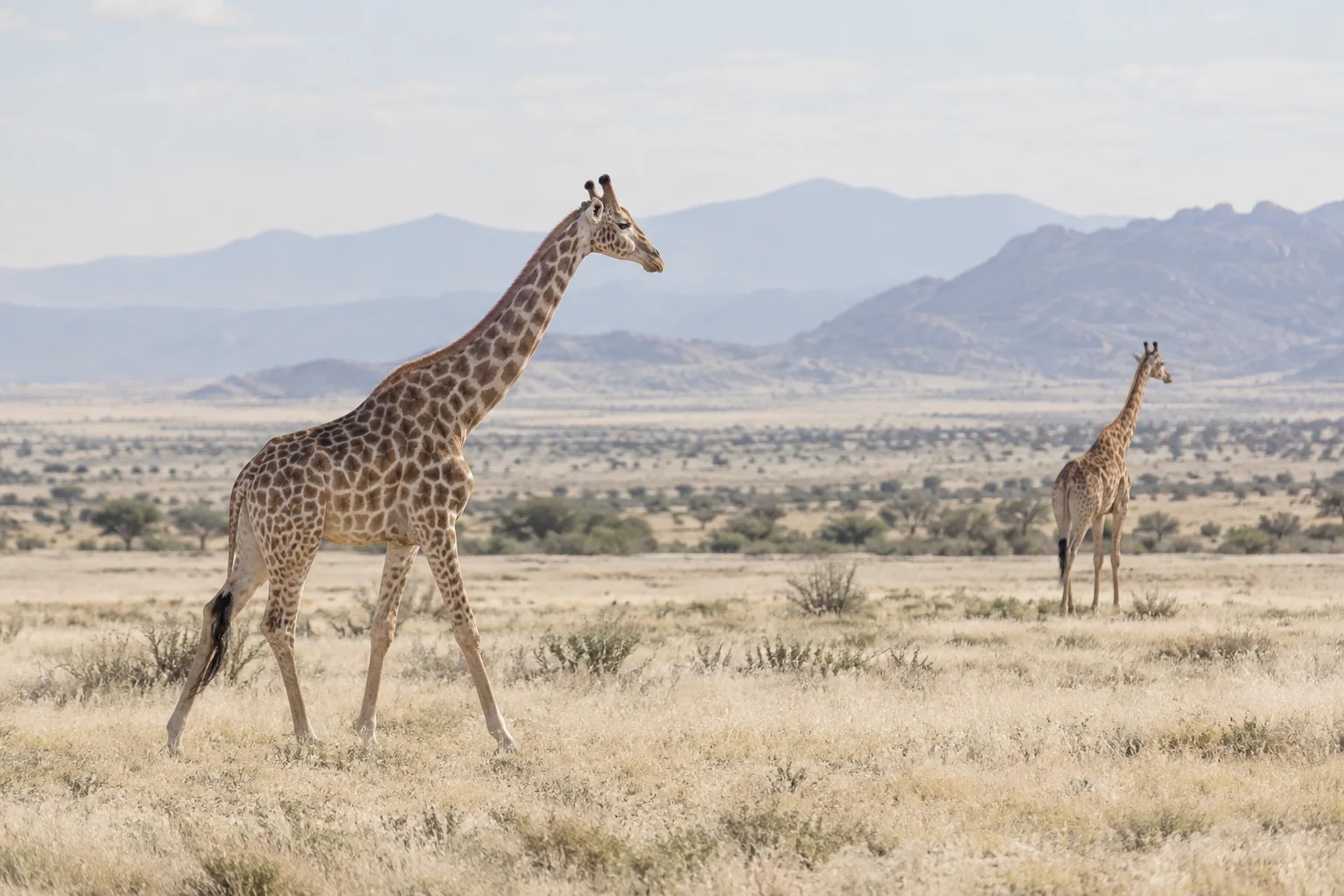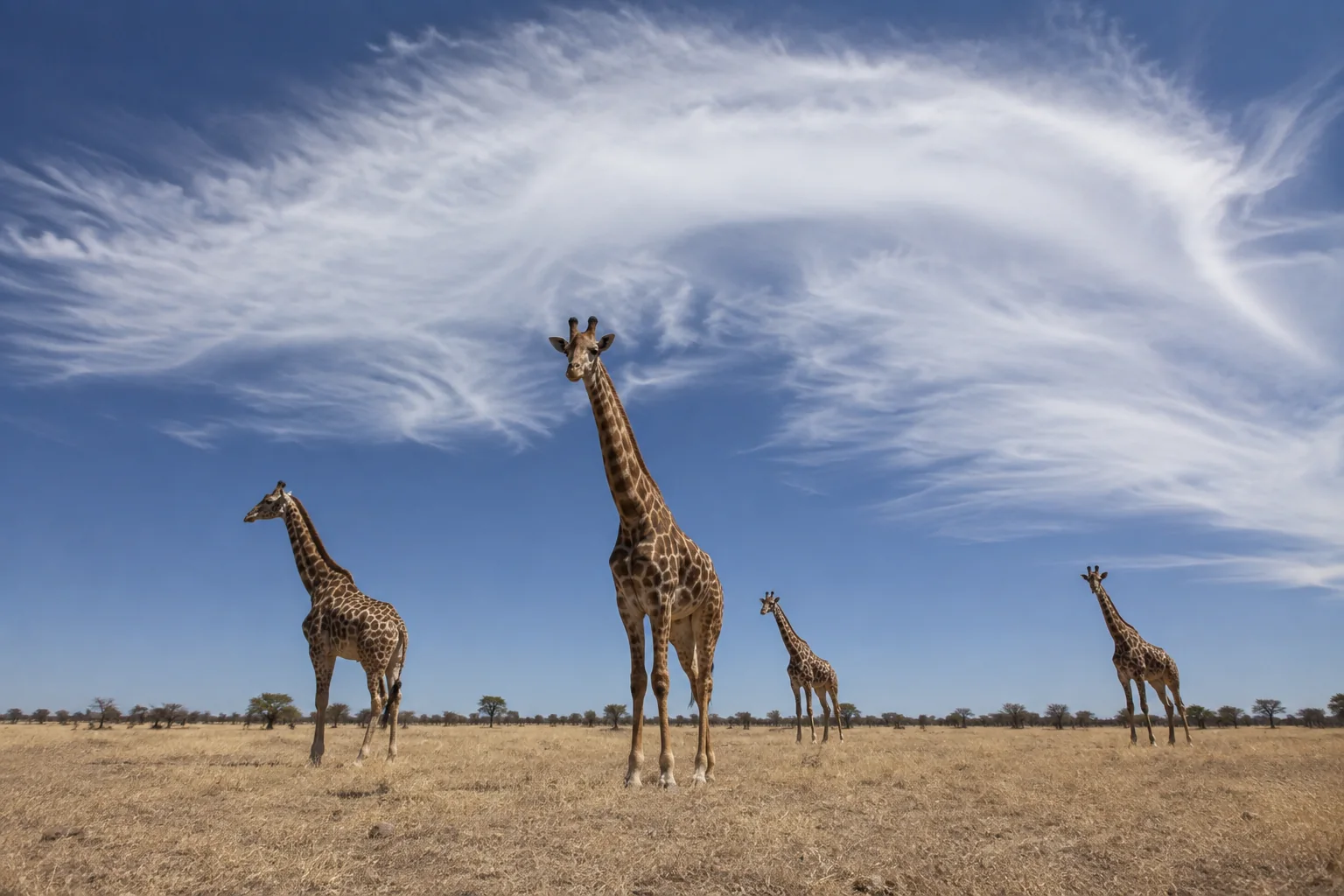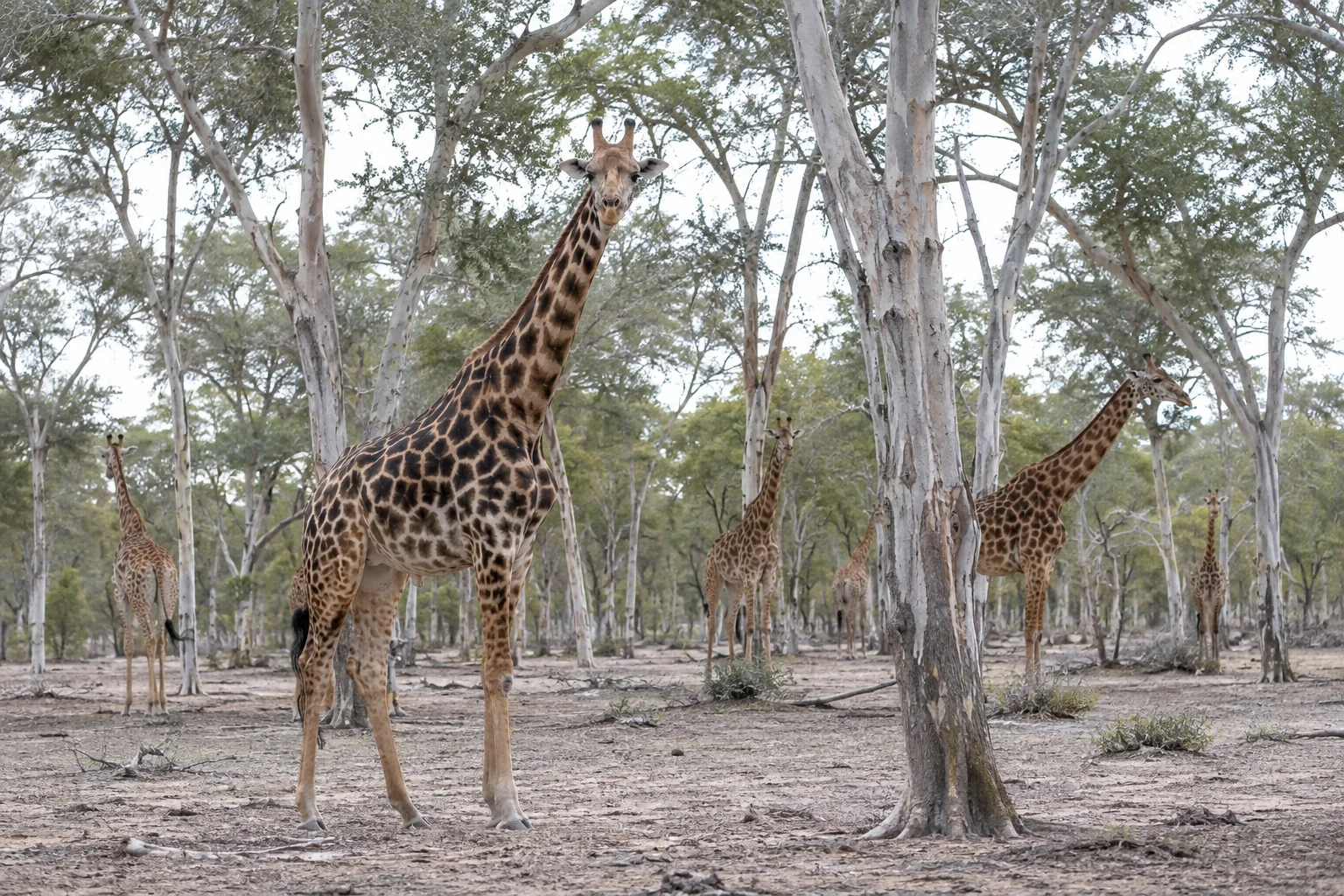
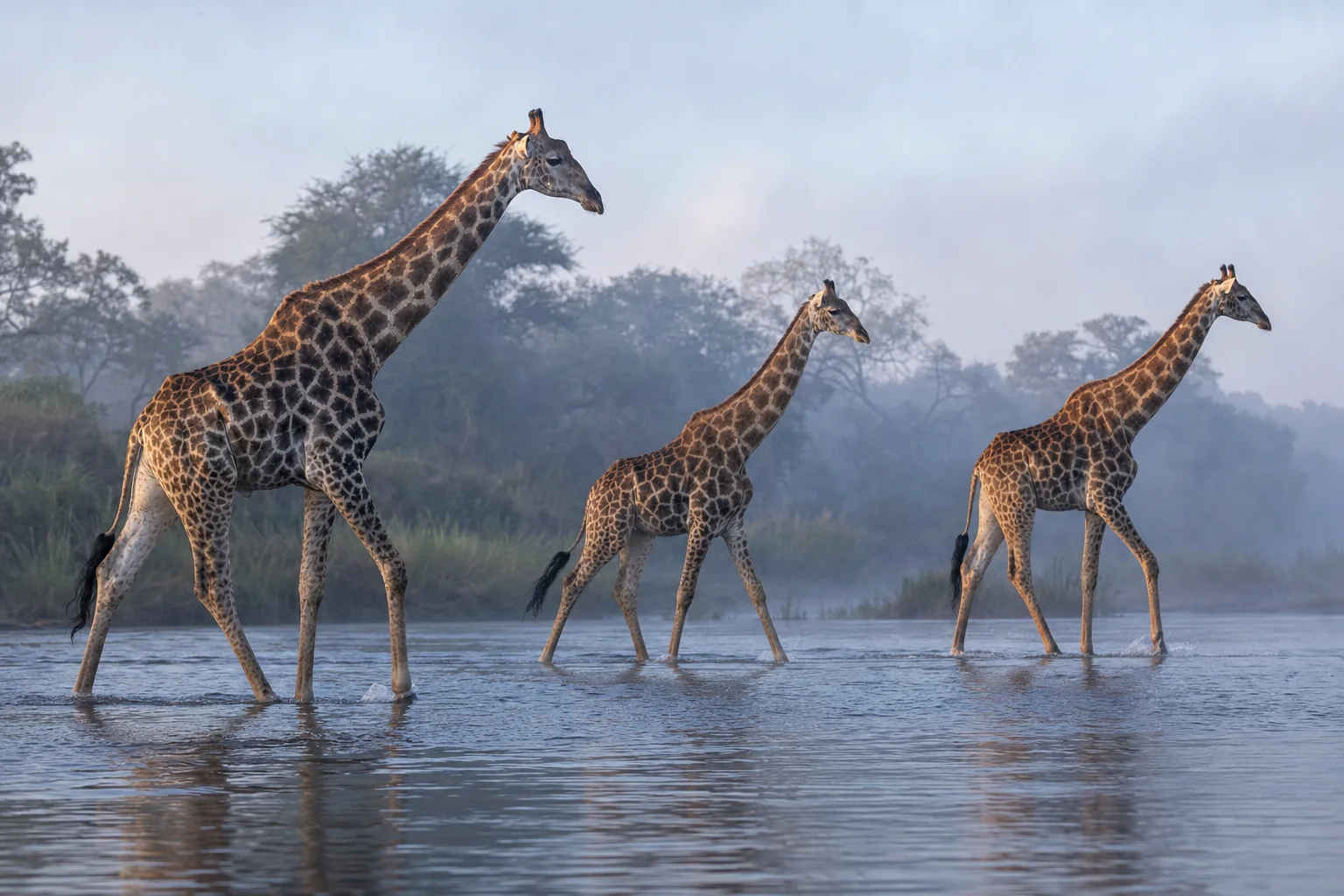
A species can look familiar while its future remains difficult to read. Masai giraffes live across famous savannas, community lands and an isolated river valley, but those landscapes do not share one population trajectory. The useful conservation question is therefore not simply how many remain. It is where the estimate came from, which subspecies it covers, and whether survival, recruitment and movement are being maintained in each place.
What is a Masai giraffe?
The Masai giraffe, Giraffa tippelskirchi, is one of the four giraffe species recognised by the IUCN SSC Giraffe and Okapi Specialist Group in August 2025. Within it are two subspecies: the widespread Masai giraffe in the strict sense and the geographically isolated Luangwa giraffe in Zambia.
This makes “Masai giraffe” a name used at two levels. It can mean the whole species, including Luangwa giraffes, or the narrower subspecies G. t. tippelskirchi. The Latin phrase sensu stricto, or “in the strict sense,” is sometimes used for the narrower meaning. Checking that level matters before comparing ranges or population figures.
Masai giraffes browse in savanna and woodland, from the Serengeti and Tarangire systems to drier Tsavo-Mkomazi and the river-associated habitat of the Luangwa Valley. The giraffe habitat guide gives the broader biological context.
Coat patterns are clues, not proof
Masai giraffes are often described as having irregular brown patches with jagged, leaf-like or star-like margins. That can be a useful field clue when the animal's location and history are known. It is not a guaranteed taxonomic test from one photograph.
The specialist group's 2025 taxonomic assessment did not use pelage characteristics to decide the species framework. It found that coat pattern had not been systematically evaluated across giraffe populations and could vary within a population and with age. The assessment instead considered genetic, cranial and biogeographic evidence together.
That distinction also prevents a common error: a dark old male is not automatically a separate taxon. Repeated coat photographs can still be excellent for recognising individuals, as the coat-pattern science guide explains.
The two Masai giraffe subspecies
The IUCN specialist group's current framework recognises both subspecies as distinct:
| Subspecies | Scientific name | Current distribution |
|---|---|---|
| Masai giraffe, sensu stricto | G. t. tippelskirchi | Native populations in southern Kenya and Tanzania; a founder-derived population in Rwanda |
| Luangwa giraffe, also called Thornicroft's giraffe | G. t. thornicrofti | Zambia's Luangwa Valley |
The Luangwa population is not a third giraffe species. Genomic and skull evidence supported retaining it as a subspecies within G. tippelskirchi. The taxonomic assessment also notes that the genomic comparison lacked samples from some intermediate populations. Recognition is the authority's present conclusion, not proof that every relationship is resolved.
Where Masai giraffes live
The natural distribution of Masai giraffe sensu stricto is centred on southern Kenya and Tanzania. Kenyan landscapes include Tsavo, Amboseli-Magadi, Nairobi–Athi-Kaputiei and the Maasai Mara. Tanzania contains a large share of the subspecies, but current nationwide evidence is incomplete.
Luangwa giraffes occur naturally in eastern Zambia. Their distribution follows parts of the Luangwa Valley across public, private and communal management areas. This isolated range is more than 400 kilometres from the closest Masai populations to the northeast, according to the taxonomic assessment.
Rwanda is a present range country with an introduced population
Rwanda requires a more careful label. Six Masai giraffes—two males and four females—were moved from southern Kenya to Akagera National Park in 1986. Their descendants form Rwanda's only giraffe population. African Parks describes the event as an introduction, while Rwanda's giraffe action plan uses “(re)introduced” and notes uncertainty about earlier natural occurrence.
The unambiguous fact is the origin of the present population. It is founder-derived from Kenyan animals rather than an uninterrupted documented remnant. Calling all four countries equivalent native populations would erase that history.
How many Masai giraffes are left?
The best concise species-wide figure is 43,926, but it needs a source and date attached. The Giraffe Conservation Foundation's June State of Giraffe 2025 synthesis divided the estimate as follows:
| Taxonomic scope | June 2025 estimate | Reported estimate range |
|---|---|---|
| Masai giraffe sensu stricto | 43,162 | 42,220–54,374 |
| Luangwa giraffe | 764 | 654–895 |
| Masai giraffe species total | 43,926 | 42,874–55,269 |
These are compiled estimates, not animals counted simultaneously across four countries. The report classified the five-year comparison as stable because the estimated change from 2020 was -3%, within its 10% stability threshold; over thirty years it reported -39%. Neither label describes every landscape.
The report itself warns of a major evidence gap in Tanzania: much of its nationwide estimate relied on data almost ten years old. That makes “stable” a dated synthesis classification, not proof from one range-wide repeated survey. Our population guide explains why an estimate should travel with its geographic scope, observation period and method.
Kenya's later numbers do not produce a new global total
Kenya's National Wildlife Census 2025 adds newer national evidence, but it does not reconcile neatly with the June global compilation. Table 4.6 of the official WRTI-linked report reports 10,410 Masai giraffes across nine sites, compared with 13,762 in its 2021 column. The report says densities and totals were affected in some places by changes in surveyed area; the Maasai Mara row, for example, covers much less area in 2025 than in 2021.
Another prose passage in the same report gives 13,530 without reconciling it with Table 4.6. A November 2025 GCF Kenya profile reports about 14,122 after data-quality checks. These values cannot be treated as one comparable measurement.
The Kenyan sources should be reported by version, while 43,926 remains explicitly the June 2025 all-range synthesis. Adding or substituting the figures would manufacture an estimate no source published. The survey-methods guide explains how coverage and detection can change an estimate without matching biological change.
What the current conservation status means
The current official Endangered listing belongs to the Masai subspecies under its older name, Giraffa camelopardalis tippelskirchi. It was published in 2019, before the specialist group adopted the four-species framework. The Luangwa subspecies has a separate Vulnerable listing under that older taxonomy.
As checked on 6 September 2026, GCF's conservation-status page says new Red List assessments are underway. Its 2025 report recommends Vulnerable for G. tippelskirchi as a species. That recommendation is not a completed IUCN Red List reassessment and should not replace the existing listing in a headline.
Taxonomy and conservation status answer different questions. The first asks which evolutionary units are recognised. The second evaluates extinction risk for a specified unit against Red List criteria. Our endangered-status guide keeps these decisions, dates and names separate.
Why different landscapes can have different futures
Species totals can conceal the demographic processes that determine whether a population persists. Survival, reproduction and movement respond to local food, predation, illegal killing, settlement, land management and physical barriers. Two primary studies show why “the Masai giraffe trend” is too coarse a diagnosis.
Tarangire: connected populations can still contribute differently
Lee and Bolger's 2017 study used 2012–2014 encounter histories from 1,094 individually identified female giraffes across five Tarangire Ecosystem subpopulations. The sites represented national parks, a conservancy and game-controlled areas with different combinations of protection, livestock, farming and settlement.
The analysis classified three populations with stronger protection and fewer human impacts as demographic sources and two game-controlled-area populations as sinks. Adult female survival in sources and movement among them contributed strongly. Yet two growth calculations disagreed on direction; the authors judged decline more likely from a longer aerial index.
The study supports landscape-specific management, not a claim that one land label causes success. A conservancy source had substantial daytime livestock use but no permanent settlement or agriculture, showing why “livestock present” is not a complete mechanism. Our Serengeti survival and recruitment commentary explores a related question: which life stage explains change in a particular population, and what further evidence is needed to identify its cause?
For a different kind of connectivity evidence, read our commentary on Masai giraffe genomes across the Gregory Rift. It separates inherited signals of population history from direct observations of animals moving today.
Tsavo-Mkomazi: suitable habitat must remain connected
Muthiuru and colleagues' 2024 study addressed another problem in the transboundary Tsavo-Mkomazi landscape. From aerial survey records, it modelled where habitat was potentially suitable and how resistant the surrounding landscape might be to movement. It predicted 15,002 square kilometres of suitable habitat, with more than 17% on community ranches outside protected areas.
The model identified community ranches and conservancies as important potential links between core areas, while human habitat modification, rainfall and elevation were leading predictors. This does not prove that every modelled corridor is used, legally secured or safe. The study used sightings as presence data, not GPS tracks of animals making each predicted journey, and it did not estimate population growth.
Together, the studies show why local futures diverge. A place can contain giraffes yet lose demographic support if adult survival falls. A protected core can remain occupied while connections to seasonal resources narrow; land outside a park can be essential when its use and layout permit movement. Protecting giraffe habitat therefore means protecting functions, not colours on a map.
Luangwa: better coverage is not automatically recovery.
The Luangwa example supplies a third warning. A 2023 survey estimated a median 760 adults and subadults, higher than the older 500–600 estimate, but it covered a wider modelled range and used spatial capture–recapture. Within the previously documented range, its estimate was broadly consistent with the earlier figure.
Our Luangwa survey commentary follows that comparison. The lesson for this profile is narrow: finding animals south of an older mapped boundary improves knowledge of distribution, but it does not reveal when they arrived or prove that births exceeded deaths.
What threatens Masai giraffes?
The recurring pressures are habitat loss and fragmentation, illegal killing, restricted movement, and environmental variability that changes food and water availability. Their importance and interaction vary by landscape. The giraffe threats guide covers the mechanisms across species; a Masai profile should not pretend the same mix applies equally from Akagera to Luangwa.
Habitat conversion can remove browse. Roads, fencing and settlement can divide what remains. Illegal killing reduces survival and can turn a connected area into a demographic sink. Rainfall can change vegetation condition, but a local association is not a universal climate-causation claim.
Small or isolated populations face additional constraints. Rwanda's population descends from six founders, while the Luangwa subspecies is geographically separated from other Masai giraffes. These histories make continued monitoring important, but founder number or isolation alone does not diagnose present genetic health, carrying capacity or trend.
What credible conservation progress would show
A progress claim should name the population, period and intervention, then measure a matching outcome. More patrols are activity; lower illegal mortality is an outcome. A mapped linkage is a hypothesis; repeated movement through a secured route is stronger evidence of function. After a translocation, survival and reproduction help establish whether a population took hold. The translocation guide explains that distinction.
For abundance, comparable repeat surveys should keep geographic coverage, age scope and observation method as stable as possible. Individual-based monitoring can then help explain change through adult survival, calf recruitment and movement rather than asking a headcount to answer every question.
No single protected area, conservancy or research programme proves a species-wide recovery. The stronger story is also more useful: different landscapes expose different limiting processes, so evidence can direct the right response in each place.
What to remember
- Masai giraffe is both a species name and, in the strict sense, one of its two subspecies; the other is the Luangwa giraffe.
- Native populations occur in Kenya, Tanzania and Zambia. Rwanda's current Akagera population descends from six giraffes moved from Kenya in 1986.
- The 43,926 figure is a June 2025 all-range synthesis, not a live or simultaneous census.
- Later Kenyan sources contain unreconciled estimates, so they cannot be inserted into the global total or treated as a clean biological trend.
- The existing Endangered listing concerns the Masai subspecies under the older taxonomy; the species-level reassessment remains pending.
- Tarangire, Tsavo-Mkomazi and Luangwa illustrate different questions about survival, connection and survey coverage.
Frequently asked questions
Is the Masai giraffe the largest giraffe species?
There is no sufficiently robust source in this profile's authority pack for that species-wide superlative. Body size varies with sex, age and population, and the 2025 taxonomic assessment did not use size or coat pattern as a simple field key. It is more accurate to identify the taxon from reliable population origin and the current classification.
Are Masai and Luangwa giraffes the same?
They belong to the same species, Giraffa tippelskirchi, but are recognised as two subspecies: G. t. tippelskirchi and G. t. thornicrofti. Luangwa, or Thornicroft's, giraffes are the isolated Zambian subspecies.
Are Masai giraffes native to Rwanda?
The present Akagera population was founded by six animals moved from Kenya in 1986. African Parks calls this an introduction; Rwanda's giraffe action plan uses “(re)introduced” because earlier natural occurrence is uncertain. The population's modern founder history is not disputed.
Does the stable 2025 label mean Masai giraffes are recovering?
No. It describes GCF's estimated species-wide change from 2020 within its stability threshold. It does not establish a common trend in every landscape, and the same report identifies major data gaps, especially in Tanzania.
Why can't Kenya's 2025 figure replace the older global estimate?
Because the figures have different geographic scopes, source versions and survey inputs. Kenya is already represented in the global synthesis. Replacing one component without a published reconciliation would create a new total that no authority assessed.
Sources
Sources checked on 6 September 2026. Population figures retain the source's date and taxonomic scope.
- IUCN SSC Giraffe and Okapi Specialist Group (2025), An Evaluation of the Taxonomic Status of Giraffe, linked above.
- Giraffe Conservation Foundation (2025), State of Giraffe 2025, version 2, and its current conservation-status page.
- Omondi et al. (2025), National Wildlife Census 2025 Technical Report, methods and Masai Table 4.6.
- Lee & Bolger (2017), Movements and source–sink dynamics of a Masai giraffe metapopulation.
- Muthiuru et al. (2024), Human footprint and rainfall shape Masai giraffe's habitat suitability and connectivity in a multiple-use landscape.
- Sun et al. (2025), First rangewide density estimate of the endemic and isolated Luangwa giraffe in Zambia.