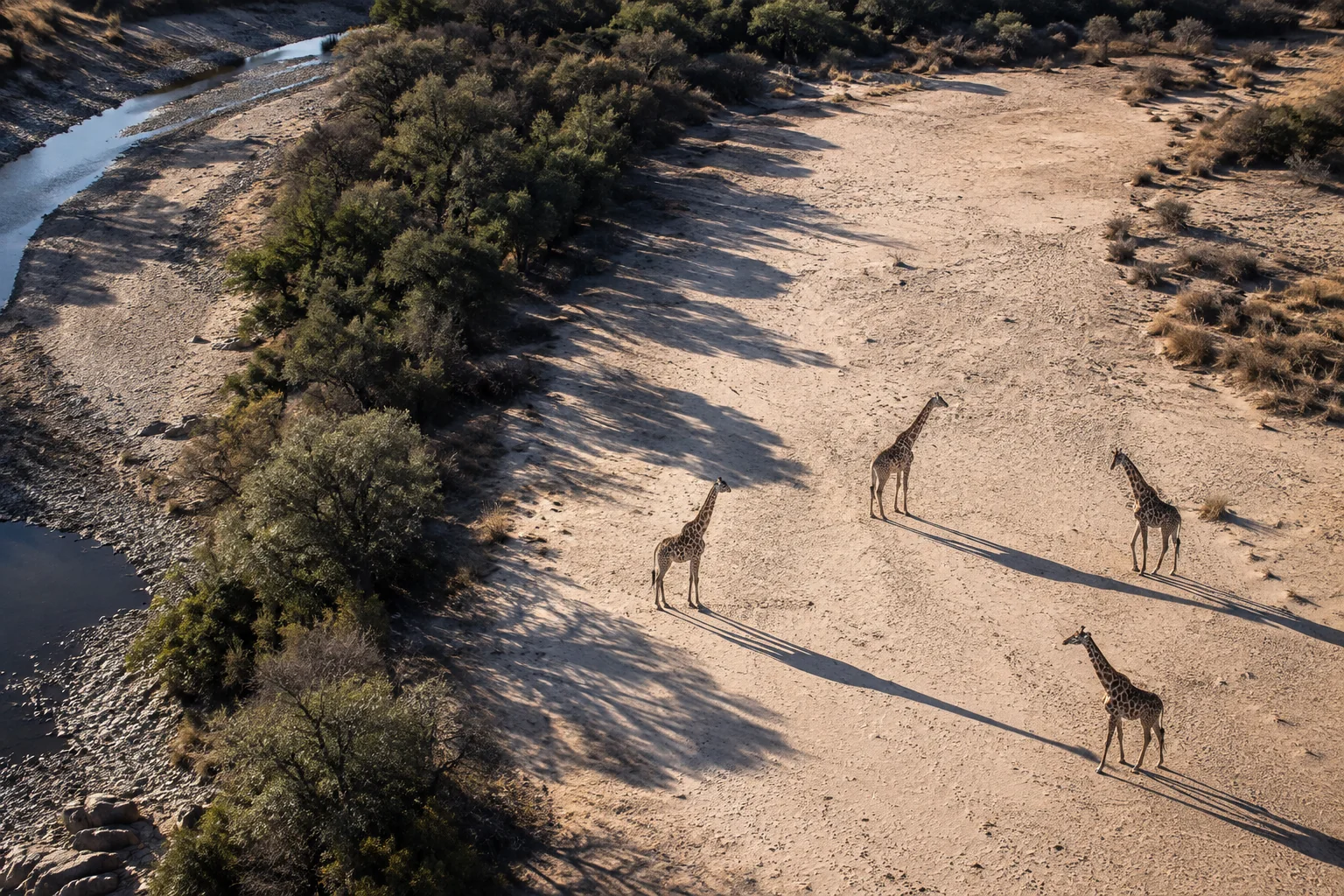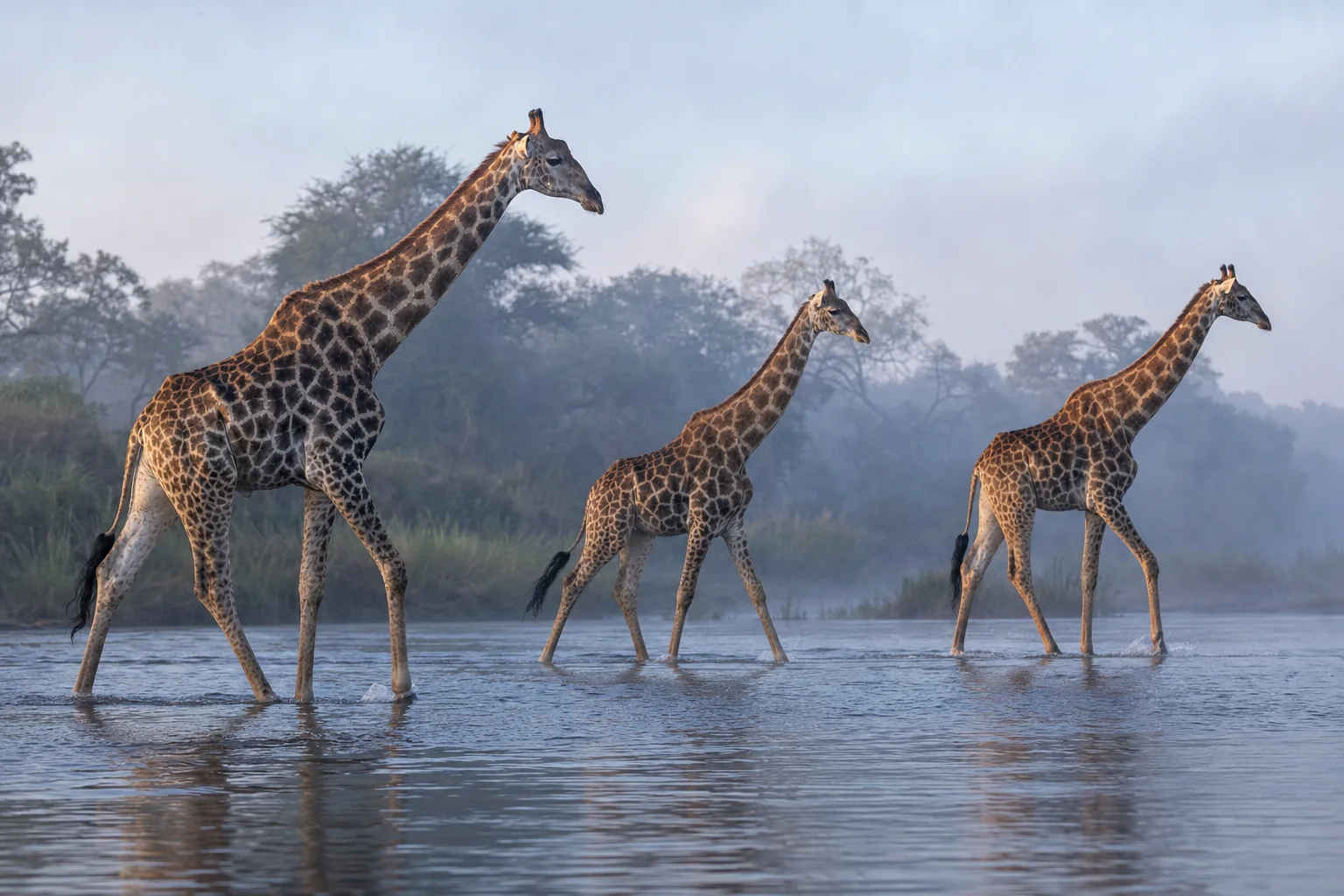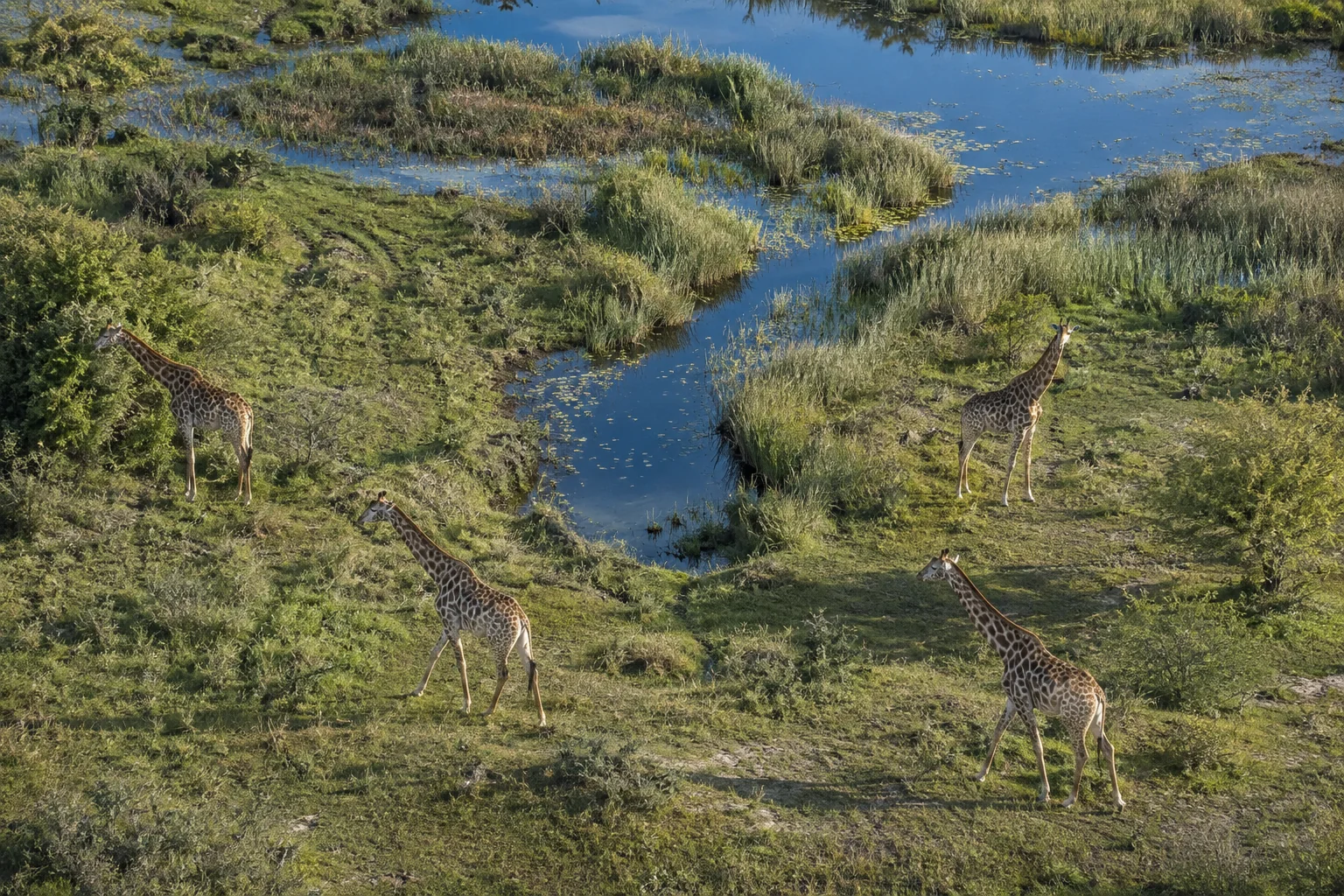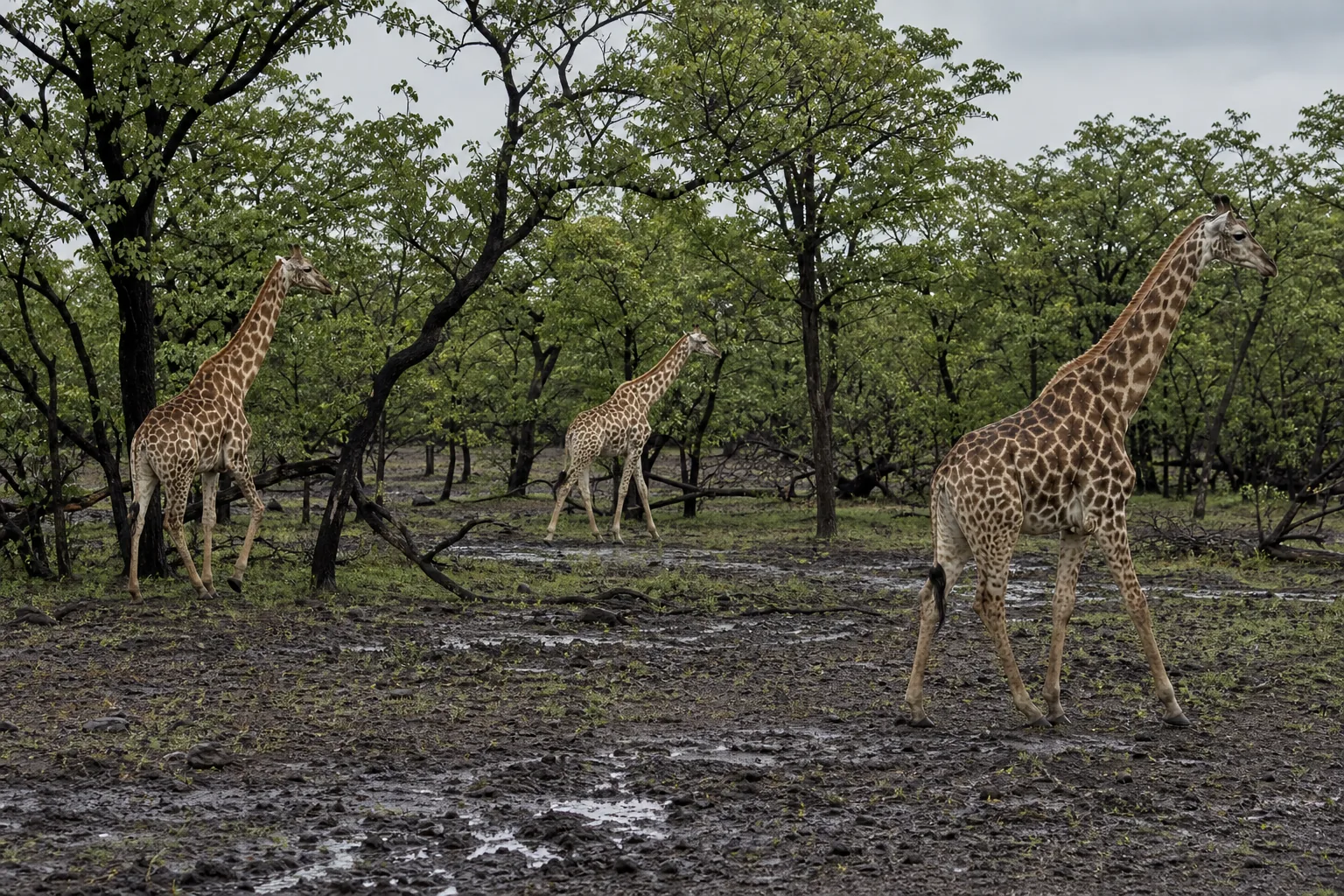
Every wild Luangwa giraffe belongs to one geographically isolated population. That makes the subspecies unusually easy to place on a map—and unusually vulnerable to whatever happens within its one Zambian valley. Understanding it requires more than a new population total: its two common names, river-linked ecology and survey history all change what the numbers mean.
What is a Luangwa giraffe?
The Luangwa giraffe is the Zambian subspecies Giraffa tippelskirchi thornicrofti. It belongs within the Masai giraffe species, Giraffa tippelskirchi, under the four-species framework adopted by the IUCN SSC Giraffe and Okapi Specialist Group on 21 August 2025. The other subspecies is the Masai giraffe in the strict sense, G. t. tippelskirchi; our Masai giraffe profile covers their shared species.
Why is it also called Thornicroft's giraffe?
Luangwa giraffe and Thornicroft's giraffe name the same animal. “Thornicroft's” is the long-established historical common name; “Luangwa” ties the name directly to the valley where the subspecies lives. Current IUCN specialist-group material presents them together as Luangwa/Thornicroft's giraffe.
Older sources use Giraffa camelopardalis thornicrofti because giraffes were then assessed as one species with multiple subspecies. That historical scientific name still appears in the current Red List assessment and much of the ecological literature. It describes the classification used at the time, not a different population.
Is it a species or a subspecies?
The specialist group's complete August 2025 taxonomic assessment rejected treating G. thornicrofti as a separate species and supported G. t. thornicrofti as a subspecies of Masai giraffe. Its assessment combined three evidence types rather than relying on a coat pattern:
| Evidence | What the assessment found | What it does not establish |
|---|---|---|
| Cranial form | Analyses distinguished Luangwa and Masai giraffe skull morphology at subspecies level | That every live animal can be identified from appearance alone |
| Genomes | Genome-wide analyses found structure within Masai giraffe sensu lato | That sampling is complete; some intermediate Masai populations were missing |
| Biogeography | Rift topography and more than 400 km separate Luangwa giraffes from their closest relatives | That geography alone measures present genetic health |
Coat markings are not a secure taxonomic test from one image. The coat-pattern science guide explains why photographs are more powerful for recognising individuals.
Where do Luangwa giraffes live?
Luangwa giraffes occur naturally only in Zambia's Luangwa Valley. Their range follows the Luangwa River system at the southern end of the East African Rift and is separated from the closest Masai giraffe populations in Tanzania by more than 400 kilometres. There is no extralimital or introduced population in the 2025 range synthesis.
The valley contains a mosaic of national parks, game management areas, private reserves, community forests and settled or farmed land. The most comprehensive published survey sampled several land uses and confirmed giraffes farther south than the previous published range boundary.
One valley, several land tenures
A single population can cross administrative borders even when it remains biologically isolated from other giraffes. An animal may move between habitat under different rules, while forage, water, fencing and human activity change across the same landscape.
Protecting a park core cannot by itself maintain every place the population uses. Conversely, recording a giraffe outside a national park does not prove that all surrounding land is secure habitat. The giraffe range guide distinguishes a taxon's distribution from one sighting, a modelled possibility or a legal boundary.
Why does the Luangwa River matter?
The Luangwa River is not just a line through the range. Its channels, lagoons and floodplains support the woody plants on which giraffes browse. Riparian forest occurs alongside mopane and munga woodland, thickets, scrub and open grassland, but the river-associated alluvial zone supplies particularly important feeding habitat.
In the 2023 survey published by Sun and colleagues, no giraffe detection was farther than 6.2 km from a permanent river. The fitted dry-season model put density effectively at zero beyond 7.5 km. Older field work similarly described most use close to the river.
Those distances are an ecological result, not a timeless border. The 2023 fieldwork ran from August to November, across the dry season and its transition. Wet-season forage and water can change how animals distribute themselves. “River-linked” is supported; “never found farther away” would be stronger than the evidence.
Riverine food in a seasonal landscape
River margins concentrate trees and shrubs such as sausage tree, tamarind and winter thorn, while mopane and mixed munga woodland add other choices. Luangwa giraffes eat leaves, shoots, flowers, stems and fruit rather than grazing a grass-dominated diet.
The river can also act as a shifting barrier. In a long-term Luangwa account, Berry and Bercovitch reported that exceptionally low flow in 1994 and 1995 let giraffes of both sexes and ages cross dry sections into the west-bank study area. Before then, their observations suggested only mature bulls waded across. Water therefore shapes access as well as food, but one observed episode should not be turned into a universal rule for every year.
How Luangwa giraffes live
Decades of observations provide unusually long local records through seasonal change.
Browsing and seasonal diet
Berry and Bercovitch's feeding-ecology study analysed forty years of records from 1973–2014. Its publisher abstract reports feeding on 93 identified plant species, although only a few supplied most of the diet. Reported dietary diversity was about 13% higher in the dry season than in the wet season, with sausage tree (Kigelia africana) and woolly caper bush (Capparis tomentosa) prominent dry-season foods.
Plant count is not the same as nutritional importance. A giraffe may sample many plants while depending heavily on a small number, and a seasonal shift may reflect availability as much as preference. The giraffe diet guide explains how selective browsing changes with plant chemistry, rainfall and life stage.
Fluid groups and long lives
Like giraffes elsewhere, Luangwa giraffes live in a fission–fusion social system: individuals join and leave groups rather than remaining in one permanent herd. The 2023 survey encountered groups from solitary animals to larger gatherings, but a brief encounter is a snapshot, not a lifetime social unit. Our giraffe social-behaviour guide explains how age, sex, food and relationships influence those changing associations.
Long-term Luangwa research has followed recognisable animals across decades. Abundance alone cannot reveal which adults survive, which calves reach independence or how reproductive success accumulates across a long life. Coat patterns let researchers reconnect observations years apart.
How many Luangwa giraffes are left?
The strongest current field estimate is a median 760 adults and subadults in 2023, with a 95% Bayesian credible interval of 651–890. It came from photographs of individually recognised giraffes and a spatial capture–recapture model that estimated animals not detected. It was not a direct count of 760, did not include calves in the abundance model and is not a live 2026 total.
The June State of Giraffe 2025 report carried that evidence into a compiled estimate of 764, with a range of 654–895. It was not a separate 2025 field census.
| Statement | Date and scope | Careful interpretation |
|---|---|---|
| 760 (651–890) | Median model estimate from August–November 2023; adults and subadults | Best systematic baseline for the surveyed region of inference |
| 764 (654–895) | June 2025 compiled status report | Dated synthesis derived from recent evidence, not a new count |
| +18% in five years | 2025 synthesis comparison with its 2020 figure | Reported estimate change; wider coverage prevents treating it as measured growth alone |
| −36% in thirty years | 2025 synthesis comparison with its 1995 figure | Long comparison across changing sources and methods, not one repeated survey design |
The 2023 survey covered a much larger modelled area than earlier work. Within the previously documented range, its mean estimate of 612 was broadly consistent with the older 500–600 range; newly targeted southern territory contributed a mean estimate of 150. The higher range-wide result therefore improved knowledge of distribution without establishing when those animals arrived or whether births exceeded deaths.
Our Luangwa survey commentary examines the sample flow and comparison in detail. The broader survey-methods guide explains why count, identity and estimate are different numbers.
Why isolation changes the risk
Isolation has two meanings here. It helped produce a recognisable lineage, and it concentrates the future of that lineage in one population. If disease, extreme weather or sustained habitat conversion affects the valley, another Luangwa population is not available nearby to replace losses through natural immigration.
The same isolation does not prove that the population is currently inbred, genetically unhealthy or doomed. Genomic structure supports recognition as a subspecies; it is not itself a diagnosis of inbreeding depression. The 2025 taxonomic assessment also cautioned that sampling of intermediate Masai giraffe populations was incomplete.
Population size, age structure, genetic diversity and habitat connection answer different questions. A population can be stable in abundance while losing options to move, or genetically distinctive while retaining useful diversity. Good monitoring keeps those endpoints separate.
What is the Luangwa giraffe's conservation status?
The Luangwa giraffe is currently listed as Vulnerable on the IUCN Red List under the older one-species name Giraffa camelopardalis thornicrofti. The wider giraffe assessment likewise still treats giraffe as one Vulnerable species. Those are official assessments; the August 2025 taxonomy did not automatically rewrite the Red List.
New assessments using the four-species framework are underway, according to GCF's current conservation-status summary. State of Giraffe 2025 recommends retaining Vulnerable for Luangwa giraffe under the updated taxonomy. A recommendation is evidence submitted to a status process, not a completed official category.
The giraffe endangered-status guide explains why taxonomy and extinction-risk assessment can move on different schedules. “Vulnerable” also does not mean safe: it identifies elevated extinction risk under specific criteria and evidence, not a prediction that extinction is imminent.
What threatens Luangwa giraffes?
The central structural risk is a small range containing one population. Within it, loss or fragmentation of river-associated woodland can remove food and restrict movement. Rapid land conversion, infrastructure and fencing can change a landscape even where giraffes currently tolerate low levels of human presence.
Sun and colleagues found a curved association between modelled giraffe density and a Human Footprint Index. Density was not lowest at every sign of people, but it declined at the higher end of the observed gradient. This was an observational landscape analysis. It does not show that development helps giraffes, that every occupied site is safe or that human presence caused the density pattern.
Natural predation, disease and variable rainfall can also affect survival and recruitment. Those processes are not interchangeable with illegal killing or habitat conversion, and their importance cannot be ranked from a general threat list. The giraffe threats guide separates mechanisms from assumed local causes.
What useful conservation evidence looks like
The 2023 estimate is a baseline. The next population statement becomes stronger when a repeat survey holds geography, season, age scope and detection model as constant as possible. Otherwise, improved access or a wider search can look like biological growth.
Abundance is only one endpoint. Repeated individual histories can estimate adult survival and recruitment; movement observations can test whether land between riverine areas remains usable; vegetation and land-use records can show whether the food landscape is being maintained. These measures help explain why a number changes.
Because the population crosses different land tenures, evidence needs compatible collection across the landscape. That does not mean publishing exact animal locations. A public account can report methods, broad range, uncertainty and trends while withholding sensitive records. The habitat-protection guide distinguishes marking land on a map from maintaining its ecological function.
What to remember
- Luangwa giraffe and Thornicroft's giraffe are two names for Giraffa tippelskirchi thornicrofti, a subspecies of Masai giraffe.
- Its only wild population occurs in Zambia's Luangwa Valley, more than 400 km from the closest Masai giraffe populations.
- Riverine and alluvial habitat is central to its ecology; the 2023 dry-season survey found a strong association with permanent rivers.
- The best field estimate is a 2023 median of 760 adults and subadults, not an exact all-age count.
- Wider survey coverage helped produce a higher range-wide estimate, so the number does not by itself prove population growth.
- The official Vulnerable listing uses the older one-species taxonomy; a recommendation under the new framework is not yet a completed assessment.
Frequently asked questions
Are Luangwa giraffe and Thornicroft's giraffe the same?
Yes. Both common names refer to Giraffa tippelskirchi thornicrofti. “Thornicroft's” is the historical name, while “Luangwa” identifies the valley where the subspecies occurs naturally.
Is the Luangwa giraffe a separate species?
No under the IUCN specialist group's August 2025 framework. It is a distinct subspecies within Masai giraffe, Giraffa tippelskirchi. The group found support from cranial form, genomics and biogeography, but did not support species rank.
Do Luangwa giraffes live anywhere outside Zambia?
No natural or introduced population outside Zambia is listed in State of Giraffe 2025. The population is endemic to the Luangwa Valley.
Are there exactly 760 Luangwa giraffes?
No. The number is the median of a model fitted to 2023 adult and subadult survey data. Its 95% Bayesian credible interval was 651–890, calves were excluded from the abundance model, and the population can change after the survey period.
Does the 18% five-year increase mean the population recovered?
Not by itself. That is a comparison in the 2025 synthesis. The strongest recent survey covered a wider area, and its estimate within the previously documented range was broadly consistent with earlier figures. Comparable repeat surveys are needed to estimate biological change.
Sources
Sources checked on 7 September 2026. Population figures retain the date, geographic scope and type of estimate used by their source.
- IUCN SSC Giraffe and Okapi Specialist Group (2025), An Evaluation of the Taxonomic Status of Giraffe.
- IUCN (21 August 2025), announcement of the specialist group's four-species framework.
- Giraffe Conservation Foundation (2025), State of Giraffe 2025, version 2.
- Sun et al. (2025), range-wide Luangwa survey in Scientific Reports.
- Berry & Bercovitch (2016), population census and long-term comparison in Oryx.
- Berry & Bercovitch (2017), seasonal feeding ecology in African Journal of Ecology; ecology claims above are limited to the publisher abstract and indexed metadata.
Editorial source check: 7 September 2026. This profile does not publish survey coordinates or claim that its illustrative hero shows Zambia or a Luangwa giraffe.