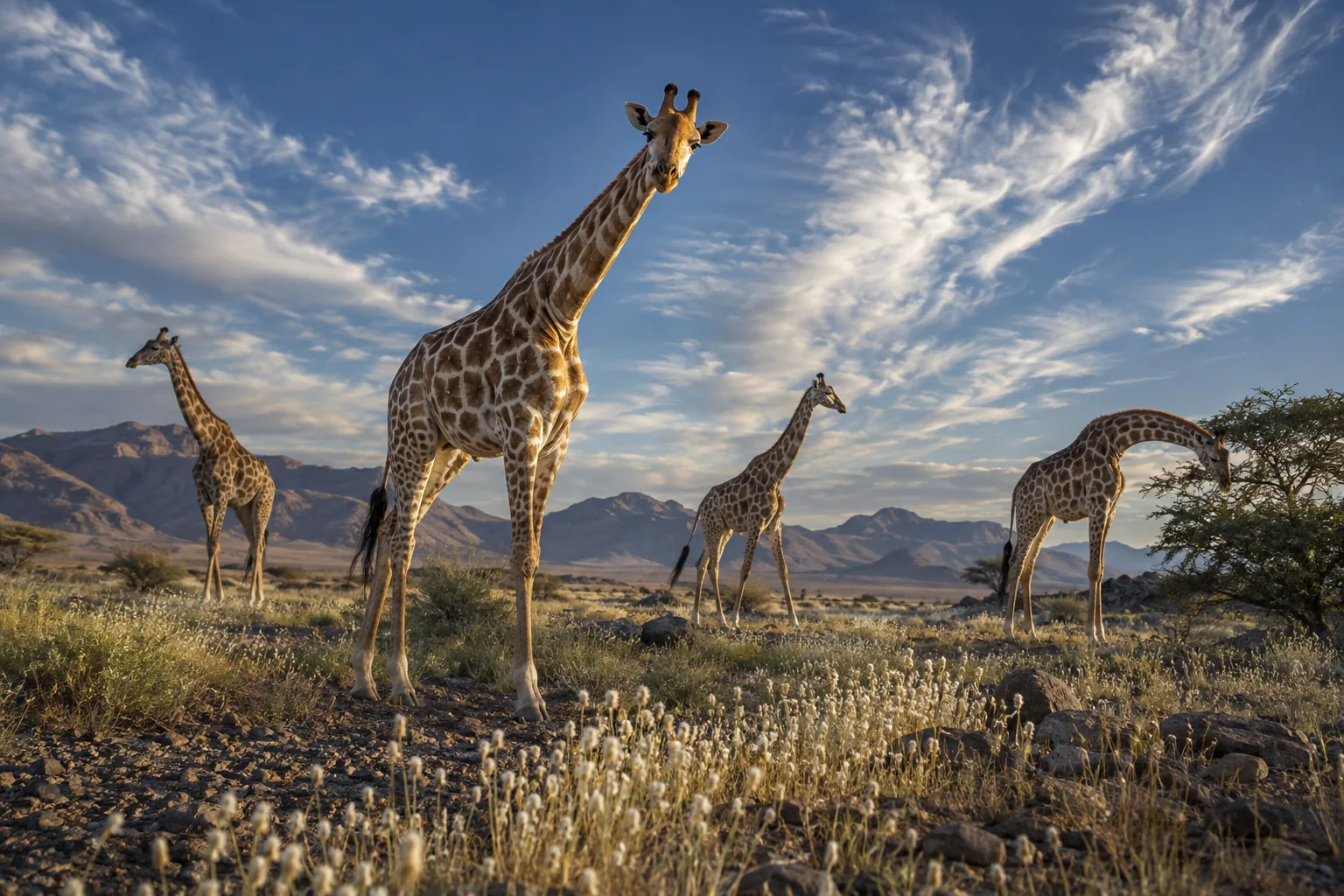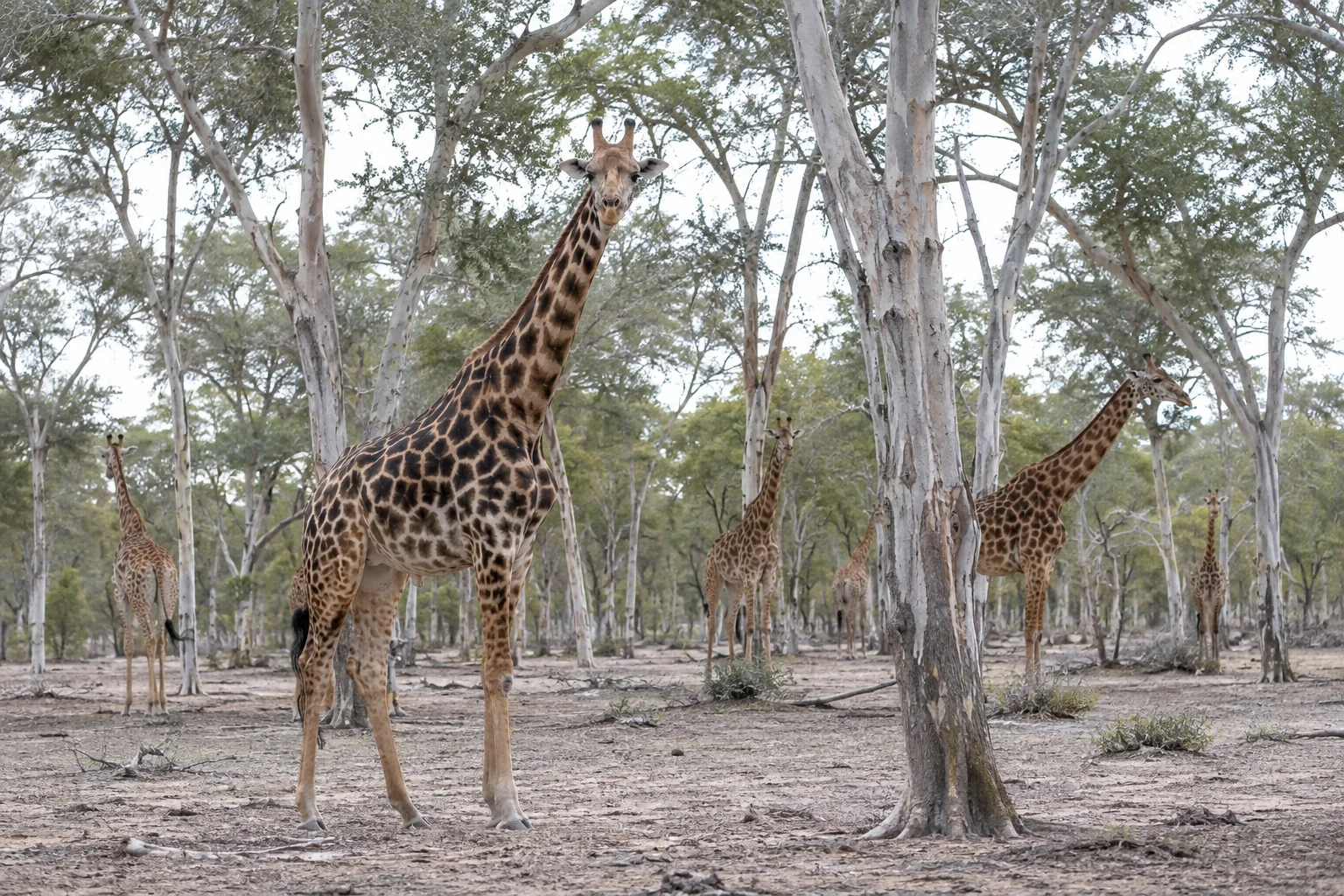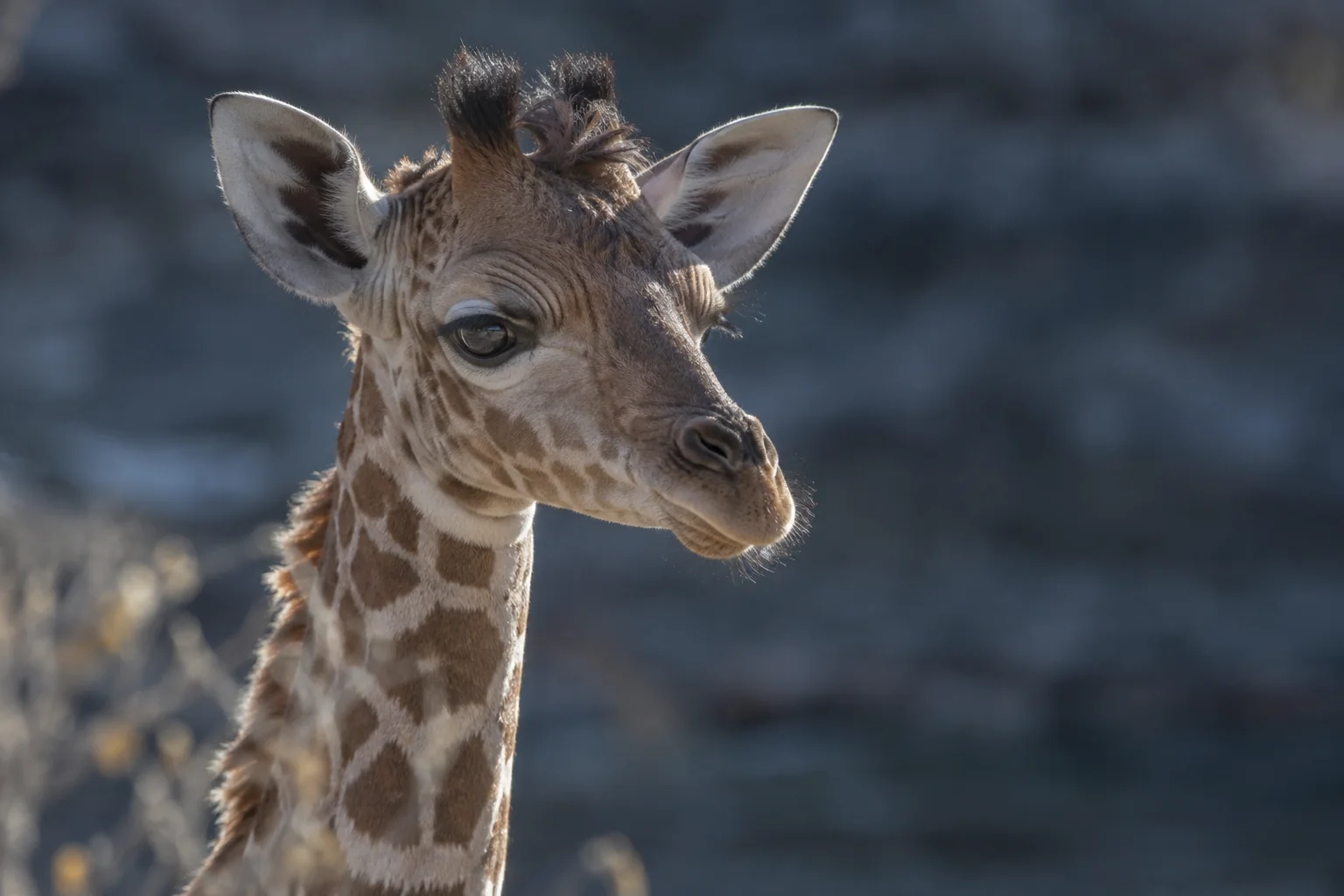
A giraffe calf adds one animal to a population. An adult female may contribute calves across many years. Losing her removes both an animal that has survived the hazards of early life and her future opportunities to reproduce. A steady supply of births can therefore coexist with a shrinking population.
That pattern helps explain the different fortunes of Masai giraffes in Tanzania’s Serengeti Ecosystem. In their 2025 study, co-lead authors Monica Bond and Dominik Behr and their colleagues found broadly stable populations in central Seronera and southern Ndutu during their study periods, but continuing declines in western Kirawira and northeastern Bologonja.
Birth rates were similar across the four sites. What distinguished the declining populations was a lower chance that an adult or subadult remained alive and resident the next year. This measure, called apparent survival, cannot separate death from permanent departure. It nevertheless locates the demographic problem: the declining sites were losing established animals, even while new calves arrived.
A single total for Serengeti giraffes would conceal those local differences. The study gives conservationists a reason to investigate losses in particular places and stages of life, rather than assume that the whole ecosystem faces the same problem.
Coat patterns turn sightings into lives
An ordinary count can show that fewer giraffes were seen. It cannot easily reveal whether the difference arose because fewer calves were born, more adults disappeared, or animals were simply missed. Recognising individuals makes those possibilities easier to examine.
The researchers photographed giraffes’ right sides and matched their individually distinctive coat patterns with WildID software. Each match linked a sighting to an animal’s previous encounters, building a history of when it appeared and which age class it occupied. Their combined record contained 1,520 identified giraffes, accumulated across sites and years.
An animal missed in one survey might appear again later. Models use such encounter patterns to estimate the chance of overlooking a giraffe, instead of treating every missed photograph as a loss. In Seronera, repeated surveys within short annual periods also helped estimate temporary absences from the study area. Permanent departures remain inseparable from deaths because both end an animal’s local record.
Building the long Seronera history required joining three sources: road surveys in 2008–2010, Snapshot Serengeti camera-trap images in 2011–2016, and renewed road surveys in 2018–2023. With no photographs available for 2017, these supplied 15 years of observations across a 16-year span. The models accounted for differences in detection between the survey methods.
That continuity is a central achievement of Bond, Behr and colleagues’ work. Photographs collected in different ways became evidence about how one local population changes through time. The shorter records elsewhere then supplied a comparison across the ecosystem. Our population-survey guide explains why identifying animals and allowing for missed sightings can answer questions that counts alone cannot.
The same ecosystem holds different trajectories
| Study site | Period used for the recent comparison | Population pattern |
|---|---|---|
| Seronera, central Serengeti | 2008–2023, with no photographic data in 2017 | Broadly stable, with annual fluctuations |
| Ndutu, southern woodlands | Surveys spanning 2018–2021 | Relatively stable over the shorter record |
| Kirawira, western corridor | Surveys spanning 2019–2023 | Declining, with lower apparent survival of older animals |
| Bologonja, northeastern woodlands | Surveys spanning 2019–2023 | Declining, with especially low apparent survival |
The shorter site records used different models from the long Seronera series. They provide a comparison of local trajectories, rather than four equally long experiments.
Bologonja’s estimates were particularly concerning, including low calf survival as well as losses of older animals. Its smaller sample also fitted the model less well, making the exact rates less secure. The broader contrast remained clear in the authors’ interpretation: births were similar, while adult and subadult persistence was lower at the declining sites.
Recent stability also needs a historical reference. Comparisons with earlier surveys suggest that Seronera had already undergone a substantial decline since the 1970s before stabilising. Kirawira and Bologonja continued to decline. The historical work used different survey methods, requiring adjustments before comparison; the recent stable trend should therefore be understood as persistence at a reduced level, rather than recovery to former numbers.
Why births still matter in a stable population
The long Seronera record let the team ask a second question. Beyond the differences between places, which changes accompanied better and worse years within one population?
Adult apparent survival and calf recruitment had the strongest positive associations with annual population growth. In this paper, recruitment means model-estimated births. It does not mean young animals confirmed to have survived to adulthood. Entry by subadults from elsewhere also contributed, while estimated adult immigration was very low.
The distinction between the two comparisons matters. Similar birth rates across four sites do not make births unimportant. They mean that births did little to explain why those places had different trajectories. Within Seronera, years with more births and better adult persistence were associated with better population growth. The result describes the history the researchers observed; it does not measure what a particular conservation intervention would achieve.
A related 2016 study by Derek Lee and colleagues followed 860 adult females and 449 calves at five sites in the Tarangire ecosystem. Variation in adult female survival contributed most to differences in modelled local population growth. Together, the studies make a useful point about giraffes’ slow life cycle: protecting animals that can reproduce over many years may be crucial even when attention is naturally drawn to the arrival of calves.
Where did the missing giraffes go?
Only one identified animal was recorded moving between the four Serengeti sites: a subadult male that travelled 45.3 kilometres from Seronera to Ndutu. The sites were separated by more than 40 kilometres, but there were no obvious physical barriers preventing movement among them.
The authors combine that limited detected interchange with low estimated immigration into Seronera to argue that reduced true survival is the likelier explanation for the edge declines. They identify illegal hunting as a probable pressure. The study did not determine individual causes of death, and movement into unsurveyed areas remains a possible explanation for some losses.
This unresolved distinction changes what useful follow-up would look like. If animals are leaving, researchers need to know where they settle and whether the pressures at their former sites persist. If they are dying, identifying the causes would guide a different response. Wider photographic monitoring and suitable movement or fate data could help distinguish these possibilities.
The limited observed interchange also means that a stable neighbour cannot be assumed to replenish a declining site quickly. Local losses deserve attention even while giraffes remain numerous elsewhere in the ecosystem.
Can local protection improve the outcome?
Derek Lee’s 2018 evaluation of the Little Chem Chem area within Burunge Wildlife Management Area, in the Tarangire ecosystem, provides a practical comparison. In 2014–2015, management shifted from sport hunting to photographic tourism and added ranger training, equipment and resource protection.
Giraffe apparent survival and population growth increased after these changes. A comparison site in Tarangire National Park, monitored using the same photographic approach, did not show the same improvement. Following both places before and after the change helped distinguish the local response from conditions affecting the wider region.
The study evaluated a package of changes and cannot assign the result to one component or guarantee it elsewhere. Its connection to Serengeti is nevertheless concrete: the demographic rates that reveal a local problem can also become outcomes to follow when conservation action is introduced. The Tarangire studies draw on the same regional monitoring programme and provide different analyses, rather than wholly independent replications.
Following the next change
The authors call for more work at Kirawira and Bologonja to confirm the pattern and identify the causes of low apparent survival. Alongside tracking missing animals beyond the current boundaries, two comparisons could make that work more informative.
Which local pressures accompany losses? Linking individual histories to rainfall, forage conditions, disease observations and appropriately aggregated information on human pressures could narrow the explanations. Several pressures may change together, so an association would identify a hypothesis to investigate rather than prove a cause.
Does a conservation change keep more adults in the population? Continued monitoring at the intervention site and a comparable area could test whether adult persistence improves and whether population growth follows. The comparison would need to account for movement and changing survey effort, as well as births.
The value of these photographic histories is that the question can move beyond how many giraffes remain. Researchers can follow which animals are being lost, which generations replace them and whether a local response changes that balance. The population and demography collection connects this work with other studies of how giraffe populations persist.
Sources
- Monica L. Bond, Dominik M. Behr, Derek E. Lee, Megan K. L. Strauss, Petra E. Campbell, Douglas R. Cavener, George G. Lohay, James M. Madeli, Maria Paniw and Arpat Ozgul (2025). Demographic drivers of population dynamics reveal subpopulation-specific conservation needs for giraffes in the Serengeti Ecosystem. The Journal of Wildlife Management 89(5), e70037. DOI: 10.1002/jwmg.70037. Published 13 May 2025. Bond and Behr share primary authorship. Full paper. Public data and code record.
- Derek E. Lee, Monica L. Bond, Bernard M. Kissui, Yustina A. Kiwango and Douglas T. Bolger (2016). Spatial variation in giraffe demography: a test of 2 paradigms. Journal of Mammalogy 97(4), 1015–1025. DOI: 10.1093/jmammal/gyw086; author-organisation full text.
- Derek E. Lee (2018). Evaluating conservation effectiveness in a Tanzanian community wildlife management area. The Journal of Wildlife Management 82(8), 1767–1774. DOI: 10.1002/jwmg.21549; author-organisation full text.