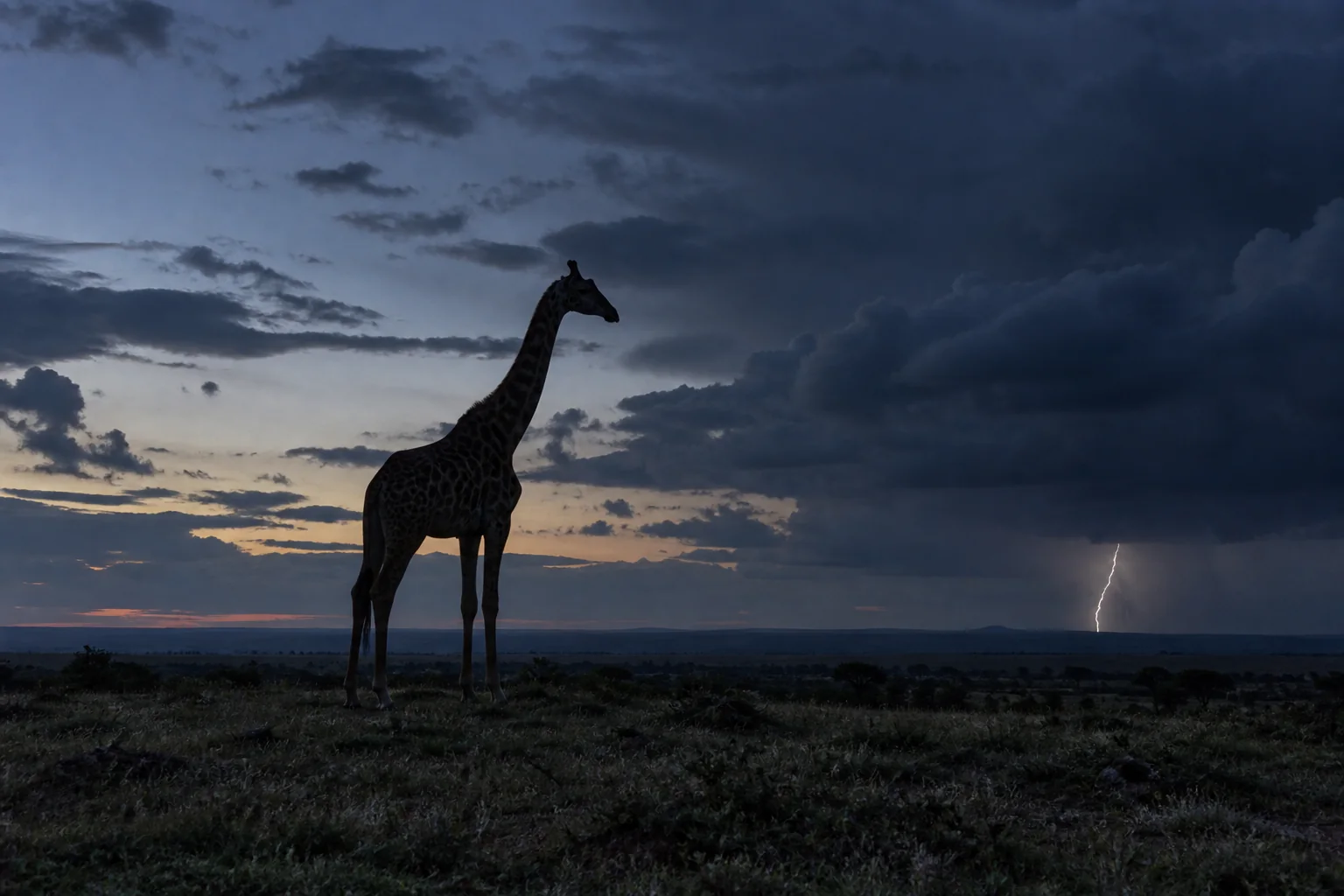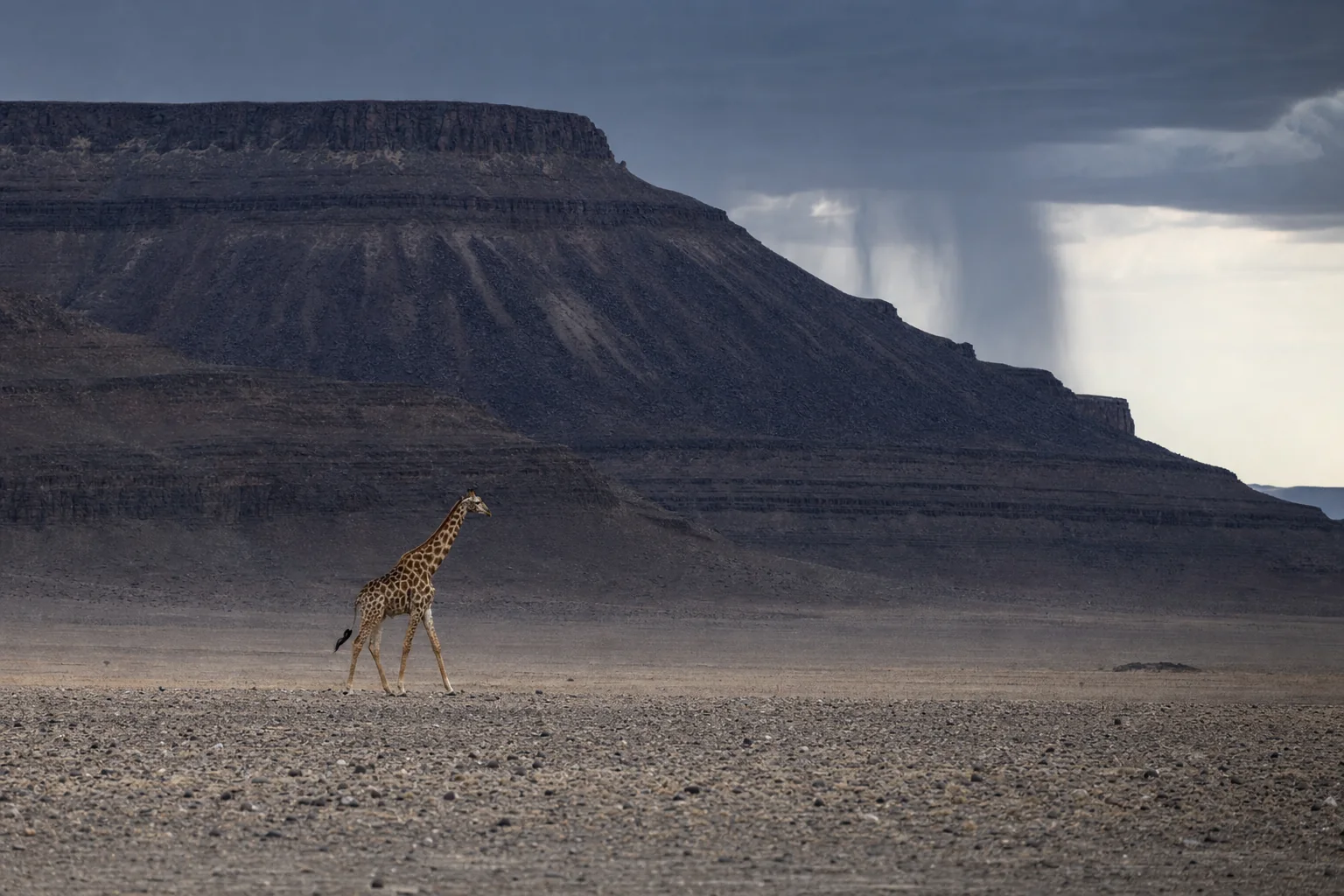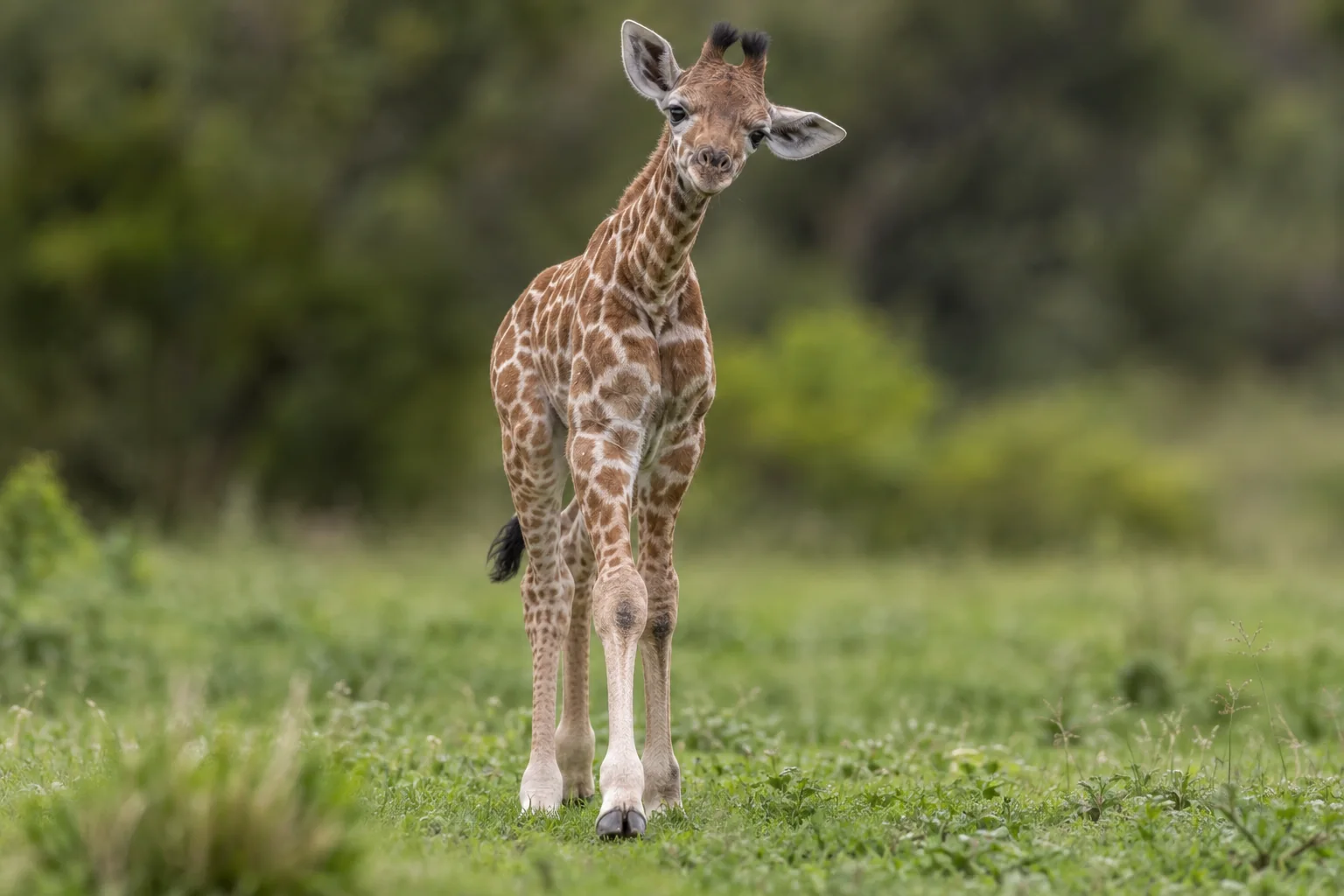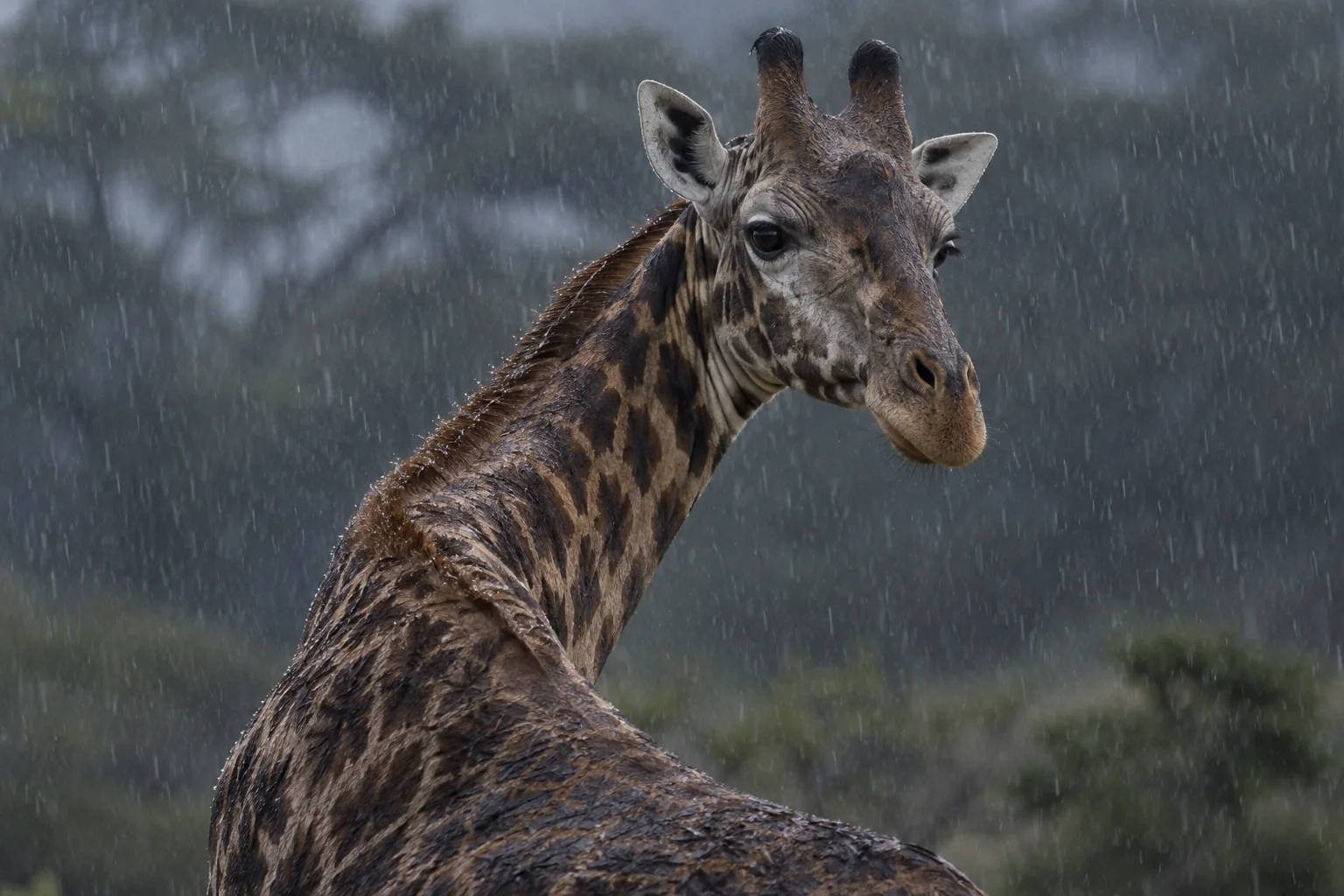
Rain sounds like rescue for a dry savanna. Yet an eight-year study of giraffes found that unusually wet conditions did not consistently mean better survival. That matters because a landscape becoming greener can look reassuring while concealing a more complicated biological response. The useful question is not whether rain is good or bad. It is what changed, for which giraffes, during which season—and what the evidence can explain.
What did the researchers contribute?
The paper is Effect of local climate anomalies on giraffe survival, by Monica L. Bond, Arpat Ozgul and Derek E. Lee, published on 10 June 2023 in Biodiversity and Conservation, volume 32, pages 3179–3197. DOI: 10.1007/s10531-023-02645-4.
The team connected a long-running photographic study in northern Tanzania's Tarangire Ecosystem with a precise environmental question: how did departures from usual seasonal conditions relate to giraffe survival?
Its contribution rests on continuity. Recognising the same animals repeatedly makes a different kind of study possible from counting whichever giraffes happen to be visible. Separating adults from juveniles, distinguishing three seasons and considering landscape context made the question more informative still.
The published contribution statement credits Bond and Lee with collecting field data, all three authors with analysis, and Bond with leading the writing. That sustained observational work deserves specific recognition: it supplied the individual histories needed to investigate variation that a single photograph or population total could not reveal.
The animals were Masai giraffes. Findings from this population are not automatically findings for every giraffe species or landscape.
How did 2,385 giraffes become survival histories?
Field observations ran from January 2012 to February 2020. The paper's main results table and figures describe 2012–2019. Researchers repeatedly photographed giraffes and matched their coat patterns to maintain individual identities.
The analysis separated 1,248 giraffes first detected as adults, older than three years, from 1,137 first detected as newborns, aged zero to three months. The second dataset followed giraffes first detected as newborns across the study years; it does not mean every animal remained a newborn throughout the study. Juvenile age and sex groups were considered in the models, including animals whose sex had not been established.
Each year had three seasonal observation occasions, with two repeat surveys at each occasion. Repeated visits help distinguish animals that are present but missed from animals that are less consistently available to be seen. Our photographic-survey guide explains that observation problem.
A missing photograph is not a confirmed death
The outcome was apparent survival: remaining alive without permanently leaving the study area. A giraffe that dies and one that moves away for good can both disappear from subsequent survey records.
The models also addressed temporary absence and detection. That is an important strength, but it does not turn every permanent disappearance into a known death. Nor does it identify disease, predation or another cause for each animal.
Two boundaries served different purposes. Distance from the survey area's edge helped model observation and temporary absence. Distance from the protected areas' edges was examined in relation to survival. An observation boundary and a conservation boundary are not the same biological variable.
What counts as an unusually wet season?
The researchers defined three four-month seasons: short rains, October–January; long rains, February–May; and the dry season, June–September.
They examined land-surface temperature, rainfall and NDVI, a vegetation-greenness index. Each variable was expressed as a standardized departure from its local average for that particular season. Zero represented the seasonal average; positive and negative values represented conditions above or below it.
A wet season can therefore have a negative rainfall anomaly if it is drier than its usual wet-season conditions. A dry season can have a positive anomaly while still receiving less rain than a typical rainy season. Comparing calendar seasons and comparing departures within a season answer different questions.
This distinction also prevents a second shortcut: an unusual season is not, by itself, evidence of a long-term trend. The study associated local seasonal variation with giraffe histories; it was not a formal attribution of those changes to human-caused warming.
The team compared current-season conditions with lagged or cumulative windows. For juveniles, it also considered conditions around conception and early gestation. The main results favoured current-season associations and reported little support for those delayed effects. That does not prove delayed effects can never occur.
What did the study find?
The following is an original reading aid summarising the main paper's reported patterns. It is not a new analysis or a set of universal environmental rules.
| Seasonal anomaly | Adult result | Juvenile result |
|---|---|---|
| More rain than usual | Lower apparent survival in supported models, with seasonal and landscape context | Lower apparent survival overall, but not the same negative pattern during the short rains |
| Greener vegetation than usual | Lower apparent survival; greenness appeared in the three top-ranked adult models | Little support for a greenness association |
| Warmer land surface than usual | Higher apparent survival within the observed conditions | Little support for a temperature association |
The short-rains exception matters. Juvenile rainfall responses were not uniformly negative: the Results describe a slight positive association during that season farther from protected-area edges. This is a result about age, season and context, not evidence that every extra millimetre of rain carries the same consequence.
Adults nearer protected-area edges had lower apparent survival during the short rains, and the plotted relationships differed across seasonal and spatial settings. A boundary is a context, however, not a measured cause. The analysis did not separately identify livestock exposure or illegal hunting as the reason for each disappearance.
Model support is not a percentage of animals lost
The researchers compared alternative statistical models using AICc, which balances fit with complexity. Their reported model weights describe relative support within that candidate set—not the probability that a proposed biological explanation is true.
In Table 1, the leading adult model had weight 0.35; the leading juvenile model had weight 0.04. Neither number is a survival rate or a 35% or 4% population decline. Support for the juvenile models was spread across many alternatives, while current rainfall appeared consistently among the supported models described in the Results.
The positive adult-temperature association needs the same care. It concerns the conditions observed in this study. The authors explicitly note that more extreme future heat could reveal limits. They did not measure a safe maximum temperature or establish that continued warming benefits giraffes.
Why might a greener season still be difficult?
The paper makes useful biological proposals without completing a cause-of-death investigation.
More plant growth could change the nutrient concentration of leaves, so greenness and food quality need not increase together. Wetter conditions could also alter parasites, infectious disease or the vegetation cover available to stalking predators. Seasonal human activity and livestock exposure could contribute to patterns near protected-area boundaries.
These are competing or interacting explanations to investigate. NDVI did not assay the nutrients in leaves eaten by each giraffe. Rainfall did not measure parasite burdens, and a modelled disappearance did not reveal whether an animal encountered a predator.
The distinction makes the science more valuable, not less: the study identifies when and where to ask more specific biological questions. Our feeding guide explains why suitable browse is more than a green landscape.
How does this connect with other giraffe research?
A survival association is not a population forecast
Lee and colleagues' 2016 spatial-demography paper examined survival, reproduction and population models across Tarangire sites. Adult female survival contributed strongly to differences in projected growth among sites. That helps explain why investigating adult survival can matter for conservation.
But demographic importance and climatic association are separate questions. Knowing that population growth is sensitive to a vital rate does not show that one rainfall anomaly caused a population decline. The climate paper did not run the earlier study's full population comparison.
The 2016 analysis also came from an earlier part of the same Tarangire photographic research programme. Its 2012–2014 period overlaps the climate study's window, with different geographic and analytical coverage. It is a methodological connection, not independent replication of the rainfall result.
Add births and movement to understand population change
Bond, Behr and colleagues' 2025 Serengeti study adds another useful layer. Its Seronera analysis modelled births and immigration alongside apparent survival and abundance. Adult survival and calf recruitment were strongly associated with annual growth variation in its retrospective analysis; calf recruitment there means model-estimated births, not survival to adulthood.
A survival result is therefore important without being a complete population forecast. Reproduction, entry and how rates vary together also matter. Our Serengeti commentary follows that separate study in depth.
Serengeti is a different ecosystem with different data and annual analyses. Its results cannot identify what caused the Tarangire climate associations or be pooled casually with seasonal estimates.
Two research directions worth investigating
These are editorial proposals, not findings of the paper, claims of novelty or instructions to wildlife authorities. They build on questions the research makes possible.
Separate leaf quantity from leaf quality
One next step would connect repeated measurements of vegetation greenness with the nutritional composition of plants giraffes actually browse, on the same seasonal timeline as individual histories.
A useful comparison would ask whether similarly green periods with different browse quality also differ in apparent survival. That could help distinguish a food-quality explanation from greenness acting mainly as a marker of other wet-season processes.
Plant choice, grazing, rainfall and disease exposure can vary together; matching their timing would not remove all confounding. Non-invasive observations and appropriately permitted sampling should avoid disturbing animals, and sensitive locations should remain private.
Compare seasonal responses across landscapes
The authors recommend testing local climate-anomaly effects in southern giraffe populations across their latitudinal range. Building on that recommendation, a second direction would pre-specify an anomaly-based analysis in other giraffe landscapes, using locally appropriate seasons and comparable observation methods. Does a rainfall association recur, reverse or depend on vegetation and human context?
The important replication is across relevant environmental conditions—not simply adding more photographs. Hundreds of giraffes experiencing the same wet season do not create hundreds of independent weather events. Study duration, the number of seasonal contrasts, detection differences and the definition of the local baseline all deserve explicit attention.
Such work could reveal where the Tarangire pattern travels and where it does not. It would not, on its own, establish a causal mechanism or remove the need to distinguish permanent departure from death.
What to remember
This study turned years of individual recognition into a more precise conservation question. Rainfall, temperature and greenness did not have one interchangeable association with survival, and adults and juveniles did not respond identically.
Its practical contribution is a better set of questions about seasonal vulnerability—not a rule that rain is harmful or a forecast that giraffes will disappear. The threats guide places this local evidence alongside other conservation pressures.
Frequently asked questions
Did rain kill the giraffes in the study?
The study found rainfall associations with apparent survival. It did not determine a cause of death for every missing animal. Proposed mechanisms need their own evidence.
Does warmer weather help all giraffes?
No such general conclusion follows. The positive association concerned adults in one population under the observed conditions. Juveniles differed, and extreme-temperature limits were not measured.
Were 2,385 giraffes alive together at one time?
That number is the combined set of individual histories used over the study period. It is not a simultaneous census, a death tally or a count of independent climate events.
Sources
This commentary uses the full Bond–Ozgul–Lee main article, including its table and figures, and the main texts of both linked research connections. The focal supplementary download was unavailable during our check; supplementary-only details and raw-data reanalysis are not represented as verified here.
Sources checked 10 September 2026. The focal article is published under Creative Commons Attribution 4.0. Our comparison and research proposals are editorial synthesis, not source figures, new field findings or author endorsement. No full papers or precise wildlife records are republished.
Explore the science hub and research library for related evidence.