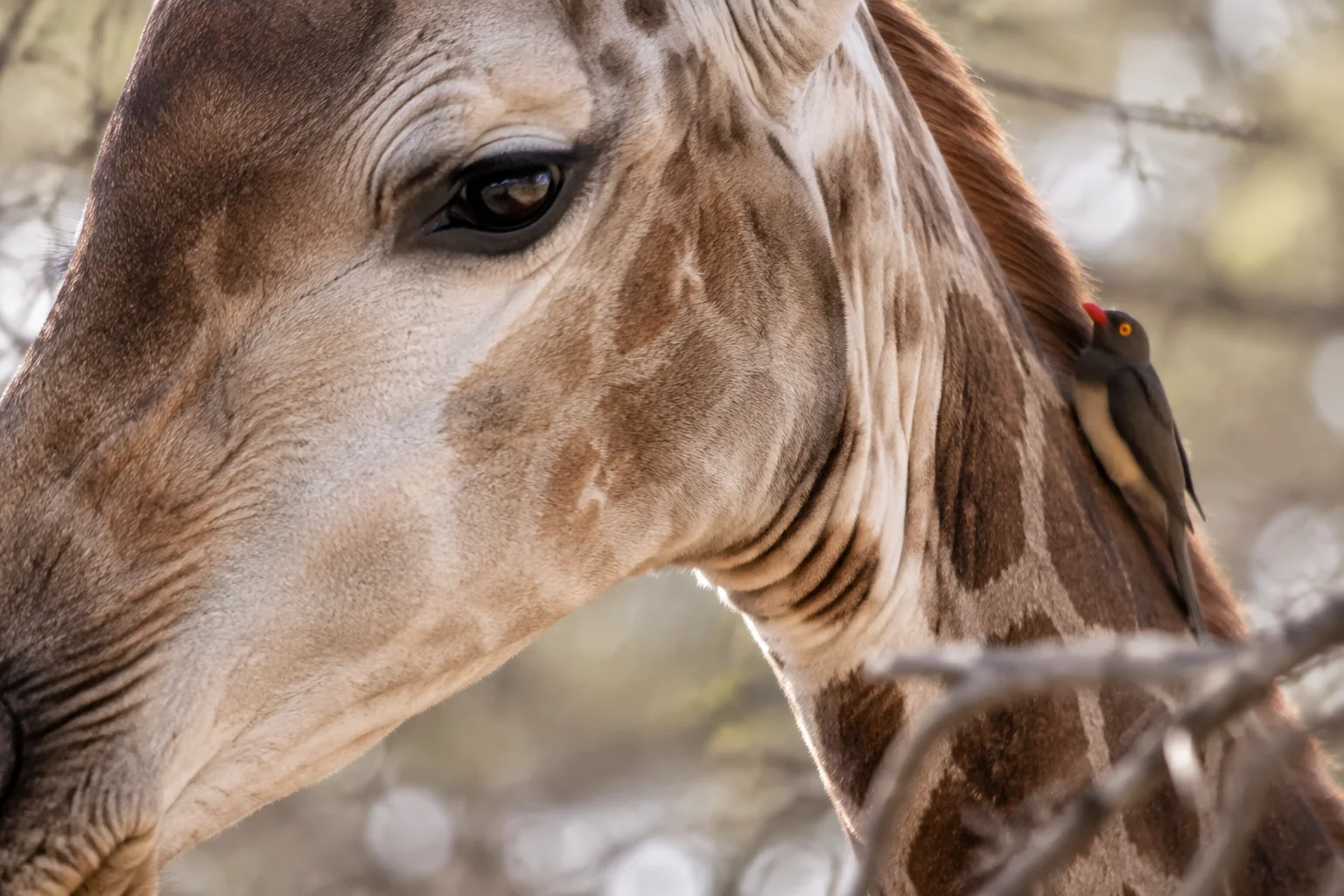
A giraffe does not need a lion's roar to overturn the idea that it is silent. A few seconds of recorded humming are enough. The harder question begins after you hear it: was the animal calling to another giraffe, and did the listener respond? That gap between a sound and its meaning is where an animal-noise question becomes a much more interesting story.
Listen to a real giraffe hum
This research recording accompanied the study by Anton Baotic, Florian Sicks and Angela S. Stoeger, published in September 2015. Start at a comfortable volume; the clip is approximately 12 seconds long.
Sound description: a low, sustained humming vocalisation with a layered, harmonic structure, as identified in the study. This is a non-speech animal recording; there are no words to transcribe. The clip's length is not the duration of one measured hum.
Recording: Anton Baotic, Florian Sicks and Angela S. Stoeger (2015), Additional file 5, Figure 3a. CC BY 4.0; container changed from MOV to M4A, audio unchanged. Download audio (M4A, 132 KB).
The paper describes recordings from Berlin Tierpark, Copenhagen Zoo and Vienna Zoo. Its caption for this particular supplementary file does not identify which zoo or individual produced it. The twilight illustration above is not a photograph of the recording session.
If you only wanted the animal sound, you now have a sourced example. If you want to explain it to someone else, keep one qualification: giraffes can hum; this is not a translation of what a giraffe is saying. Our giraffe facts for kids gives younger readers more discoveries and a printable activity. The wider giraffe behaviour guide introduces the changing social groups in which communication matters.
What other sounds do giraffes make?
There is no need to choose one sound and pretend it is the giraffe equivalent of every dog's bark. Research has documented several different acoustic forms, and the evidence behind them is not identical.
| Sound | What the evidence describes | What to avoid assuming |
|---|---|---|
| Hum | Sustained, harmonic sounds in the 2015 zoo recordings | Every hum has the same meaning or occurs during sleep |
| Grunt | An example supplied with the 2015 paper | One example establishes a universal emotional message |
| Hiss | Broadband calls analysed in wild giraffes in 2018 | Hissing has been shown to encode a named predator |
| Snort | Short, pulsed calls; nasal air release observed in the field study | Any sudden noise near a giraffe is necessarily its call |
“Broadband” means that sound energy extends across a range of frequencies. “Harmonic” describes an organised relationship between frequency components. These are descriptions of sound structure, not labels for emotions.
Wild recordings add a different setting
A 2018 study by Volodina and colleagues analysed 22 hisses and 20 snorts from nine wild-living giraffes in Namibia and Kenya. The calls accompanied vigilance around people or cheetahs. The researchers observed nasal air release during snorts, but could not establish whether the hisses came through the nose or mouth.
This is valuable context, not a giraffe phrasebook. The observations do not show that one acoustic pattern means “cheetah” and another means “person.” Nor do five recording sessions tell us how frequently every giraffe calls throughout its life.
The paper's supplementary examples allow a more technical comparison with humming. Our giraffe predators guide explains why the caller's age and the predator involved also matter when interpreting danger. The predation and calf-survival evidence area covers that broader research question, not a translation of alarm calls.
Are giraffe sounds too low for humans to hear?
The recorded hums were low-pitched, but low-pitched does not mean infrasonic. Infrasound conventionally refers to frequencies below about 20 hertz. Hertz, abbreviated Hz, measures cycles per second.
In the 2015 humming study, the mean fundamental frequency was about 92 Hz. The fundamental is the underlying repetition frequency, not the only frequency present in a harmonically rich sound. The researchers did not record giraffe vocalisations in the infrasonic range in this dataset.
That finding has two boundaries. It is evidence against calling these particular hums infrasonic. It is not proof that no giraffe could ever produce any sound below 20 Hz in another setting.
Pitch is not loudness
Imagine two recordings of the same musical note, one played softly and one loudly. Their playback levels differ without the note necessarily changing. The same distinction matters when somebody calls a giraffe sound “low”: do they mean deep in pitch, faint in level, or both?
A phone, laptop and headphones do not reproduce a recording identically. If a clip is difficult to hear, that alone cannot establish its original sound pressure, its distance from the microphone, or a giraffe's hearing threshold. Do not turn your device to an uncomfortable level to make a biological point.
It is also easy to misread an average. Approximately 92 Hz describes the study's measured calls collectively; it is not a compulsory note that every giraffe hum must match. A species does not become a tuning fork because a paper reports a mean.
Why do giraffes hum at night?
Keeping contact when visibility is limited is a plausible explanation, but the humming study did not demonstrate it. The researchers found 65 hums in more than 947 hours of recordings, with the hums occurring in the nighttime sessions. They did not have simultaneous nighttime video to identify the callers or establish what they were doing.
This matters for appealing stories about giraffes talking to separated friends or humming in their sleep. Nighttime is a recording period; sleep is a behavioural state. One does not prove the other. Our giraffe sleep guide explains why posture, inactivity and measured sleep should not be casually substituted for each other.
Three questions, three kinds of evidence
First ask whether a sound occurred. A recording and its acoustic analysis can answer that.
Next ask who produced it and under what circumstances. That may require synchronised video, identified animals and observations before and after the sound.
Finally ask what effect it had on another animal. Did a receiver change its behaviour because of the sound, rather than because it saw movement or detected another cue? A carefully designed comparison can help separate those explanations.
The Austrian Academy of Sciences giraffe-acoustics project sets out this combination of recording, behavioural observation and playback research. Its research aims are not completed findings in themselves. That distinction is especially important when reading a project page written before later papers appeared.
What newer research tells us about listening
Giraffe communication is not only about what comes out of the animal's mouth or nostrils. It also involves what the animal hears. A study published on 20 August 2026 investigated responses to lion vocalisations and red-billed oxpecker alarm calls in free-ranging Southern giraffes.
The giraffes showed stronger and more consistent vigilance responses to the lion sounds, regardless of which sound type came first. The research institution's September 2026 account and the paper's published abstract describe differential responses to these direct predator and other-species warning cues.
This does not decode the hum above: the playback sounds came from other species. It does show why “giraffes are quiet” is a poor reason to assume sound is unimportant to their lives.
For the broader evidence landscape, our giraffe research library connects readers with reviewed summaries and study references. A promising experiment, a recorded call and a complete communication system remain different levels of understanding.
Try this listening exercise
Listen once without looking for a message. Write down only what you can describe: whether the sound seems sustained or abrupt, whether it changes, and where it begins and ends in the clip. These are your listening observations, not calibrated acoustic measurements.
Then make three short notes:
- Known from the source: this is a supplementary humming example from a published zoo study.
- Not supplied for this clip: the individual caller and its behavioural state.
- Question for further research: whether another giraffe responds, and in what way.
Now try the sentence “The giraffe is lonely.” Can you derive it from the sound alone? No. An emotional interpretation requires more evidence than a human listener's impression of a low noise.
This is a useful classroom activity because the goal is not to guess the right emotion. It is to notice when a description becomes an interpretation. Our general giraffe facts guide offers other examples where a memorable detail benefits from a small but important qualification.
Observe without trying to provoke a call
At a zoo or on safari, follow the site's rules and your guide's instructions. Do not play these recordings at animals or try to startle a giraffe into making a noise. Research playback is not an invitation to conduct your own wildlife experiment.
Quiet observation can still be interesting. Note the surroundings, nearby animals and what you could actually see. If you hear something, keep the uncertainty about its source rather than automatically assigning it to the tallest animal in view. A careful unanswered question is more useful than an invented certainty.
What to remember
- Giraffes are not voiceless: researchers have recorded humming and other sounds.
- The player contains a credited research supplement.
- The 2015 hums were audible-frequency sounds; their social function was unresolved.
- Wild call observations and newer playback experiments add evidence without turning every sound into a translated message.
Frequently asked questions
Do giraffes moo? Some accounts use words such as moo or bellow to describe giraffe noises. Such labels can reflect how a sound struck the observer rather than a standardised call classification. For a sourced example, listen to the published hum above.
Can baby giraffes make sounds? Yes; the 2015 paper discusses a recorded newborn bellowing during a handling examination. That context does not establish a universal mother–calf contact call. Our baby giraffe guide covers early life more broadly.
Do giraffes only hum at night? Hums were recorded only in the nighttime sessions of the 2015 study. That is not evidence that daytime humming is impossible in all giraffes.
Is this what a wild giraffe in Namibia sounds like? The embedded hum comes from a European zoo study. Namibia was one location in the separate 2018 hiss-and-snort study; the recordings should not be confused.
Sources
- Baotic, Sicks and Stoeger, Nocturnal “humming” vocalizations, BMC Research Notes (2015), including Additional file 5 and its rights statement.
- Volodina and colleagues, Hiss and snort call types of wild-living giraffes, BMC Research Notes (2018).
- Baotic, Differential weighting of lion vocalizations and oxpecker alarm calls in giraffes, Behavioral Ecology (2026), published abstract and the Austrian Academy of Sciences' account.
- Austrian Academy of Sciences, giraffe-acoustics research project description. Links appear beside the supported claims.
Reviewed against these sources on 6 September 2026. This is a reader's guide, not an exhaustive catalogue of every reported giraffe sound.