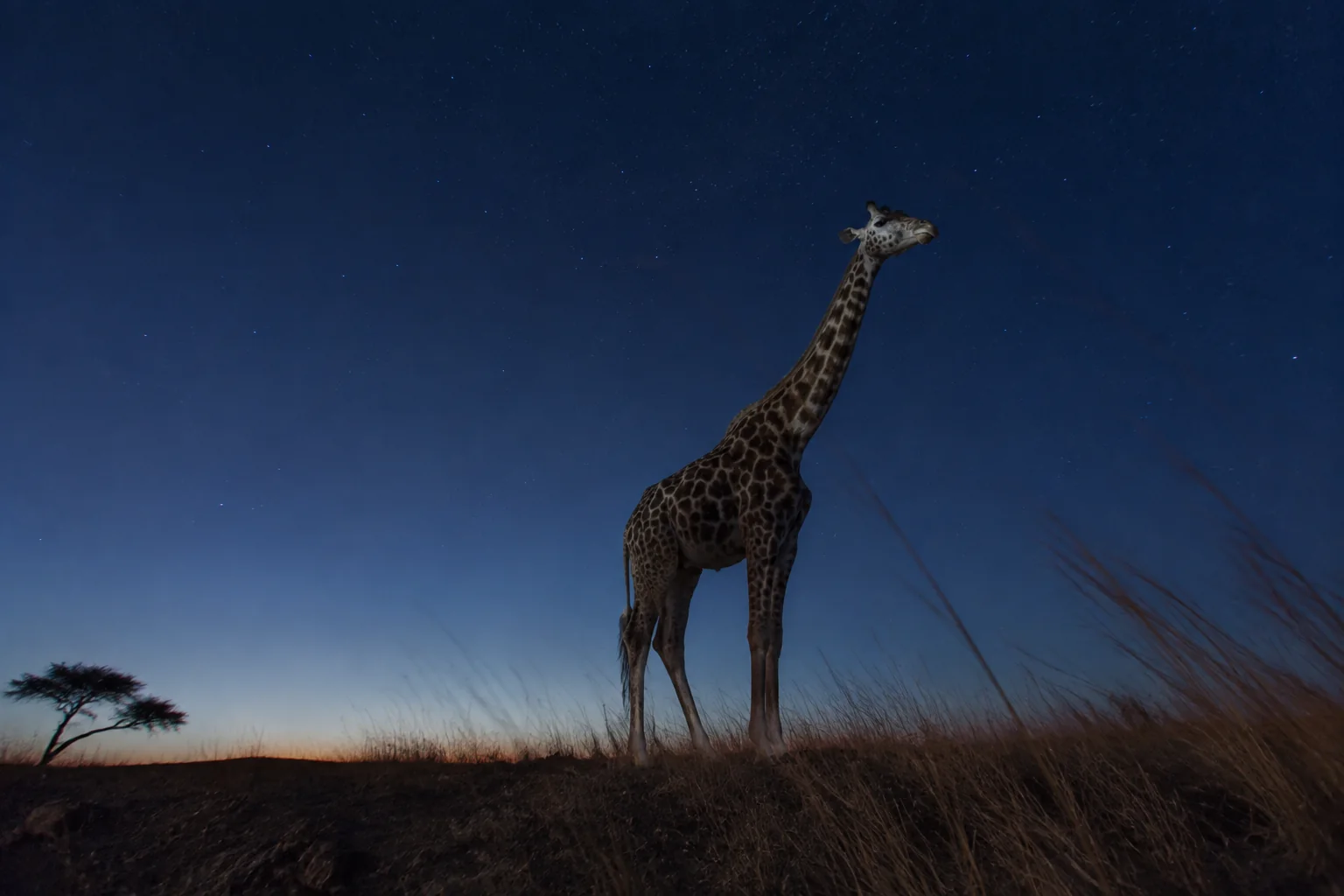
A microphone can listen after the people watching giraffes have gone home. In recordings from three European zoos, that extra shift captured something distinctive: sustained, low hums with layers of harmonics. They were neither silence nor the short, noisy snorts that observers already knew giraffes could make.
Anton Baotic, Florian Sicks and Angela S. Stoeger described these sounds in a 2015 study. Their discovery changed the evidence for what a giraffe can produce with its voice. It also exposed the gap between recording a vocalization and understanding a conversation.
Listening below the expected range
The researchers were interested partly in an elusive possibility: infrasound. Frequencies below about 20 hertz are beneath the conventional lower limit of human hearing, so a giraffe could conceivably produce a signal that nearby people would miss. Existing claims about giraffe infrasound lacked the detailed recordings needed to settle that question.
Recording equipment therefore had to capture very low frequencies. For outdoor work, the team used a microphone modified for that purpose. Indoors, programmable recorders collected sound between evening and morning. An example signal near 14 hertz confirmed that the overnight equipment could detect energy in the infrasonic range; that demonstration was a check of the recorder, not the identification of an infrasonic giraffe call.
The archive combined recordings from Berlin Tierpark, Copenhagen Zoo and Vienna Zoo, collected in different periods. No other animal species shared the giraffe facilities during the recordings. That mattered when deciding whether similar unusual sounds appearing at all three institutions came from giraffes.
The team inspected 908 hours and 50 minutes recorded at night, alongside 38 hours and 22 minutes recorded by day. They searched visual displays of sound for tonal, sustained or infrasonic signals. This was a targeted search, not a complete census of every noise: brief broadband sounds resembling snorts were difficult to separate from ordinary bumps and cracks and were excluded from this analysis.
The pattern inside a hum
Sixty-five humming vocalizations emerged: 34 from Berlin, 22 from Copenhagen and nine from Vienna. All came from the overnight sessions. The much larger night sample means that this result should not be converted into a precise comparison of calling rates across the full day.
A spectrogram displays time along one direction and frequency along the other. In the study's examples, multiple bands rise and fall together above a low fundamental frequency. Those harmonics distinguish the hums from a sudden rush of air spread across many frequencies. Some examples are brief; others carry a longer, wavering contour.
The mean fundamental frequency was approximately 92 hertz, with considerable variation among calls. The lowest measured frequencies reached about 35 hertz, and the calls lasted from roughly four-tenths of a second to just over four seconds. These were low sounds, but the measured hums were above the infrasonic boundary. The study found no convincing giraffe infrasound in its recordings.
That negative result is narrower than proving giraffes can never produce infrasound. Animals sharing a small enclosure may have little need for a signal used over much greater distances. Nevertheless, an appealing account of hidden communication cannot substitute for an identified sound and evidence of its use.
A voice without an identified caller
The central limitation was visual. The researchers did not have synchronized night footage showing which giraffe hummed or what the animals were doing. They could not assign a call to a particular age, sex or individual. Nor could they establish that another giraffe responded.
The housing arrangements offered a possible clue. Some giraffes were separated from companions overnight: all individuals at Berlin occupied individual stalls, with calves alongside their mothers, while particular animals were separated at the other zoos. A contact call could help maintain a relationship when a companion is difficult to see. Yet separation was not experimentally varied, and the recordings did not show a hum restoring contact.
Even a richly structured sound does not prove that listeners extract information from it. Frequency patterns might potentially carry identity or arousal, but demonstrating that requires comparing known callers and testing responses. The study's result was an acoustic description, not a decoded vocabulary.
Why social context is the next missing observation
A later field study of giraffe associations illustrates why the circumstances of a call matter. After accounting for age, sex and tendencies to join larger groups, researchers found the clearest evidence of individual partner preferences during foraging. Group membership by itself did not describe the same social relationship in every activity.
That study did not investigate humming. Its relevance is methodological: if social preferences change with activity, a call's meaning cannot be inferred simply because several giraffes are nearby. A night recording paired with behaviour could distinguish an animal contacting a separated companion from a sound produced during rest or another activity.
Identifying the caller would also allow repeated calls from one individual to be separated from differences among animals. Playback could then ask whether listeners discriminate among sounds, although a turn toward a speaker would still need to be distinguished from a more specific response.
The hums made a previously vague question experimentally approachable. Giraffes had supplied a repeatable sound with measurable structure. Explaining what it does requires listening to the receiver as carefully as to the caller.
Sources
- Anton Baotic, Florian Sicks and Angela S. Stoeger (2015). “Nocturnal ‘humming’ vocalizations: adding a piece to the puzzle of giraffe vocal communication.” BMC Research Notes 8, 425. Full paper.
- Zoe Muller, Mauricio Cantor, Innes C. Cuthill and Stephen Harris (2018). “Giraffe social preferences are context dependent.” Animal Behaviour 146, 37–49. Paper. 2019 corrigendum.