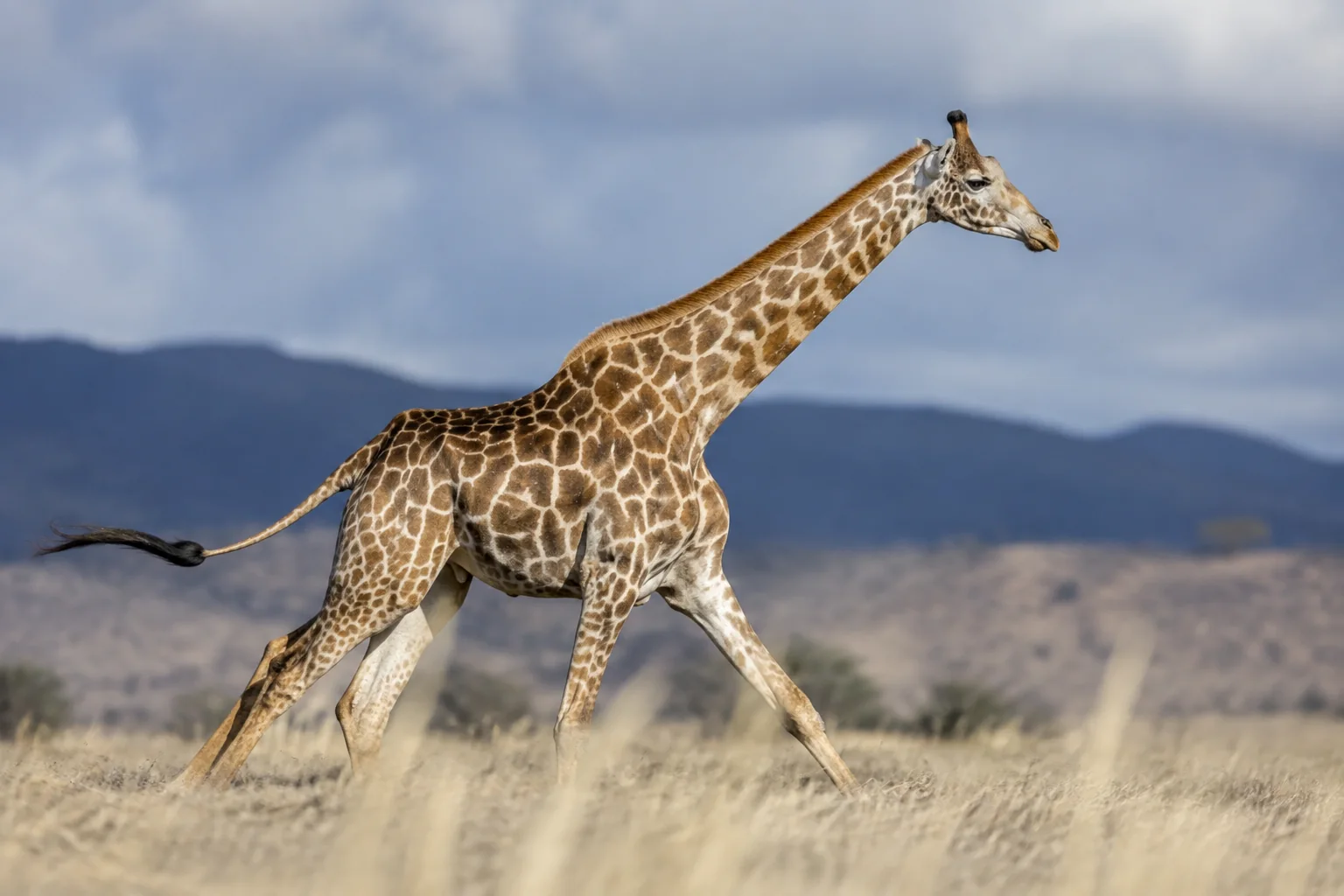
Around midnight, a giraffe herd can become difficult to follow for a very practical reason: it starts moving. For researchers watching from a vehicle, rough terrain may then bring an observation to an end. What looks like the end of a resting period could therefore leave the rest of the night unwritten.
Anna Lena Burger-Schulz, Eric Thiel, Julian Fennessy, Stephanie Fennessy and Paul Wilhelm Dierkes used movement sensors to continue that record. Their study followed three free-roaming Angolan giraffes in Namibia across the hours from evening to morning. The result revealed two recurring windows of greater inactivity, with an active interval between them.
This is a different question from asking how many minutes a giraffe sleeps. Timing shows how rest fits into the night. A short total can conceal a consistent rhythm, and an observation ending at midnight can miss a second resting window entirely.
Staying with the animal after the observer leaves
The team fitted three young adults—one male and two females—with small devices attached to an ossicone, one of the bony projections on the head. The devices included acceleration sensing and position recording. Their analysed nighttime records covered December 2018 through March 2019, with slightly fewer nights for one female after her logger stopped returning data.
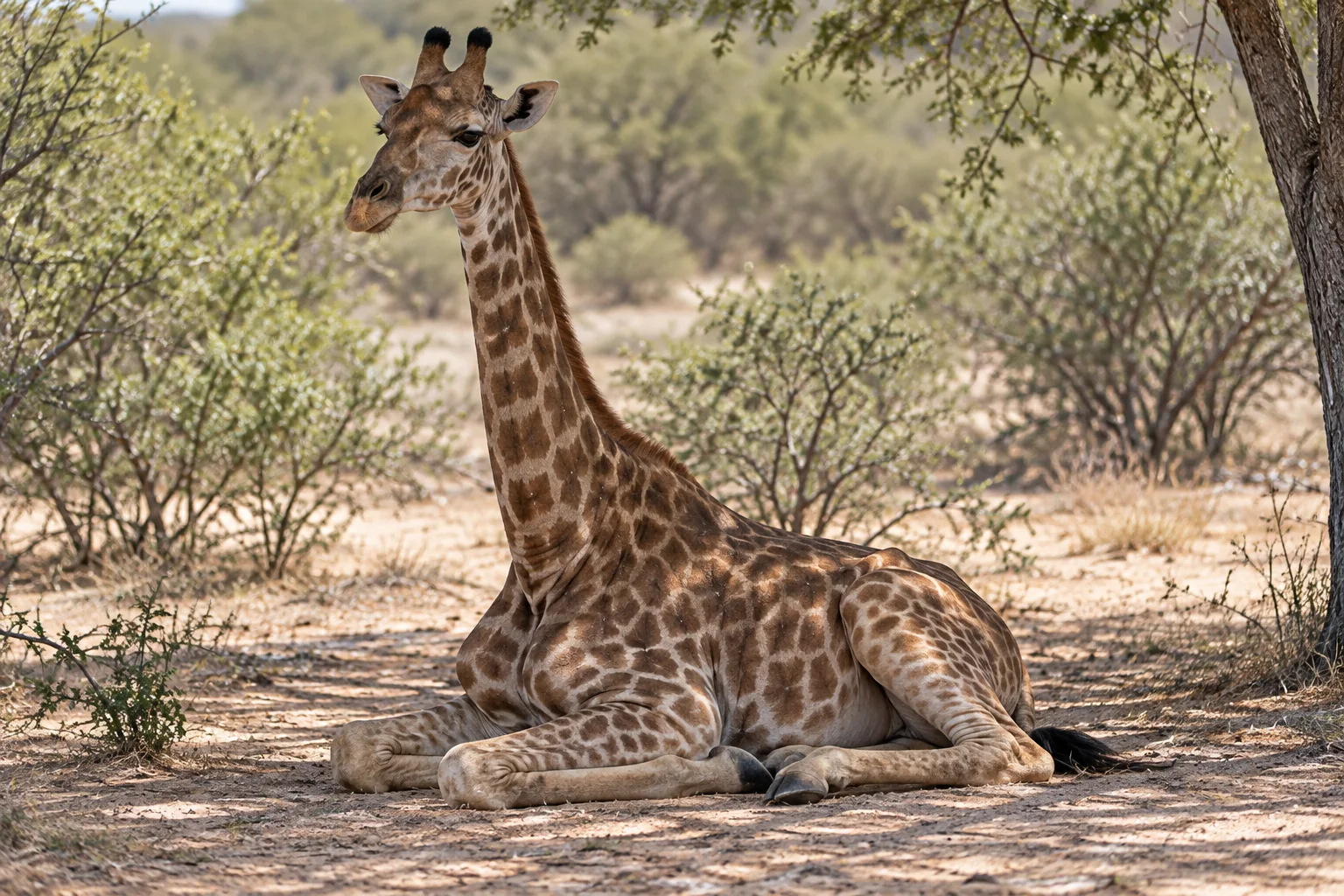
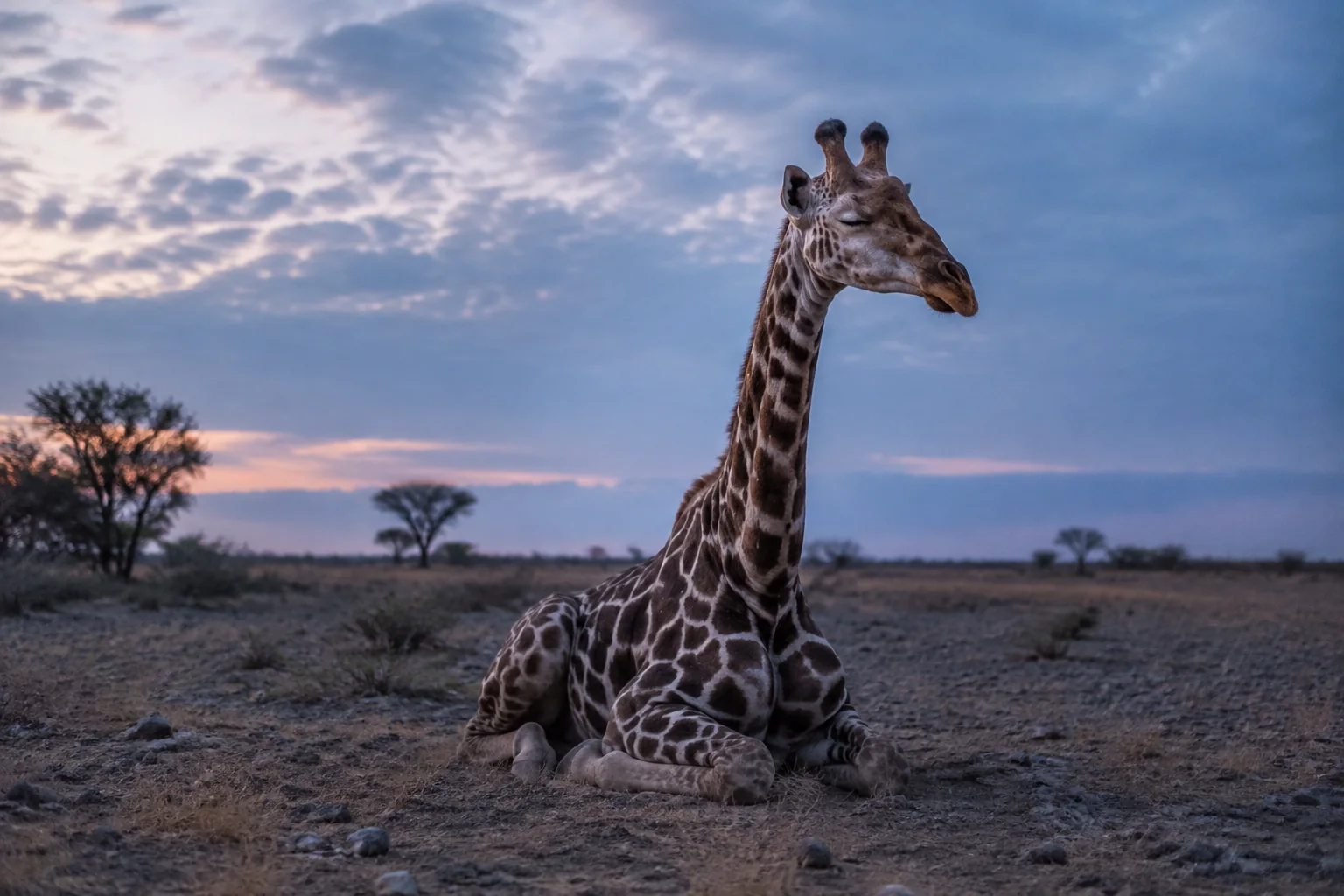
A sensor on the head registers both movement and orientation. Walking and feeding produced changing signals, while standing or lying with little head movement produced steadier ones. A particularly distinctive position occurred when a giraffe lay down, bent its neck backward and rested its head on its flank or the ground.
Researchers call this REM sleep posture because it is associated with a sleep state in which the head needs support. In this study it remained a behavioural indicator. There were no recordings of the brain's electrical activity to verify sleep stages, and ordinary inactivity could include wakeful standing or lying.
The researchers paired sensor records with video and thermal images to check what the patterns represented. Figure 1 follows one animal through changes in posture while the corresponding sensor traces change alongside it. That connection between a visible animal and a numerical record made the later remote observations interpretable.
But the field imposed a tradeoff. Recording once a second drained the battery too quickly to cover a whole night. The researchers reduced sampling to once a minute. That preserved the long record while sacrificing fine detail within it.
Two peaks, rather than two long sleeps
When the team arranged the records by hour, the same broad shape appeared in all three animals. Inactivity was more concentrated around 21:00–23:00 and again around 03:00–05:00. The characteristic head-resting posture was also more frequent in those windows, with a dip around midnight.
Figure 4 plots each giraffe separately. Their curves differ in height, but the earlier and later peaks are visible across the individuals. An analysis of repeating frequencies supported the two-part pattern within the twelve-hour nighttime window.
The peaks do not mean that each giraffe had two uninterrupted sleep sessions. Brief posture events occurred within longer periods of relative inactivity, interspersed with other behaviour. Nor could the available recording rate reliably separate walking from feeding. The midnight rise establishes increased activity, not a demonstrated midnight meal.
The animals also differed. The male had less recorded head-resting posture and lower total inactivity than the females. With just one male and two females, those differences cannot establish a sex difference for giraffes generally. They are individual observations that a larger sample could investigate.
Monthly comparisons found some differences in inactivity but no clear differences in the number or total duration of the recorded head-resting events. That four-month result does not cover a complete annual cycle, and the timing pattern remains evidence from one setting and three young adults.
Why the sampling rule changes the sleep number
To classify a head-resting event, the researchers required the distinctive sensor pattern to persist for at least two minutes. Shorter events were omitted. This rule helped distinguish sustained posture from uncertain brief changes, but it necessarily missed some genuine short bouts.
The reported average of 8.6 minutes per night therefore concerns the head-resting posture detected under that rule. It is not a measurement of total sleep, and it cannot establish a giraffe's minimum sleep requirement. Missing short events also raises the average duration of the events that remain in the dataset.
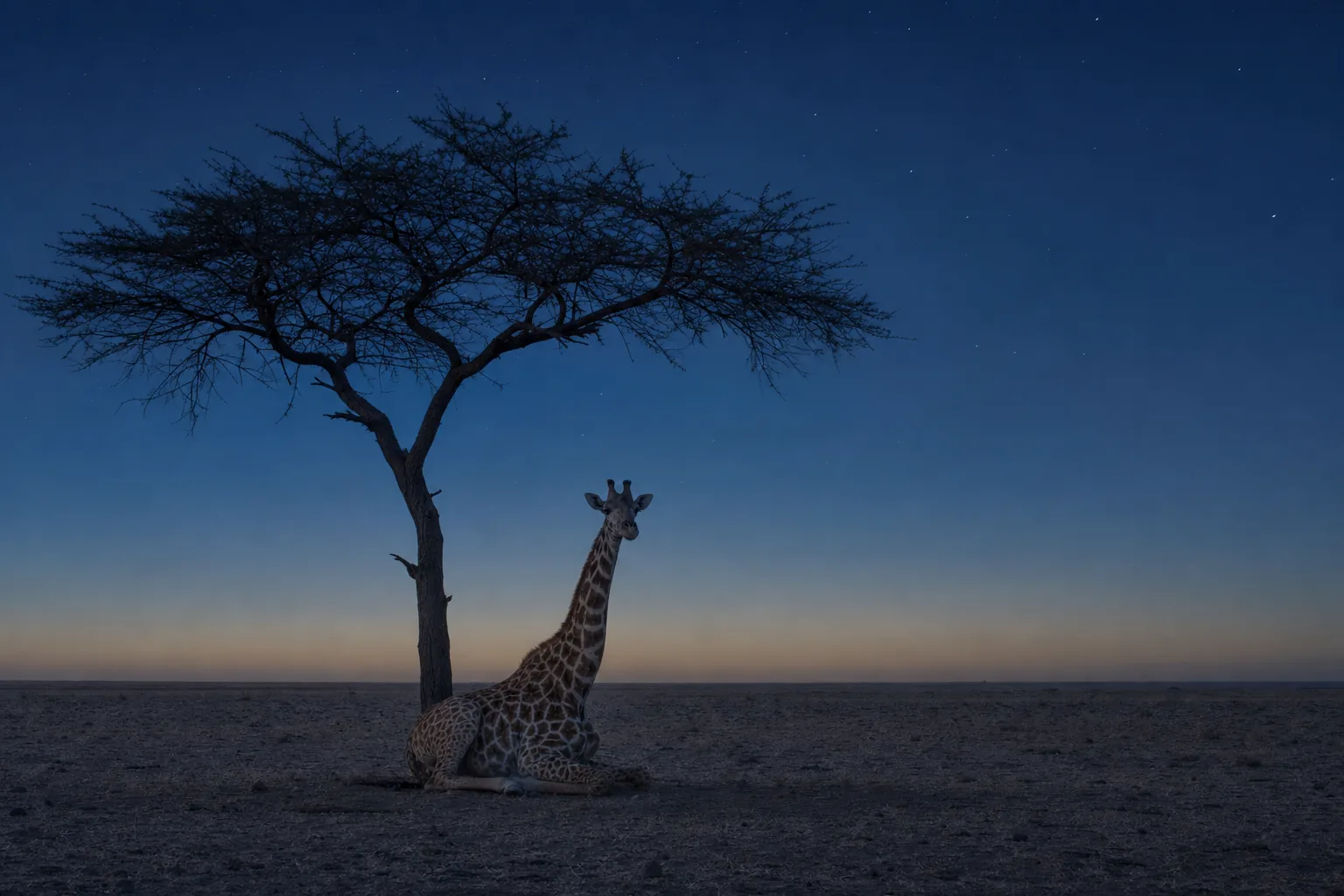
The earlier field study by Anna Lena Burger and colleagues watched group behaviour using thermal and night-vision cameras. Its observations showed giraffes settling after sunset, with some animals remaining active while others lay down or rested their heads. Groups often moved away after several hours, which prevented observers from constructing a full nighttime budget.
The sensor study addresses that missing stretch of time. The earlier cameras, meanwhile, supply social context that three individual loggers cannot fully recover. Together, the methods show why improving coverage and understanding companions are complementary aims rather than interchangeable ways to calculate one sleep total.
A recurring resting rhythm gives researchers a concrete next question: whether disturbance, season or different environments shift those windows or reduce the opportunity to rest within them. The present study did not measure the effects of such disruptions. It established the nighttime pattern against which those future changes could be examined.
Sources
- Burger-Schulz, Anna Lena; Thiel, Eric; Fennessy, Julian; Fennessy, Stephanie; and Dierkes, Paul Wilhelm (2023). “Accelerometry reveals nocturnal biphasic sleep behavior in wild giraffe.” Frontiers in Mammal Science, 2, 1243883. Full paper.
- Burger, Anna Lena; Fennessy, Julian; Fennessy, Stephanie; and Dierkes, Paul W. (2020). “Nightly selection of resting sites and group behavior reveal antipredator strategies in giraffe.” Ecology and Evolution, 10(6), 2917–2927. Earlier group observations.