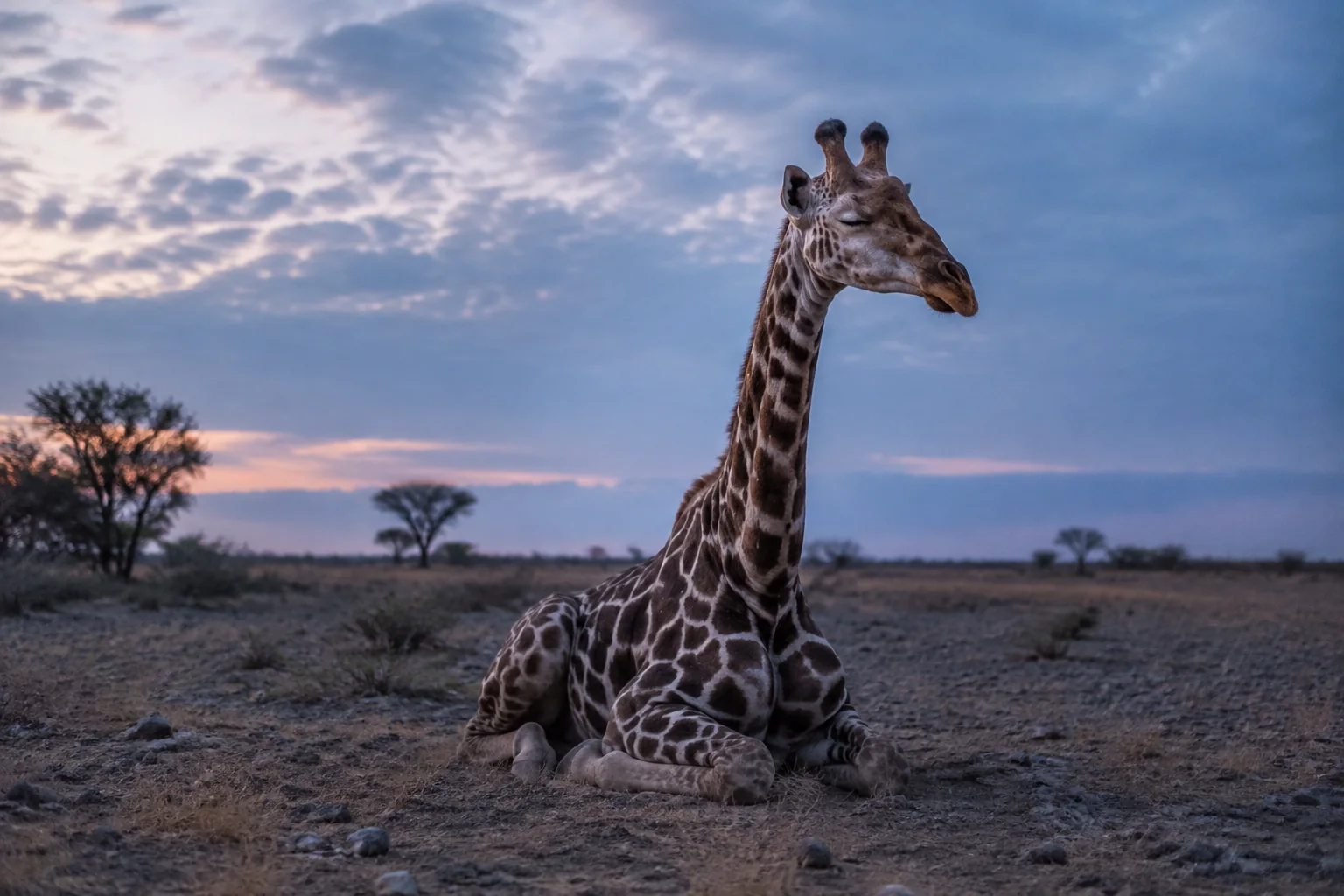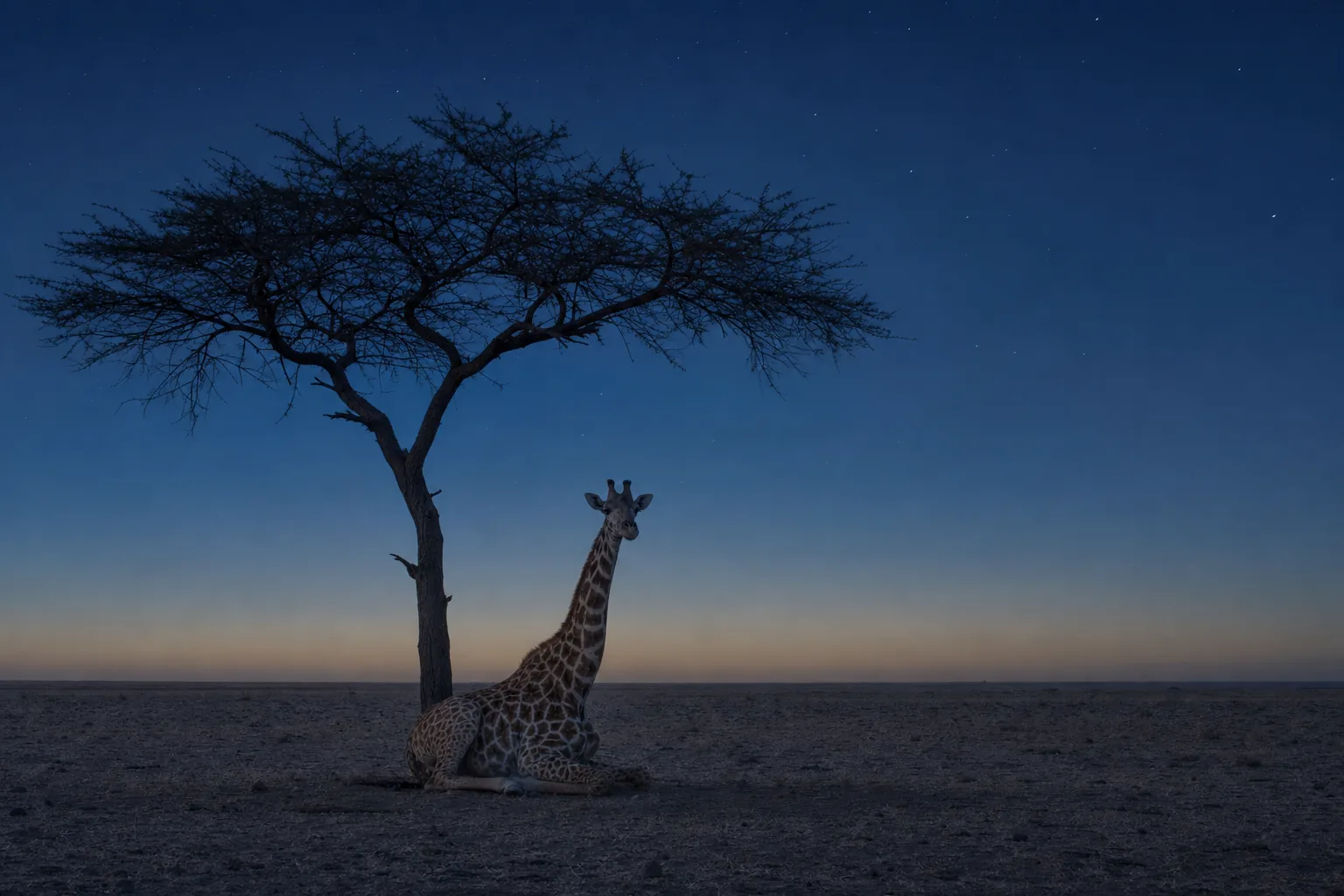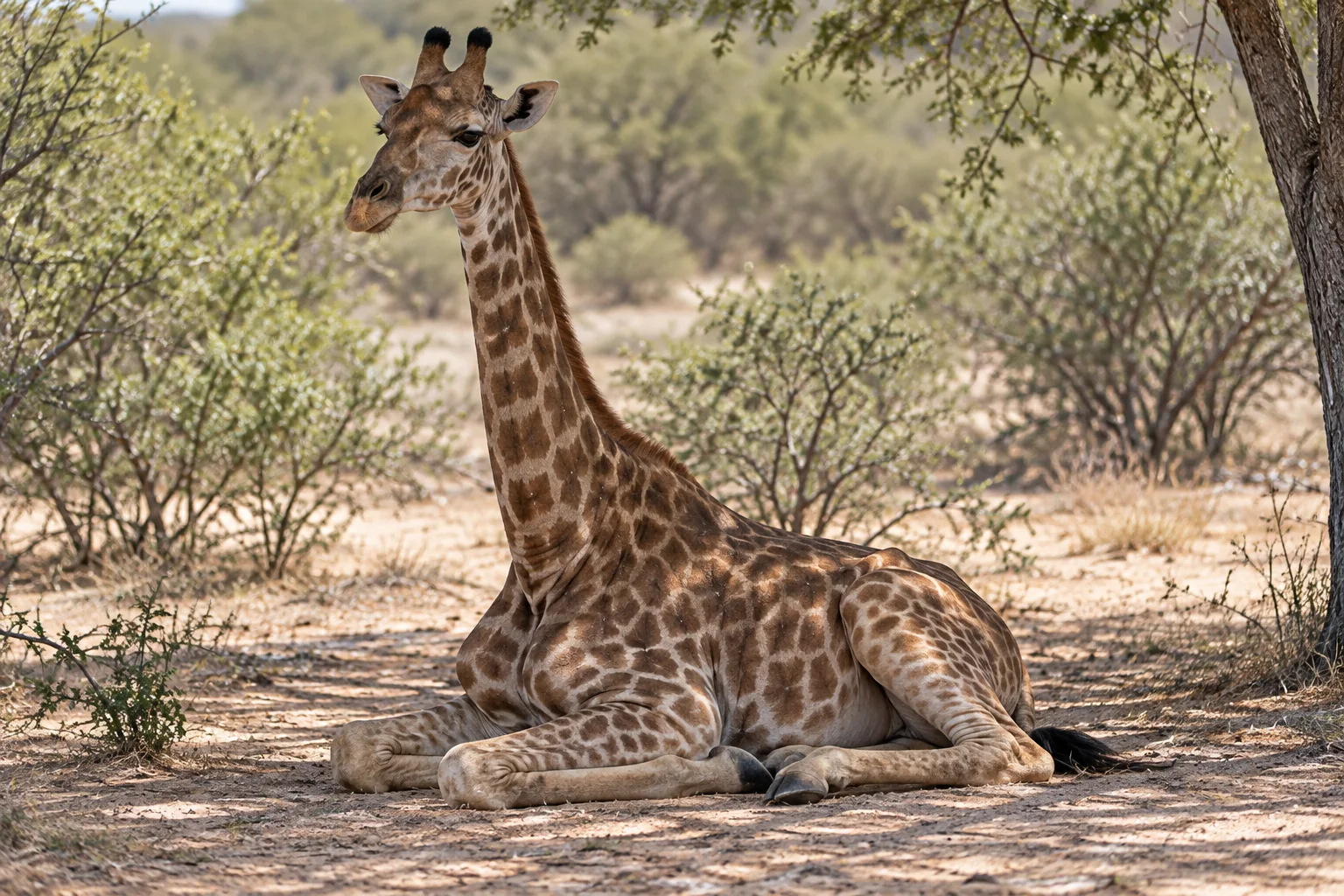
The most exposed member of a resting giraffe group may be the one with its head folded back. To adopt that posture, the animal has lowered its body to the ground and brought its long neck around to rest its head on a flank or the ground. Getting up again is a different task from simply turning to look.
Anna Lena Burger, Julian Fennessy, Stephanie Fennessy and Paul W. Dierkes asked how wild giraffes arrange their nights around that vulnerability. Their 2020 study used thermal imaging and night-vision cameras to watch groups settle in a Namibian savanna setting.
The revealing feature was what happened around a resting animal. Other giraffes often remained active nearby, and the whole group seldom adopted the head-resting posture together. That pattern makes a plausible protective arrangement visible, while leaving an important distinction between having alert neighbours and deliberately organizing sentinels.
Watching a group become still
The team located groups before sunset and followed them to their first resting area. They worked from a vehicle, using thermal cameras to see several animals at once and a night-vision system for closer detail. The two views complemented each other: a broad view exposed the group's arrangement, while a narrower view helped identify posture.
Observations covered 24 nights across dry and wet seasons. They began around twilight and continued after sunset, sometimes toward midnight. Weather, moving animals and inaccessible terrain limited the duration. The study consequently describes the first part of the night rather than a complete nocturnal time budget.
Three categories organized the records. An animal could be active, lying with its neck and head raised, or in the characteristic head-resting posture. The active category included feeding and standing, so activity did not always mean walking around. The head-resting category required the position to last more than ten seconds.
The authors used that posture as an indicator associated with REM sleep. They did not record brain activity, and explicitly acknowledged that the physiological sleep stage had not been demonstrated in these giraffes. Lying quietly with the head up was a separate category; it could not simply be added to a count of confirmed sleep.
Darkness also limited identification. Coat patterns could not reliably distinguish individuals in the thermal images, so some animals probably appeared in records on several nights. The published totals of observed animals should not be read as an independently identified population sampled once each.
A group portrait over three hours
After sunset, groups usually stopped moving and some animals lay down. Others remained standing or feeding nearby. Individuals shifted among the three states rather than taking up fixed roles for the entire observation.
Figure 3 follows thirteen giraffes in one group for three hours. Each animal has its own line, showing when it was active, lying or resting its head. The lines do not fall into the head-resting state together. In this example, at least three animals remained active while others lay down or adopted the sleep-associated posture.
Across the observations, head-resting commonly involved one or two animals at a time; the greatest simultaneous number recorded was three. An animal often entered the posture after another had raised its head again. The researchers also reported a standing giraffe scanning the surroundings throughout observation periods.
These details support the idea that resting animals can have vigilant companions nearby. They do not show that an animal accepted a guard assignment, watched specifically for another's benefit or triggered another giraffe's decision to sleep. A group with individuals on different activity schedules can produce some overlap between rest and vigilance without an organized rota.
A further comparison resisted a simple prediction. Head-resting event duration did not increase clearly with group size. If more companions always allowed a giraffe to remain vulnerable for longer, that relationship might have been expected. Its absence in this dataset helps keep the protective interpretation tied to what was actually observed.
Resting places allowed more than rest
The researchers returned to resting areas in daylight. Imprints in sandy ground helped reconstruct where animals had lain in relation to vegetation and one another. Combined with the night images, those traces showed groups using open areas near scattered trees or sparse low bushes.
Such an arrangement could provide views across the surroundings while keeping browse within reach. Giraffes that remained active often fed, so a site had to accommodate several activities. The study did not compare attack rates across resting-site designs, however, and the area had no free-ranging lions. Predator avoidance is an interpretation of the arrangement, not an experimentally measured benefit here.
The groups also changed resting locations between nights. They did not return to a reliably fixed sleeping site where the team could simply leave a camera trap. Their movement is part of the story: understanding rest requires following both the animals and the setting they select.
A later study led by Burger-Schulz fitted three giraffes with movement sensors and obtained records through whole nights. It found two broad resting windows, one after sunset and another before dawn, with greater activity around midnight. That fills a temporal gap in the camera observations, but three loggers cannot establish the behaviour of every companion around a resting individual.
The two studies therefore point toward a more specific investigation: combine full-night individual records with group observations and compare settings with different predator exposure. The question is no longer merely whether giraffes rest together. It is whether, when and how the activity of particular neighbours makes a vulnerable posture possible.
Sources
- Burger, Anna Lena; Fennessy, Julian; Fennessy, Stephanie; and Dierkes, Paul W. (2020). “Nightly selection of resting sites and group behavior reveal antipredator strategies in giraffe.” Ecology and Evolution, 10(6), 2917–2927. Full paper.
- Burger-Schulz, Anna Lena; Thiel, Eric; Fennessy, Julian; Fennessy, Stephanie; and Dierkes, Paul Wilhelm (2023). “Accelerometry reveals nocturnal biphasic sleep behavior in wild giraffe.” Frontiers in Mammal Science, 2, 1243883. Later whole-night study.