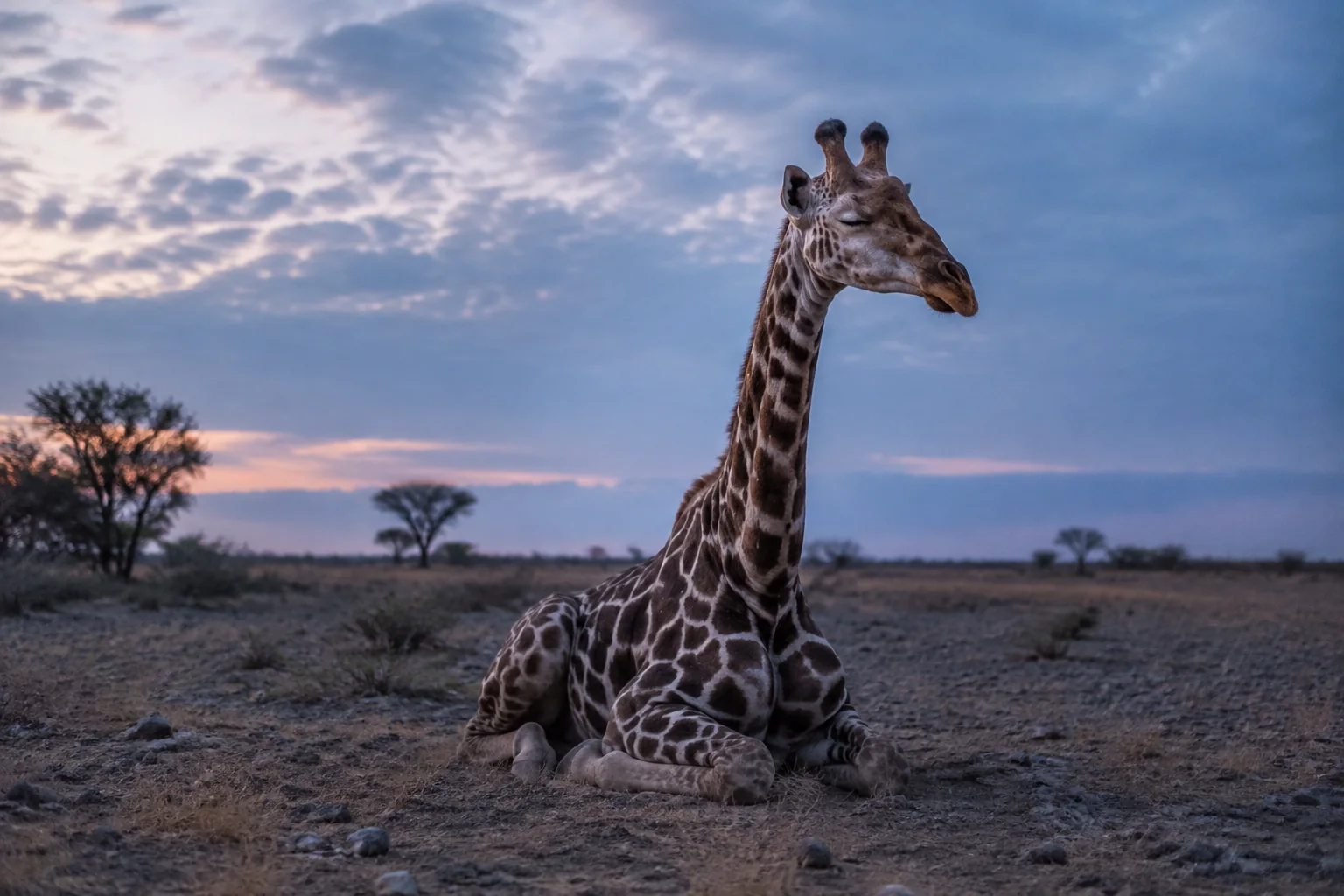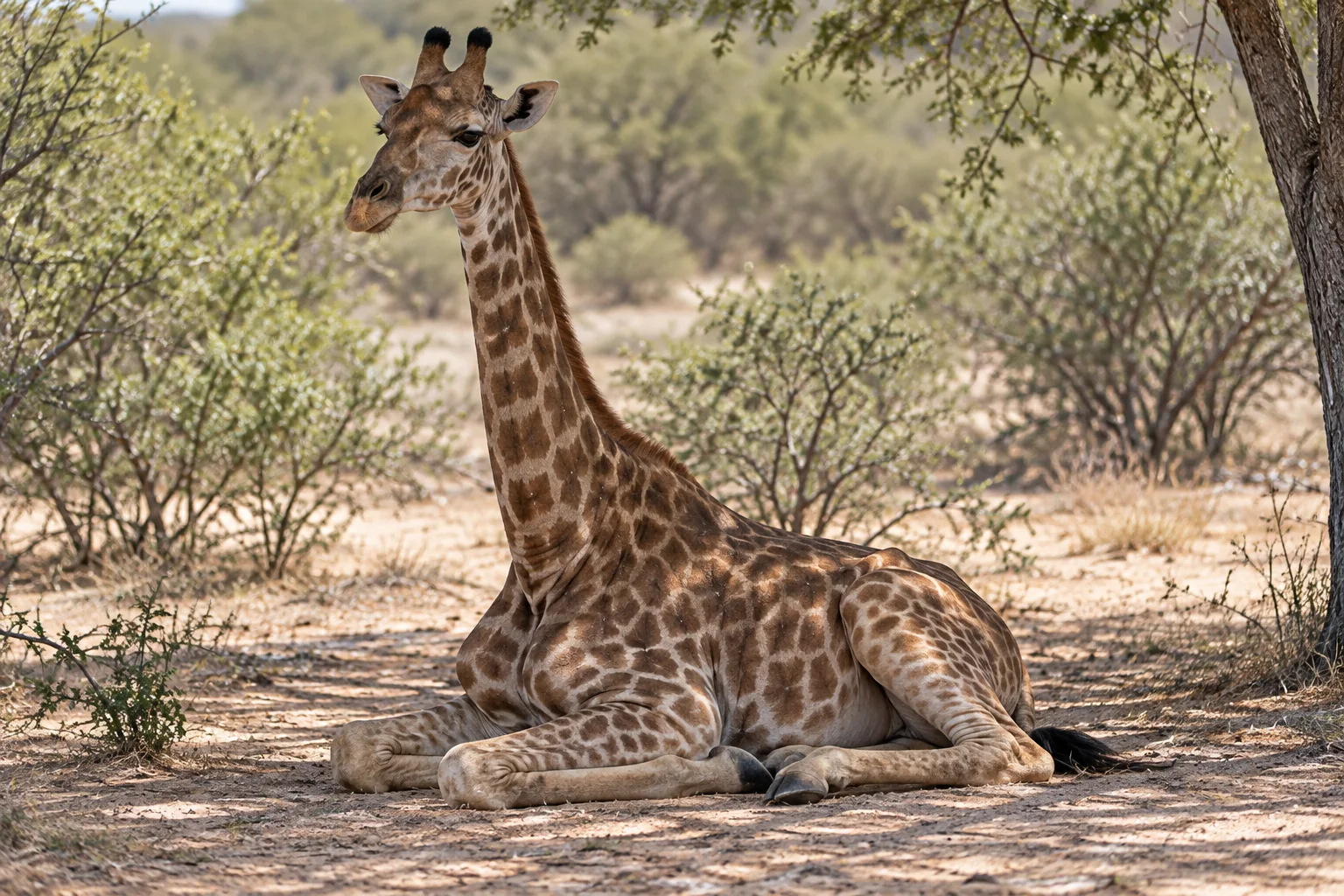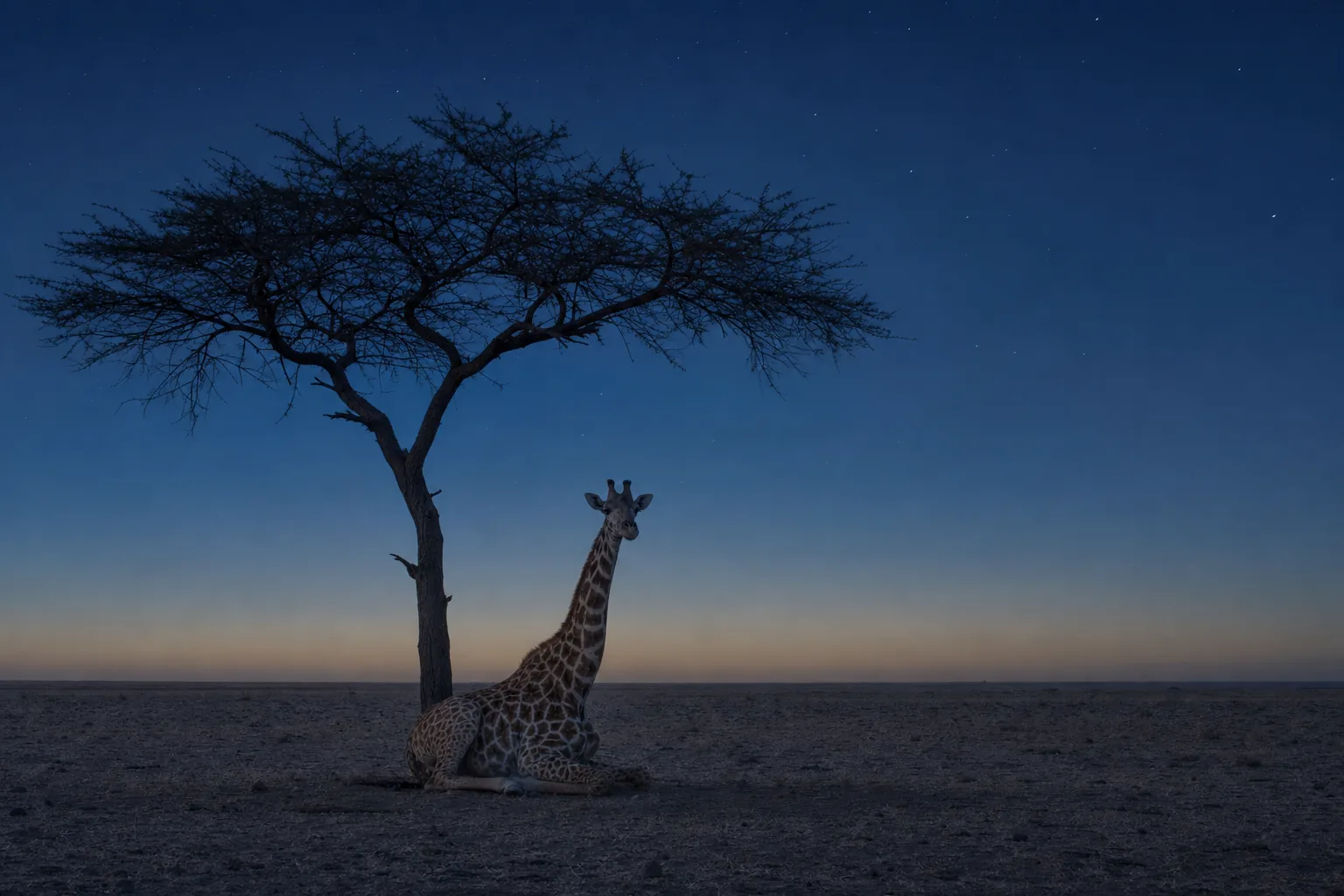
A giraffe lying beneath a tree looks like an animal finally switching off. But is it asleep, resting, or about to get up? That distinction sits behind one of the most confusing giraffe facts: one source says minutes of sleep, another says hours. The real story is more interesting than a record for staying awake—and helps explain what researchers can learn after dark.
Do giraffes sleep standing up or lying down?
Both have been recorded. The familiar head-curled-back position is not the only behaviour researchers count as sleep. Tobler and Schwierin’s zoo observations included standing and recumbent, or lying, sleep. Their study used video and behavioural criteria, rather than treating every motionless animal as asleep. The comparison below links to their original paper.
For the wider animal, start with our giraffe facts guide. Here the focus is narrower: posture, time, and the nighttime evidence. The giraffe behaviour guide introduces the social setting around those individual observations.
Resting is a description; sleep needs a definition
If you take a photograph of a lying giraffe, you have recorded a body position at one moment. You have not recorded the preceding hour, the next movement, or the animal’s responsiveness. Even a sharp photograph leaves those questions open.
This is why a caption such as “giraffe resting with its head upright” is more defensible than “giraffe in deep sleep” when the image alone supplies the evidence.
How much do giraffes sleep? Read the numbers correctly
There is no single daily allowance established for every giraffe. The following figures are useful precisely because their labels are different.
| Published research | Reported result | What the figure describes |
|---|---|---|
| Tobler and Schwierin, 1996; zoo observations | About 4.6 hours per 24 hours | Total behavioural sleep; juvenile excluded from this total |
| Burger-Schulz and colleagues, 2023; three Angolan giraffes in Namibia | About 8.6 minutes per night | Characteristic sleep-position time inferred from head movement |
| The same 2023 field study | About 490.8 minutes per night | Inactivity, not a claim that all this time was sleep |
Sources: 1996 behavioural sleep study and 2023 field accelerometry study. The latter’s nighttime window was 19:00–07:00, and its method excluded sleep-posture events shorter than two minutes. These are study results, not competing measurements of an identical quantity.
Why “only minutes a day” can mislead
A total and one component of that total answer different questions. Think of an imaginary observation sheet with separate columns for lying, head position, and movement. Adding one column does not automatically give the sum of every sleep state. Nor can a nighttime observation establish a whole day without information about the remaining hours.
The mistake is not necessarily in a published number. It can appear when a summary drops the words identifying what was measured. “Per night” becomes “per day”; “sleep posture” becomes “all sleep”; a study average becomes a rule for every animal. Keeping the label is as important as keeping the decimal point.
What does a sleeping giraffe look like?
In a 2024 camera study at Opel-Zoo, Germany, researchers distinguished lying with the head upright from a brief head-supported posture associated with REM sleep. REM means rapid eye movement. During that posture the long neck turns back so the head can rest, rather than remaining held high.
The three female reticulated giraffes were observed around the clock for roughly three weeks. Lying bouts were interrupted by other activities, especially feeding. The open-access study and its figures show why a nighttime activity record is more informative than one still image.
A posture is not a brain recording
The study describes recognisable behaviour from cameras. That is not the same measurement as electrical brain activity. Calling a posture “REM-sleep posture” preserves this distinction; casually replacing it with “scientists measured deep sleep” does not.
For readers examining a study figure, first check its legend. Which colour means lying? Is another colour reserved for sleep posture? Are gaps periods when the animal was out of sight? An unobserved period should not silently become either waking or sleeping time in your interpretation.
Where do wild giraffes rest at night?
Field observations at Okapuka Ranch in Namibia offer a more specific answer than “somewhere safe.” Burger and colleagues followed 77 giraffes across 24 nights in two seasonal observation periods. Resting sites included open places with individual trees or sparse bushes, combining visibility with some shelter. The study used night-vision and thermal equipment.
At resting sites, some animals remained alert while others lay down or adopted the characteristic sleep posture. Simultaneous sleep-posture events were rare. The researchers interpreted the pattern in terms of possible protection against predators. Their 2020 resting-site study documents these observations.
That does not establish a formal guard rota, with one giraffe assigned a shift. Nor does the study identify one ideal sleeping site for all giraffes across Africa. Vegetation, visibility, and social context belong in the explanation without turning a local finding into a universal rule. The habitat and range guide provides the larger geographic picture.
Do calves sleep differently from adults?
Age deserves attention. A 2020 study recorded 63 giraffes at 13 European zoo institutions using infrared-sensitive cameras. Younger age classes spent more time in the REM-sleep posture than adults, while nighttime activity increased with age. Recordings covered winter observation periods, from late afternoon to the following morning.
The age-and-nighttime-activity study is stronger evidence for age-related differences than an appealing photograph of a curled-up calf. It does not supply one universal number for how long every wild newborn sleeps. Our baby giraffe guide covers the broader early-life questions.
Compare like with like before drawing a conclusion
“Young” can describe more than one developmental stage. A study’s juvenile or subadult category should not automatically be renamed “newborn.” Likewise, an observed association with age does not show that birthdays alone cause each difference.
For a classroom comparison, ask students to identify the animals, setting, behaviour, and recording window before discussing the result. Those four details reveal whether two claims are really addressing the same question. The kids’ facts and worksheet offer a starting point for practising this kind of evidence reading.
How scientists turn a quiet night into data
The work starts before a researcher presses record. A behaviour must have a definition that another observer can apply. Otherwise, one person’s “rest” can become another person’s “sleep,” creating disagreement in the data even if they watch the same animal.
Seeber, Ciofolo and Ganswindt developed a giraffe ethogram, a catalogue of defined behaviours, using published work and observations of wild and captive giraffes. Their 2012 behavioural inventory addresses this need for consistent terminology. It is a framework for observation, not another daily sleep estimate.
Imagine designing a small observation exercise using existing footage. Before starting, write down exactly what qualifies as standing, lying, feeding, and out of view. Decide whether you are recording the behaviour at regular moments or timing each complete event. Then keep that rule unchanged through the exercise.
The resulting record can answer a modest question: what was visible during this footage under these definitions? It cannot establish the giraffe’s whole-day sleep requirement. That boundary makes the exercise useful, rather than disappointing. It shows how an observation becomes evidence and where a fresh measurement would be needed.
The research library helps locate original papers. Check methods and figure captions alongside the abstract, especially when the headline contains a striking time estimate.
What to remember
Giraffes do sleep, but the most memorable number is not necessarily the most useful answer. Preserve the distinction between an animal’s posture, a period of inactivity, and a study’s definition of sleep. Keep the place, age group, and recording window attached to the result.
For an accurate short explanation, say: giraffes sleep in bouts; research has recorded standing and lying sleep, and different studies count different aspects of it. Avoid presenting either “only minutes” or one hourly total as an unqualified rule.
Knowing more about nighttime behaviour adds depth to the conservation story; it does not by itself prove a population trend or tell us how many giraffes remain. Those questions require different evidence, explained in our giraffe population guide.
Frequently asked questions
Can giraffes lie down? Yes. Lying behaviour appears in both zoo and field observations. Being tall does not prevent a giraffe from resting on the ground.
Do giraffes sleep for just a few minutes a day? That is not a reliable blanket statement. A brief total for a particular posture is not necessarily total sleep across 24 hours.
Are giraffes with their heads upright always awake? A still image alone is not enough to establish a sleep state. Researchers use defined behavioural criteria and observations through time.
Do giraffes take turns guarding sleepers? Researchers have seen alert animals while others rest. A fixed, organised shift system goes beyond what that observation establishes.
Can you tell whether a giraffe is dreaming? Not from the observations summarised here. A posture associated with REM sleep does not reveal an animal’s subjective experience or the content of a dream.
Sources
The six linked primary papers support different parts of the explanation: total behavioural sleep, field movement measurements, around-the-clock zoo observations, Namibian resting sites, age-related activity, and a standardised behaviour inventory.
The comparison table is our synthesis, not a pooled estimate or reanalysis of raw observations. We have deliberately not averaged its figures. Follow the individual papers to inspect their methods and original results; this guide does not reproduce their full text or research images.