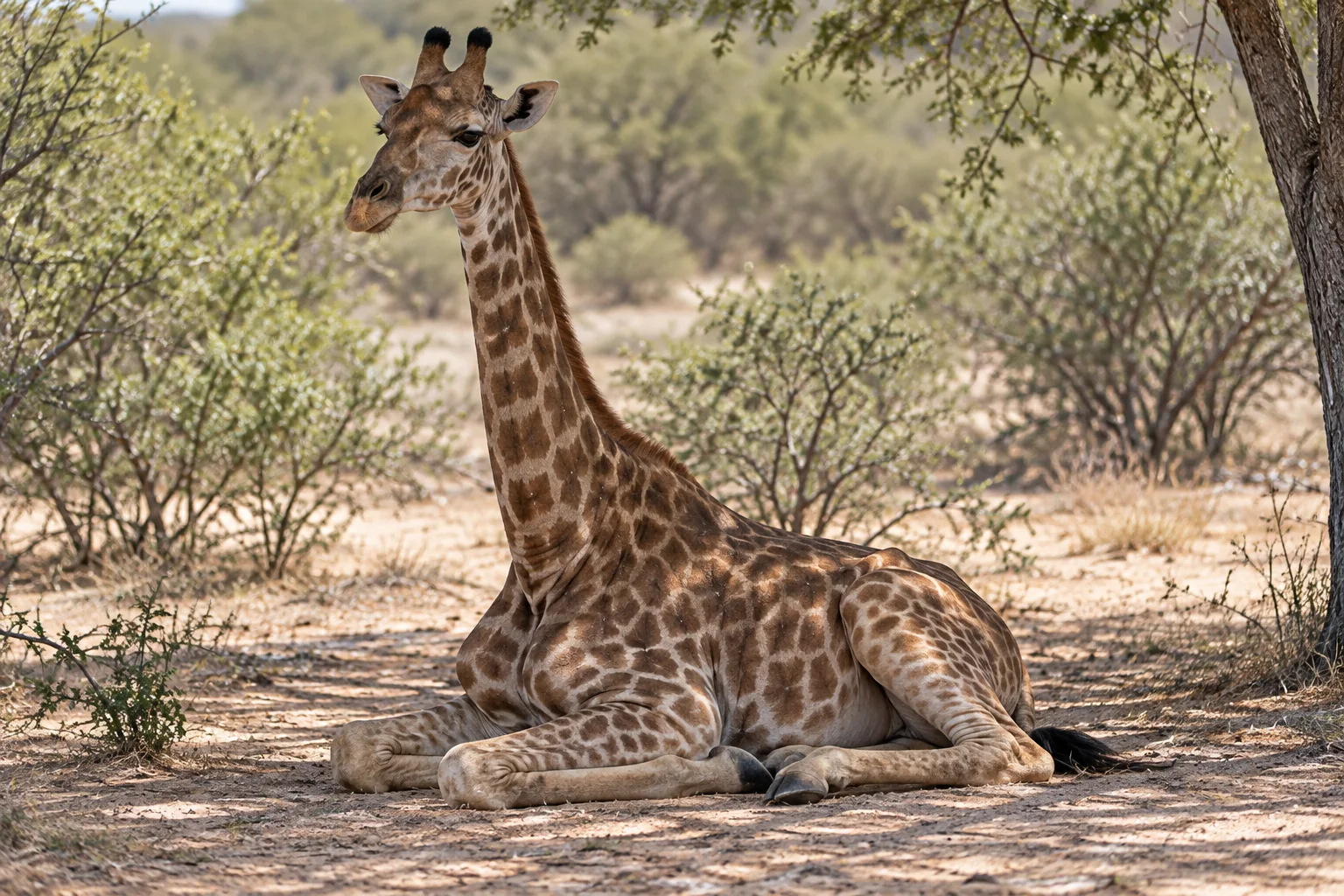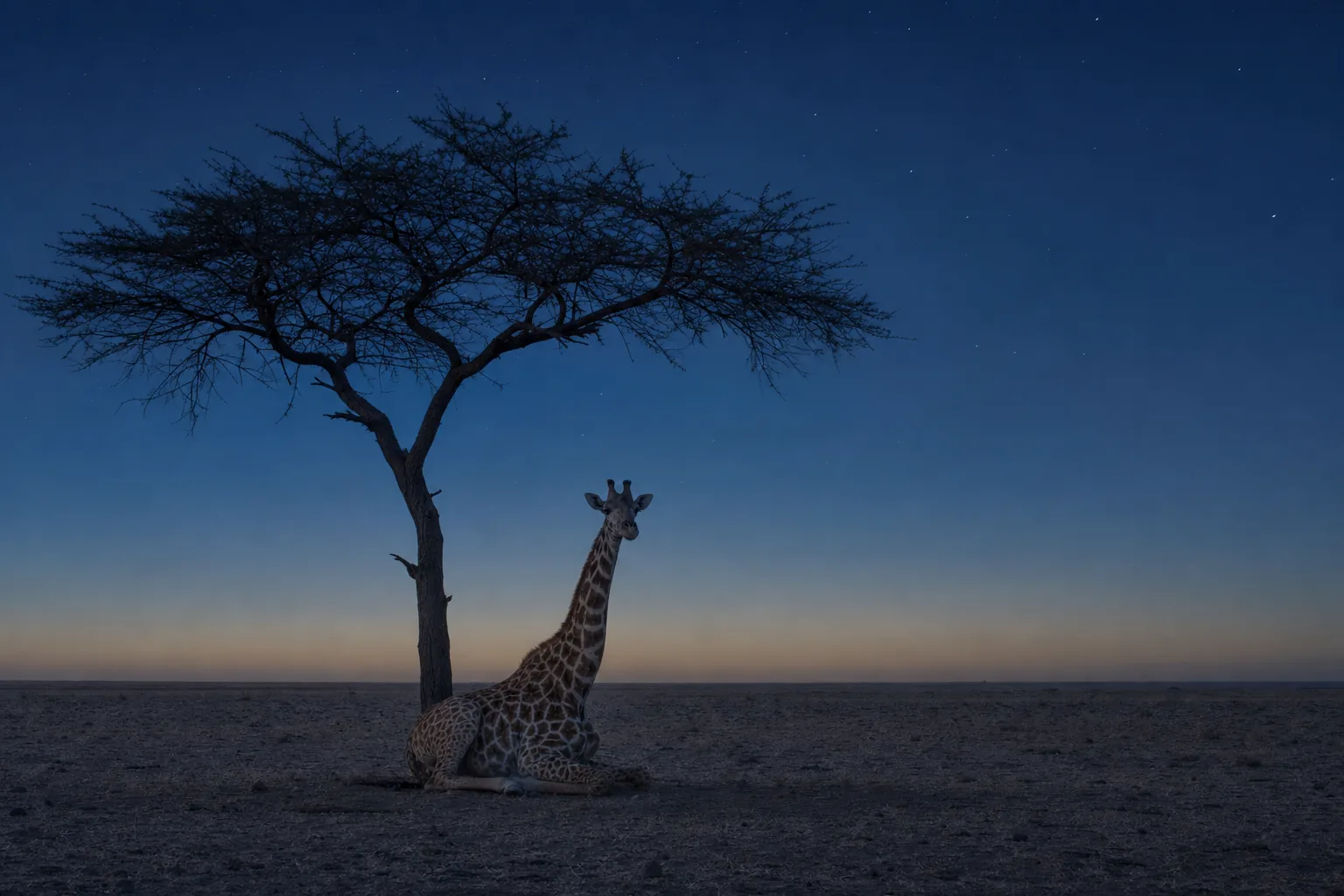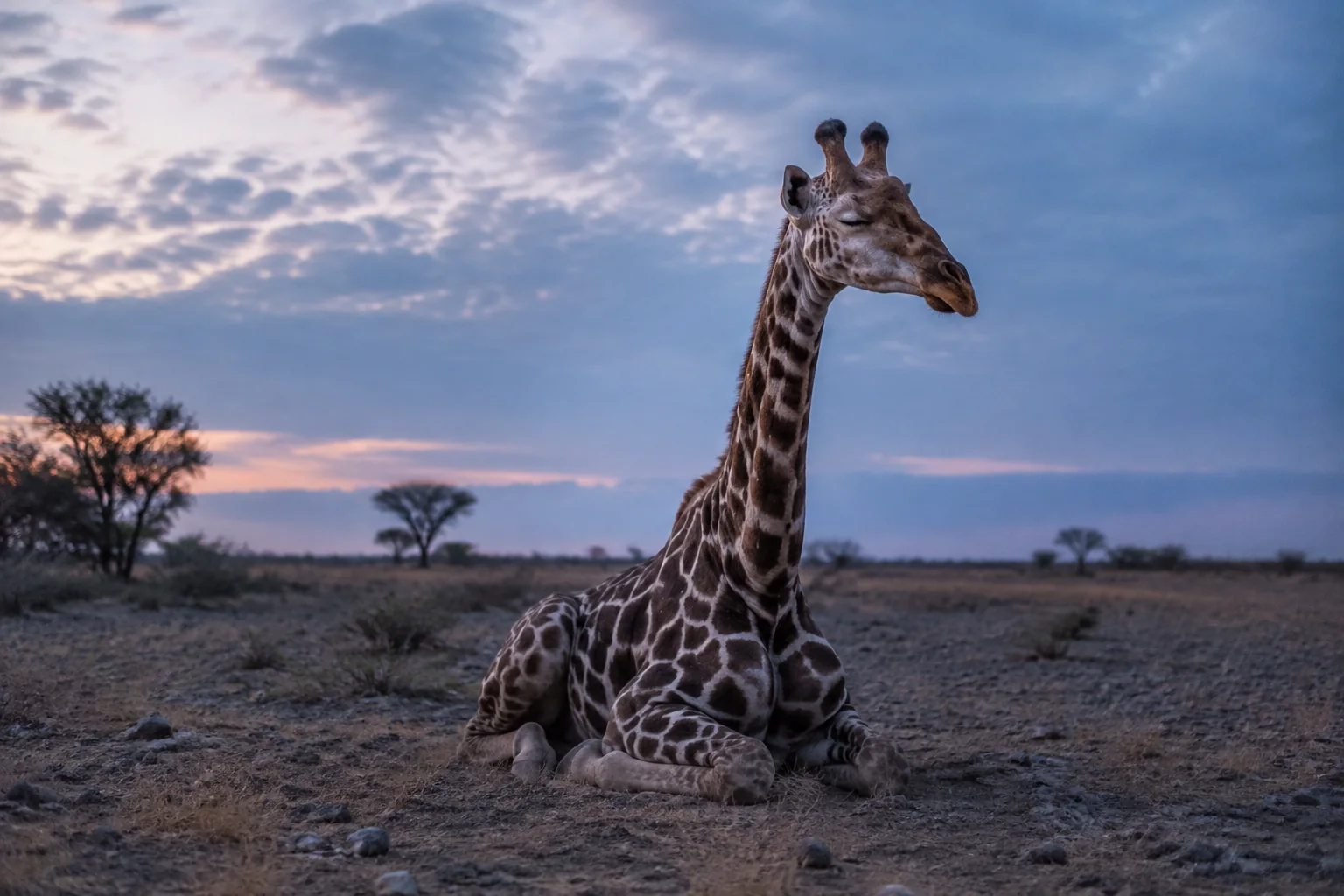
The same move outdoors gave two giraffes different nights. One adult female remained lying down for longer stretches and often chose grass. The other had shorter lying bouts than indoors and frequently settled near a companion.
Miho Saito, Masayuki Matsunaga, Hiroki Fukuizumi and Masayuki Nakamichi documented those differences in a 2024 Kyoto City Zoo study. Their question was practical: what happens when giraffes that normally spend nights inside instead remain in a larger outdoor enclosure? The answer depended on which animal was being watched and which feature of resting was measured.
More ground, different surfaces
The two females' indoor space measured about 100 square metres. The large outdoor enclosure covered roughly eleven times that area, with sand and patches of grass. Both settings provided food, so the comparison concerned a collection of housing differences rather than simply the presence or absence of feed.
The study compared eighteen indoor nights recorded in 2020 with thirteen outdoor nights in 2021. A storage-system failure prevented the intended same-year indoor comparison. Between those periods, the younger female also gave birth, changing the social setting. The calf accompanied the females outdoors at night; the adult male did not.
These details rule out treating the result as a clean experiment in which surface alone changed. Weather, year, age, social composition and enclosure conditions accompanied the move. The researchers could identify contrasting patterns, but not assign each pattern to one cause.
The animals also could not freely move between indoors and outdoors during the studied outdoor nights. Choosing a grassy resting place within the enclosure was a genuine local choice; it was not evidence that a giraffe preferred outdoors over an available indoor alternative.
A lying bout is not a night's sleep
The cameras recorded when a giraffe lowered its body to the ground and when it stood again. The interval between those events was a lying bout. Image resolution did not permit reliable identification of the small eye or ear movements needed to distinguish sleep stages, so the authors deliberately described sleep-related behaviour.
Outdoors, motion-triggered cameras produced short recordings rather than an uninterrupted view from every position. The researchers inferred that the animal remained lying in the gaps between an observed start and end. Bouts with missing endpoints or interruptions by another animal were excluded from duration analysis.
The measurements therefore concern the length of observed bouts, not total sleep per night. Longer bouts could mean more sustained rest, but total time down also depends on how often an animal lies. Neither sleep depth nor brain activity was measured.
For the older female, average bout duration rose from about 139 minutes indoors to 158 outdoors. The younger female showed the opposite direction, from roughly 96 minutes to 82. Both within-female differences were reported as statistically significant.
The oldest animal already had longer bouts indoors, so the outdoor pattern did not create that individual distinction from nothing. Her frequent use of grass suggests that surface comfort could have contributed to longer bouts outside. It remains an explanation rather than a controlled test of grass against stone or sand.
Companions were part of the resting place
The sequence of settling also changed. The older female was usually the first of the pair to lie down outdoors, while the younger female more often initiated lying indoors. Outdoors, the younger female frequently lay within two body lengths of the older female or the calf.
Those observations make social surroundings relevant to any interpretation of the housing change. An animal can respond to extra space by choosing where to be in relation to someone else, rather than simply spreading farther out.
The authors discuss familiarity and temperament as possible explanations, but the study did not experimentally separate companions or measure a feeling of reassurance. Nearby resting is evidence of proximity. Whether proximity caused greater comfort would require another comparison.
Broad space use can conceal repetitive movement
The researchers also divided the outdoor enclosure into eleven unequal zones and recorded where each giraffe was during daytime and night-time observations. A space-use index summarized how unevenly the animals distributed their time, allowing for different zone areas.
That index did not clearly differ between day and night for each animal. Resource areas such as feeding and drinking places remained important. Yet the younger female supplied a warning against reading broad space use as an automatic welfare improvement: she paced in large circles that crossed several zones.
Repeatedly walking the same circuit can produce a relatively even distribution across an enclosure. A score describing locations does not reveal whether the animal reached them while browsing, exploring or pacing. The behaviour attached to a position matters as much as the position itself.
A separate visitor-perception study found that people distinguished the apparent adequacy of giraffe space from the adequacy of the social group. That work measured human impressions, whereas the Kyoto cameras followed the animals. The connection is useful for explaining why neither an enclosure's appearance nor one summary of space use settles the resting question.
The Kyoto findings support monitoring individuals as night housing changes. They also point toward a stronger next comparison: offering indoor and outdoor access at the same time, recording complete nights and tracking which surfaces and companions each giraffe selects. Extra space creates options; the animals' use of those options is the evidence needed to understand its benefit.
Sources
- Miho Saito, Masayuki Matsunaga, Hiroki Fukuizumi and Masayuki Nakamichi (2024). “Effects of nocturnal outdoor enclosure access on space use and sleep-related behaviour in captive giraffes.” Journal of Zoo and Aquarium Research 12(3), 154–163. Full paper.
- Wilson C. Sherman, Darren E. Minier, Caterina N. Meyers and Michelle L. Myers (2022). “The More the Merrier? Zoo Visitors’ Affective Responses and Perceptions of Welfare across an Increase in Giraffe Density.” Journal of Zoological and Botanical Gardens 3, 289–299. Full paper.