A warning is useful only if an animal pays attention. But attention has a cost: a giraffe that stops eating to look for danger gives up feeding time, even when nothing attacks. The problem is therefore more subtle than whether a giraffe can hear an alarm. How much of its meal should it interrupt for a warning from another species?
Anton Baotic and Georgine Szipl investigated that question through playback experiments with wild Southern giraffes. Their 2025 study found that red-billed oxpecker alarms prompted giraffes to interrupt feeding and become watchful. The response lasted longer in the study area where lions lived. That contrast opens a window onto how giraffes might adjust their attention to the danger around them.
A bird’s alarm adds something eyes alone cannot supply
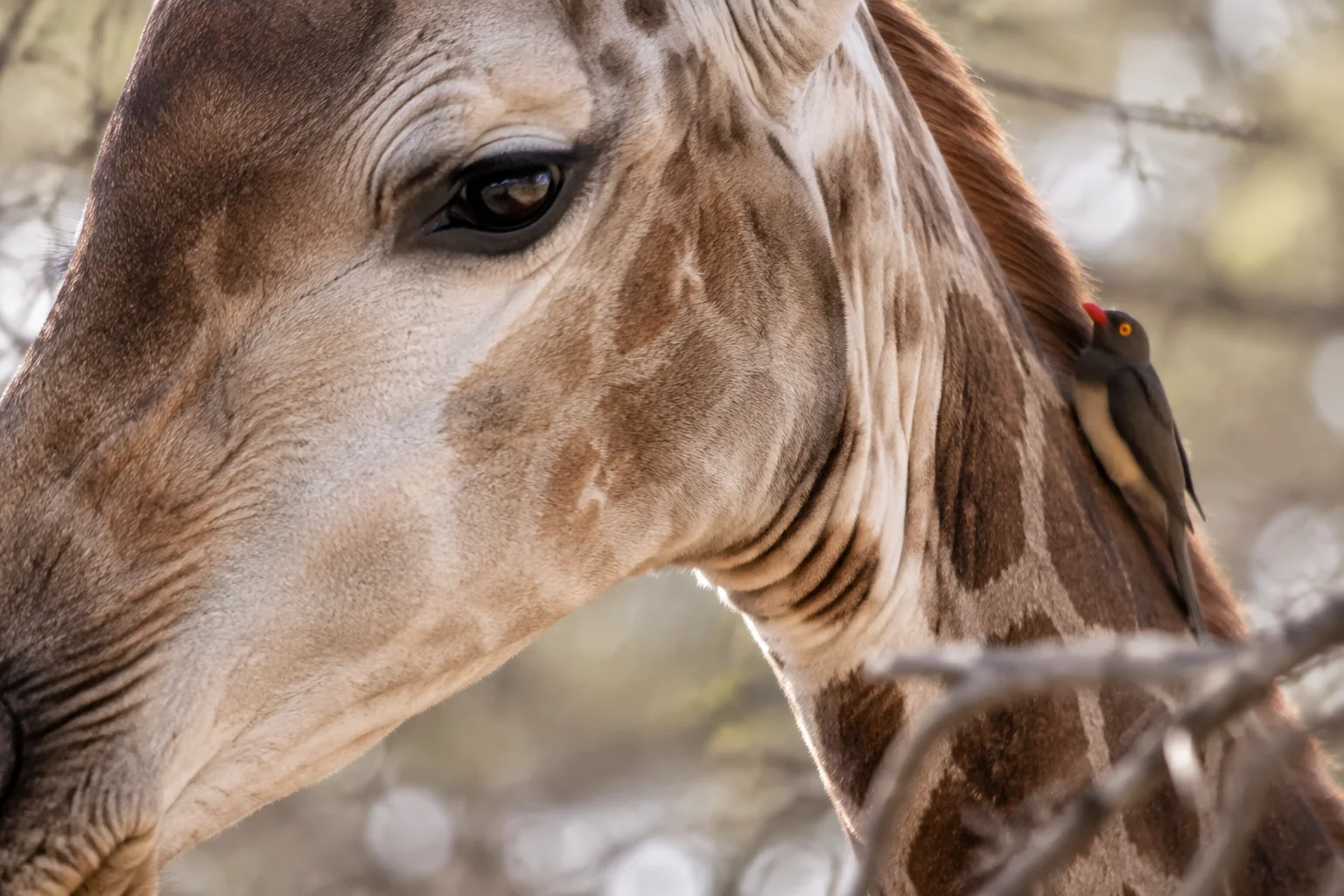
Red-billed oxpeckers are the small birds often seen clinging to large African mammals. Giraffes provide places to perch and find food, including parasites on their skin. This close association also puts giraffes within hearing distance of the birds’ calls.
Oxpeckers can give harsh alarms when disturbed, including when people approach. A giraffe need not have seen the disturbance itself to use the sound as a reason to look. Scientists call this eavesdropping: one species obtains information by listening to another. It does not require the caller to be deliberately warning the listener.
For a giraffe, the potential advantage is an earlier opportunity to inspect its surroundings. Even an elevated view cannot guarantee that every threat has been detected. Lions can prey on giraffes, so another animal’s reaction could provide useful additional information.
Yet noticing that a giraffe looks up when an oxpecker calls leaves a difficulty. Both animals might have seen the same approaching threat. To show that the sound itself changes the giraffe’s behaviour, the researchers needed to present the call separately from the event that originally produced it.
A hidden speaker separates the warning from the disturbance
Baotic and Szipl worked in South Africa’s Limpopo Province during July–September in 2023 and 2024. Their sample comprised 53 individually identified Southern giraffes in seven reserves. Five neighbouring reserves formed one research area; two more reserves each formed a separate area. Only one of those three areas contained lions.
Oxpeckers occurred throughout the study areas and were regularly seen on giraffes. The comparison therefore involved animals already living around these birds. It was not a contrast between giraffes familiar with oxpeckers and giraffes hearing them for the first time.
Baotic collected field recordings and conducted the playbacks. A hidden speaker broadcast a short sequence of either oxpecker alarms, ring-necked dove coos or African black-headed oriole calls. All three birds occurred locally. The dove and oriole recordings were ordinary, non-alarm calls: they helped reveal whether a giraffe responded to any familiar bird sound or particularly to the oxpecker alarm.
Trials began with a giraffe calmly feeding at a tree or bush, with no other giraffe within 25 metres. The focal animal had no oxpeckers perched on it, and the researchers avoided trials with calls from the study birds audible nearby. These choices reduced the chance of a live bird or a close companion supplying an extra warning. Sound types were presented in varying order, and each valid trial included an oxpecker sequence and at least one control.
The researchers then watched the videos in detail. Did the giraffe stop feeding, turn its head and neck towards the speaker, direct its ears forwards or scan its surroundings? How long did those behaviours last? Baotic and Szipl’s analysis accounted for the different recordings played to the same individual, rather than treating each playback as a new giraffe.
This is a different question from what sounds giraffes themselves make. Here, the evidence comes from what a listening giraffe does after another species calls.
An interruption that could be measured
The oxpecker recordings produced a marked change. Across the recorded trials, interruptions to feeding averaged about 13 seconds after oxpecker alarms. No feeding interruptions were recorded during the dove or oriole controls. Giraffes also spent more time facing the sound, holding their ears forwards and scanning after the alarms. These figures describe behaviour during the playbacks, not a daily loss of feeding time. The paper’s supplementary tables give the underlying measurements.
Several of those actions occur together. A giraffe can point its ears forwards while turning its head and keeping its mouth away from the leaves. Adding the durations would count some seconds more than once. Instead, the researchers combined the linked measurements into a score representing the overall vigilance response. Higher scores meant longer durations of this related set of watchful behaviours.
The score was higher for oxpecker alarms than for either control. That is the experimental finding: changing the sound changed how the giraffes divided their time between feeding and vigilance.
The next comparison concerned where they lived. At the reserve with lions, giraffes showed stronger, more sustained vigilance after oxpecker alarms than in either lion-free research area. Responses to the ordinary bird calls remained low across areas. The difference was associated specifically with the alarm response, rather than appearing as a stronger reaction to every sound.
Starting to look and continuing to look are different decisions
An animal can react to a sound quickly but return to its meal almost immediately. Another can begin at the same speed and keep watching. The study separated these two aspects of a response: the delay before the first reaction, called latency, and the duration of the vigilance that followed.
Oxpecker alarms elicited initial responses that were largely absent during the control playbacks. The researchers’ latency analysis did not detect a difference between the three areas. The geographic contrast concerned sustained vigilance: giraffes at the lion reserve continued responding for longer.
That distinction gives the result its biological meaning. Living around greater danger might change how long it is worthwhile to keep checking after a warning, even if the cue already attracts attention elsewhere. Baotic and Szipl suggest that experience with predation could help giraffes adjust this balance.
The experiment changed the calls; it did not assign giraffes to different predator histories. Only seven of the sampled giraffes came from the single lion-inhabited reserve. That reserve also differed in other ways, and field approaches there used a vehicle for safety. The study therefore associates sustained vigilance with the lion-inhabited setting without isolating learning as its cause. All study populations already encountered oxpeckers, so a response in a lion-free area also cannot establish that recognition is inborn.
Does the roughness of the call help hold attention?
The calls differed in sound as well as biological context. Oxpecker alarms were harsh and spread energy across a broad range of frequencies. Dove and oriole calls had a more orderly, tonal structure. After the playback work, the team measured how much of each call consisted of regular sound components compared with noise-like components. Oxpecker alarms had much more of the latter.
That offers a plausible route by which the call could attract attention. In a separate experiment on meerkats, Simon W. Townsend and Marta B. Manser compared naturally occurring versions of the same alarm type with and without additional irregular sound components. Eight male meerkats, each from a different group, showed stronger responses and spent less time foraging after the irregular versions. Keeping the alarm category comparable helped the researchers examine the significance of its structure.
The giraffe study leaves that mechanism open. Its controls differed from oxpecker alarms in bird species, normal function and acoustic structure together. The giraffes might have responded to roughness, to a familiar warning associated with disturbance, or to a combination. The comparison with meerkats suggests a useful next experiment: vary particular sound features while keeping the rest of the oxpecker call comparable. Any altered recording would need checking to ensure it still sounded like a biologically plausible call.
What earlier detection can offer
The possible benefit becomes tangible in another mammal that hosts oxpeckers. In Roan D. Plotz and Wayne L. Linklater’s black rhino study, researchers made 86 controlled approaches to 11 adult female rhinos. Rhinos with oxpeckers detected all 38 approaches in that condition, whereas those without the birds detected 11 of 48. Detection also occurred at a greater average distance when oxpeckers were present and calling.
That study connected alarm-associated vigilance to an actual approaching person. The giraffe playbacks established the listening response without measuring earlier detection of a lion or improved survival. Together, the studies identify a plausible sequence worth investigating: a bird reacts, its mammal host becomes vigilant, and that extra attention may reveal a threat sooner. Each step needs evidence in the animal and setting concerned.
For conservation, the immediate implication is that the other species sharing a giraffe’s habitat can contribute information as well as food or physical cover. The research record for this study places the experiment alongside related work. Whether losing oxpeckers removes a meaningful protection for giraffes depends on how often their warnings provide useful information in the wild.
Following the warning through a giraffe’s life
Baotic and Szipl propose following responses over time, including where predator conditions change. If individually recognised giraffes were observed before and after a planned lion reintroduction, researchers could ask whether those same animals gradually sustain longer responses. Comparable giraffes at reserves without such a change would help distinguish predator experience from season, food availability or repeated exposure to the playback itself. The opportunity would depend on management decisions already being made, rather than introducing predators merely to test a hypothesis.
A second question begins with the bird. What actually triggers its alarm, and how often does the sound precede a threat relevant to giraffes? The authors identify this uncertainty, and their field recordings were elicited by approaching people. Observations linking natural oxpecker calls, the events around them and subsequent giraffe behaviour could reveal when the sound provides an early warning. Rare or hidden encounters would make that difficult, especially if a successful warning prevents an encounter from developing.
The finding already changes how the association can be understood. An oxpecker near a giraffe is a potential source of information about its surroundings. The giraffe’s response has a measurable cost in interrupted feeding, and the time it devotes to that information differs between landscapes. Explaining how that adjustment develops is the next part of the story.
Sources
Focal research: Anton Baotic and Georgine Szipl (2025). Predator experience enhances giraffe vigilance to oxpecker alarm calls. BMC Biology 23, 304. DOI: 10.1186/s12915-025-02395-5. Read the full open-access paper, including its linked supplementary tables and source data.
Acoustic comparison: Simon W. Townsend and Marta B. Manser (2011; first published online in 2010). The function of nonlinear phenomena in meerkat alarm calls. Biology Letters 7, 47–49. DOI: 10.1098/rsbl.2010.0537. Read the full paper.
Oxpeckers and threat detection: Roan D. Plotz and Wayne L. Linklater (2020). Oxpeckers Help Rhinos Evade Humans. Current Biology 30, 1965–1969.e2. DOI: 10.1016/j.cub.2020.03.015. Read the paper through the Rhino Resource Center.