A giraffe that raises its head at a roar has noticed something. Whether it resumes feeding a few moments later or continues watching is a second decision. Those actions can look similar in a short video, yet they imply different amounts of time spent assessing a possible threat.
Anton Baotic and Georgine Szipl made that distinction central to their 2025 study of predator recognition. In two South African reserves, giraffes responded quickly to recordings of lions. The conspicuous difference was how long the response continued: adults living with lions remained vigilant much longer than those in a reserve without them.
A roar in a lion-free landscape
The researchers worked with 27 adult southern giraffes at a reserve without large predators and 24 at another reserve where lions had been reintroduced about five years earlier. Testing took place in 2024. Both sites offered dry-season savanna habitat, but their recent predator histories were very different.
Each giraffe heard two kinds of recording on the same day: a sequence of lion roars and grunts, and cooing from a ring-necked dove. The order varied. A hidden loudspeaker supplied the sound while the team recorded the animal's behaviour, beginning only after calm feeding. The experiment focused on individual giraffes without other giraffes in the visible vicinity, reducing the opportunity to copy a neighbour's reaction.
The dove provided a comparison with a familiar, non-alarm sound. If giraffes at one site were simply more reactive to any playback, both sound categories might differ. Instead, the clearest difference between reserves concerned the lion recordings.
The team also recorded more than a single head turn. It timed interruptions of feeding, orientation toward the speaker, scanning and other attentive behaviours. Some giraffes cautiously investigated the sound source. Moving closer was therefore assessed in its behavioural context, rather than automatically interpreted as attraction to the recording.
A rapid start, a different ending
For the animals showing an initial response, the analysis found no clear difference between reserves in how quickly they stopped feeding or turned toward the lion sound. That supports a useful distinction: a lack of recent lion exposure did not make these adult giraffes oblivious to lion recordings.
The subsequent behaviour diverged. The paper reports average vigilance durations of roughly eight and a half minutes in the lion-experienced population and less than a minute in the lion-free population. Individual variation was large, so those averages describe the contrast between these samples rather than fixed response times for giraffes.
The statistical analysis combined several overlapping measures of vigilance and showed a strong lion-specific difference between the reserves. Responses to the dove controls were similar. At the lion-free site, the composite measure did not clearly distinguish lion from dove trials, despite the brief orienting responses recorded during lion playbacks.
That is why the quick head turn and prolonged vigilance should not be collapsed into a single claim that giraffes either recognise lions or do not. The study suggests that attention can begin in both settings, while sustained assessment differs with the ecological setting.
Is the sound itself alarming?
Lion calls and dove coos differ acoustically. The researchers examined a measure describing how much of a call is tonal and how much is noisy. The lion recordings were generally harsher and less tonal than the dove recordings.
This offers a possible explanation for rapid orientation even at the lion-free site: some sound characteristics may be especially attention-grabbing. The authors interpret the pattern as compatible with evolved sensitivity to danger cues, followed by a response shaped by experience.
The experiment cannot isolate that inherited component. It did not test newborn giraffes or manipulate early experience, and lion calls differed from dove calls in more than one acoustic property. Crucially, differences in the measured harshness among the lion recordings themselves did not predict vigilance. The broad lion-versus-dove comparison therefore cannot establish that harshness alone caused the response.
Likewise, the animals were not followed before and after lions arrived. The reserve comparison is consistent with learning from predators, but it does not reconstruct what each giraffe experienced or exclude every other difference between sites.
Direct danger and another animal's warning
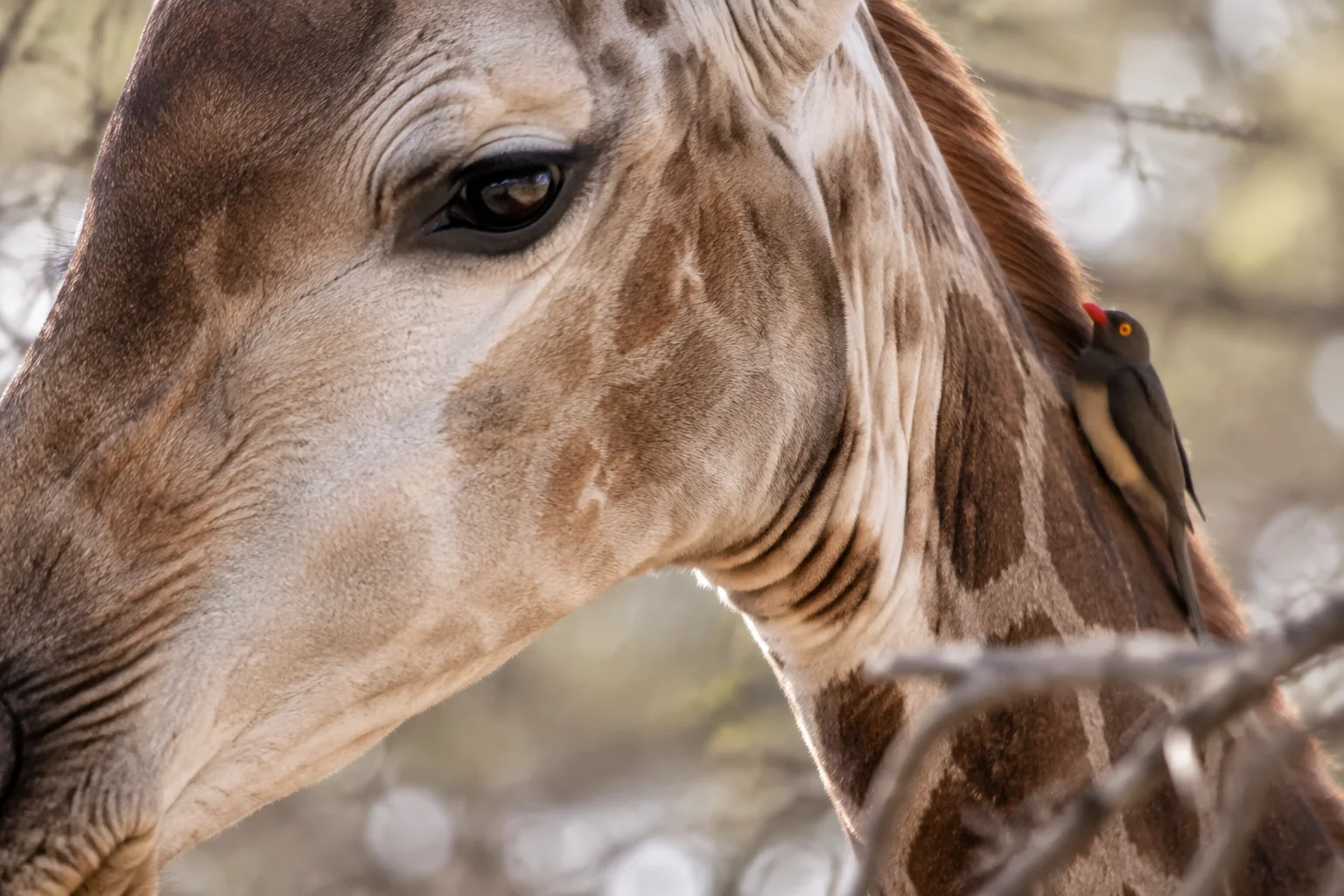
These results complement a separate experiment on oxpecker alarm calls. That study asked whether giraffes respond to warnings made by another species. The lion experiment asks about a direct cue from the predator itself. The same research programme and reserves connect the questions, so they should not be presented as wholly unrelated confirmations.
Another playback study using human-associated sounds found the clearest mechanical-noise responses at the site with least human exposure. Experience can therefore be associated with weaker reactions to some familiar sounds and stronger sustained reactions to a biologically consequential one. The studies do not identify one general rule that familiarity always makes an animal calmer.
How does experience become useful?
The authors identify a next question that follows directly from the result: how do giraffes acquire information about predators? An individual might learn through its own encounters, repeated sounds or the reactions of companions. This experiment deliberately limited immediate social influence, but it did not measure learning earlier in life.
Following identifiable animals as predator exposure changes would help separate those possibilities. Observing younger giraffes alongside experienced adults could reveal whether responses develop with encounters or with social surroundings, although age, independence and risk exposure change together and would need to be considered.
The practical point is narrower than a claim that a playback can prepare giraffes for predators. Returning lions changes the information prey must evaluate. Baotic and Szipl show why monitoring that adjustment should include the time giraffes remain alert, not simply whether their heads turn when a lion is heard.
Sources
Anton Baotic and Georgine Szipl (2025). Learning to fear: predator recognition in giraffes is shaped by evolved sensitivity and ecological experience. Frontiers in Ecology and Evolution 13, 1634218. DOI: 10.3389/fevo.2025.1634218. Read the full paper.
Kaitlyn Taylor, Sean van der Merwe, Francois Deacon, Andri Grobbelaar and Anton Baotic (2025). Ecological Exposure History Shapes Giraffe Vigilance Responses to Anthropogenic Noise: A Multisite Playback Experiment. Ecology and Evolution 15, e72763. Full paper.