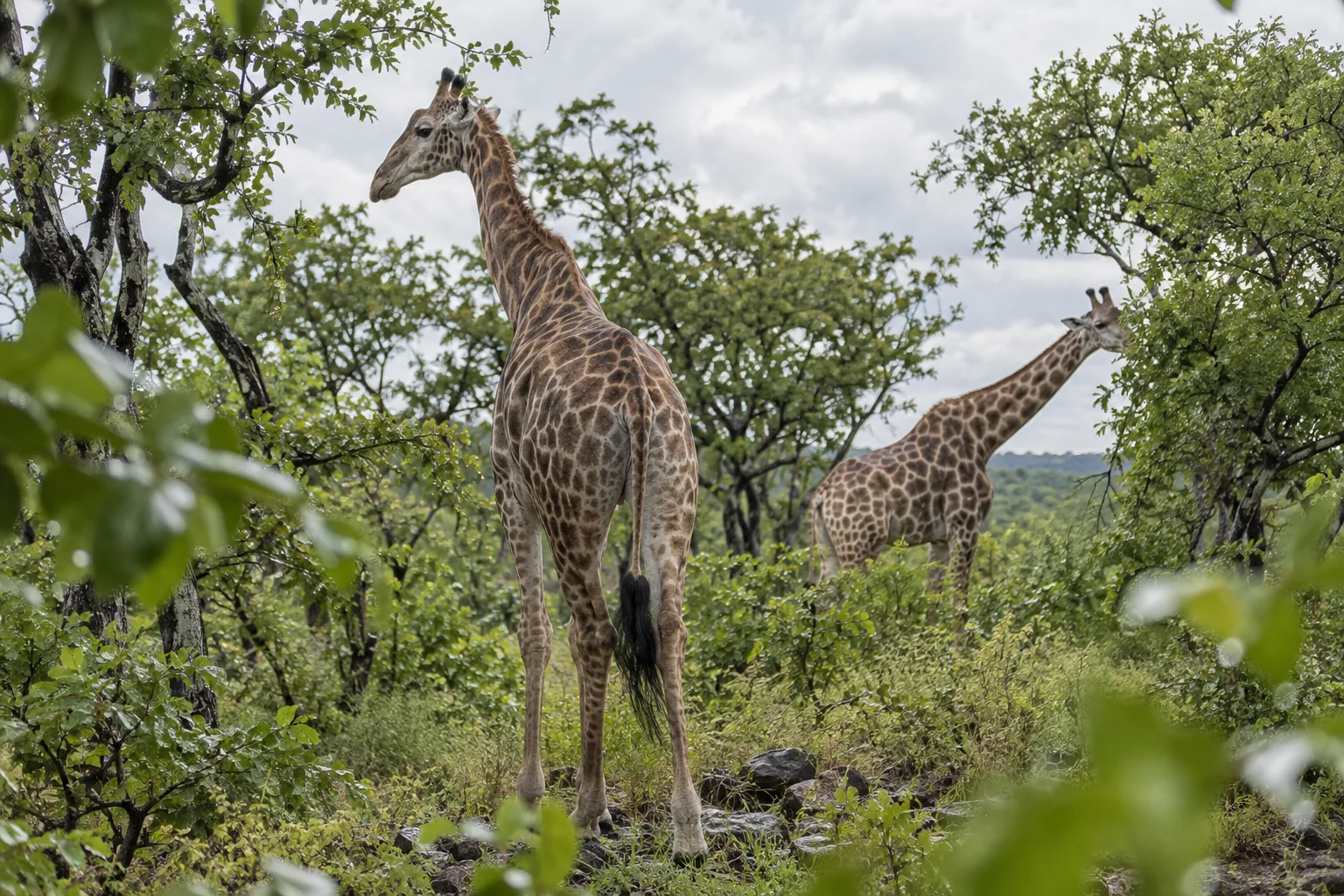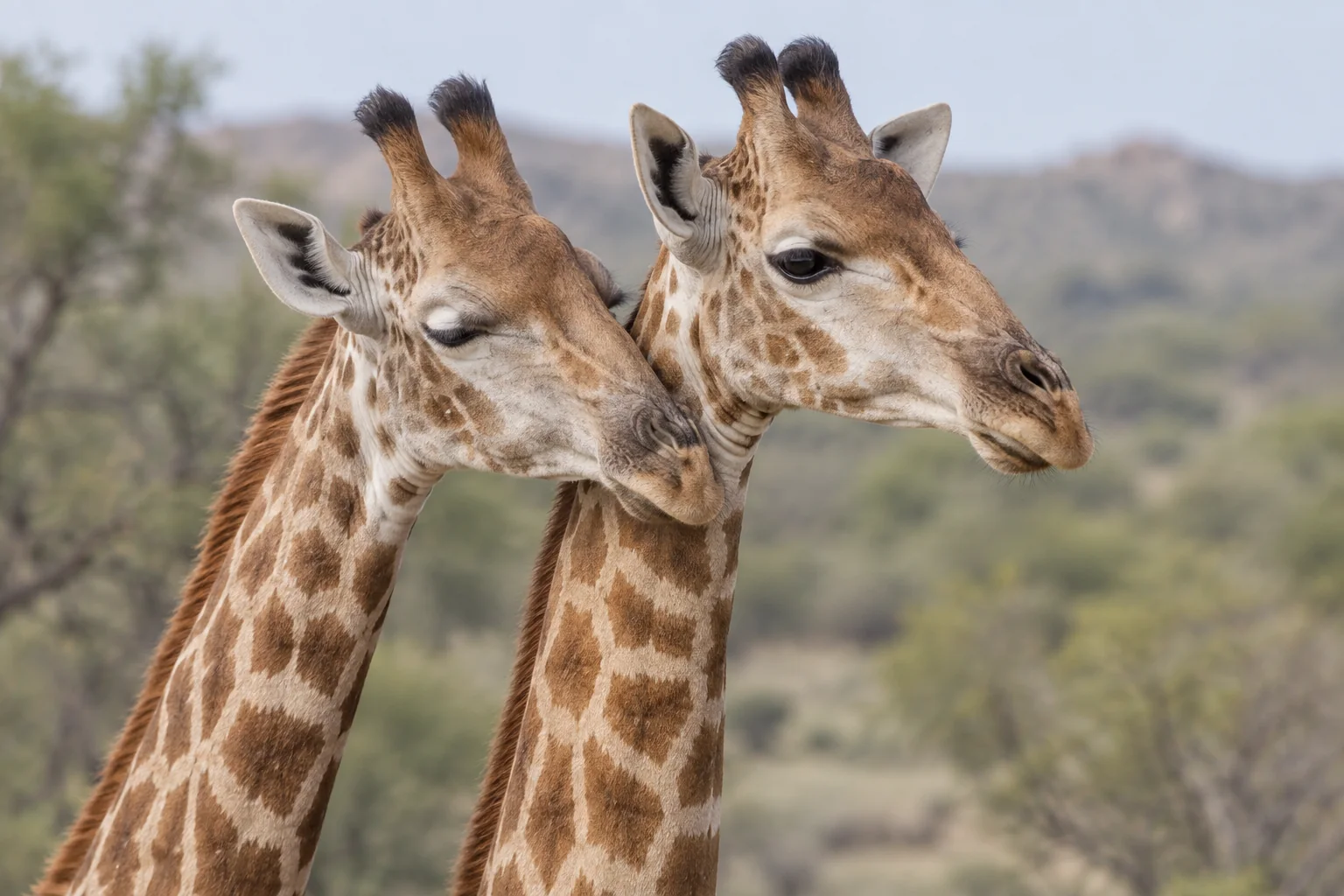
Two giraffes stand close together. It is tempting to treat that distance as a measure of their relationship. But neighbours may be sharing a useful part of an enclosure, while animals that are often farther apart may still greet, groom or rub against each other when they meet.
Chiara Grasso, Giorgia Poso and Christian Lenzi tested how well these two views matched in a group of six zoo giraffes. They compared a network built from friendly physical interactions with mapped distances between the same animals. The closest pair also had frequent social contact, but proximity and contact did not align consistently across the group. Their 2022 study makes a small but useful distinction: a map can contribute to understanding relationships without replacing behavioural observation.
Two records of the same social group
The study followed five females and one male at Bioparc Valencia in Spain from March to May 2017. Several were related, one female was pregnant, and the male had been neutered. These details matter because the group offered particular social opportunities and reproductive circumstances, rather than a miniature version of every wild herd.
A trained observer collected two complementary kinds of data. During ten-minute focal sessions, the observer recorded the behaviour of a selected giraffe. The analysis concentrated on nuzzling, grooming and rubbing: actions directed by one animal toward another.
Direction mattered. If one giraffe repeatedly groomed another, that was different from both animals initiating comparable amounts of grooming. The network therefore recorded who acted, who received the contact, and how frequently interactions occurred. It could distinguish a reciprocal pair from a pair in which most contact came from one member.
Alongside these observations, the researcher recorded locations during repeated scans of the enclosure. Positions first drawn on a map were transferred into a geographical information system, allowing distances between individuals to be compared. Landmarks and preliminary checks against photographs helped the observer place animals on the map.
The final dataset comprised 1,171 focal observations and 307 location scans. These are repeated records from six animals, not observations of more than a thousand independent giraffes. Their value lies in describing the same small set of relationships in detail.
Feeding was deliberately left out
The researchers avoided observations during feeding because keepers distributed food at varying locations without a standardized pattern. Giraffes drawn together by food could appear socially close even if the attraction was to the food itself.
That decision improved the interpretation of the remaining observations in one respect, but narrowed it in another. Feeding together can itself reveal tolerance and preference. Excluding those periods means that the resulting network describes the observed non-feeding context, rather than the complete daily social life of the group.
This is a recurring problem in studying animal relationships. A useful control can remove an alternative explanation while also removing part of the behaviour one ultimately wants to understand. The answer is to retain the context when interpreting the result.
A strong match for two sisters, a partial match elsewhere
The two youngest females, Sahira and Lluna, provided the clearest agreement. They were sisters, had the shortest median distance between them, and showed frequent reciprocal affiliative interactions. Here, the location record and the contact record pointed in the same direction.
Their relationships with the oldest female, Ché, were less straightforward. Ché was often relatively close to each of them, but the contact-based network placed those relationships at different, lower interaction frequencies. Nearness did not automatically mean a high rate of nuzzling, grooming or rubbing.
The broader group contained many two-way interactions. The male was described as more solitary, yet he also had reciprocal relationships with several females. A single label such as “solitary” would therefore miss contacts visible in the directed network.
The authors’ prediction—that physical proximity would correspond to the network of affiliative behaviour—was supported most clearly for one pair and only partially for two others. This should not be inflated into proof that the two methods agreed throughout the group. The informative result is precisely that their agreement was incomplete.
What could explain the differences?
The authors suggested that the pregnant female’s changing behaviour might help explain why her two young daughters associated with the older female. But the project did not include a controlled comparison of the mother before, during and after pregnancy. Pregnancy is a plausible context for the observed relationships, rather than an experimentally established cause.
Age, kinship, the availability of space and individual history could all contribute. With six animals in one enclosure, the study could not independently estimate each influence. Hand-mapped positions also introduce measurement uncertainty, and repeated distance records should not create an illusion that the social conclusion rests on hundreds of unrelated pairs.
A study of adolescent giraffes in two Kenyan populations helps explain the wider relevance of age: adolescents repeatedly associated most strongly with peers of the same sex. That result concerns being observed in the same group, not the Valencia study’s direct contact measures. It supports investigating age-related social patterns while illustrating why apparently similar “association” results can be built from different observations.
Use the map to ask a better question
For zoo staff, enclosure positions can show which animals regularly share space and which rarely come close. The Valencia study suggests following that information with observations of what happens during contact: who initiates it, whether the other animal reciprocates, and which activities bring them together.
A mismatch may itself be informative. Two animals that stand near one another but seldom interact could have a different relationship from two that actively seek physical contact. Neither pattern alone establishes good or poor welfare, and this project measured no welfare outcome resulting from a management change.
The study’s contribution is a way to make a familiar scene more precise. Distance and directed contact describe different aspects of social life. Looking at both gives a fuller account of the six giraffes than either a proximity map or a list of friendly actions could supply on its own.
Sources
- Chiara Grasso, Giorgia Poso and Christian Lenzi (2022). “Social Network-Proximity Association: Preliminary Evaluation of Giraffe Sociality in a Zoo-Housed Group.” Animal Behavior and Cognition 9(1), 80–88. Full paper.
- Zoe Muller, Innes C. Cuthill and Stephen Harris (2022). “Adolescence and the development of social behaviour in giraffes.” Mammalian Biology 102, 1333–1343. Related study.