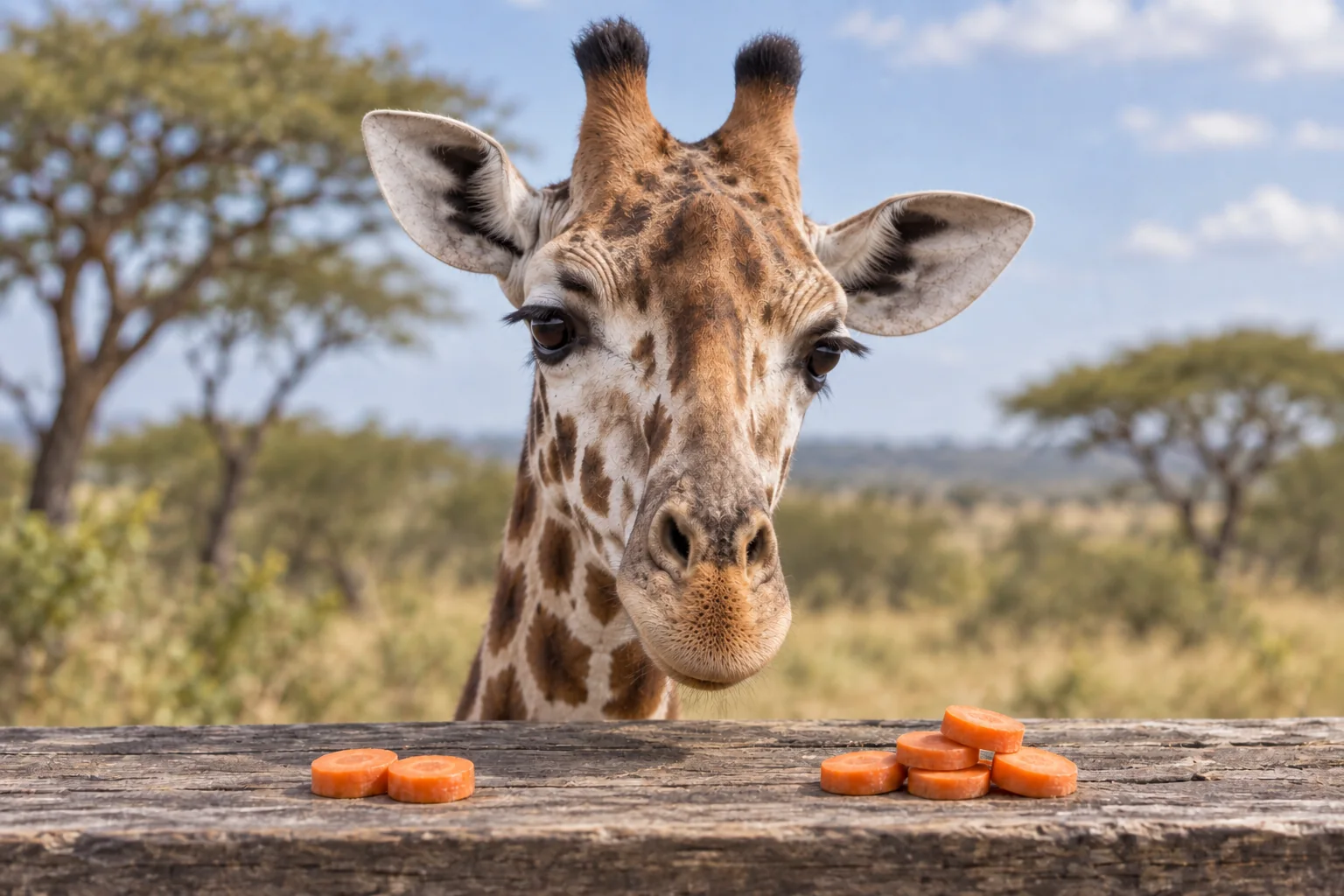
The right answer can be reached for the wrong reason—or, more precisely, for a reason different from the one a researcher is testing. A giraffe that chooses a shaken box containing carrots might have inferred that the rattling sound means food. It might also have selected the box that moved.
Álvaro López Caicoya, Federica Amici, Conrad Ensenyat and Montserrat Colell used that distinction in a 2021 comparison of giraffes, European bison and forest buffalos. Giraffes performed best overall across the tasks, but their choices in the shaking tests exposed a more specific pattern: the movement of the box appeared to guide them even when it led to an empty container.
A hidden carrot is still there
The study began with a basic physical problem. Objects persist when they disappear from view. For an animal, keeping track of something hidden can help it search in a useful place rather than starting over whenever visibility changes.
Researchers call this ability object permanence. In the simplest task, the experimenter showed the contents of two containers, closed both lids and waited briefly before offering a choice. Touching the food-containing container gave the subject access to the carrots. Two other conditions extended the delay to 30 or 60 seconds, adding a memory demand.
The researchers tested five European bison and five forest buffalos at Barcelona Zoo. They compared their results with six giraffes from Barcelona and Leipzig that had previously completed the same task programme. The giraffe observations were therefore reused for a new comparison, not collected as an independent replication of the earlier giraffe study.
Subjects first became familiar with a simple one-container version. All could approach voluntarily, and food or water deprivation was not used. The researchers adapted container size so that each species could retrieve the reward with its own feeding anatomy. Comparable questions did not require pretending that a bison handles food like a giraffe.
Why shake an empty box?
In the sound-based tasks, subjects did not first see where the food was hidden. The experimenter shook one of the two closed containers. When the full box was shaken, the carrots made a noise. When the empty box was shaken, it remained silent.
If an animal understands the connection between an object inside a container and the noise produced by shaking, the two situations offer complementary information. A rattling box may contain food. A silent shaken box should direct the search toward the other one.
The giraffes did well when the full box was shaken. Their performance dropped sharply when the empty box was shaken, because they tended to choose the moving box in both conditions. Movement drew attention to one option; choosing it happened to be successful in the first condition and unsuccessful in the second.
This is an informative result rather than a spoiled success story. The empty-box trial allowed the team to distinguish responses that would otherwise look identical. Without it, high performance with a noisy container could easily be presented as evidence of reasoning about sound.
The experiment also included a condition in which subjects could rely only on smell to locate the food. The results did not support smell as the explanation for successful performance in the other tasks.
A comparison with an evolutionary question
Why compare these particular animals? The researchers were interested in whether an animal's everyday challenges might help explain differences in cognition. Giraffes and European bison have social groups that split and rejoin, while forest buffalo groups are generally more cohesive. The species also differ in dietary breadth.
The team predicted that giraffes would perform best overall, followed by bison and then forest buffalos. That was the observed ordering in the study. Longer delays generally made the tasks more difficult, and the forest buffalos' choices were especially influenced by preferences for one side.
A side preference matters because always choosing left can reduce apparent success even if an animal sometimes tracks the food correctly. The researchers included this tendency in their analysis, along with repeated observations of the same subjects.
The sample was nevertheless too small and narrow to settle why the species differed. The bison were all females, each bovine species came from one zoo group, and motivation, previous experience or task design can affect performance. The results offer a way to investigate evolutionary hypotheses about social and feeding demands; they do not turn those hypotheses into demonstrated causes or produce a universal intelligence league table.
Different tasks reveal different skills
A later study of statistical food choices tested four Barcelona giraffes with mixtures of preferred carrots and less-preferred zucchini. In that experiment, the animals could choose samples from the mixture offering better odds of a carrot, including comparisons designed to rule out simply choosing the larger number of preferred pieces.
That later result does not erase the empty-box finding. The tasks ask different questions. A giraffe can use information about proportions in one setting and attend to a person's movement in another. The animals and research programme also overlap, so the papers should not be counted as independent surveys of giraffe cognition across many populations.
The useful next step is to change one feature at a time. A sound task with less conspicuous container movement could help determine whether visual attention is masking information the giraffes can use. Broader sampling across groups would test whether the observed species differences persist under other husbandry and social histories.
Caicoya and colleagues made an understudied set of animals available for a more precise comparison. The achievement lies as much in exposing the route to a choice as in counting correct choices. A shaken empty box showed something that a row of rewarded successes could have concealed.
Sources
Álvaro López Caicoya, Federica Amici, Conrad Ensenyat and Montserrat Colell (2021). Comparative cognition in three understudied ungulate species: European bison, forest buffalos and giraffes. Frontiers in Zoology 18, 30. DOI: 10.1186/s12983-021-00417-w. Read the full paper.
Álvaro López Caicoya, Montserrat Colell and Federica Amici (2023). Giraffes make decisions based on statistical information. Scientific Reports 13, 6788. Full paper.