A red bucket can change a feeding opportunity without changing the food. To an animal unfamiliar with that object, approaching the meal may involve a decision about the surroundings as well as the reward. Hesitation could be sensible caution, while investigating could create access to food that companions leave alone.
Alina Schaffer and colleagues explored that tension in a 2021 experiment with ten hoofed mammal species, including giraffes. They found a link between an animal’s position in its social group and how it approached food beside unfamiliar objects. Understanding that link requires looking beyond whether an animal seemed bold on a particular day.
The food stayed familiar
Researchers call a fearful or cautious response to novelty neophobia. It can help an animal avoid danger, but it can also delay access to a useful resource. The study examined reactions to unfamiliar objects near food, a specific situation in which those competing possibilities could be observed.
The team worked in four European zoos. After excluding four animals whose behavioural observations could not be completed, the analysis included 74 individuals from ten species. Six were giraffes living together at Leipzig Zoo. Other participants included goats, deer, camels, horses and Barbary sheep.
Each group first encountered preferred, familiar food in two familiar locations. During the experimental sessions, an unfamiliar object was placed beside one location. For most groups, the objects were a red plastic bucket and a blue plastic bowl, presented in separate sessions. Barbary sheep received different objects because their keepers already used similar buckets and bowls.
Offering the familiar food on both sides made the comparison informative. An animal could approach a meal without going near the new object. That helped the researchers distinguish a reaction to novelty from a general lack of interest in eating.
All animals remained with their social group in their usual outdoor enclosure. The choice was therefore made among companions, with the opportunities and competition that a shared feeding situation brings.
Being well connected is different from being dominant
Before interpreting the feeding choices, the researchers needed a picture of each animal’s social position. They repeatedly recorded the nearest neighbour of every group member, building a network from those observations.
An animal occupied a more central position when its connections linked it to other well-connected members. Centrality described its place in that proximity network. It was not a direct measurement of affection, friendship or leadership.
Dominance was assessed separately. It concerned who prevailed in competitive encounters or had priority over food. For the giraffes, no aggressive encounters were observed during the study period, so the researchers and keepers used feeding priority to establish ranks.
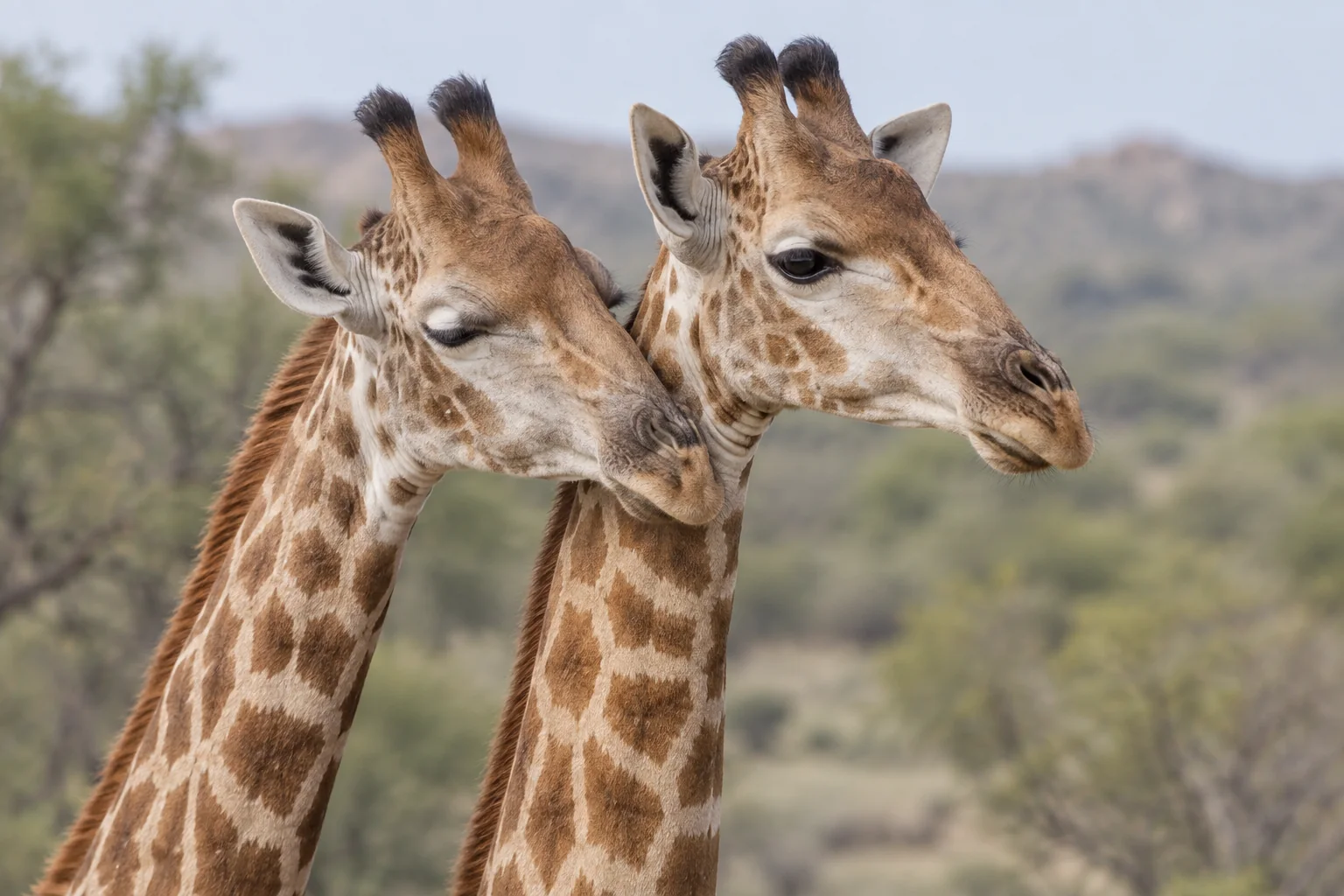
Keeping those measures apart matters. An animal can be well integrated into a group without being its highest-ranking member. Our guide to giraffe social behaviour introduces the broader range of relationships that can sit behind animals sharing a space.
A social pattern in the first approach
Videos supplied three different observations: how long an animal took to approach the food, how long it then took to eat, and how much time it spent nearby. These describe different stages of a response. An animal might approach readily but hesitate before eating, or remain near food after its first mouthful.
In the combined analysis, more central individuals tended to take longer to approach food on the side with the unfamiliar object than on the familiar side. Less central individuals showed the reverse pattern. The analysis accounted for repeated observations of the same animals and evolutionary relationships among the species.
The authors suggested that social position could affect the value of exploring. An animal with reliable access to resources through its group might gain less by approaching an uncertain opportunity. A less integrated animal might have more to gain by investigating food that others avoid. Another possibility is that cautious individuals help maintain group cohesion, while more exploratory individuals move beyond it.
Those are explanations to investigate. The experiment did not change the animals’ social connections, so it cannot establish that becoming more central makes an individual more cautious. The statistical association was also uncertain enough to warrant replication, and it appeared in approach time rather than consistently across all three measures.
Nor was this a separate demonstration that central giraffes are more neophobic. The finding came from the analysis across species; six giraffes from one group cannot establish a general rule for giraffe populations.
The larger group raises a further question
Barbary sheep stood out in the time spent near food. They spent significantly more time on the side with the unfamiliar object. The giraffes and the other species did not show a reliable difference between sides on this measure.
The Barbary sheep also formed the largest study group, with 15 animals. The authors proposed that having more companions could help animals approach unfamiliar situations: others might provide information or make an encounter feel less risky.
But species and group size were entangled in this comparison. The researchers had not experimentally enlarged groups while holding the other conditions constant. The paper therefore points to a useful follow-up: compare groups of the same species living in similar conditions but containing different numbers of animals. Comparing group and individual encounters could also help separate the effects of upbringing from the immediate presence of companions.
A hesitation has more than one possible meaning
These animals were responding to unfamiliar objects during brief zoo sessions. Their choices do not automatically describe how they would react to a predator, a strange sound or a new food in the wild. Three of the six giraffes also had previous experience with other experimental tasks, a reminder that animals arrive with different histories.
The practical lesson for interpreting behaviour is to ask what the animal is being offered, who else is present and which part of the response is measured. That is also useful context when reading experiments on giraffe cognition: willingness to approach an apparatus and success once interacting with it are different questions.
Schaffer and colleagues made familiar food the common reference point and added novelty around it. Their comparison shows why an animal’s first step towards something new is worth understanding in its social setting.
Sources
Alina Schaffer, Alvaro L. Caicoya, Montserrat Colell, Ruben Holland, Lorenzo von Fersen, Anja Widdig and Federica Amici (2021). Neophobia in 10 ungulate species—a comparative approach. Behavioral Ecology and Sociobiology 75, 102. Read the full paper.