Southern giraffes have the largest estimated total of the four giraffe species. That reassuring headline is also where careful reading must begin. The total combines two subspecies across nine natural-range countries, and the latest synthesis says better surveys and newly included private-land records explain part of its rise. One big number cannot tell us that every population grew, that every lineage is secure or that one conservation model caused the change.
What is a southern giraffe?
The southern giraffe is Giraffa giraffa, one of the four giraffe species recognised by the IUCN SSC Giraffe and Okapi Specialist Group in August 2025. The framework contains two southern subspecies:
- Angolan giraffe — Giraffa giraffa angolensis.
- South African giraffe — Giraffa giraffa giraffa.
The IUCN announcement says the task force considered genetic, anatomical and biogeographical evidence. It also says the new taxonomy will guide upcoming Red List assessments. Taxonomic recognition and an extinction-risk assessment are therefore related but separate steps.
This profile focuses on what the species name, population evidence and range history mean together. The wider endangered-status guide compares the assessment language used for all giraffes.
How many southern giraffes are in the June 2025 synthesis?
The Giraffe Conservation Foundation's State of Giraffe 2025 reports 68,837 southern giraffes in the species' natural range, with a stated estimate range of 51,973–90,313. It reports another 221 animals separately as extralimital—outside the species' natural range. These are June 2025 source figures, not a live count.
| Taxon | 2020 compilation | June 2025 estimate | Reported 2025 estimate range | Report's trend label |
|---|---|---|---|---|
| Southern giraffe | 46,165 | 68,837 | 51,973–90,313 | Increasing |
| Angolan giraffe | 16,729 | 15,663 | 11,879–19,923 | Stable |
| South African giraffe | 29,590 | 53,174 | 40,094–70,390 | Increasing |
Source: State of Giraffe 2025, southern chapter and Table 1. The two June 2025 subspecies estimates sum to the June 2025 species estimate. The report's printed 2020 subspecies comparators total 46,319—154 more than its printed 46,165 species figure. We preserve that source mismatch rather than recompute the frozen dataset. The contrast is still more informative than “up 49%”: the Angolan figure is slightly lower than in 2020, while the South African figure is much higher.
The report explicitly says the apparent southern-giraffe growth is partly due to improved survey coverage and private-land populations that earlier assessments excluded. It also says some private lands remain uncounted. Subtracting 46,165 from 68,837 can describe the difference between two compilations; it cannot, by itself, measure how many more animals were born than died.
The population guide explains this distinction across all four species, while the survey-methods guide shows how observation, coverage and estimation interact.
What changed in South Africa's evidence?
A 2025 country-wide population study helps answer that question. Hoffman and colleagues assembled records from 86 public and 913 private properties across all nine South African provinces. They estimated 29,536 southern giraffes, with a reported likely range of 21,744–39,859; private land accounted for 49.4% of the total.
The earlier 2019 assessment estimated 21,053–26,919 but lacked private-property data from four provinces and extrapolated from a smaller base. The newer study widened that evidence base. Its inputs still span 2014–2025 and include aerial and ground surveys, literature, questionnaires, citizen-science observations and information from authorities. Not every stakeholder contributed.
That is valuable national evidence, but it is not a repeat census conducted everywhere with one unchanged method. It supports the conclusion that previous coverage missed many giraffes. It does not isolate land ownership as the cause of survival or convert every difference between estimates into demographic growth.
What is the southern giraffe's current conservation status?
As checked on 6 September 2026, the southern giraffe has not been assessed as a species on the IUCN Red List. GCF recommends Least Concern for a future species assessment, and its current status page says the four-species assessments are underway. “Expected” or “recommended” is not the same as published.
| Taxonomic unit | Current Red List position | Later recommendation or expectation |
|---|---|---|
| Giraffe under the older one-species treatment | Vulnerable | To be replaced by species-specific assessments when completed |
| Southern giraffe as Giraffa giraffa | Not assessed as a species | Least Concern recommended |
| Angolan giraffe under the older subspecies treatment | Least Concern | Least Concern recommended to be retained |
| South African giraffe as a subspecies | Not assessed | Least Concern recommended |
This is why “southern giraffes are Least Concern” needs qualification today. It accurately describes the recommendation, but not a completed species-level assessment. The unit and date must travel with the category.
Where do southern giraffes live?
The June 2025 report lists the species' natural-range countries as Angola, Botswana, Eswatini, Malawi, Mozambique, Namibia, South Africa, Zambia and Zimbabwe. Strongholds occur in Botswana, Namibia, South Africa and Zimbabwe, while the smaller national populations and the two subspecies are not distributed evenly across that list.
A country-level natural range does not prove that every herd at every site is native. Giraffes have been moved within and between countries, sometimes to restore a locally lost population and sometimes beyond their natural distribution.
Iona National Park illustrates the first case. The report records two Angolan-giraffe reintroductions from Namibia in 2023 and 2024 after an absence of more than a century at that site. Angola remains part of the species' natural range: this was a local return within it, not evidence that every Angolan population had the same history.
By contrast, the report classifies southern-giraffe populations in the Democratic Republic of Congo, Mali, Nigeria and Senegal as extralimital. It reports those animals separately from the 68,837 natural-range estimate. The translocation guide explains why source, destination, lineage and follow-up matter when animals are moved.
Can coat and geography identify the subspecies?
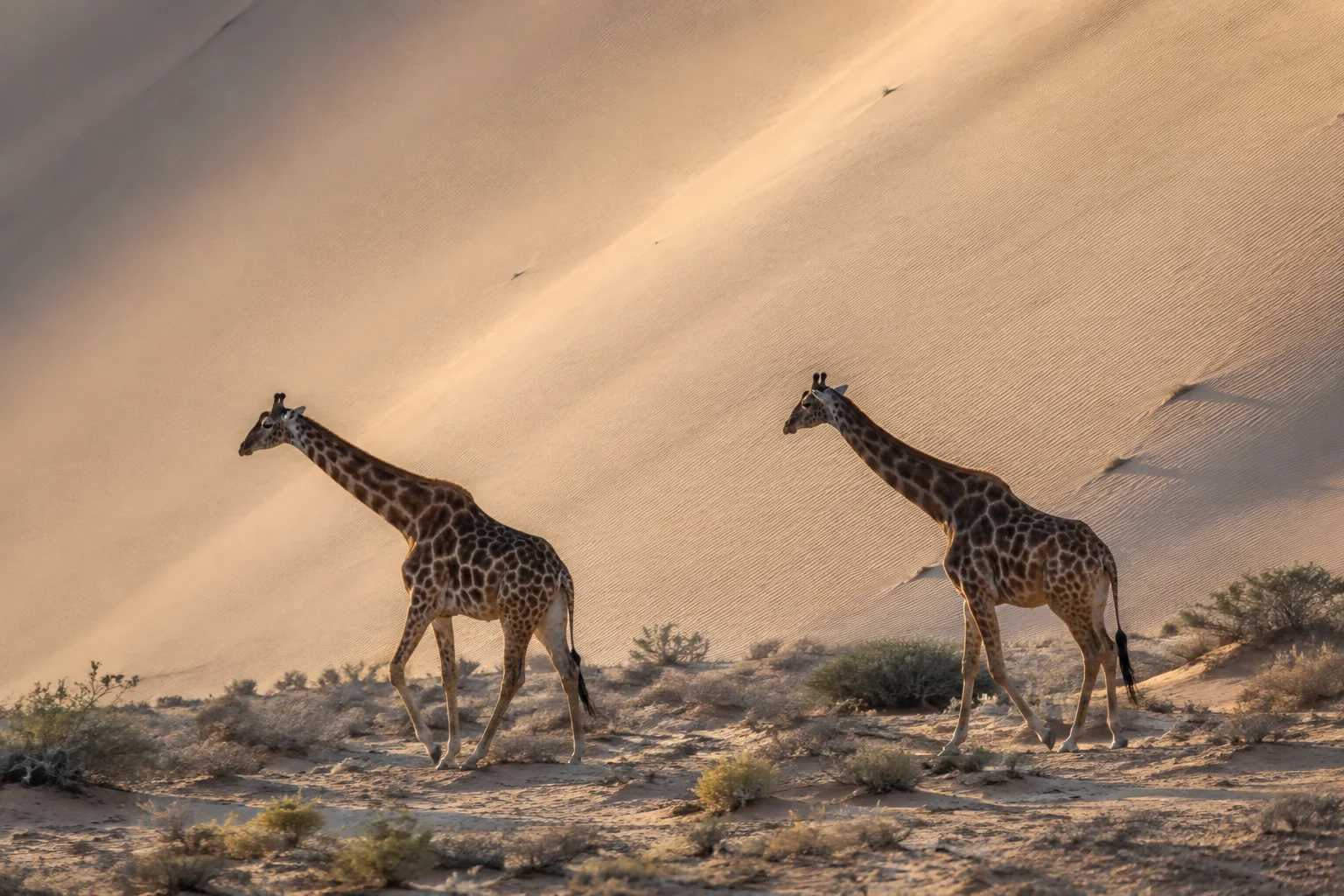
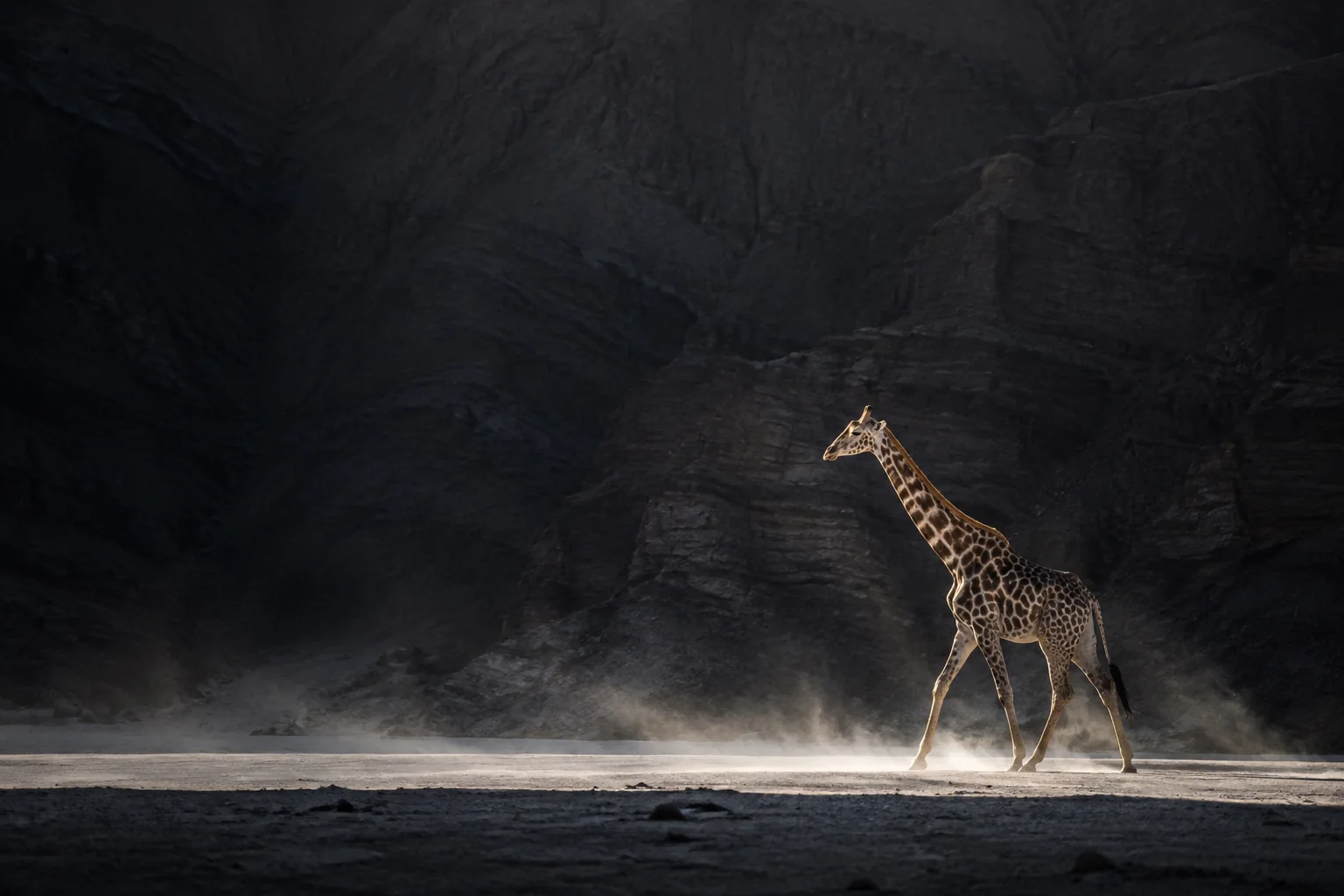
Southern giraffes are commonly described as having large, irregular brown patches on a lighter background, with uneven spots continuing down the lower legs. Angolan giraffes in arid northwestern Namibia can appear especially pale. The GCF southern-giraffe profile gives a useful visual description.
It is a field clue, not a universal identification test. Lighting, age, individual variation and an animal's movement history all complicate a photograph. Most importantly, human translocations and historical ancestry can put a lineage somewhere that a simple range map would not predict.
For a sighting, record the place, date and the source of any identification. For a management decision, provenance records and genetic evidence can matter. The coat-pattern guide explains the different task of recognising individual giraffes from their markings.
What did genetic research change?
The useful lesson is not that each newer technique makes all older work worthless. It is that different genetic evidence answers different questions, and broader genomic sampling can correct an assignment based on maternal ancestry or location alone. The taxonomy and genetics guide supplies the wider four-species context.
A 2014 map built from maternal lineages
Bock and colleagues' 2014 open-access study analysed 1,562 mitochondrial DNA positions from 161 giraffes in eight populations, with two okapis as an outgroup. It found distinct Angolan and South African maternal lineages and suggested that the Angolan lineage extended farther east than previously assumed, including southern Zimbabwe.
Mitochondrial DNA is inherited through the mother. It can reveal a matriline, but it does not describe all ancestry in the nuclear genome. The geography it suggested was therefore a well-supported result for that marker, not the final word on every individual's subspecies.
A 2019 warning from central South Africa
Van Niekerk and colleagues sampled introduced populations in central South Africa. Their 47 animals came from ten private Free State herds, a provincial reserve and one Northern Cape herd. Short mitochondrial regions placed 24 sampled animals with the Angolan lineage and 23 with the South African lineage.
Founder origins were often unknown, and some private groups held only a few animals. The study made a practical case for lineage-aware movement between small herds. Its scale and maternal marker do not establish how common admixture is across South Africa, identify paternal ancestry or prove that translocation is always harmful.
Whole genomes changed key assignments in 2024
Prochotta and colleagues' 2024 population-genomics study sequenced 85 southern giraffes from ten populations across southern Africa and analysed them with 12 previously available southern-giraffe genomes. Some population-structure analyses used 66 unrelated individuals.
The whole-genome evidence placed Bubye Valley Conservancy giraffes with the South African subspecies despite their Angolan mitochondrial lineage. Central Kalahari Game Reserve giraffes showed mixed Angolan and South African ancestry. In northwestern Namibia, sampled giraffes retained an Etosha ancestry signal associated by the authors with the documented 1991 introduction. It was most frequent in the Hoarusib sample; three sampled Hoanib animals also showed an Etosha component, although the study's separate gene-flow test detected support between Etosha and Hoarusib rather than Hoanib.
Those results show why geography cannot “settle” identification. They also have limits: ten sampled populations do not represent every southern giraffe herd, possible source populations remain unsampled, and the authors say the long-term genetic consequences of the Namibian movement are unknown. Genomics improves the evidence; it does not remove uncertainty.
What can a large species total conceal?
First, it can conceal concentration. The June report attributes 13,895 of 15,663 Angolan giraffes to Namibia—about 88%. It attributes 29,536 of 53,174 South African giraffes to South Africa—about 56%. A species-wide total therefore does not describe the same distribution of risk or monitoring capacity everywhere.
Second, it can conceal different trajectories within the total. The report labels the Angolan comparison stable and the South African comparison increasing. Neither label proves that each local population followed the same direction.
Third, abundance can conceal population structure. The 2024 genomic study found relatively low runs of homozygosity overall but also limited heterozygosity despite the large South African-giraffe population. These are different measures, and the result is not a verdict that the whole species is genetically safe or imperilled. It shows why headcount and genomic diversity should not be treated as synonyms.
Finally, many animals may occur in small, separated or historically moved herds. That does not justify inventing a uniform decline or listing every generic giraffe threat against the species. It does justify asking where a figure came from, whether populations remain connected and whether managers know the animals' origins.
What would count as evidence of conservation progress?
The evidence becomes clearer when the claimed outcome is specific:
- A return to a site can be shown by documented release and subsequent presence, as at Iona. Establishment, reproduction and long-term persistence require longer follow-up.
- A better estimate can be shown by wider coverage and transparent methods, as in the South African property study. It is not automatically a higher biological growth rate.
- A lineage-aware decision can be supported by provenance and genomic evidence. It does not mean every admixed population should be managed identically.
- A population increase needs comparable observations through time, with survey effort and uncertainty accounted for.
Protected areas, communal land, private properties, translocations and tourism can all be part of particular conservation histories. Their presence alone does not identify which action caused a range-wide change. The better question is what outcome was measured, where, over what period and against which comparison. Our guide to evaluating giraffe conservation develops that standard.
What to remember
- Southern giraffe means one species with Angolan and South African subspecies.
- The June 2025 natural-range estimate is 68,837, with 221 extralimital animals reported separately.
- Better coverage and newly included private-land records explain part of the higher 2025 compilation, so “49% growth” overstates what the comparison establishes.
- The species-level Least Concern category is recommended or expected, not yet a completed Red List assessment.
- Coat and location are useful clues; population history and whole-genome evidence can overturn a simple identification.
- A large species total can hide concentration, unequal trends, small managed herds and genetic structure.
Frequently asked questions
Is the southern giraffe a separate species?
Yes. The IUCN SSC Giraffe and Okapi Specialist Group adopted Giraffa giraffa as one of four giraffe species in August 2025. It contains the Angolan and South African subspecies.
How many southern giraffes are left?
The June 2025 GCF synthesis estimates 68,837 in the natural range and reports a broad estimate range of 51,973–90,313. It lists 221 extralimital animals separately. Keep the source date and scope with the number.
Is the southern giraffe Least Concern?
Not yet as a completed species-level IUCN Red List assessment. The southern species is currently unassessed, while GCF recommends and expects Least Concern. The older Angolan subspecies assessment is Least Concern; the South African subspecies has not been assessed.
Can I identify an Angolan giraffe by its pale coat?
A pale coat in arid northwestern Namibia is a useful clue, not proof. Individual variation and translocation history matter, and whole-genome studies have corrected assignments previously based on mitochondrial lineage or geography.
Sources
Sources were checked on 6 September 2026. Key sources are:
- IUCN SSC Giraffe and Okapi Specialist Group's 2025 four-species announcement.
- Giraffe Conservation Foundation's State of Giraffe 2025, conservation-status page and southern-giraffe profile.
- Hoffman and colleagues' 2025 South Africa population study.
- Bock and colleagues' 2014 mitochondrial study.
- van Niekerk and colleagues' 2019 central South Africa genetics study.
- Prochotta and colleagues' 2024 southern-giraffe population-genomics study.
Authority and primary-source links appear beside the claims they support. The research summaries state their geography, sample, method and limits; none is treated as a range-wide experiment proving what caused the species total to change.
This article does not recalculate the frozen June 2025 dataset, assign a new Red List category or imply that cited researchers endorse this interpretation.