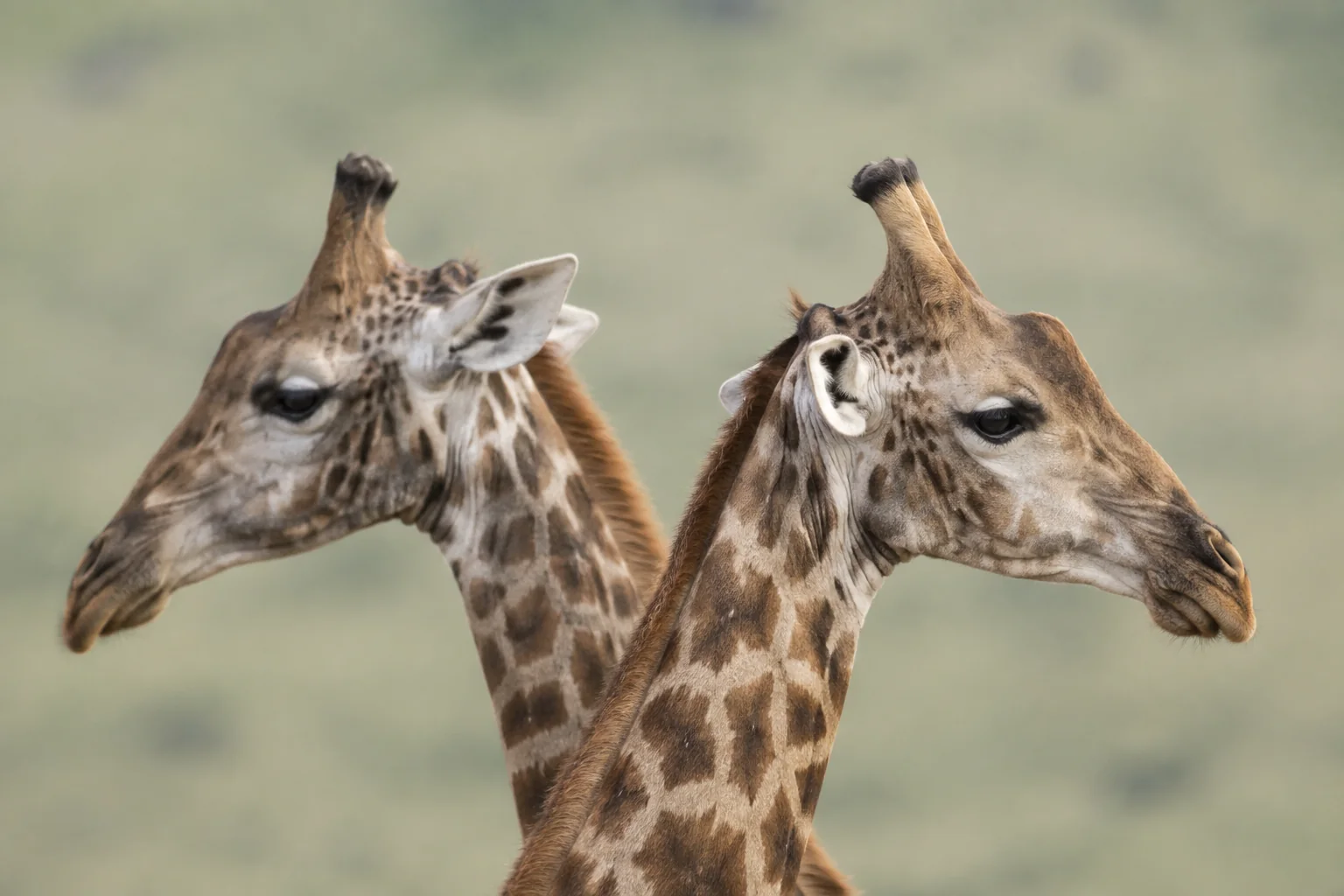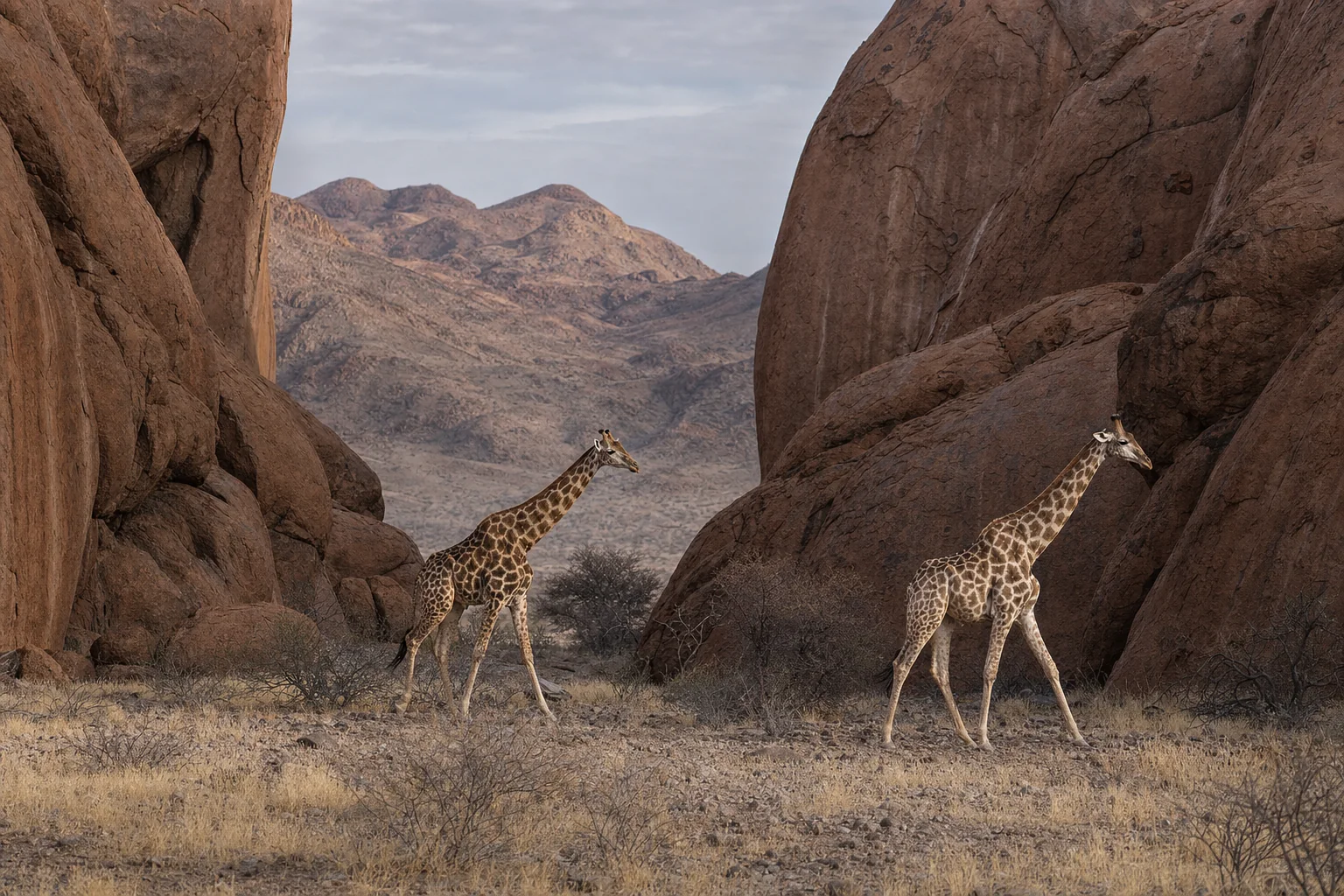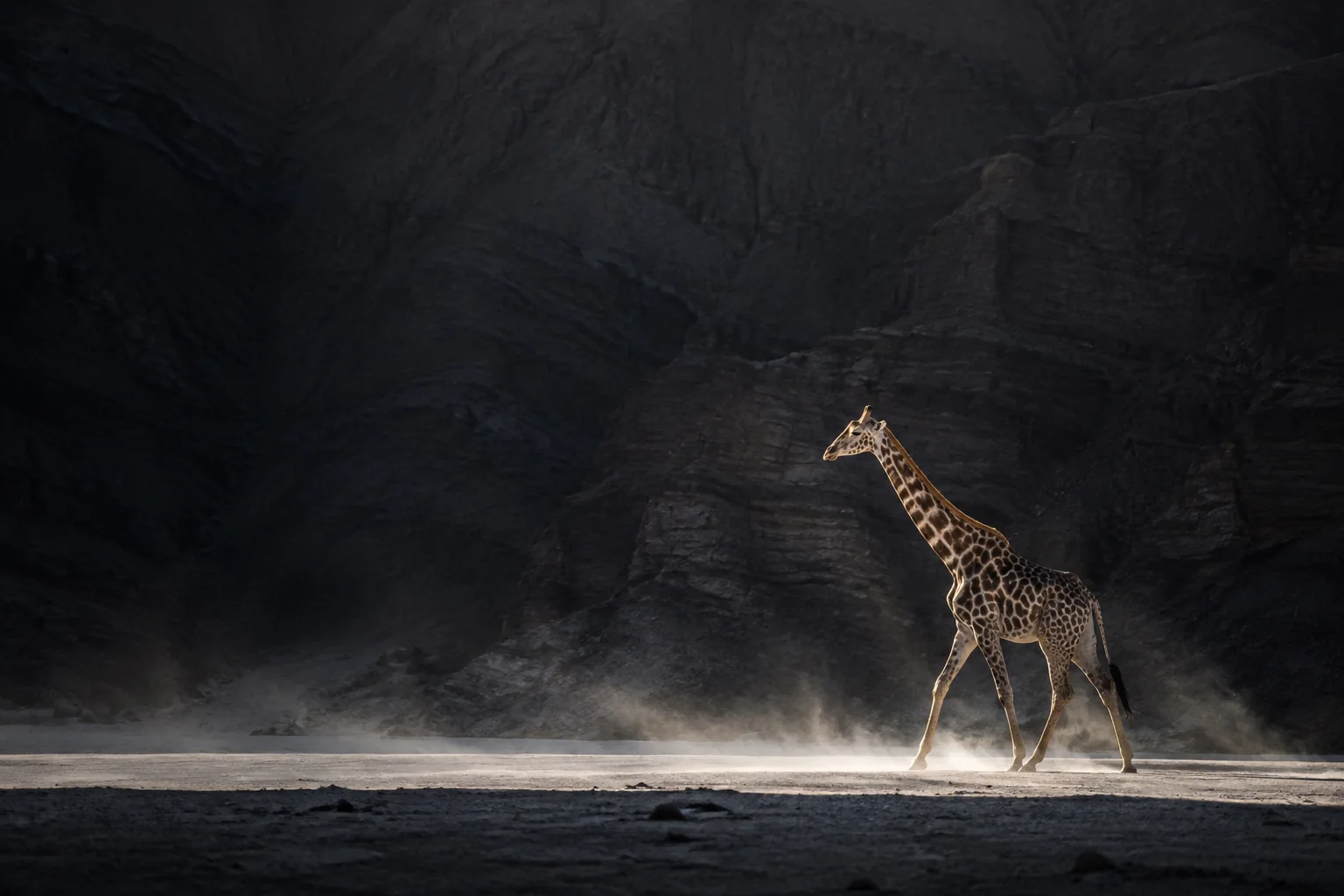
Tracing a family only through mothers leaves out most of its branches. Follow a giraffe’s mother, then her mother and her mother before that, and the chain can tell a coherent story. It cannot describe every ancestor who contributed to the animal’s DNA.
That difference became important when David Prochotta, Sven Winter, Julian Fennessy and Axel Janke examined southern giraffes in a 2024 genomic study. Earlier maternal-DNA evidence had suggested that the Angolan subspecies extended unexpectedly far east. Reading DNA inherited from both parents changed the interpretation of two populations carrying that maternal signature.
One animal carries two kinds of genetic history
Most of a giraffe’s DNA sits in the cell nucleus, packaged into chromosomes inherited from its mother and father. Across generations, that nuclear inheritance is repeatedly mixed and reshuffled.
Mitochondria, the cell structures involved in supplying energy, carry a small genome of their own. In these animals, mitochondrial DNA is normally inherited through the mother. It therefore follows a narrower route through the family history.
Both records are useful. A mitochondrial lineage can reveal a connection that persists over many generations. The nuclear genome samples far more of the ancestry behind an individual. When the two disagree, the disagreement can itself contain information about how populations met and reproduced.
The question was particularly relevant to the two subspecies of southern giraffe: Angolan and South African giraffes. Geography and appearance had not always made their boundaries clear, and earlier mitochondrial studies had raised further questions about populations in Botswana and Zimbabwe.
Reading beyond a maternal marker
The team sequenced 85 southern giraffes from ten populations and combined those data with 12 previously published southern giraffe genomes. Different analyses used different subsets. The principal population-structure comparison retained 66 unrelated individuals, helping prevent close family relationships from dominating a comparison intended to describe populations.
The researchers examined many variable positions across the nuclear genome, reconstructed mitochondrial relationships, and compared ways of grouping the animals. One analysis represented genomes as combinations of genetic clusters. Another placed individuals near or far from one another according to their overall genetic similarity.
Agreement among these approaches could strengthen an interpretation. Disagreement could reveal that a simple branching family tree was a poor description of a population with ancestry from more than one source.
The same maternal label covered different populations
Giraffes from Bubye Valley Conservancy in Zimbabwe carried mitochondrial DNA that grouped with Angolan giraffes. Across the nuclear genome, however, they grouped with South African giraffes. In the broad two-cluster analysis, the team did not detect the substantial mixture seen in the Central Kalahari animals.
The authors therefore identified the sampled Bubye Valley population as South African giraffes despite its Angolan maternal signature. A maternal lineage had been informative about ancestry, but insufficient for assigning the population’s wider genetic identity.
Botswana’s Central Kalahari Game Reserve presented a different case. Its sampled giraffes also carried Angolan mitochondrial ancestry, while their nuclear genomes showed a substantial contribution from both subspecies. In the model with two main clusters, approximately one-third of their ancestry was assigned to Angolan giraffes and two-thirds to South African giraffes.
Those proportions describe a genetic model, not fractions of animals in the reserve. Nor do they reconstruct an exact list of ancestors. They express how the sampled genomes relate to the reference groups under that particular model.
Other comparisons supported the mixed interpretation. The Central Kalahari giraffes lay between the two subspecies in the analysis of overall genomic variation. Different tree-building methods placed them on different sides, illustrating the difficulty of forcing a population with two sources of ancestry onto a single branch.
How a maternal signature can outlast other ancestry
One explanation involves historical breeding between populations followed by repeated breeding into one of them. A female carrying an Angolan mitochondrial lineage could have descendants whose nuclear ancestry became increasingly South African over generations. Her mitochondrial lineage could continue through daughters even as the wider ancestry changed.
This process is often called mitochondrial capture. It helps explain why a mitochondrial relationship need not match the predominant nuclear relationship. The paper discusses this historical interpretation for Bubye Valley; the DNA pattern does not directly reveal the particular matings or route that produced it.
For Central Kalahari, the authors favoured a longer history of natural contact between the subspecies. Its geographical position makes that plausible. They considered how past landscape changes might have allowed populations to meet, while acknowledging that wider sampling is needed to reconstruct the history and that undocumented movements by people cannot be completely excluded.
The five sampled Central Kalahari individuals carried a similar broad ancestry mixture. That is a reason to investigate the population further, rather than assuming that every giraffe across the reserve must have exactly the same history.
A past move also left a genomic trace
The wider survey included desert-dwelling Angolan giraffes in northwestern Namibia and animals from Etosha National Park. Prochotta and colleagues describe how earlier mitochondrial work had found relatively little of the Etosha maternal signature in the desert sample, leading to the suggestion that introductions had contributed little to the receiving population.
The nuclear genomes revealed a more substantial Etosha-related contribution, especially in giraffes from the Hoarusib catchment. The researchers interpreted that pattern in light of a documented 1991 introduction from Etosha.
This example shows what a broader inheritance record can add. Descendants can carry nuclear DNA from an introduced animal without carrying its mitochondrial lineage. The genomic signal supplies evidence of a genetic contribution; evaluating the long-term ecological or health effects of that contribution requires other observations.
A richer history changes the management question
The Central Kalahari population’s mixed ancestry is part of the diversity the authors argue should be understood and conserved. Treating it simply as Angolan would conceal much of that history. Treating its mixture as a defect would also miss the possibility that it records natural contact across a changing landscape.
The researchers recommended taking its distinctive ancestry into account when considering animals for moves between populations. This is one reason giraffe translocation planning needs information about both the source and the receiving population.
Their study gives the next investigation a clear task: sample more widely across the contact region and test histories that can account for the nuclear and mitochondrial patterns together. A single inherited marker can preserve a real connection. A fuller genome can show how that connection fits into a much larger family story.
Sources
David Prochotta, Sven Winter, Julian Fennessy and Axel Janke (2024). Population genomics of the southern giraffe. Molecular Phylogenetics and Evolution 201, 108198. DOI. Read the full paper through the University of Veterinary Medicine Vienna repository.