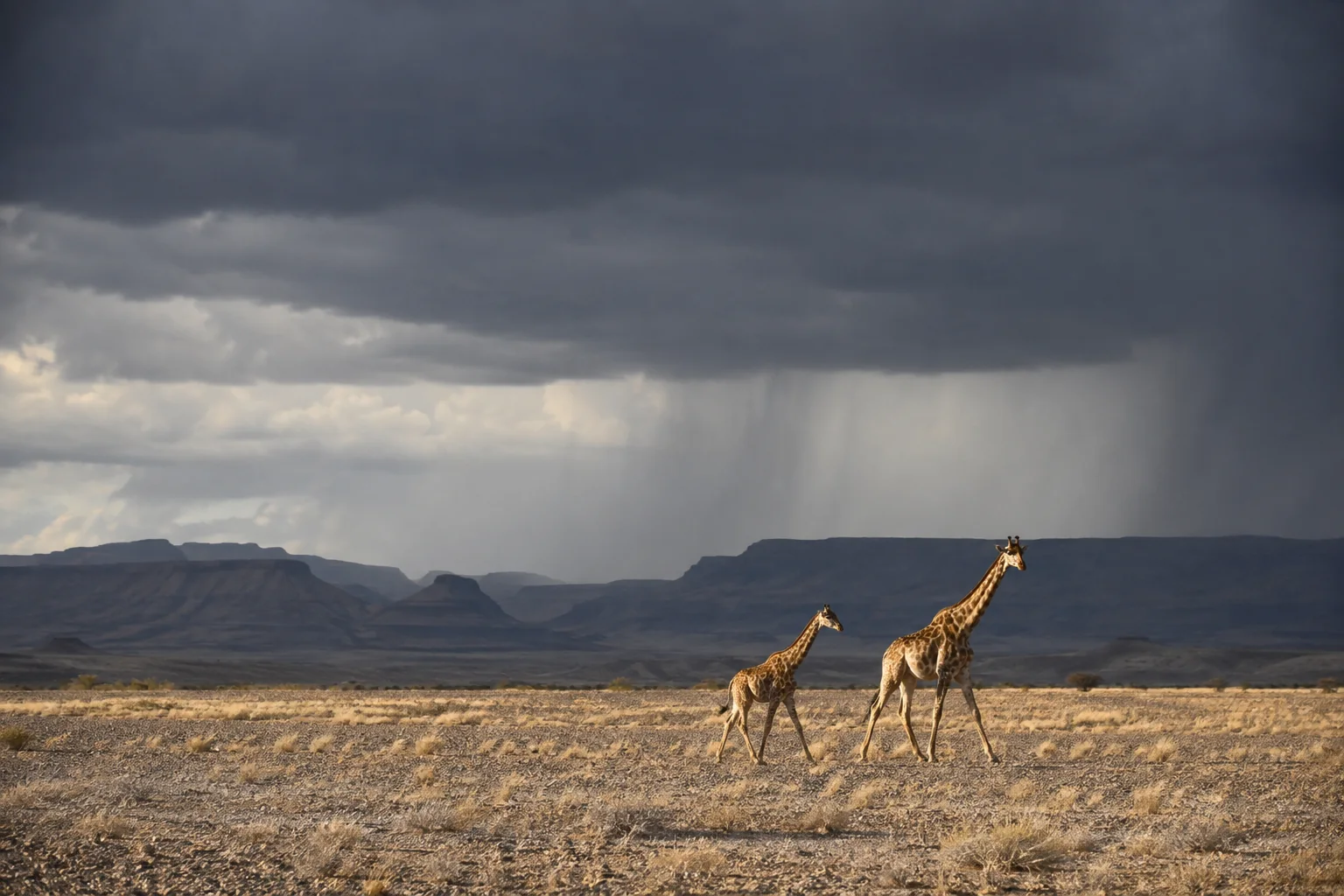
Five new calves. More giraffes using an area after protection changes. A declining population moving closer to stability. Each can be a meaningful conservation gain, but each tells a different story. If we judge every project only by whether its headline count rises, we can overlook useful progress—or celebrate a change that had a different explanation.
What does successful giraffe conservation look like?
Conservation tries to change the conditions that determine whether giraffes can persist. That can mean maintaining land they can use, reducing damaging pressures or restoring a population where it has disappeared. Success becomes understandable when the action is connected to an outcome: what changed for the animals, where, and over what period?
The examples below show three kinds of evidence. A Tanzanian wildlife-area study measured local density. Another examined survival and population growth rates after management changed. A Niger case report documented giraffes being reintroduced and subsequently reproducing. Those are useful achievements to examine individually, not interchangeable endorsements of every conservation programme.
For the wider problem, read why giraffes are threatened and the guide to giraffe threats. This page focuses on the next question: what evidence tells us that an action is helping?
The giraffe conservation glossary explains density, apparent survival and reintroduction in plain language.
Randilen: more giraffes using a protected area
Randilen Wildlife Management Area in Tanzania began operating in May 2014. Patrols were intended to reduce illegal hunting and livestock and pastoralist presence. Lee and Bond's 2018 study compared giraffe density there with nearby Lolkisale before and after the change.
The comparison matters. A wet year or wider population shift could affect both places. Researchers therefore used 2012–2013 as the baseline, treated 2014 as a transition and examined 2015 as the first full year afterwards. Giraffe densities had not differed detectably before establishment; afterwards, estimated density was higher in Randilen.
This was a positive short-term local result. The authors considered redistribution a likely explanation: giraffes may have shifted into the wildlife area. More animals using the area is not the same as more being born across the landscape. One impact site, one comparison and a single full post-change year also limit generalisation.
The finding gives a concrete reason to investigate how protection changes habitat use. It does not establish benefits to local livelihoods, which the study did not measure.
Burunge: improvement before population growth
In Little Chem Chem, a subsection of Tanzania's Burunge Wildlife Management Area, a 2014–2015 change combined photographic tourism replacing sport hunting with greater ranger and resource-protection support. Derek Lee's 2018 evaluation compared giraffe demographic estimates before and afterwards with an adjacent Tarangire National Park comparison.
Estimated apparent survival and seasonal population growth rate improved in the intervention subsection. But the plotted growth-rate estimates remained below one: the estimated decline became slower, rather than turning into net growth. That is a meaningful distinction between improvement and recovery.
What does “apparent survival” mean?
It combines remaining alive with not permanently leaving the study area. The estimate cannot distinguish death from permanent emigration. The bundled intervention, short post-change period and one impact–comparison pair also prevent isolating the contribution of each action. PAMS, which supported the intervention, was among the study's funders.
This is evidence from Little Chem Chem, not proof that the entire Burunge population increased. The giraffe survey-methods guide explains how photographic histories produce estimates rather than a simple tally of sightings.
For the people-and-practice side of protection, the ranger work guide explains roles, patrol records and professional accountability.
Niger: restoring giraffes, then recording births
Operation Sahel's 2024 case report, by Richard Harvey, Sara Ferguson and Julian Fennessy, describes moving 12 West African giraffes to establish a second population within their historical range in Niger. Eight moved in 2018 and four in 2022.
The authors reported no mortality during the operations or post-translocation, without a separate mortality cutoff. They also recorded five calf births by the end of 2023. That is an encouraging reproductive outcome after reintroduction, not merely a photograph of animals arriving.
The next questions concern those calves' later survival, population trend and persistence. The report does not estimate them, so the five births should not become a claim that a self-sustaining population has already been demonstrated.
This example gives reintroduction a purpose beyond moving animals: restoring a population in another part of its range. Our Operation Sahel commentary examines the report closely; the translocation guide explains the wider decisions and monitoring involved. This is not a handling or veterinary tutorial.
Three results that should not share one label
This original comparison keeps the measured result beside the action. It is a reading aid, not a ranking of organisations or a reanalysis of the researchers' data.
| Case and action | What the evidence showed | What success means here |
|---|---|---|
| Randilen: wildlife-area establishment and patrols | Higher local giraffe density after management changed, relative to a nearby comparison | A short-term habitat-use response, potentially involving redistribution |
| Little Chem Chem: tourism and protection management changes | Improved apparent survival and growth-rate estimates, with growth still below stability | Better demographic performance, not demonstrated population expansion |
| Operation Sahel: staged reintroduction | A completed reintroduction and five recorded births by end-2023 | An early reproductive milestone, with establishment still to assess |
These distinctions help a reader follow progress rather than demand an instant final result. A project can achieve an early objective and still need further work. Conversely, a reassuring description of activities is not enough to establish that an animal or population benefited.
Ask what the next useful observation would be. For habitat use, it could be whether the pattern persists and what happens in neighbouring areas. For demographic improvement, it could be sustained survival and a stable or increasing trend. For reintroduction, it could be offspring surviving into later age classes. The next question follows from the result already measured.
Do local gains add up to wider recovery?
Looking across a landscape
A 2024 study by Kiffner and colleagues compared herbivore densities across six Tarangire Ecosystem management units. Community conservation areas had giraffe densities comparable to those in national parks, while the area with fewer conservation interventions had much lower giraffe density.
The analysis brought together data from 2011–2019, but each site's window differed. Randilen's data covered 2012–2015 and reused earlier surveys; this was not an independent long-term follow-up of its 2018 study. Methods and local trends also differed. The broader comparison supports the value of community-managed landscapes, not a claim that every site followed one uninterrupted recovery curve.
Reading the continental picture
In its five-year comparison, the June 2025 State of Giraffe report classified northern, reticulated and southern giraffes as increasing and Masai giraffes as stable. Those are encouraging dated trend classifications, not experiments identifying what caused them. Better coverage and changing estimation methods can also affect a reported total.
Keep the report as context and the local studies as evidence about particular actions. Our State of Giraffe reader's guide explains the report's methods; how many giraffes are left keeps different population estimates and dates separate.
People and habitat belong in the result
Community conservation is more than wildlife occurring outside a national park. It raises questions about who makes land-use decisions, who carries costs and who receives benefits. A wildlife-density study cannot answer all of them. Counting giraffes and assessing fairness require different evidence.
For a public account, look for three connected parts:
- Usable habitat: what conditions the land provides and whether animals can continue to use it across seasons. The habitat guide explores why an area on a map is only the starting point.
- Local decision-making: whose land and livelihoods are affected, how decisions are made and how disagreements can be raised. Do not assume a project name demonstrates consent or good governance.
- Documented benefits and costs: what residents actually experience, rather than a promise that tourism will eventually help everyone.
These are questions for evaluating a project, not claims that every example above answered them. A report can show an ecological gain while leaving social outcomes unmeasured. Recognising both keeps support for giraffes connected to the people sharing their landscapes.
How good conservation projects learn
A useful account does not end at “success”. It explains what managers and researchers learned and what that changes next. The studies above are valuable because their results are inspectable: a reader can distinguish the intervention, comparison and outcome.
Start with an outcome, then choose a measure
“We want giraffes to persist here” needs a more specific near-term question. Is the immediate concern animals leaving suitable land, poor survival, or the absence of a breeding population? The cases illustrate different measurements for different questions. One metric should not silently stand in for all three.
Keep activity and benefit connected
A patrol, survey or translocation is an activity. It can be necessary without being the final benefit. Reporting both the work and its outcome makes the story more useful: what was done, what changed, how the change was measured, and what else might explain it?
This does not mean conservation must wait for a perfect experiment. Essential protection should not be withheld to create a comparison. It means learning from the best feasible observations and being clear about their limits.
Follow up beyond the announcement
An early improvement creates a next question, not a permanent guarantee. Continued observation can reveal whether an encouraging pattern persists or a new problem needs attention. A disappointing result is also useful if it leads to an evidence-based adjustment rather than disappearing from the public account.
Readers can encourage that standard by valuing specific, follow-up reporting over dramatic totals. The how to help giraffes guide applies the same approach to public conservation claims without offering an unsupported ranking of charities or projects.
What to remember
- Local studies provide real reasons for optimism about giraffe conservation.
- Habitat use, demographic improvement and reproduction are different outcomes.
- A better growth rate can still mean decline; births alone do not establish persistence.
- Wider estimates provide context, not proof that one intervention caused a continental trend.
- People, habitat and long-term follow-up belong beside the wildlife result.
Frequently asked questions
Does giraffe conservation really work?
There is evidence of positive local outcomes, including those described here. The useful answer names the place, action, outcome and follow-up. It is not a guarantee that every approach works everywhere or that all giraffe populations are recovering.
Does a higher count prove a project succeeded?
Not by itself. Animals may have moved into the surveyed area, observation may have improved, or the population may genuinely have grown. Compare methods and geography, then ask what evidence connects the change to the project.
Is moving giraffes enough to save them?
Movement can be part of a planned reintroduction, but its value depends on the destination, source population, welfare and subsequent outcomes. Reproduction is an important milestone; persistence needs longer follow-up.
Should a project report results that fall short?
Yes. A clearly reported partial improvement or setback helps readers understand what remains to do. It also gives future work a baseline. Honest follow-up is more useful than turning an early milestone into a promise the evidence cannot support.
Sources
- Lee and Bond, 2018 — Randilen wildlife-area evaluation.
- Lee, 2018 — Burunge conservation-effectiveness study.
- Harvey, Ferguson and Fennessy, 2024 — Operation Sahel case report.
- Kiffner and colleagues, 2024 — broader Tarangire landscape comparison.
- GCF, State of Giraffe 2025 — inspected version 2.
Reviewed 10 September 2026. This is a general-reader synthesis, not a new analysis of the authors' data or an endorsement attributed to the researchers. The image is an illustration, not a photograph of a project or evidence of recovery.