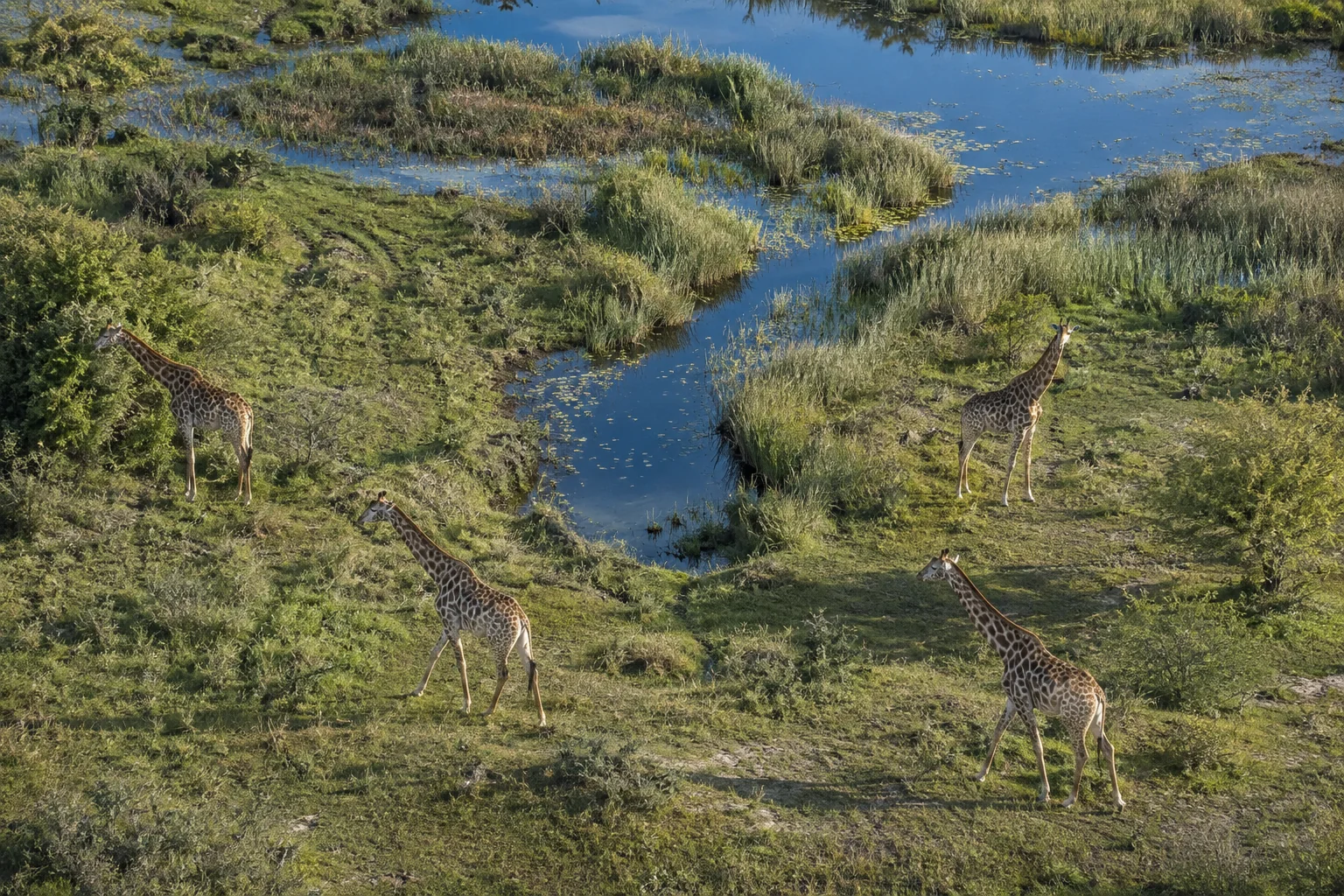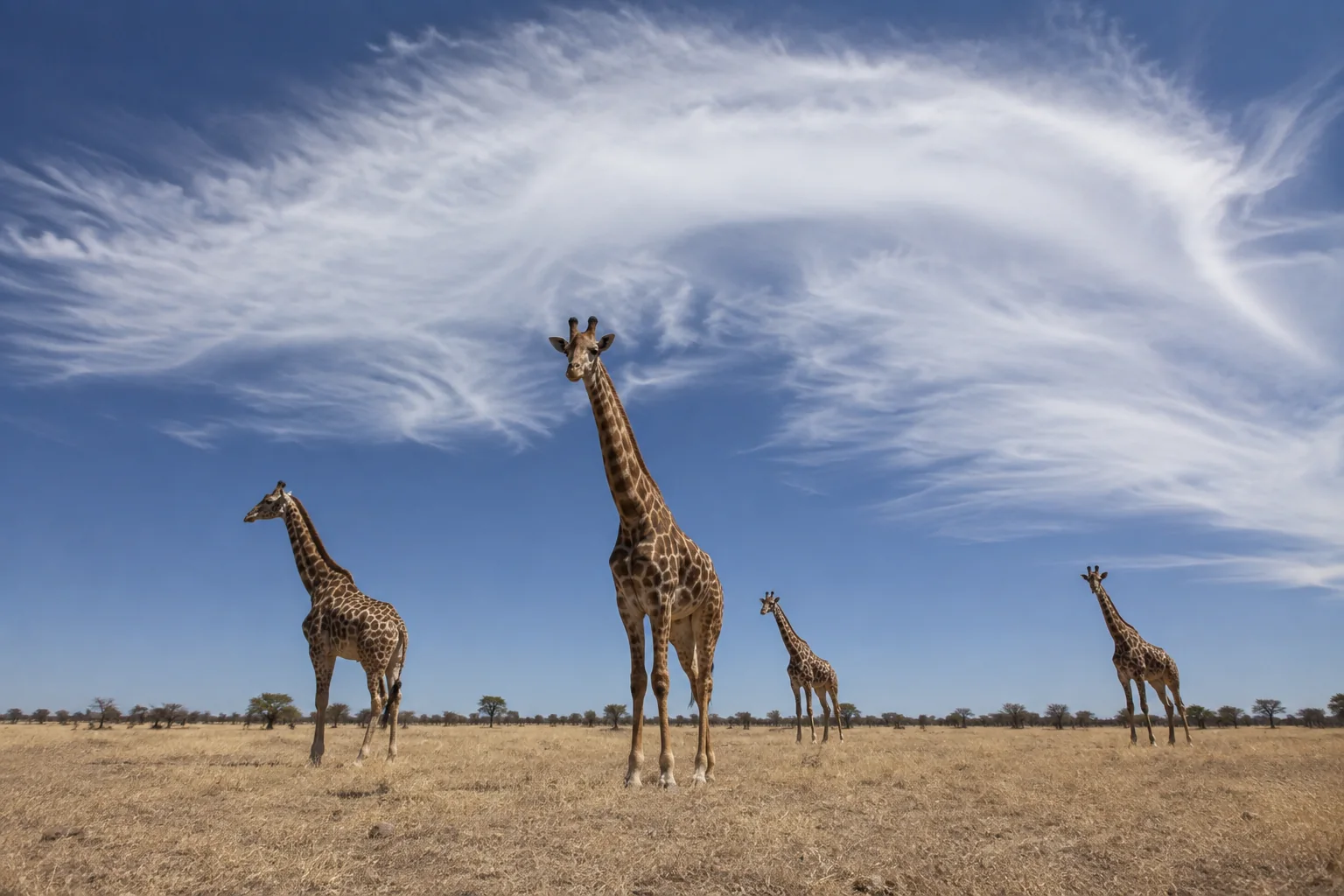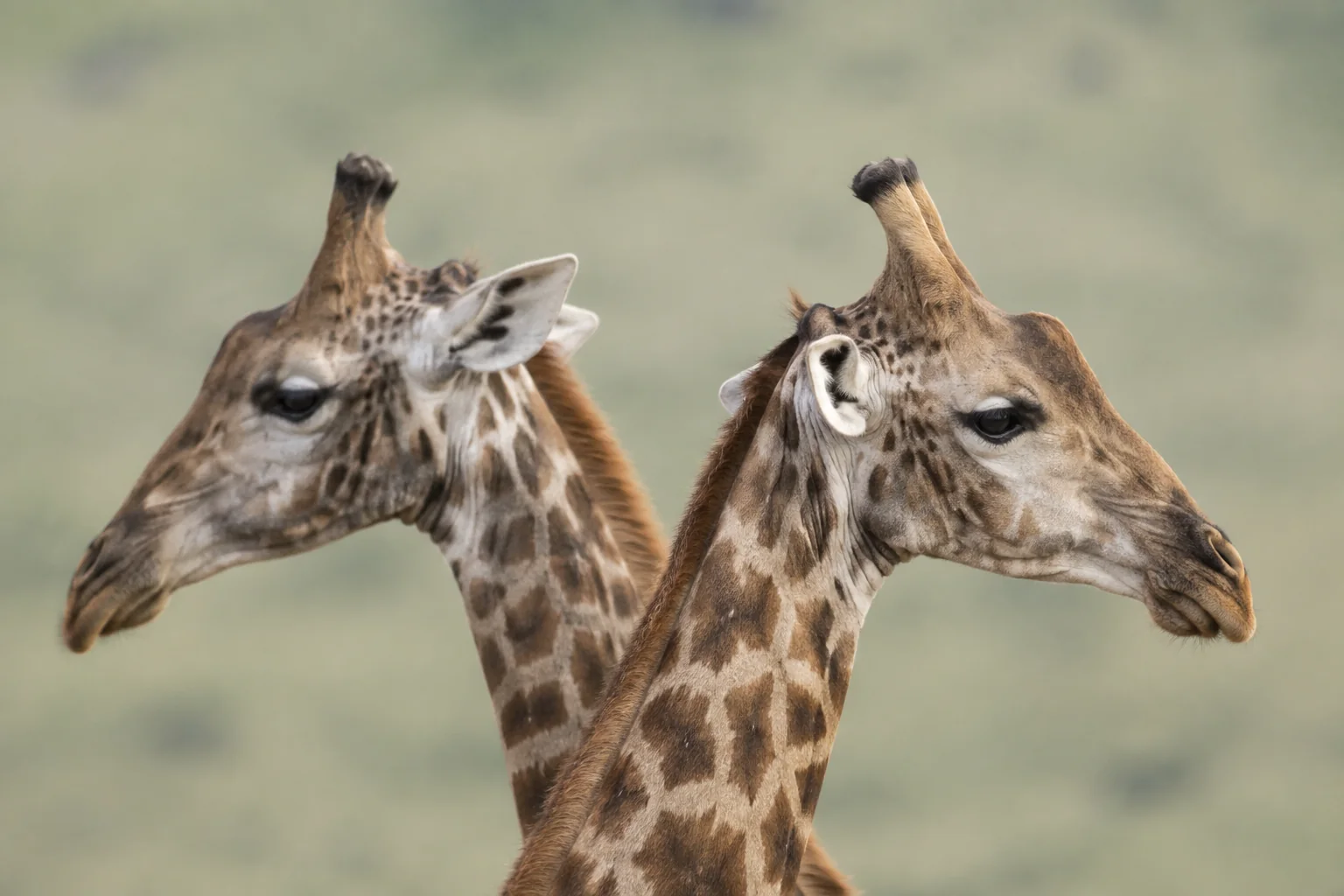
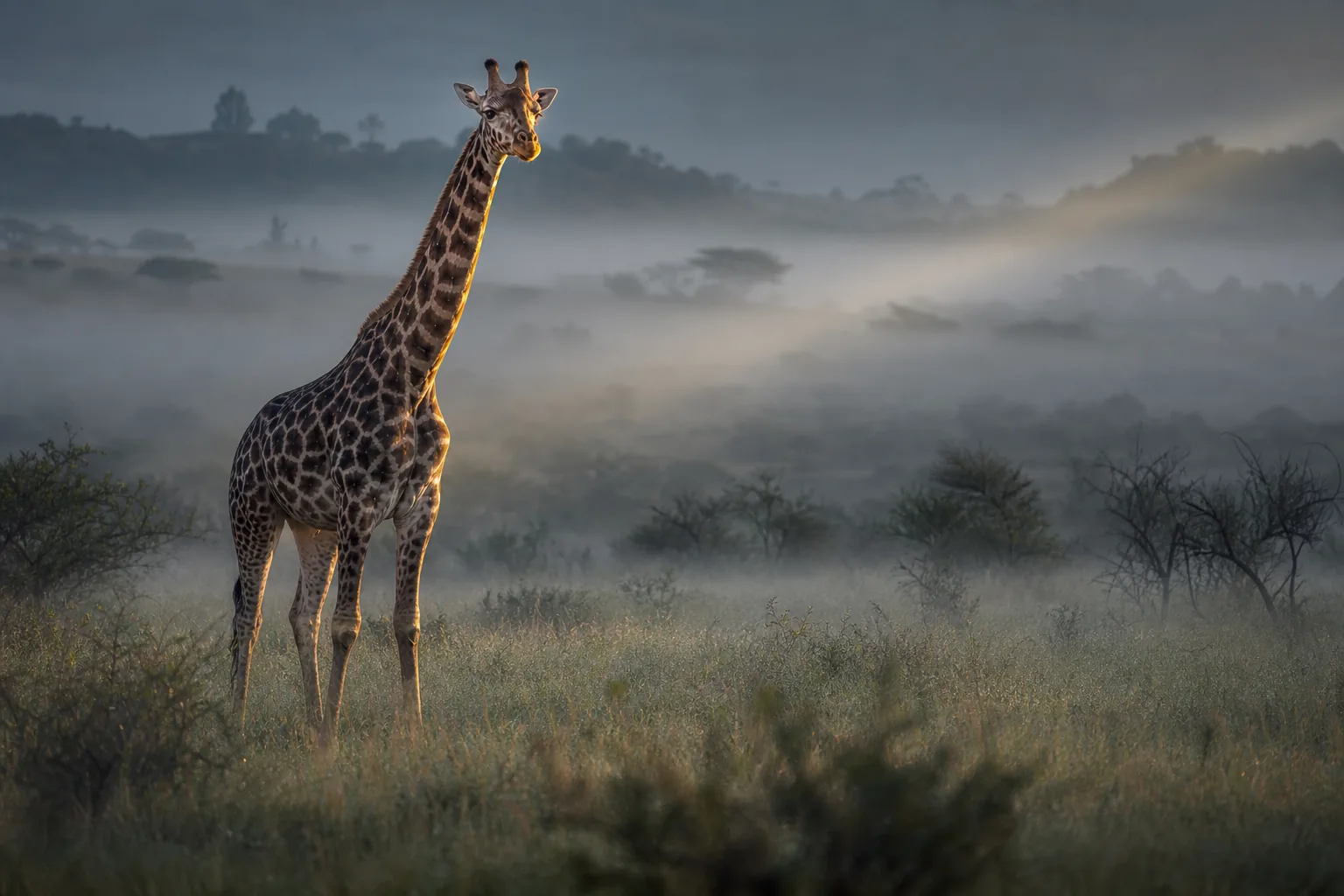
A reticulated giraffe's coat is a striking advertisement for an animal whose conservation needs are less obvious. Protecting a place where it stands today is not necessarily enough to protect the routes it needs tomorrow. This is a species of shared dryland landscapes, and understanding its future means looking beyond the portrait: at food, movement, land use and the changing evidence about how many remain.
What makes a reticulated giraffe distinctive?
The reticulated giraffe, Giraffa reticulata, is one of the four recognised giraffe species, not simply a colour variety. It has no recognised subspecies in the classification adopted by the IUCN SSC Giraffe and Okapi Specialist Group on 21 August 2025.
Look for substantial orange-brown patches separated by a pale network, giving the impression of a net stretched across the coat. The lines continue down the legs. The Giraffe Conservation Foundation's species profile describes this characteristic pattern and places the main range in northern and northeastern Kenya.
That combination of appearance and location is a useful starting point. It is not a rule that every photograph can settle. An image may hide the legs or flank, omit the location, or show an animal whose background is unknown.
Identification is a clue, not a genetic test
A 2023 genomic study by Coimbra and colleagues analysed 128 wild giraffe genomes from the Nubian, reticulated and Masai groups, mainly in Kenya. It found evidence of historical mixing between Nubian and reticulated lineages in Laikipia, while supporting their overall genetic distinctness. The authors explicitly caution against identifying giraffe species from coat characters alone, especially locally.
This does not make field identification pointless. It sets the standard of confidence: a plausible identification is different from evidence strong enough to guide the movement of animals between populations. Identifying an individual from repeated photographs is another question again; our coat-pattern guide explains that distinction.
Where reticulated giraffes live
Kenya is the centre of the documented range. Important landscapes include Wajir and Garissa in the northeast and the Laikipia–Samburu region farther west. These names matter because “Kenya” alone can suggest a single continuous population or a collection of famous national parks. Neither is an adequate picture.
Reticulated giraffes also have a natural range extending into southern Ethiopia and Somalia. The June 2025 State of Giraffe report stresses that information there is sparse or outdated, with insecurity obstructing systematic surveys. Small reported populations should not be presented as well-monitored equivalents of Kenya's strongholds.
Kenya's connected working landscapes
The species is not confined to government-managed protected areas. Community and private lands are central to its range. Consequently, the conservation question is not just how much land has a protected label, but what giraffes can do across adjoining properties.
Imagine two suitable feeding areas separated by an impassable fence. Both may remain green on a habitat map, yet their usefulness to an animal moving between them has changed. Conversely, a working landscape need not be empty of wildlife to support livelihoods. The practical question is which land uses, boundaries and seasonal arrangements permit both to persist.
Our habitat and range guide covers the wider geography. For reticulated giraffes, keep the landscape between named sites in view as well as the sites themselves.
How many reticulated giraffes are left?
There is no responsible single-number answer without a source date and geographic scope. Two 2025 publications now need to be distinguished:
| Source | Geographic scope | Reported estimate | How to read it |
|---|---|---|---|
| GCF, State of Giraffe 2025, June synthesis | Species across its range | 20,901 | Historical all-range synthesis; reported +31% over five years and −42% over thirty years |
| Kenya, National Wildlife Census 2025 | Kenya only | 31,201 | Later national estimate; not an updated global total |
The national figure comes from Table 4.8, page 50 of the WRTI-linked census report. Its methods include aerial total counts and aerial sample-based estimates. Some entries were carried forward: the reticulated chapter says Mandera and Turkana were not resurveyed. “2025 census” therefore does not mean every animal in the total was newly observed that year.
Why the figures must not be combined
The later Kenya-only estimate exceeds the earlier global synthesis. That is a reason to update how the older number is described, not evidence that thousands of animals appeared between publications. Different source datasets, coverage and estimation decisions must be reconciled before making a biological comparison.
Do not add the two figures: Kenya is already part of the global figure. Nor should the later Kenyan result simply be substituted into the old table alongside unchanged estimates elsewhere and labelled a new global assessment.
For a school assignment or news report, a defensible sentence is: “Kenya's 2025 national census reports an estimated 31,201 reticulated giraffes.” If discussing the earlier all-range synthesis, name GCF and June 2025 explicitly. Our population guide explains why source versions matter, and the survey-methods guide explains the underlying counting problem.
What Endangered means after the taxonomy change
Reticulated giraffes were assessed as Endangered in 2018, under the older subspecies name Giraffa camelopardalis reticulata. That dated assessment should not be silently rewritten as a newly completed assessment of Giraffa reticulata.
As checked on 6 September 2026, GCF's conservation-status page still distinguishes existing Red List listings from expected four-species categories and says new assessments are underway. Giraffes collectively remain listed as Vulnerable under the older single-species assessment. A proposed future category is not an official replacement.
The apparent contradiction is therefore largely about different questions. Taxonomy asks which species an animal belongs to. A Red List assessment evaluates extinction risk for a specified taxon using stated evidence and criteria. Recognising a species does not automatically complete that second process, and a larger population estimate does not itself remove a threatened category.
For the full distinction between current listings, older names and recommendations, see are giraffes endangered?.
Food, water and movement in a dry landscape
Reticulated giraffes are browsers: leaves and other parts of woody plants matter more to their feeding than a carpet of grass. Their long tongue and mobile lips help them gather foliage, including among thorns. Like other giraffes, they are ruminants, bringing food back to the mouth for further chewing. These are general giraffe feeding adaptations, described by San Diego Zoo Wildlife Alliance, not findings from a reticulated-only feeding experiment.
Foliage also supplies moisture. That helps explain how giraffes can go without frequent drinking, but it does not mean water scarcity is irrelevant. Food and water are not wholly separate resources when leaves supply both. The diet guide explores browsing in more detail.
For a reader looking at dryland habitat, the useful distinction is between having vegetation and having accessible food. A distant stand of suitable trees cannot help an animal that cannot reach it. Likewise, the presence of a water point does not establish that surrounding feeding habitat is adequate. Conservation planning has to consider the combination, not treat each resource as a box to tick.
What a Laikipia tracking study can tell us
A 2026 study by Boudreaux and colleagues examined movement around Loisaba and Mpala conservancies. Its analysis used 14 reticulated giraffes and selected GPS records from 2017 and 2019. It compared observed movement steps with alternatives available to the animals, then modelled landscape connectivity.
Within Loisaba, the animals selected movement through moderately covered vegetation and around water features in both seasonal analyses. This is more specific than saying giraffes “like savanna”: vegetation structure and the arrangement of resources help distinguish usable routes within it.
However, the sample was small, the analysis pooled animals rather than separating age, sex and group effects, and detailed landscape data were limited. Its connectivity maps predict where movement may be channelled; they do not prove that a corridor has been secured or that a conservation intervention increased survival. Our Laikipia GPS research commentary follows the steps from recorded locations to corridor predictions and asks how those predictions could be checked.
A further caution concerns movement near roads. The study found an association, not evidence that building roads benefits giraffes. Several explanations are possible, including where suitable habitat and existing roads coincide. The habitat-fragmentation evidence area connects this question to wider research.
Threats and conservation priorities
Kenya's 2023–2027 giraffe recovery plan identifies a concrete mixture of pressures for reticulated giraffes in Samburu, Laikipia and Isiolo: illegal killing, fences and blocked corridors, charcoal production, invasive plants, and drought-related shortages of forage and water. It also identifies livestock competition as a concern. These are planning priorities for named landscapes, not a measurement of how much each factor contributes everywhere.
The mechanisms differ. Illegal killing removes animals directly. Loss of browse reduces feeding opportunities. A blocked route changes access even when habitat on either side survives. During resource shortages, these pressures can overlap, making an isolated intervention an incomplete answer.
Livestock presence alone does not establish competition severe enough to drive a population decline. That requires evidence about shared resources, timing and consequences for giraffes. Equally, describing an area as a conservancy does not demonstrate that every relevant threat has been reduced.
The national plan's priorities include protection, habitat, coordinated monitoring, community participation and wildlife-compatible infrastructure. They describe work to undertake, not a certificate of completed recovery. The wider threats guide explains why distinguishing these mechanisms matters.
What would count as convincing conservation progress?
For this species, useful progress reporting should connect a named place to a specific result. “More giraffes recorded” needs a survey comparison. “A route reopened” needs evidence that the obstruction changed and animals can use the route. “Coexistence improved” needs information about local people's experiences as well as wildlife observations.
These are related achievements, but they are not interchangeable. A catalogue of identified animals is valuable monitoring infrastructure; its existence does not establish improved survival. A new land agreement can be important, but hectares under agreement do not by themselves measure safe movement or adequate food.
Ask which outcome was measured, over what period, and what else changed. If an organisation attributes a population increase to its programme, look for evidence linking the intervention to that change and addressing alternative explanations. That standard allows genuine progress to be recognised without turning every encouraging number into a conservation success story. Our guide to evaluating giraffe conservation develops that question further.
What to remember
- The net-like coat is useful for recognition, but photographs alone cannot settle every species identification.
- Kenya is the main documented stronghold; evidence across the rest of the range is much thinner.
- Keep the June 2025 global synthesis separate from Kenya's later national estimate.
- The existing Endangered listing and the 2025 taxonomic change are different decisions.
- Reticulated giraffe conservation needs accessible habitat, evidence about threats and participation by the people sharing the landscape.
Frequently asked questions
Are reticulated giraffes the same as Somali giraffes?
“Somali giraffe” is another name used for the reticulated giraffe, including in Kenya's recovery plan. It does not mean the species lives only in Somalia; its main documented range is in Kenya.
How can I recognise a reticulated giraffe?
Look for orange-brown patches divided by a conspicuous pale network, including down the legs, and check the location. Treat this as a field clue rather than a universal diagnostic test, particularly for animals of unknown origin.
Is 20,901 still the number left in the world?
It is the estimate in GCF's June 2025 all-range synthesis. The later Kenyan census reports a higher national estimate, so 20,901 should not be presented as a definitive current worldwide total. A revised global synthesis needs to reconcile the evidence.
Does a higher estimate mean reticulated giraffes are safe?
No. First establish what is comparable and how the estimate was produced. Then consider distribution, threats and extinction-risk assessment separately. A larger reported total cannot demonstrate that every local population is secure or explain which actions produced a change.
Sources
Sources were checked on 6 September 2026. Links beside the relevant claims identify the evidence used here. The two primary research papers are available as lawful open-access full text through their DOI links.
For the population comparison, use GCF's permanent State of Giraffe 2025 record and the census linked from WRTI's official downloads page. In the census, Table 4.8 is on printed page 50; the overview of survey methods is on pages 4–5. These publications have different scopes and must remain separately attributed.