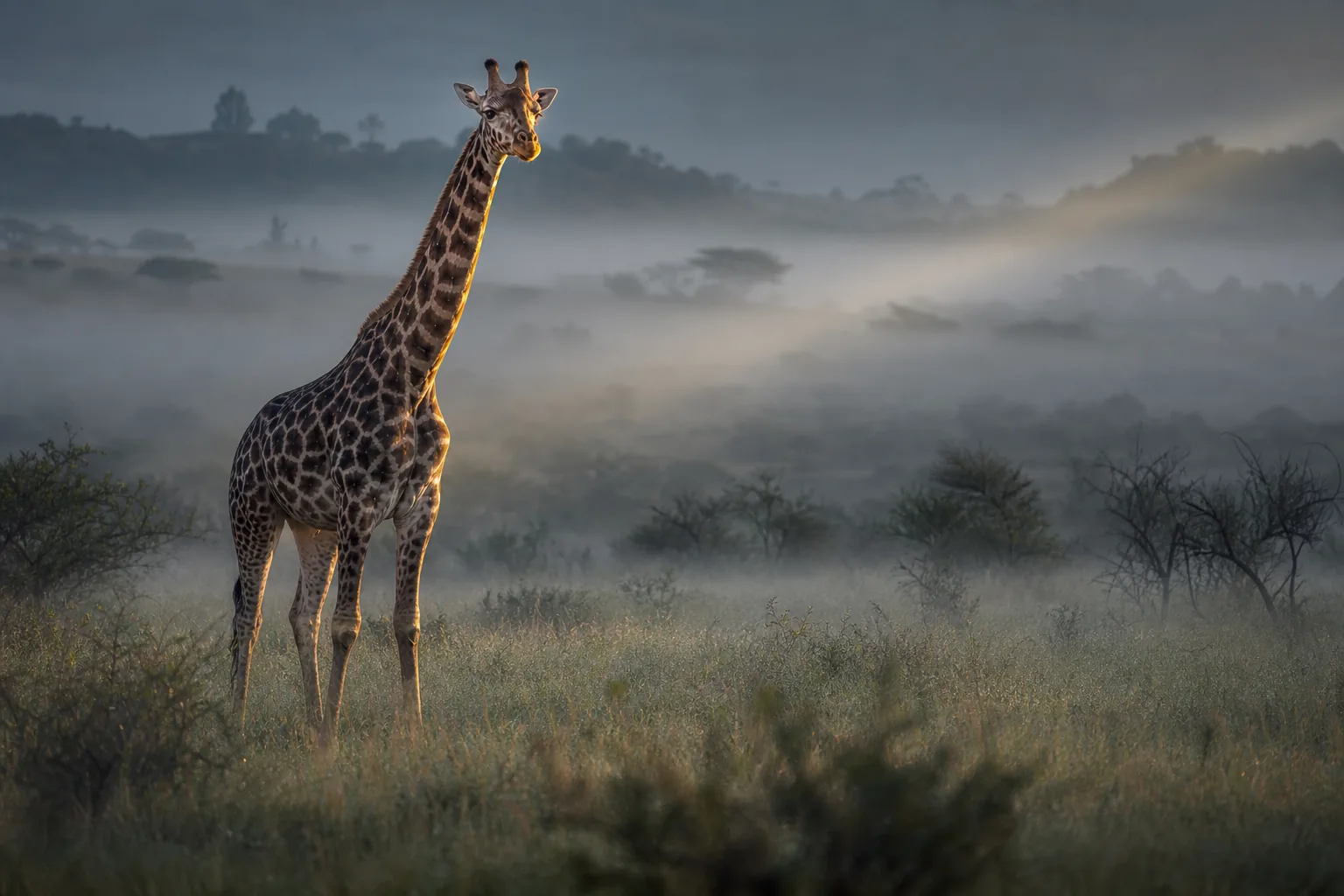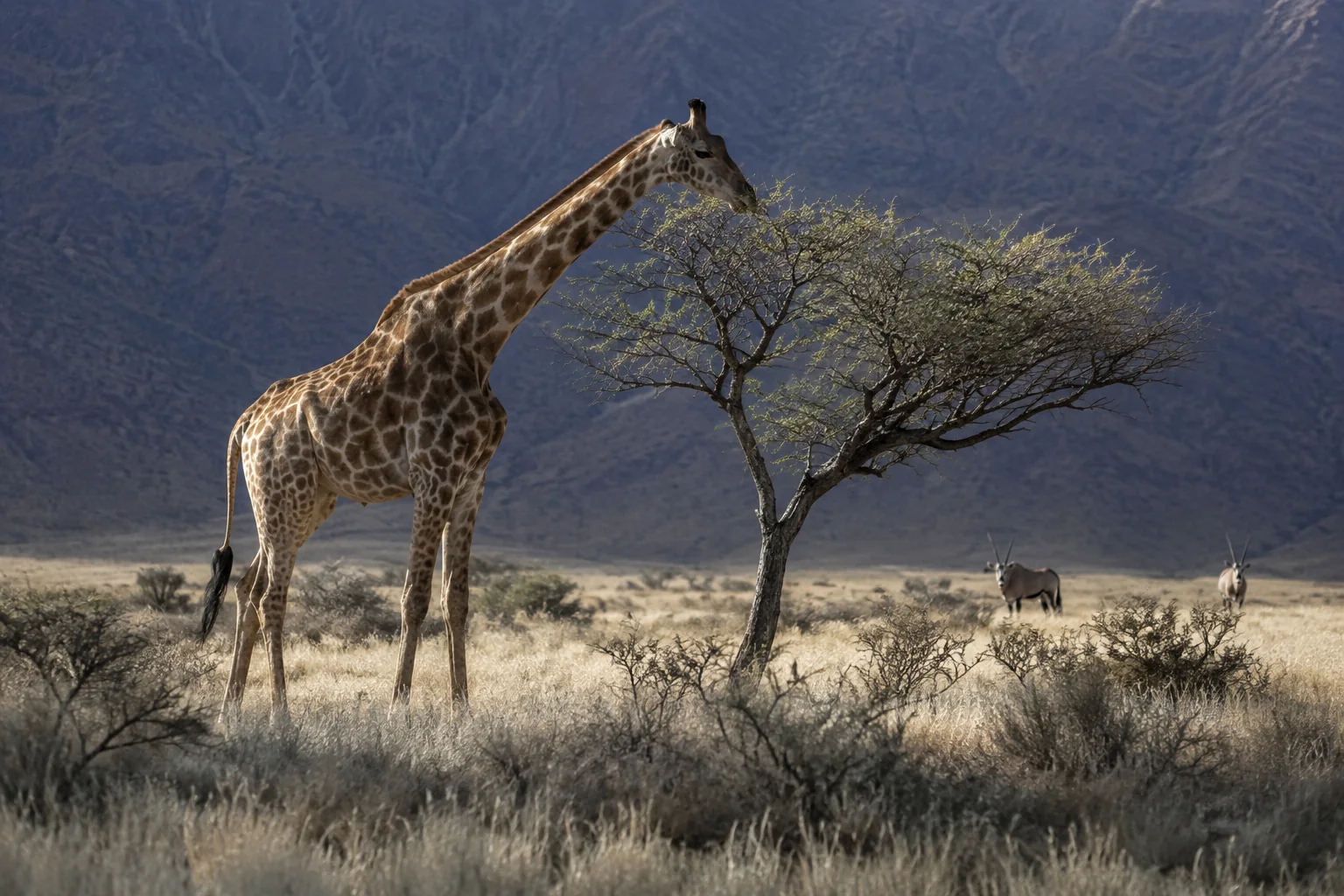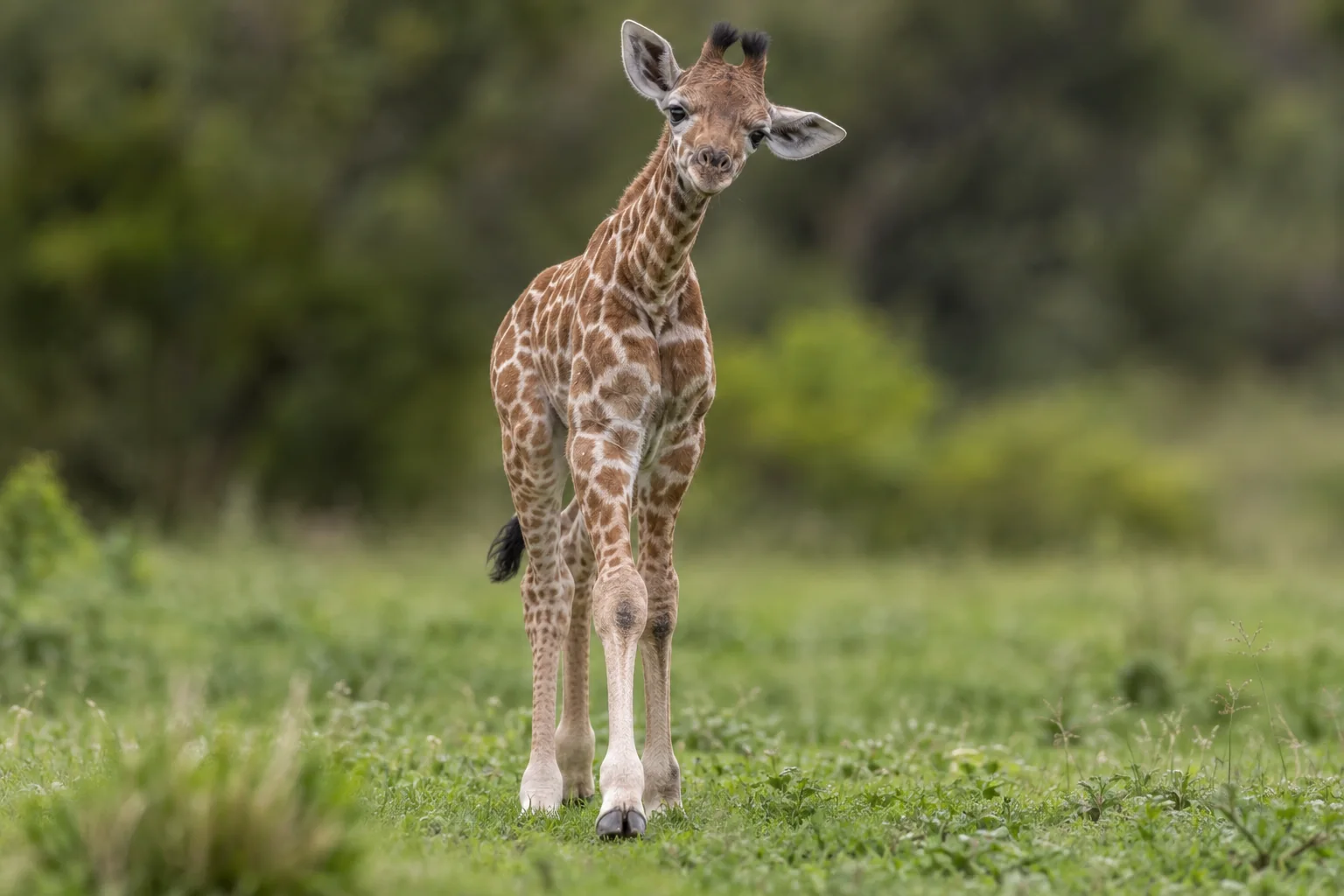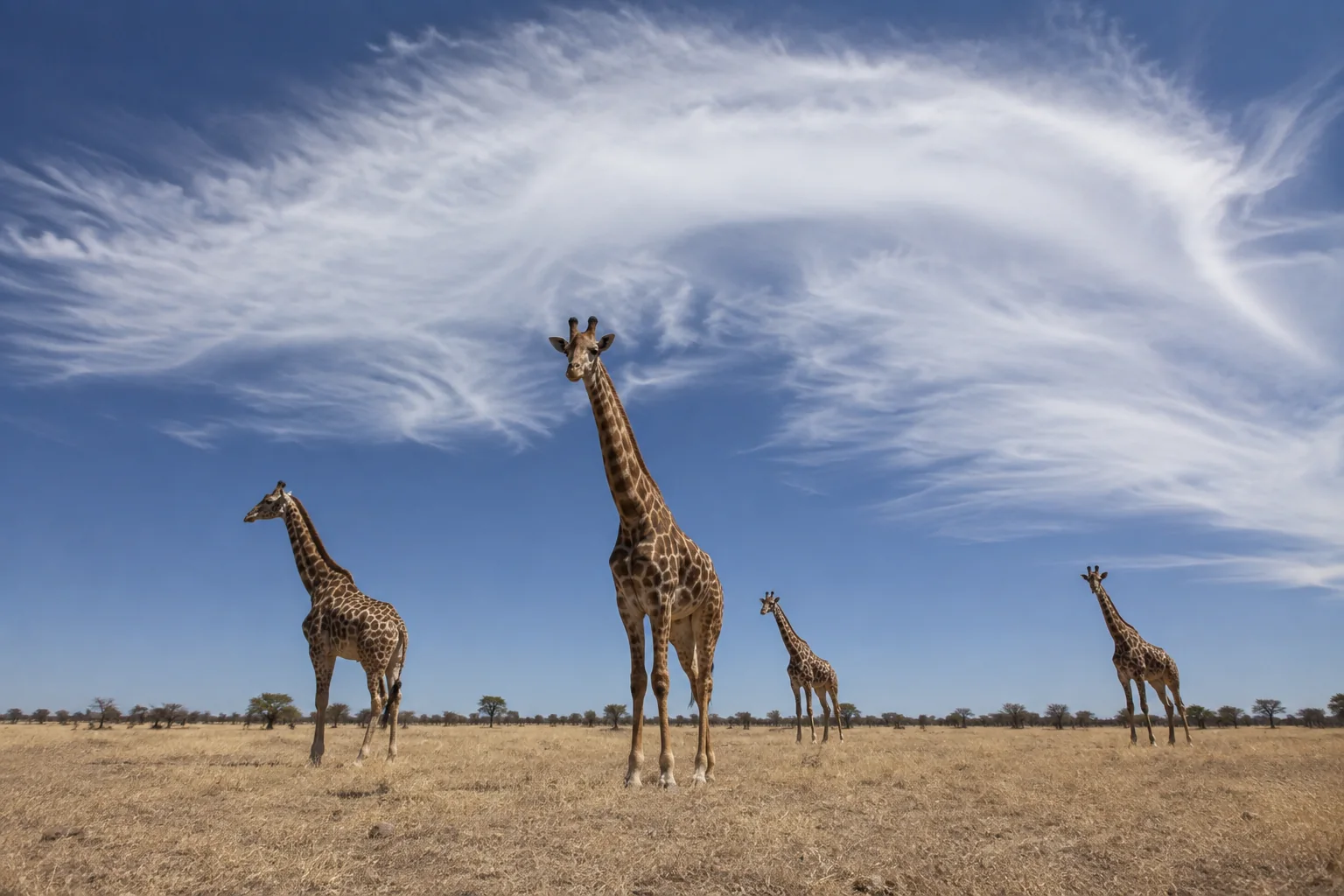
Put every giraffe in Kenya into one total and three different conservation stories disappear. Reticulated giraffes in northern drylands, Masai giraffes in southern landscapes and Nubian giraffes in scattered populations all contribute to that number. To understand what Kenya is protecting, start with the animals and their places—not just the headline count.
Which giraffes live in Kenya?
Kenya's national reports distinguish reticulated, Masai and Nubian giraffes. These are three useful country-level groups, but their names do not all occupy the same taxonomic level. In the four-species framework recognised by the IUCN SSC Giraffe and Okapi Specialist Group in August 2025, Nubian giraffe is a subspecies of northern giraffe. Kenya's Masai giraffes belong to the Masai subspecies, G. t. tippelskirchi, whose range is not confined to Kenya.
This original source map puts those names beside the 2025 national census report's figures. Counts are attributed to that publication, not presented as the number alive today.
| Giraffes in Kenya | Current placement | Broad Kenyan geography | Reported 2025 figure |
|---|---|---|---|
| Reticulated | Species: Giraffa reticulata | Northern and northeastern Kenya, including Laikipia | 31,201 — Table 4.8, p. 50 |
| Masai, also spelled “Maasai” in the report | Masai subspecies: G. tippelskirchi tippelskirchi | Southern Kenyan landscapes | 10,410 — Table 4.6, p. 48 |
| Nubian, including Kenyan populations formerly labelled Rothschild's | Subspecies of northern giraffe: G. camelopardalis camelopardalis | Scattered current populations, particularly central and western Kenya; management history matters | 1,388 — Table 4.7, p. 49 |
The census programme ran from June 2024 to August 2025, using different survey methods and some earlier records. The three table entries sum to 42,999, whereas the report's national summary prints 43,002. Its Nubian table also has a conflicting outer year heading. Both issues are explained below and retained in the downloadable data; neither has been silently corrected.
Why older names can be confusing
An older Kenyan source may say “Rothschild's” where a newer one says “Nubian,” or “Somali” for reticulated giraffe. Do not count these alternative labels as additional giraffe groups. Conversely, a biological hierarchy matters: Nubian and northern are not interchangeable geographical labels. Nubian is one subspecies within the wider northern species.
Our four-species guide explains the full framework. Here, the important task is matching each Kenyan report entry to the animals it describes. That also means checking the source's date before carrying its classification into a new article or lesson.
Three groups, different landscapes
Reticulated giraffes: northern and northeastern Kenya
The national census describes a broad northern and northeastern distribution, including Laikipia. A country boundary alone does not capture the variety within that range: a national figure brings together records from different survey areas rather than describing one continuous herd.
For readers, this is the first useful connection between the map and conservation. Ask which landscape a study covered before treating its finding as a result for every reticulated giraffe in Kenya. A local habitat study and a national census have different jobs. The reticulated giraffe profile covers the animal, its dryland setting and the detailed national-versus-global estimate comparison.
Masai giraffes: southern Kenyan landscapes
Kenya's Masai giraffe records include southern ecosystems such as Amboseli, the Athi-Kapiti landscape, Tsavo and the Masai Mara. These names help locate the story, but an ecosystem survey area is not automatically identical to the park or reserve carrying a similar name.
That distinction becomes important when comparing census tables. A row labelled Masai Mara, for example, can cover a much wider reporting area than a visitor imagines from the reserve's name. The Masai giraffe profile explains the species and its wider East African context; the worked example below stays with the Kenyan report.
Nubian giraffes: current occurrence needs a history
For Nubian giraffes, “where they are now” and “where they occurred naturally” are especially important to separate. The abstract of Muneza and colleagues' 2024 Kenyan review describes the population as predominantly extralimital and/or restricted to closed protected areas in central and western Kenya. Extralimital means outside the native range used by the source; a closed population has restricted movement into and out of it.
This makes management history part of reading a distribution map. A point showing present occurrence is not, on its own, a map of historical range or evidence of a freely connected population. The northern giraffe profile explains Nubian identity and conservation history in more detail. This guide does not list small populations or individual animals' locations.
How many giraffes are in Kenya?
About 43,000 in the 2025 national report is the concise answer supported by this source. The Wildlife Research and Training Institute's official downloads page links the National Wildlife Census 2025 Technical Report. The abridged PDF's Table 4.2, printed page 16, reports 43,002 nationally.
There is a small unresolved arithmetic discrepancy: the three group figures printed in that summary and the detailed giraffe tables add to 42,999, three fewer. We preserve the published total as a reported total and show the separate calculation. The difference is a source inconsistency, not a confidence interval and not evidence that three identifiable animals were lost.
The Nubian table has another reporting ambiguity. Its outer column heading says “Year 2022,” while the nested count heading and surrounding 2025 discussion identify the figures as 2025. We follow the latter when labelling the 1,388 entry, with this conflict attached.
There are larger scope questions than that three-animal discrepancy. The report explicitly says that Mandera and Turkana were not resurveyed for the reticulated entry and earlier values were retained. Its Nubian inventory includes managed facilities. Consequently, the national total should not be described as a simultaneous new count of exclusively wild giraffes.
For the global figure, use the separate world population guide. Do not simply substitute a later Kenyan figure into a global synthesis: the sources can differ in definitions, included populations, coverage and dates.
Open the Kenya census data snapshot as JSON. It contains the three reported entries, source pages, publication and survey-period information, the reported-versus-calculated total and these limitations. It is a small, dated editorial derivative, not the underlying census dataset or a live feed.
A smaller count can come with a higher density
One row makes the importance of geography tangible. In Table 4.6, the report's Masai Mara comparison gives:
| Reporting year | Reported survey area | Giraffe count | Reported density |
|---|---|---|---|
| 2021 | 30,193 km² | 2,109 | 0.070 per km² |
| 2025 | 12,507 km² | 1,611 | 0.129 per km² |
The later row has fewer giraffes but a higher density, alongside a much smaller reported area. Density relates the count to area; neither column can be read properly without the other.
This is not a matched-area estimate of population decline or recovery. Nor does the smaller survey footprint mean that an equivalent area of habitat disappeared. The comparison alone cannot tell us how much of the difference reflects real population change. It shows why checking the area column is worthwhile before writing a trend headline.
What Kenya's national giraffe plan prioritises
Kenya Wildlife Service's 2023–2027 National Recovery and Action Plan, second edition, sets out six strategic objectives. Together they recognise that conserving giraffes involves landscapes, people, research and the circumstances of particular populations—not one action applied everywhere.
Protection and habitat are two separate objectives. One concerns reducing threats to giraffes; the other concerns securing and improving the places populations need. When reading an account of work under either heading, ask what changed for the animals or habitat, and what evidence documents it.
Enclosed populations and coordinated research are another pair. Managing populations with restricted movement raises questions different from describing a broad countrywide range. Coordinated monitoring helps give individual records a usable wider context. A count is valuable information, but interpreting it also needs its place, method and period.
Community participation and compatible infrastructure complete the six. People who share giraffe landscapes are part of the plan, rather than appearing only as an external pressure. Infrastructure is treated as a conservation consideration in its own right. The useful reading question is how a proposed activity addresses the particular landscape and people involved.
These are the plan's priorities and intended direction, not proof that every activity happened or that a 2027 target has been met. The plan gives readers a way to organise questions about national conservation; an outcome claim still needs evidence of the outcome. Our habitat protection guide explains the ecological functions behind the habitat objective.
What to remember
Kenya's giraffe story is easier to understand when the names, landscapes and sources stay together. Reticulated, Masai and Nubian giraffes contribute to a national reporting total of about 43,000 in 2025. Their individual circumstances remain important, and that total is neither a live counter nor a uniform recovery verdict.
Use the country table to find the right group, its profile to understand the animal, and the dated source to check a number. The national plan then shows how protection, habitat, population management, research, communities and infrastructure fit into the wider conservation agenda.
Frequently asked questions
Does Kenya have three or four giraffe species?
Kenya has three of the four recognised species: reticulated, Masai and northern giraffe. Kenya's northern giraffes belong to the Nubian subspecies. The country-level reporting groups therefore use a mixture of species and subspecies names; they are not three additional species alongside northern giraffe.
Are Rothschild's and Nubian separate Kenyan giraffes?
Not two additional groups to add together in this comparison. Rothschild's is a historical label associated with the Nubian giraffes discussed here. Read an older source in its own naming context, then explain how that name relates to the current framework.
Can I use 43,002 as today's wild population?
No. Attribute it to the 2025 national report, keep its scope attached and avoid implying a live, wild-only count. For a short explanation, “about 43,000 in Kenya's 2025 national census report” communicates the scale without unsupported present-day precision.
Sources
The census figures and Masai Mara example come from the National Wildlife Census 2025 Technical Report — Abridged Version: methods on printed pages 4–5, national summary on page 16 and giraffe Tables 4.6–4.8 on pages 48–50. The official WRTI index is linked above. Relevant sections and tables were checked; this is not a review of every wildlife chapter.
The national priorities come from the issued KWS plan, executive summary page 6 and strategic objectives from page 22, read from a retained PDF. Its original source link is provided above. The IUCN announcement supports the 2025 naming framework. The Muneza paper is used at abstract level only for the stated population context, not as a completed full-paper review.
Sources were checked on 10 September 2026; that date does not update their observations. The source map, explanations and limited JSON compilation are editorial additions. No census maps, copyrighted full documents, private field records or precise animal locations are republished.