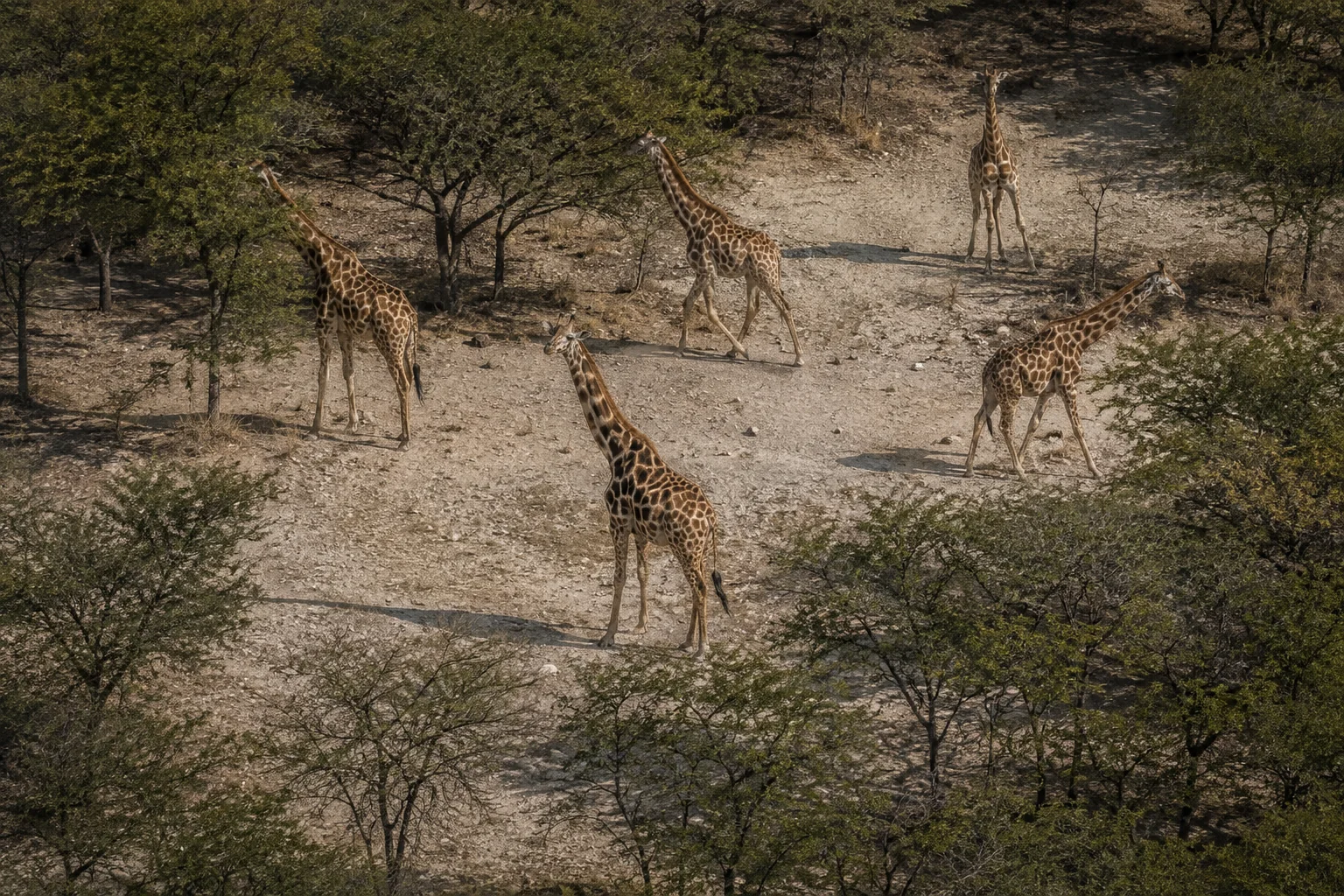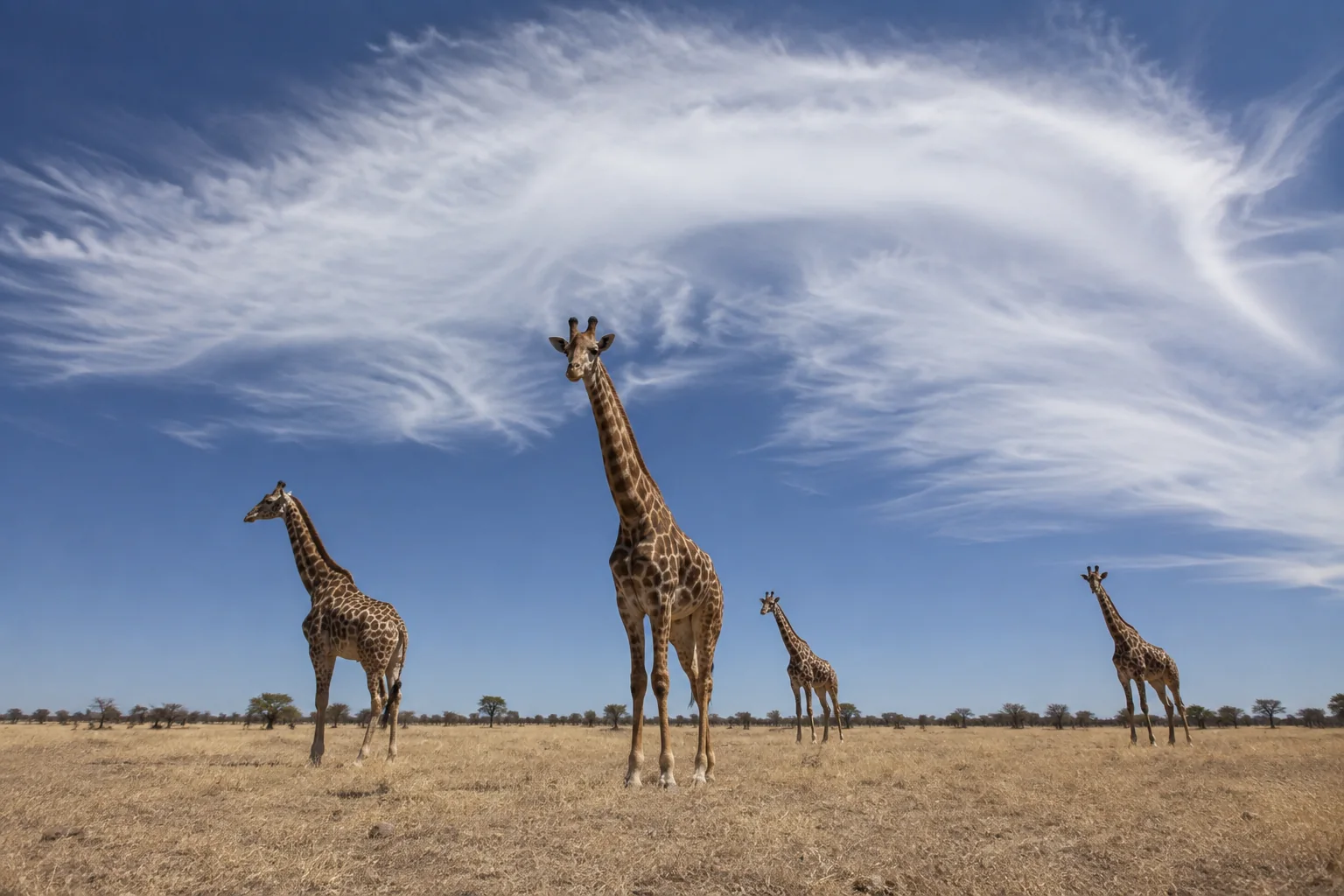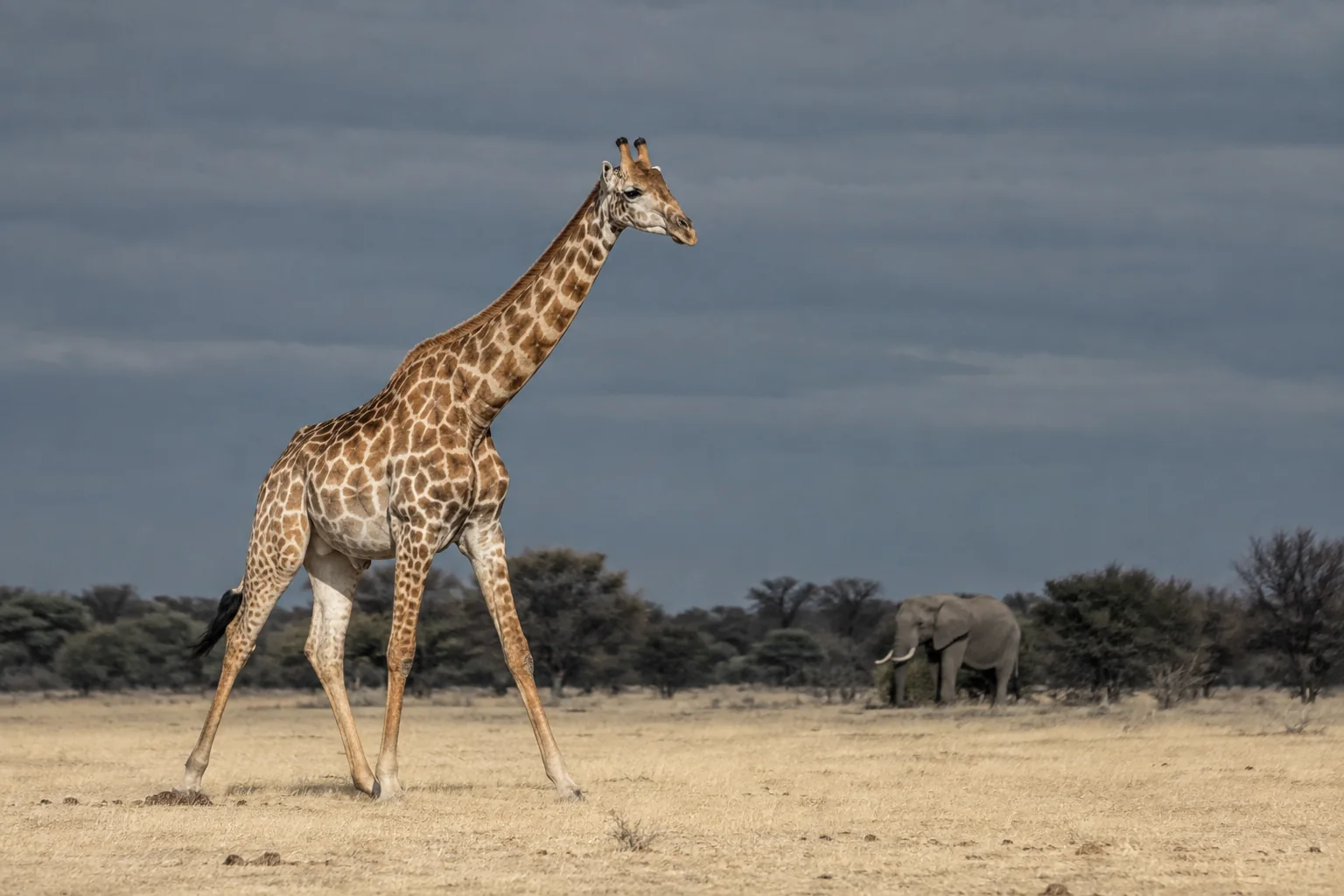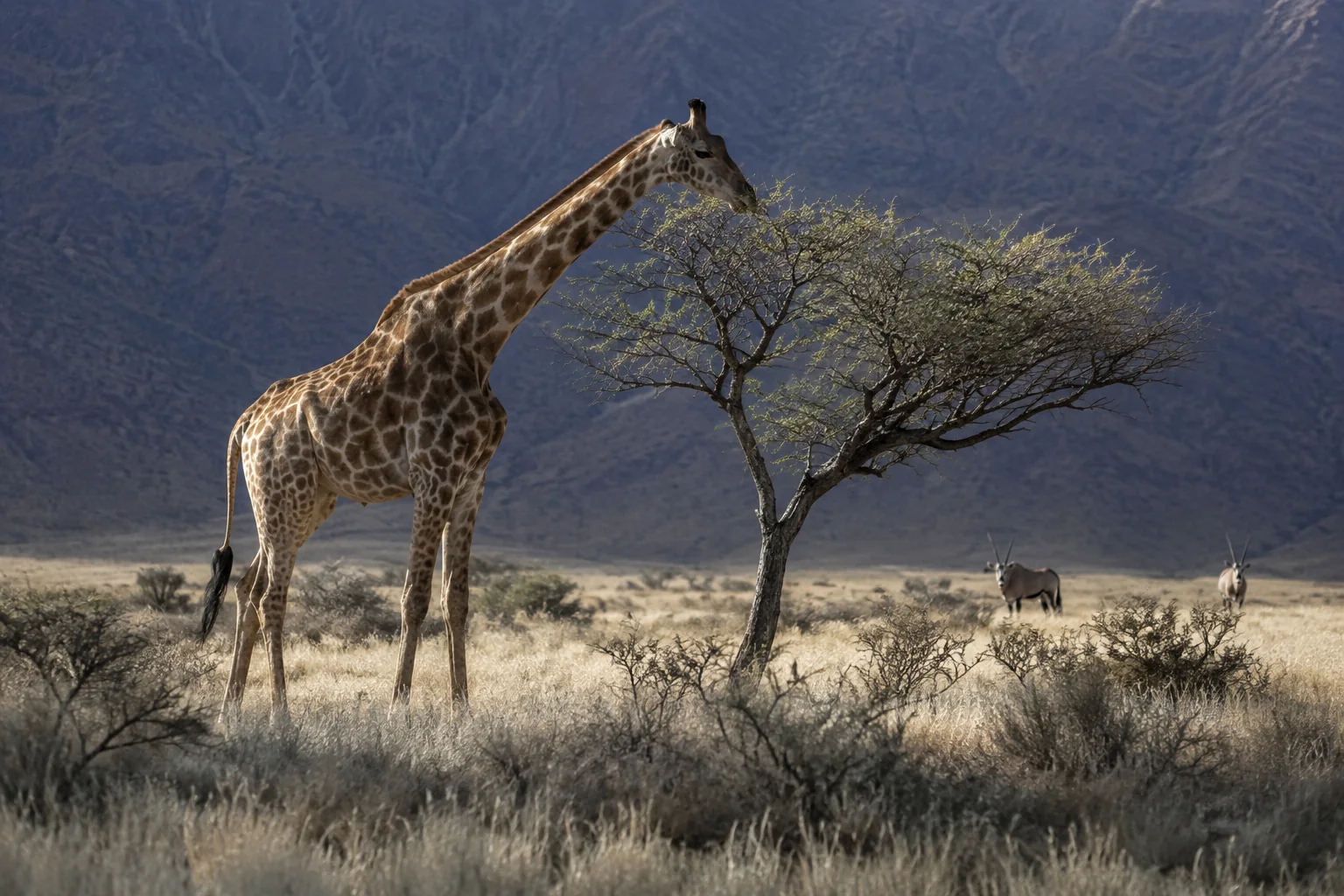
A giraffe decline can be mistaken for a problem confined to one species. Kenya’s long-running rangeland surveys showed something wider. Giraffes had fallen sharply alongside many other wild herbivores, while sheep and goats had increased and cattle had declined. The landscape was supporting a different mixture of animals, not simply fewer of everything.
Joseph Ogutu and colleagues brought together decades of aerial-survey records to examine that change. Their aggregate comparison estimated that giraffe numbers across the surveyed rangeland counties were about 67% lower in the early 2010s than in the late 1970s. The figure describes a historical, modelled comparison within the survey system. It is neither a current census nor an estimate of a 67% loss across all Africa.
The 2016 paper matters because it connects giraffe conservation to the future of shared rangelands. Its results document a widespread shift involving wildlife, livestock and human land use. Its explanations for the shift are more conditional: the surveys did not experimentally separate the effects of livestock, settlement, climate, habitat change and policy.
An archive large enough to reveal a regional pattern
The analysis drew on 361 aerial surveys conducted between 1977 and 2016 across 21 Kenyan rangeland survey units, described in the paper as counties. Together, these rangelands covered about 88% of Kenya’s land area and included protected areas as well as privately and communally used land.
Observers counted animals within calibrated strips beside the aircraft. The counts were expanded according to the sampled area to estimate populations, with an accompanying measure of sampling uncertainty. This was a sample survey, not a flight over every animal in every county. Average coverage was about 5.7% in the surveys for which that information was available.
The method was suited to conspicuous, larger animals. Sheep and goats were combined because observers could not reliably distinguish them from the air. Smaller wildlife and species too scarce for reliable trend modelling were omitted. The analysis therefore concerned the common large animals represented in the survey archive, rather than all Kenyan biodiversity.
The surveys were not equally spaced through time, and not every county was surveyed in every year. Simply adding the raw annual counts would confuse changes in effort with changes in animal numbers. The researchers fitted flexible trend models that could accommodate gaps, variation among species and irregular observations. They estimated values for missing years, combined counties and smoothed the resulting aggregate trends.
That procedure allowed a broad comparison, but it also changed the meaning of a plotted point. A point on the aggregate trend could contain model predictions for counties not surveyed that year. It was not necessarily the sum of simultaneous field counts taken across Kenya.
The giraffe line fell by about two-thirds
The national-scale giraffe panel compared an estimated average of about 76,000 giraffes in 1977–1980 with about 25,000 in 2011–2013. These rounded values express the scale of the result without implying census precision. Their corresponding decline was 67%.
The paper’s full archive extended to 2016, and later comparison periods varied among counties according to available surveys. The aggregate graph used the early-2010s window. Keeping those dates attached to the figure prevents the tempting but inaccurate shorthand that the researchers counted every Kenyan giraffe in 1977 and again in 2016.
Giraffes were among several species whose declines were both large and geographically widespread. Across the eighteen wildlife species analysed, the mean species decline was about 68%. That average is not a separate giraffe estimate, nor does it mean that 68% of every species disappeared. Some species declined much more severely and others less so.
The breadth of the pattern changed the explanatory challenge. The declining animals included different feeding types and body sizes, distributed across counties with different climates and land uses. That did not rule out species-specific causes, but it made an explanation confined to one giraffe trait or one local event inadequate for the overall result.
The authors also examined how animals were distributed among counties. A county could hold a greater proportion of the remaining wildlife while its own population declined, provided losses elsewhere were faster. A rising share of a shrinking total is not evidence of local recovery. That distinction is particularly important when identifying apparent conservation strongholds from percentage maps.
Livestock became more dominant without increasing in every measure
The headline comparison might suggest that livestock simply expanded into every space vacated by wildlife. The results were more complicated. Sheep and goats increased by about 76%, camels and donkeys increased more modestly, and cattle declined by about 25% in the aggregate comparison.
The researchers also converted animal numbers into approximate biomass using standard body weights. This gave a different view of the change because a sheep and a cow do not contribute equally to total animal mass. Livestock biomass declined slightly, by about 5%, while wildlife biomass fell by roughly 59%.
As a result, livestock biomass increased from about 3.5 times wildlife biomass to about 8.1 times wildlife biomass. Livestock had become more dominant even though its total biomass had not risen. The change combined much greater wildlife loss with a shift in the composition of domestic herds.
Biomass is a useful common scale for comparing differently sized animals. It is not a direct measure of pressure on every food resource. Browsers and grazers use different plants and plant parts, and their demands vary with season and access. Two communities with similar total biomass can therefore have different effects on vegetation and different implications for giraffes.
The authors interpreted the livestock shift partly as a response to increasingly difficult rangeland conditions and changes in pastoral livelihoods. Their data documented the changing herds; they did not directly ask every owner why a particular herd had changed.
Why simultaneous change does not identify one cause
To investigate possible drivers, the team related wildlife density to six broad variables: human density, livestock biomass density, protected-area coverage, rainfall, and minimum and maximum temperature. The relationships were often nonlinear, and the variables most closely associated with wildlife differed among species.
For giraffes, the selected multivariable analysis included human density and climatic variables. Livestock biomass did not emerge as a significant predictor in the same way; across all eighteen species, only Grant’s gazelle showed a significant livestock-density effect in that selected analysis.
That result does not prove that livestock had no effect on giraffes. Human and livestock distributions are related, and broad county measures can conceal competition or coexistence occurring at finer scales. Statistical selection among correlated predictors cannot neatly divide a landscape’s history into independent causes.
It does mean the study should not be presented as a direct demonstration that increasing livestock numbers caused the giraffe decline. The authors themselves discussed several possible explanations for positive wildlife associations with low or intermediate levels of human or livestock presence. Animals and people might select the same productive places; pastoral activity might also create useful habitat variation. Those mechanisms were proposed interpretations, not processes measured directly in this analysis.
The same caution applies to the paper’s broader discussion of conservation institutions and financial incentives. The authors argued that landholders need meaningful benefits from maintaining wildlife habitat and that conservation cannot rely on parks alone. The survey trends establish the seriousness and extent of the problem. They do not, on their own, experimentally demonstrate which policy reform will reverse it.
Detection remains part of the historical record
Using a broadly consistent survey procedure over decades is a major strength. Yet aerial estimates can still be influenced by how visible animals are, how they are distributed and how vegetation affects observation. A trend model accounts for irregular surveys and statistical variation; it does not automatically discover every animal missed by observers.
A separate Tarangire study comparing giraffe survey methods found that aerial estimates could be substantially lower than estimates from ground-based individual identification, with the difference varying among areas. That study does not supply a correction factor for Kenya’s historical series. Its relevant lesson is that observation method and local conditions can affect estimated abundance.
The Kenyan archive’s repeated regional coverage remains valuable despite that limitation. A single survey cannot reveal the same decades-long pattern, and consistently large declines across many species and places warrant attention. The appropriate response is to interpret the historical estimates with their methods attached and strengthen future comparisons, rather than treat the modelled totals as exact headcounts. Our survey-method commentary explains why local calibration matters.
A baseline for recovery, not a current verdict
The paper offers a historical reference for asking how much wildlife a landscape has lost and where recovery might be possible. It also shows why recovery cannot be assessed solely inside protected boundaries when animals depend on the surrounding rangelands.
Earlier abundance is not automatically a feasible restoration target. Some land has changed in ways that make its former use difficult to restore, and the authors acknowledged those practical limits. Nor can their analysis establish what has happened since the final surveys: later population changes require later evidence.
For giraffes, the central result is substantial enough without extending it beyond the data. Their estimated numbers fell by roughly two-thirds within a wider contraction of large wildlife, while domestic herd composition and relative dominance changed. Understanding that decline means examining the shared landscape—its resources, access and incentives—while keeping the documented trend separate from the still difficult task of assigning causes.
Sources
Joseph O. Ogutu, Hans-Peter Piepho, Mohamed Y. Said, Gordon O. Ojwang, Lucy W. Njino, Shem C. Kifugo and Patrick W. Wargute (2016). “Extreme Wildlife Declines and Concurrent Increase in Livestock Numbers in Kenya: What Are the Causes?” PLOS ONE 11, e0163249. Full primary paper.
Derek E. Lee and Monica L. Bond (2016). “Precision, accuracy, and costs of survey methods for giraffe Giraffa camelopardalis.” Journal of Mammalogy 97, 940–948. Primary paper.