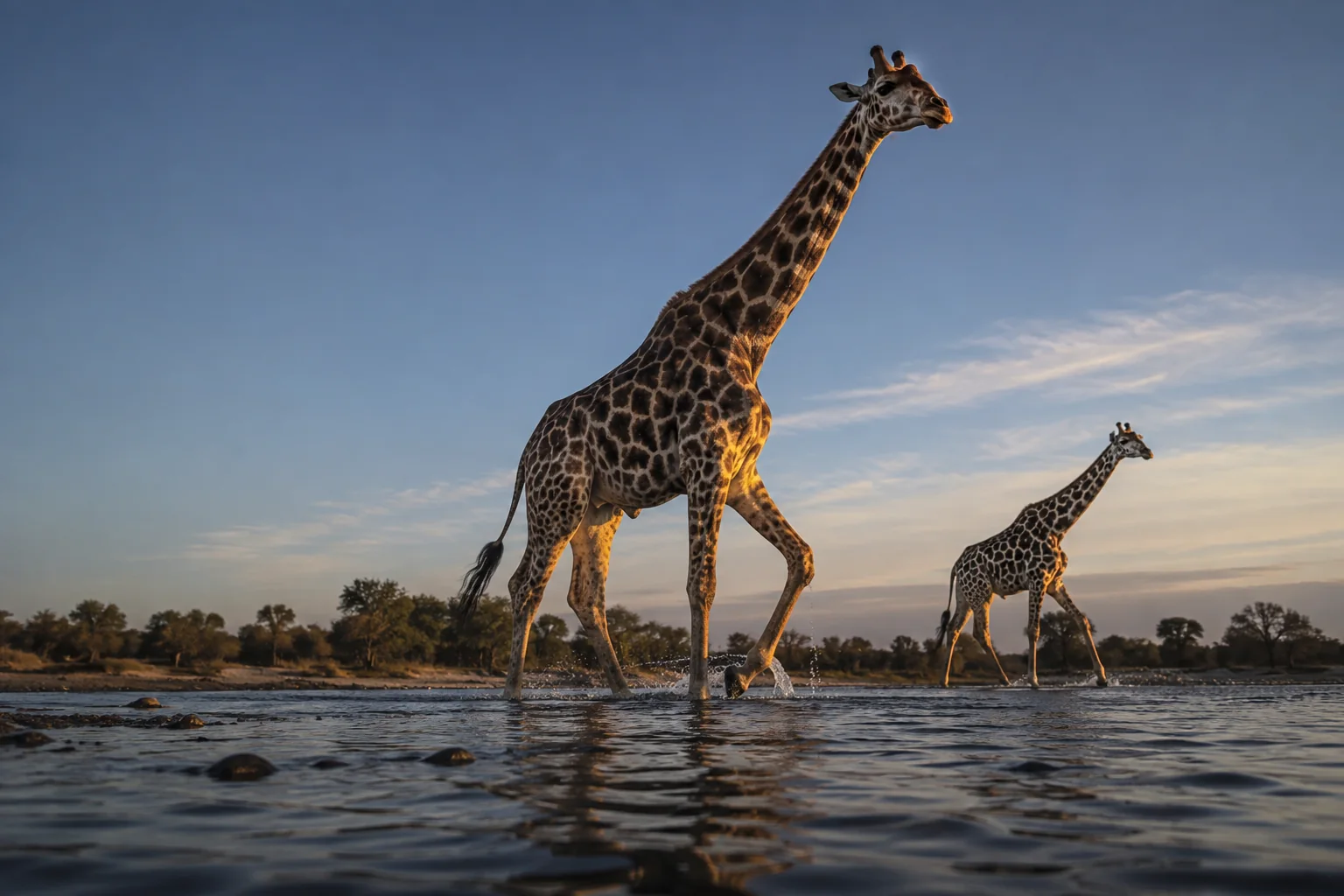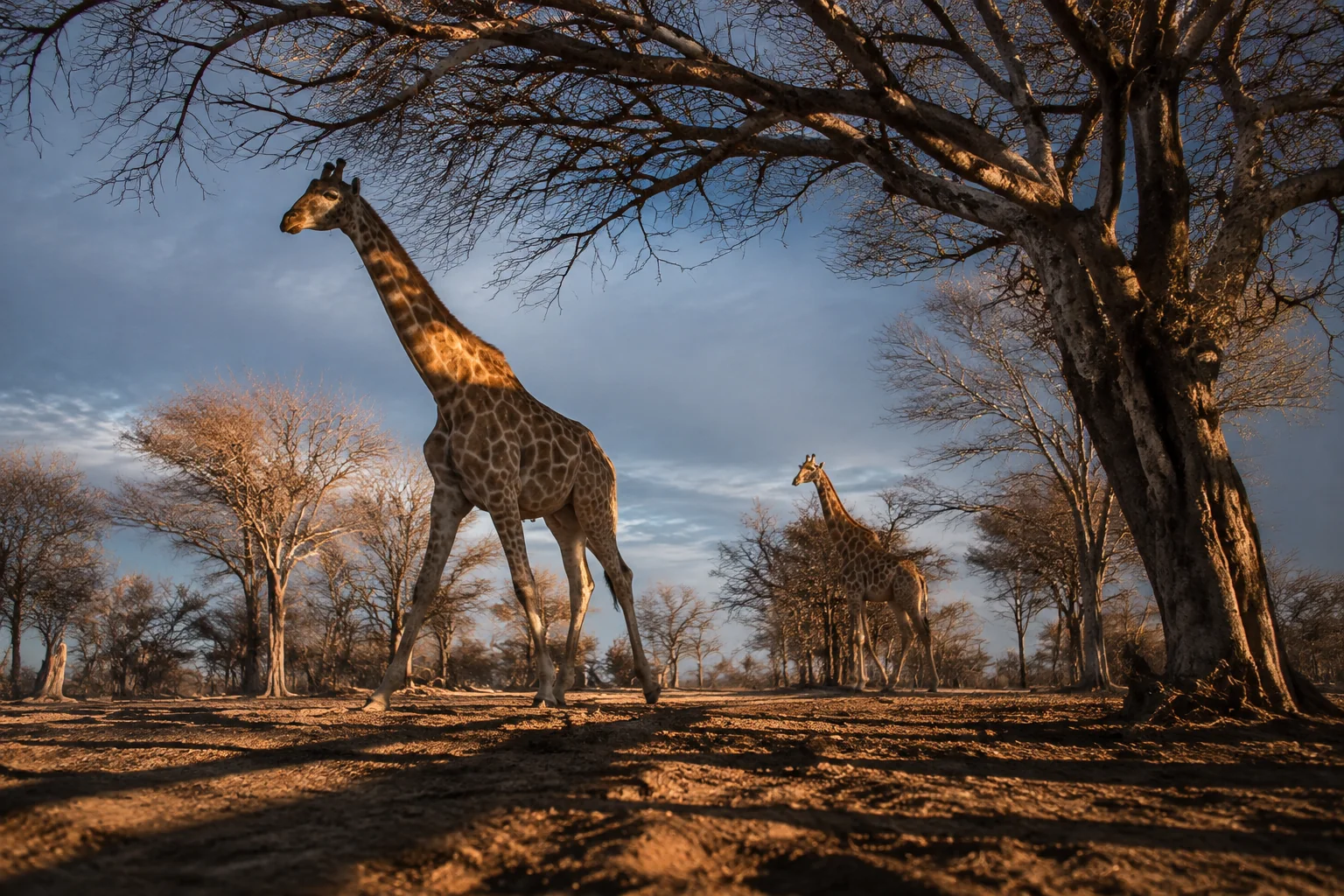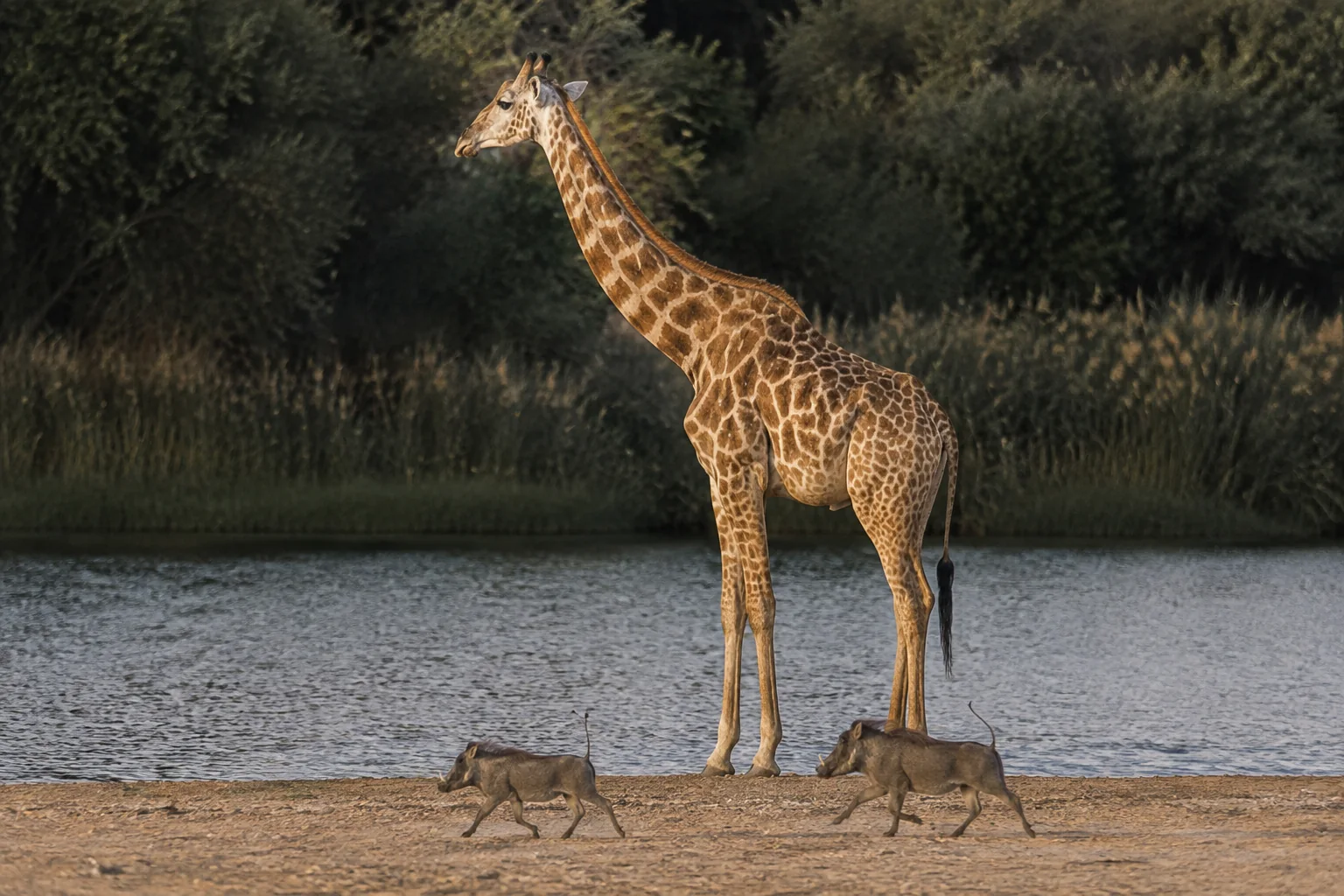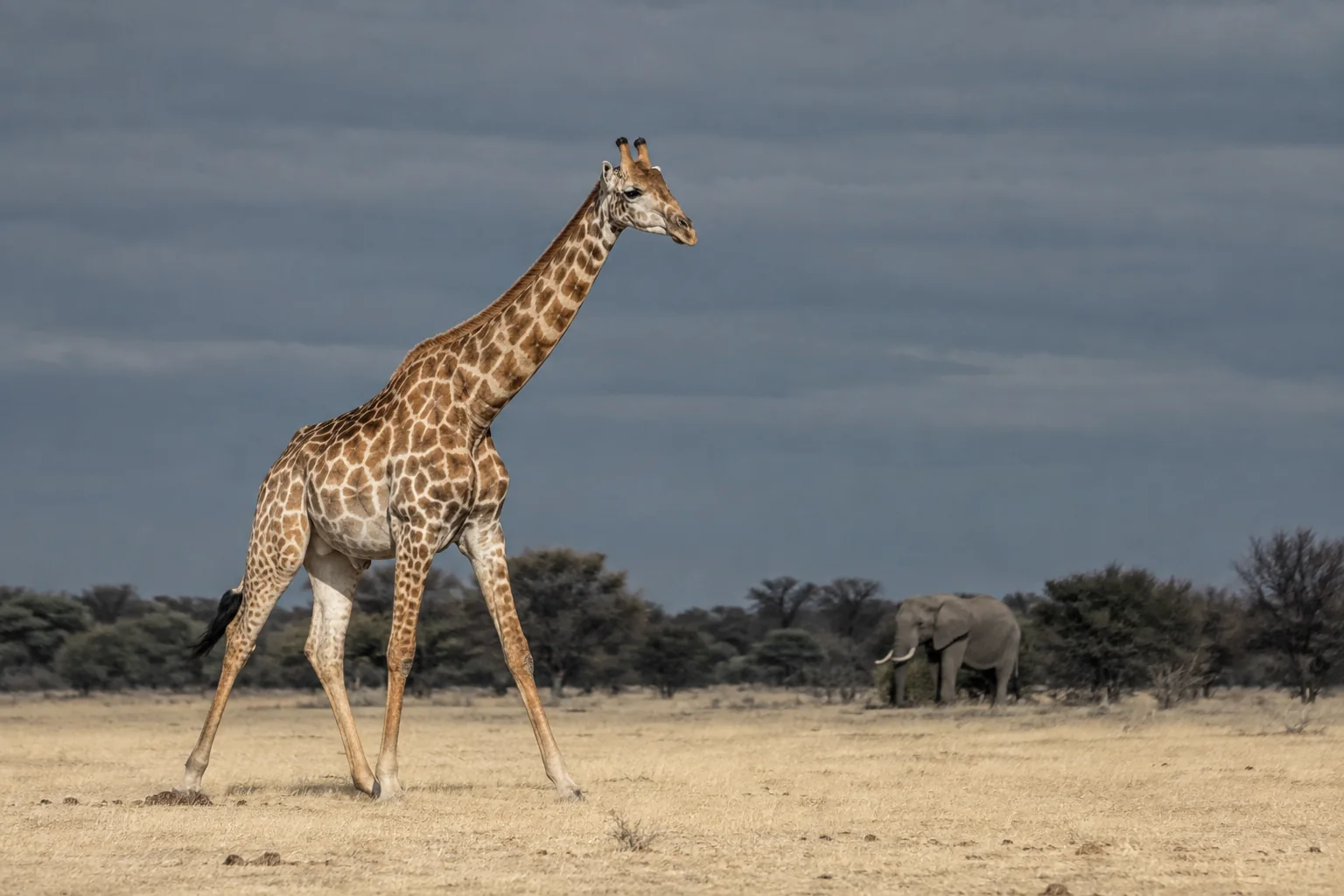
Welcoming giraffes into a landscape and dealing with their visits to a farm are different questions. A farmer may appreciate the animals while needing to protect a harvest. A neighbour may see little damage at all. To understand whether people and giraffes can keep sharing land, conservationists need to hear both experiences—and discover how common each is.
Abdullahi H. Ali and colleagues investigated that question around Bour-Algy Giraffe Sanctuary in Garissa County, eastern Kenya. Their 2026 study in Frontiers in Conservation Science found substantial interest in having giraffes nearby, including on respondents’ own land. It also recorded a smaller group reporting repeated damage. Together, those findings suggest that sustaining coexistence involves helping with particular costs while recognising the welcome that already exists.
A sanctuary surrounded by working land
The reticulated giraffes in this study live beside people who grow crops, keep livestock and run other local businesses. The Tana River supports irrigated farming, including mango trees, bananas and watermelons. In the surrounding dry landscape, access to water brings the needs of farms, livestock and wildlife into close proximity.
The researchers describe Bour-Algy as a sanctuary with community origins and a history of people and giraffes sharing space. They also describe a setting without a substantial formal tourism economy. That makes the question especially useful: how do residents view giraffes where a familiar conservation explanation—income from visiting tourists—cannot simply be assumed to account for local support?
This is one local story within the much wider picture of giraffes in Kenya. A national population count can describe the number of animals reported across the country. It cannot reveal what it means for a household when a giraffe enters its land, or whether that household wants the animals to remain.
Asking about welcome, worry and experience separately
Ali’s team brought together researchers from the Hirola Conservation Program, the Somali Giraffe Project, the University of British Columbia and Natural Resources Canada. Research assistants from the Somali Giraffe Project and Kenya Wildlife Service conducted face-to-face interviews, with local community giraffe rangers helping with translation. Participants could respond in Somali, Swahili or English.
The published analysis covers 400 adults. The methods describe a first survey phase in February 2020, several years before the paper appeared. Interviewers approached households along set walking routes and sampled farm plots along irrigation channels. Within a selected household, they sought an adult who made land-use decisions or knew about wildlife interactions.
Those choices helped reach people with relevant experience, but they also define whose answers were collected. This was a survey of selected adults around the sanctuary; it does not represent every resident of eastern Kenya. Men made up about two-thirds of the sample, and the number of people who declined an interview was not recorded. People who were away during the visits may have had different experiences.
The researchers separated three things that are easily blurred. They asked about interest in having giraffes nearby, concern about possible harm, and reported experience of encounters and damage. These are complementary forms of evidence. Wanting an animal on the landscape does not mean experiencing no losses, and worrying about a possible problem does not establish how often it happens.
The distinction also explains what interviews contribute. A movement tracker can record where a giraffe went. A household interview can reveal whether people welcomed its presence, felt anxious or remembered damage. Neither observation can stand in for the other.
Almost the same welcome on either side of a boundary
One of the study’s most informative comparisons asked about giraffes on respondents’ own land and on a neighbour’s. That moves the question beyond liking wildlife somewhere in the wider countryside: would people express the same interest when the animals were closer to their own livelihoods?
The published response counts were strikingly similar. For giraffes living on their own land, 167 respondents chose the highest interest category, compared with 168 for giraffes living on neighbouring land. A further 110 and 107, respectively, chose moderate interest. At the other end, 61 people expressed no interest in each setting.
Interest in simply seeing giraffes was slightly greater. The highest category attracted 188 responses for seeing them on respondents’ own land and 185 for neighbouring land. This gives the idea of a welcome some useful detail: a visit and a continuing presence were not quite the same proposition, but neither question revealed a large shift towards wanting giraffes only next door.
These are answers to hypothetical questions, not agreements to accept any future damage. The table also shows that respondents were not unanimous. Its contribution is to identify considerable willingness to share space within the surveyed group, rather than treating conflict as evidence that everyone wants giraffes removed.
The broader worry questions point in a compatible direction. The team asked about concerns such as personal safety, children’s safety and damage to land, using a scale from no concern to extreme concern. All six question averages fell between no concern and slight concern. Land damage had a higher average than personal safety, although the overall level remained low. That describes respondents’ perceptions; the survey did not measure injury probabilities or disease transmission.
Repeated damage can disappear inside a reassuring average
The damage responses show why broad acceptance needs to be read alongside individual costs. The paper reports 221 people who said giraffes never caused damage. It also reports 86 who described damage once, 16 who described it two to five times, and 69 who described it more than five times.
Sixty-nine people reporting repeated damage are a substantial group to overlook just because the largest category reported none. A separate question about the extent of the problem produced a similar spread: 235 respondents described giraffes as no problem on their land, while 53 called them a moderate problem and 33 an extreme problem.
The published categories for each of these questions account for 392 of the 400 respondents, leaving eight unaccounted for. They should therefore be read as reported counts, not a fully resolved estimate of damage prevalence. Nor do the published summaries establish which people both welcomed giraffes and reported losses. The clear finding is that acceptance and complaints occur within the same surveyed population.
Mango farming helps explain why the complaints deserve attention. The authors discuss giraffes feeding on mango flowers, and their paper includes photographs identified as intact and stripped flower clusters. Losing flowers can remove the possibility of fruit before there is a ripe crop to count. The eventual harvest also depends on other conditions, so translating a browsing event into lost yield or income is difficult.
The photographs illustrate the kind of damage being discussed; they are not a measurement of its frequency or financial cost. The household survey likewise did not independently measure harvest losses. A useful next investigation could follow affected and comparable unaffected trees through flowering and fruit production, alongside farmers’ accounts. That would help connect an immediate observation—flowers removed—with the livelihood consequence that matters months later.
Water gives the complaints a practical direction
Asked what caused human–giraffe encounters in their area, 87.2% of respondents identified competition for water. People could give more than one answer, so this percentage describes how frequently that explanation was offered. It is not the percentage of incidents independently shown to have been caused by water shortage.
Even with that distinction, the response is informative. It directs attention to a shared resource around which residents recognise a problem. Ali and colleagues discuss agricultural expansion along the river and propose keeping access routes to water open as one possible response. That links coexistence to a concrete feature of the landscape: whether animals can reach a resource without repeatedly entering places where people experience losses.
The idea needs evidence from both sides of the interaction. Observations of giraffe movement and water use could establish which access problems occur and when. Residents’ accounts could show where damage, disruption or extra work is concentrated. If an agreed route were subsequently maintained, follow-up would need to show whether encounters and losses changed, including on neighbouring farms. A route that shifts the burden next door would leave a different problem to address.
This is where the survey adds something to habitat protection. Keeping resources reachable has a human consequence as well as an ecological one. A useful connection for giraffes needs to be considered alongside the people living and working around it.
Respondents also suggested ways to reduce unwanted encounters, including guarding and fencing. Those answers establish interest in possible measures. The study did not compare their effectiveness, costs or consequences for people and wildlife. Similarly, the authors’ proposals for local enterprises and habitat-restoration work are possible avenues to explore, rather than demonstrated solutions from this survey.
Why people value giraffes deserves its own attention
An earlier study near Amboseli National Park in southern Kenya gives a useful reason to avoid explaining every attitude through money. Joana Roque de Pinho and colleagues interviewed 191 people, asking which animals they considered beautiful and which they would choose to save in an imagined disappearance of wildlife. They let participants name the animals themselves and explain their choices.
People who described giraffes as beautiful were more likely to choose them for rescue. The researchers compared aesthetic appreciation with personal and household characteristics; beauty was the strongest predictor of that choice for giraffes among the factors they examined. The result concerns expressed support in an interview, not observed rescue behaviour.
Those were different communities, in a different Kenyan landscape, with fieldwork conducted in 2002–2004. The finding cannot supply a reason for every Bour-Algy respondent’s answer. It does show why appreciation of an animal deserves to be investigated directly. People can value the sight and presence of giraffes in ways that a calculation of tourism receipts would miss.
That leaves two linked questions for Bour-Algy. Which everyday benefits or meanings help sustain residents’ interest in giraffes? And does that interest change when a household repeatedly loses crops or spends more time protecting them? Revisiting households over time, while documenting their experiences, could connect those questions more closely than a one-time survey can. Changing rainfall, harvests and household circumstances would also need to be considered.
Ali and colleagues have made local willingness visible alongside local complaints. The practical opportunity is to take both seriously: understand what people value about sharing the landscape, and establish which responses actually reduce the losses that make sharing harder.
Sources
Abdullahi H. Ali, Edwin L. Sangale, Mohamed H. Ali, Adam T. Ford and Carly C. Sponarski (2026). Human–giraffe conflict in eastern Kenya: local interactions, attitudes, perceived risks, and pathways to coexistence. Frontiers in Conservation Science 7, 1699294. Published 24 February 2026. DOI: 10.3389/fcosc.2026.1699294. Read the full paper.
Joana Roque de Pinho, Clara Grilo, Randall B. Boone, Kathleen A. Galvin and Jeffrey G. Snodgrass (2014). Influence of Aesthetic Appreciation of Wildlife Species on Attitudes towards Their Conservation in Kenyan Agropastoralist Communities. PLOS ONE 9(2), e88842. DOI: 10.1371/journal.pone.0088842. Read the full paper.